LFM Reviews Advantageous @ The 2015 Sundance Film Festival

By Joe Bendel. Technology can make a dystopia look like a utopia. As the spokesperson for a major cosmetic engineering firm, it is Gwen Koh’s job to convince consumers to buy into this brave new world, but she is not getting any younger. This fact of life has serious economic and social repercussions in Jennifer Phang’s Advantageous, which screens during the 2015 Sundance Film Festival.

In the near future, Koh has already beat the odds finding high profile employment as a single mother. Inconveniently, her luck is about to run out at the worst possible time. Her thirteen year old daughter Jules has been turned down by her preferred prep school, but she was accepted by her nearly as prestigious but twice as expensive second choice. She should also attend a pricey summer camp for incoming students or risk losing ground before classes even start. However, Koh’s employers have just declined to renew her contract, opting to replace her with someone younger.

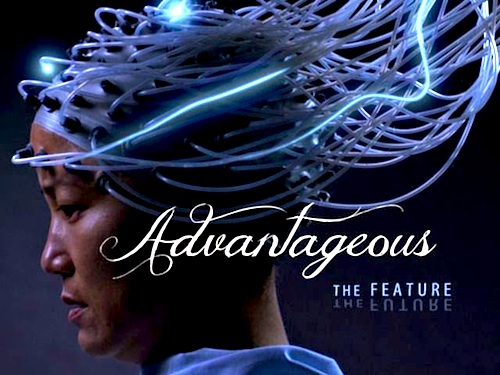
Koh will try reaching out to estranged family members, but her best hope might entail returning to her former employers as the guinea pig-public face for their newest, most radical procedure. Unfortunately, the process might not be exactly what they report it to be. Koh is clearly willing to sacrifice for her daughter, but it might cost her far more than will be immediately apparent.

Expanding her ITVS Futurestates short to feature length, Phang and lead actress-co-writer Jacqueline Kim create a compellingly personal vision of a futuristic dystopia. Frankly, some of their contentions fly in the face of recent trends, such as disproportionately high unemployment for women, when middle age men have been hit the hardest in recent years. Nevertheless, they evoke a compelling sense of economic vulnerability.
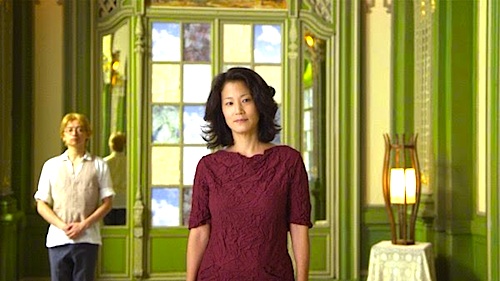
From "Advantageous."

Regardless, Advantageous is truly relationship-driven science fiction, especially Koh’s overriding love for her daughter. As Gwen and Jules Koh, Jacqueline and Samantha Kim will pretty much break your heart as their drama plays out. Frankly, once circumstances remove the former Kim from the picture, Advantageous loses some of its bite. Indeed, the third act largely feels like an overlong epilogue, except for a key scene with James Urbaniak (Simon Grim in Hal Hartley’s Henry Fool and its sequel). While he initially comes across like just another corporate suit, his relationship with Gwen Koh evolves in an intriguing way, further deepening the film.

Although Advantageous scrupulously maintains its micro focus, it still presents an impressive looking vision of the future. It is a lot like our world, but one or two steps closer to Fritz Lang’s Metropolis. Its anti-corporate, feminist biases can get a little clunky, but the performances of Kim, Kim, and Urbaniak (helmed with remarkable sensitivity by Phang) more than compensate. Recommended for those who appreciate science fiction with psychological complexity, Advantageous screens again today (1/28), tomorrow (1/29), and Friday (1/30) in Park City, as well as this Saturday (1/31) in Salt Lake, as part of this year’s Sundance Film Festival.

LFM GRADE: B

Posted on January 28th, 2015 at 5:36pm.

LFM Reviews Going Clear @ The 2015 Sundance Film Festival

From the cover of Lawrence Wright's book.

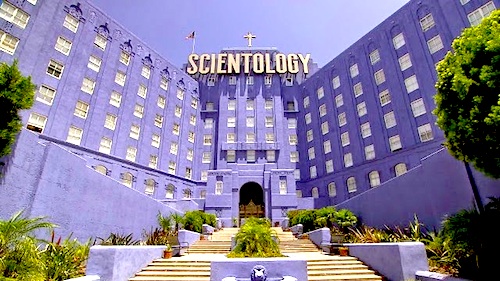
By Joe Bendel. It is a documentary, but it could have played in the Park City at Midnight section, because it is a little scary at times. Alex Gibney’s Scientology documentary is pretty much everything you think it is, except it maintains a considerably higher standard of proof than his silly Eliot Spitzer conspiracy theory film. In fact, a considerable number of former high-ranking Scientologists go on-the-record and on-camera to explain how the IRS-designated church stifles dissent in Going Clear: Scientology and the Prison of Belief, which screens during the 2015 Sundance Film Festival.

Fortunately, Gibney had producer and lead talking head Lawrence Wright’s nearly identically titled book to serve as a blueprint. Although Wright claims he never intended to write an expose that is essentially what he ended up with once he started digging. Gibney and Wright chronicle the Scientology creation story, going back to L. Ron Hubbard’s early years as an incompetent military officer and prolific science fiction writer, shining a light on his increasingly abusive relationship with second wife Sara Northrup Hollister. However, the biggest news in Clear may very well be the extent to which Oscar winning filmmaker Paul Haggis assumes the role of the leading public critic of his former “religion.”

Those who have read Wright’s book (or the excerpts that were released at the time of publication) will be generally familiar with the “alleged” harassment tactics unleashed against critics, but the totality of Gibney’s presentation is quite damning. Wright scores one of the film’s best lines marveling at the chutzpah it takes to launch a “war” against the IRS. Of course, the war is now over. Scientology won, gaining official tax-exemption and wriggling off the hook for a potential billion (with a “b”) dollar tax bill.

From "Going Clear."

It is important to emphasize every allegation in Clear comes from a former member, speaking of what they witnessed firsthand and directly participated in. Yes, they could all be lying, but their consistency and Occam’s Razor finds that unlikely. In contrast, no loyalists agreed to participate in the film, most notably including the best known celebrity adherents. Frankly, it will probably be Tom Cruise’s reputation that takes the biggest hit from the film, but Gibney and his assorted experts leave open the possibility that John Travolta might be something of a victim of various controlling tactics himself.

It is extremely disturbing to see bogus anti-Semitic rhetoric about Jews controlling Hollywood seep into the mainstream media, while the Scientology organization’s deliberate strategy to target the entertainment industry has been largely ignored. Surely, there are many well-meaning Scientologists (although the film estimates the ranks of active members have fallen to approximately 50,000), but they are not served by the leadership’s best-defense-is-a-good-offense policy. Gibney’s bracing documentary should be a wake-up call for them. Going Clear might be “controversial” (with air quotes), but it is authoritative and fully sourced. Highly recommended, it screens again this Saturday (1/31) in Park City and Sunday (2/1) in Salt Lake, as part of this year’s Sundance.

LFM GRADE: A-

Posted on January 28th, 2015 at 4:55pm.

LFM Reviews True Story @ The 2015 Sundance Film Festival

By Joe Bendel. Who is the bigger user, the disgraced journalist or the alleged family murderer? It is a close call, but the “journalist” has no competition when it comes to willful self-deception. Mike Finkel’s strange and problematic relationship with Christian Longo provides the dramatic grist for British theater Rupert Goold’s ripped-from-the-tell-alls feature debut, True Story, which screens during the 2015 Sundance Film Festival.

For a while, Finkel was the golden boy at the New York Times, scoring numerous Sunday magazine covers. Then he was busted for “compositing” victims somewhat haphazardly in a human trafficking story. At least Christian Longo was still a fan. While on the lam, he used Finkel’s name as an alias. Intrigued by the connection, the real Finkel pays a jail house visit to the man accused of killing his wife and three children. Recognizing a story that could salvage his career, Finkel agrees to co-author a book with Longo. Of course, he assumes it will be exculpatory, but early trial developments leave him feeling confused and betrayed.

Clearly, this is not a film looking to rehabilitate the NYT’s scandal-plagued image. Gretchen Mol plays Finkel’s editor as an ice cold CYAing Machiavellian, which might be the truest aspect of True Story. The ironic postscript also serves as a final middle finger to the Gray Lady. However, Goold and co-screenwriter David Kajganich are not trying to do any favors for Finkel or Longo, either. In all honesty, everyone comes out of it looking badly, but that makes it fascinating to watch.

From "True Story."

Longo, the media savvy sociopath, just might be the role James Franco was born to play. He is so frighteningly convincing turning on the charm and manipulating everyone around him, it makes you wonder. Although it is a far less showy role, Jonah Hill’s Finkel is also believably slow on the uptake (so much so, it also makes you wonder). Mol is suitably severe, but True Story is not a great vehicle for actresses, completely wasting Felicity Jones as Finkel’s more guarded but nearly personality-less girlfriend.

Franco and Hill’s scenes together have fair degree of crackle, but the suspense never really rises above room temperature. Frankly, there are no miscarriages of justice in True Story, unless you count the Times getting off easy after yet another journalistic scandal. Yet, it is strangely refreshing to see a film that is not out to gin up cheap outrage. Recommended for those who appreciate adult drama, True Story screens again this Thursday (1/29) and Saturday (1/31) in Park City and Sunday (2/1) in Salt Lake, as part of this year’s Sundance.

LFM GRADE: B

Posted on January 28th, 2015 at 4:54pm.

LFM Reviews I Am Hong Kong @ The 2015 Sundance Film Festival

From "I Am Hong Kong."

By Joe Bendel. It is eerily fitting that Hong Kong’s democracy activists chose the umbrella as their symbol. After all, they are now most definitely facing that proverbial rainy day. Aside from our colleagues at the Epoch Times, the largely AWOL American media did a terrible job of covering the Umbrella Protests. In contrast, HK filmmaker Flora Lau was there, capturing the images of a movement that deserved better in the brief but potent short, I Am Hong Kong, which screens during the 2015 Sundance Film Festival.

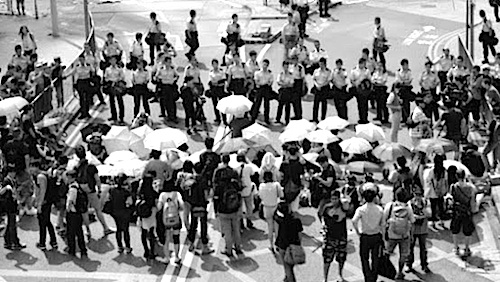
Based on her unusually subtle and nuanced narrative feature debut Bends, Lau will be a filmmaker to be reckoned with, assuming I Am Hong Kong does not cause her bureaucratic trouble down the line. Her approach for the short is elegantly simple, matching striking black-and-white stills with voiceovers from diverse protestors explaining what contemporary Hong Kong means to them, in either practical or metaphorical terms.

From "I Am Hong Kong."

These are the faces we have not seen—the mothers with young children, the senior citizens, and the attractive young college students, who surely would have had plenty of other requests for their time, were they not demonstrating for meaningful democratic reforms. Indeed, their signs are quite telling, proclaiming “No party, no karaoke, fight for democracy,” and “Keep calm and carry an umbrella.”

While Lau was there more to observe and report than to make a statement, just being there and recording it all faithfully is significant. Clocking in shy of the five minute mark, it is definitely a shorty, but visually it is powerful, almost overwhelming stuff. Very highly recommended, I Am Hong Kong is a work of journalistic art that screens again with the documentary feature The Chinese Mayor today (1/28), Friday (1/30), and Saturday (1/31) in Park City and Thursday (1/29) and Friday (1/30) in Salt Lake, as part of this year’s Sundance.

LFM GRADE: A+

Posted on January 28th, 2015 at 4:54pm.

Paginini at the Crossroads: LFM Reviews The Devil’s Violinist

By Joe Bendel. Niccolò Paginini was the Robert Johnson of classical music. His ferocious technique and unparalleled popular success were seriously considered the fruits of a Faustian bargain. The talent was always there. Getting people to listen was the hard part. In fact, it was such a tricky proposition, the materialist maestro gladly makes that deal in Bernard Rose’s The Devil’s Violinist, which opens this Friday in New York.

Sulfur has not numbed the Mephistophelean Urbani’s nose for talent. He immediately recognizes the gifts of an aspiring Don Juan violinist scuffling in grubby music halls. He pledges to guarantee Paginini’s career and serve as his personal servant in this world, if Paginini agrees to do the same for him in the next. Shortly after signing a contract he probably should have read more closely, Paginini’s career ignites. He becomes a figure of dark romance and veiled controversy, like an early nineteenth century heavy metal rock star.

Eventually, Paginini gets bored with it all, spending long hours brooding in the tub, doing his best to resemble The Death of Marat. Fortunately, Paginini somewhat snaps out of his lethargy when he accepts upstart promoter John Watson’s offer to produce and conduct his London debuts concerts. However, Paginini’s demands will stretch the limits of Watson’s resources. Met by a mob of moralizing progressive protestors, Watson and his diva mistress Elisabeth Wells are forced to quarter Paginini and Urbani in their home. Of course, Watson’s daughter Charlotte immediately catches Paginini’s eye, but she is not inclined to swoon over the maestro, at least not yet.

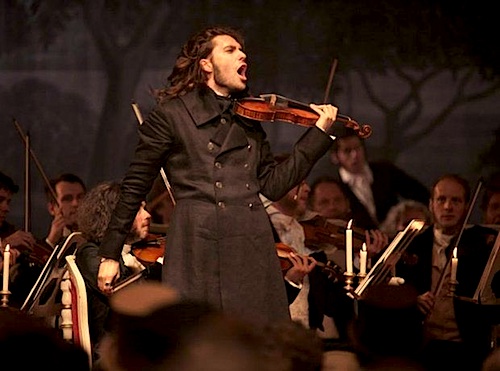
We always thought Jared Harris just might be the Devil, so Violinist practically feels like a confirmation. He is delightfully sinister chewing on the scenery. Yet ironically, Urbani (who seems to be more of a minion than Old Scratch himself) is not infrequently portrayed as a more empathetic fellow than Paginini. Regardless, it is great fun watching him lurk and glower.

From "The Devil’s Violinist."

Violin prodigy and classical crossover artist David Garrett can certainly play. Acting is a little iffier. Perhaps the many scenes of his Paginini huddling in bed sheets in a state of near catatonia was a shrewd strategic decision on Rose’s part. Fortunately, Harris has some terrific supporting players to engage with, including Christian McKay, unflaggingly earnest as Watson, as well as Joely Richardson suggesting Eliza Doolittle’s morally flexible cousin as tabloid music critic Ethel Langham.

In a way, Devil’s Violinist reconciles the classy Jekyll films Rose has helmed, such as the Beethoven bio-pic Immortal Beloved and the superior Sophie Marceau version of Anna Karenina, with his Hydish scare fare, like Candyman and SXTape. For obvious reasons, he leans towards the former, depicting Urbani more as a Svengali than a figure of satanic horror. It works relatively well, despite Garrett’s awkwardness, which sometimes even feels fitting in context. Harris certainly does his thing and Garrett’s musical chops are also quite cinematic. Recommended for classical connoisseurs who appreciate a bit of uncanny garnish, The Devil’s Violinist opens this Friday (1/30) in New York, at the Quad Cinema.

LFM GRADE: B-

Posted on January 28, 2015 at 4:53pm.

LFM Reviews Darkness on the Edge of Town @ The 2015 Slamdance Film Festival

By Joe Bendel. Young Cleo Callahan might not look like a vigilante, but she has the right skills. She is crack sharpshooter, particularly with a rifle-scope. Arguably, her investigative talents are somewhat subpar, but in such a small provincial village she is bound to find her sister’s killer sooner or later. However, the guilty party is closer than she could imagine in Patrick Ryan’s moody revenge drama Darkness on the Edge of Town, which screens during the 2015 Slamdance Film Festival.

Since the death of their parents, Callahan’s relationship with her older sister Aishling has been strained. She now lives with Foster parents, while Aishling lives the wild life—or at least she was. Although we see full well who the killer is, it feels like the sort of thing that should be held close to the vest. Regardless, Cleo Callahan soon sets out to even the score, presuming the murderer is one of the dodgy characters in her sister’s social circle.

Technically, they are innocent, but it is clearly implied they did sister Aishling wrong in more conventional ways, so there is no need to feel sympathy for their sorry hides. However, it is a different story when suspicion falls on Virgil O’Riley, the brother of her profoundly troubled best friend Robin.

The tone of Darkness is so dark, it is like Milton’s darkness visible. You do not want to know what goes on behind closed doors because it is sure to be awful. This is not a wish fulfillment vigilante movie like the later Death Wish films. It is scrupulously serious, even though there is a good deal of blood down the stretch. At times, Ryan plays with the themes and visual language of the western genre, but it is really more closely akin to a film like Heavenly Creatures, but executed in a drastically more naturalistic style.

From "Darkness on the Edge of Town."

Be that as it may, Darkness heralds the arrival of Emma Willis as a major new screen talent to watch. Her performance as Robin O’Riley is truly harrowing, riveting, and downright scary. It is bad luck for Emma Eliza Regan, whose intense slow-burning work as Callahan is likely to be overlooked, even though it is excellent, as well.

It is hard to classify Darkness as a thriller, because of its deliberate pacing and thoroughly realized sense of hardscrabble place. Still, this film has grit in abundance. Definitely recommended for patrons of Irish cinema and violent contemporary tragedies in general, Darkness on the Edge of Town screens again today (1/28) at Treasure Mountain Inn, as part of this year’s Slamdance.

LFM GRADE: B+

Posted on January 28th, 2015 at 4:53pm.