LFM Reviews Body @ The 2015 Slamdance Film Festival

By Joe Bendel. It is sort of like an episode of Girls, but with Larry Fessenden. When three former high school friends break into a McMansion for some Christmas Eve partying, they wind up with some explaining to do in Dan Berk & Robert Olsen’s Body, which screens during the 2015 Slamdance Film Festival.

Home for the holidays and slightly stoned, Holly, Cali, and Mel are looking for something to do on a cold Christmas Eve. Cali suggests they kick up their heels in her rich uncle’s pad, because he doesn’t mind her having the run of the place. Holly and Mel agree, even though there is something funny about her story (they’re stoned, remember). After a little breaking and entering (seriously, he won’t mind), they start hit the rec room hard. Eventually, Holly has the sense to ask why there are so many pictures of an Asian family on the wall.

It turns out there is no rich uncle. Cali used to babysit for the owners years ago and knew they would be away for the holidays. As this uncomfortable truth sinks in, the girls are surprised by the creepy caretaker. Things get a bit confused, resulting in his apparently fatal accident. With no legal justification for their presence there, the three friends need to get their stories straight, but the circumstances and resulting moral dilemmas keep getting more complicated.

From "Body."

The good news for Larry Fessenden fans is that he has a new genre film at Slamdance. The bad news is that he spends nearly the entire film flat on his back. Still, let’s just say he has his moments. Nevertheless, the relationship between the three twentysomething women really forms the heart of the film. Berk & Olsen take a fair amount of time to establish their complicated relationships somewhere along the continuum between friends and frienemies. Viewers get the sense they have long histories together and are used to being around each other, even if their feelings are a bit ambiguous. There is also something vicariously enjoyable about watching them run amok in that swanky pad.

Inevitably, matters take a dark turn and get progressively darker, but Body is more closely akin to a claustrophobic stage-thriller than a horror movie. Helen Rogers anchors the film quite effectively as Holly, who passes for the film’s voice of reason and the closest thing it has to a conscience, whereas on the other hand, Alexandra Turshen clearly enjoys getting the film’s best opportunities for scenery chewing and most pointed lines as the mildly sociopathic Cali (hey, nobody’s perfect).

Oddly, Body feels a bit restrained, especially with Fessenden along for the ride, but it vividly captures the weird vibe of being somewhere rather isolated during a time of collective celebration, like the holidays. It is a clever and aesthetically economical dark thriller, recommended for genre fans when it screens again this Thursday (1/29) at Treasure Mountain Inn, as part of this year’s Slamdance.

LFM GRADE: B

Posted on January 26th, 2015 at 5:55pm.
LFM Reviews It Follows @ The 2015 Sundance Film Festival

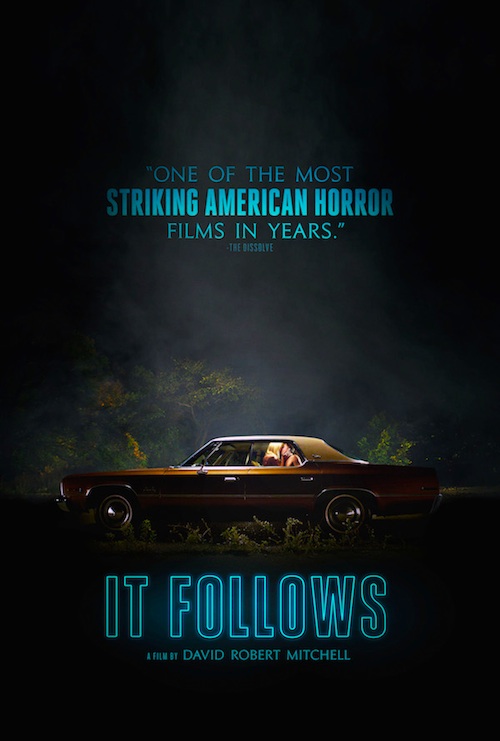
By Joe Benel. Finally, the abstinence education movement has the horror film it has always needed. When a suburban neighborhood bombshell finally sleeps with her newest boyfriend, she would have been much more fortunate to be infected with an STD. Instead, she picks up some sort of supernatural stalker. She can run or she can try to pass it on to someone else, but there will be no hiding from the malevolent entity in David Robert Mitchell’s It Follows, which screens during the 2015 Sundance Film Festival.

Everyone on the block is devoted to Jay, including her less glamorous younger sister, her dweebish elementary school boyfriend Paul, and Greg, the high school bad boy living next door to him. Ill-advisedly, she has decided to take the plunge in the mysterious Hugh’s back seat. At first, it is all lovey dovey, but after a spot of chloroform, she wakes up bound to a wheelchair. At this point, he gives her the bad news, pointing it out, in the spectral flesh.

An uncanny entity will now stalk her. It can take the form of any person, but only she and the formerly infected can see it. It can only walk and it is suspensefully slow, but it never stops until it catches it prey. Hugh does not want that to happen to her, because it would then follow the chain back to him again. Naturally, Jay and her friends assume it was all part of some sick game devised by the jerk calling himself Hugh, but a few unsettling incidents soon convince them otherwise.

It Follows is a distinctly creepy film due to the nature of its bogeyman, who often impersonates close family members, just to be cruel. Other times it assumes some truly ghoulish guises, but it could be anyone purposefully walking towards Jay. Yet, Mitchell also takes the time to develop his characters and establish their relationships. Even the location of their respective houses is important to his narrative.

Granted, Adam Wingard’s The Guest went south about halfway through, but it and It Follows really herald Maika Monroe as the up-and-coming “It-Girl” of genre cinema. She does the scream queen stuff well enough, but also forges believable chemistry with her assorted costars. Keir Gilchrist (a bit of a cold fish in Dark Summer) is particularly effective in this respect as the torch-carrying Paul.

Okay, so their big third act plan does not make much sense, but the movie essentially acknowledges as much, by having it go spectacularly awry. You would hardly expect it from his previous film, The Myth of the American Sleepover, but Mitchell’s horror film mechanics are unfailingly sure-footed, while Mike Gioulakis’ massively moody cinematography and the eerie electronic soundtrack concocted by Richard Vreeland, a.k.a. Disasterpiece, give it the look and ambiance of vintage 1980 horror, in the best sense. Highly recommended for genre fans, It Follows screens again today (1/25) and Friday (1/30) in Park City and Saturday (1/31) in Salt Lake, as part of this year’s Sundance.

LFM GRADE: A

Posted on January 25th, 2-15 at 2:58pm.

LFM Reviews Z for Zachariah @ The 2015 Sundance Film Festival

By Joe Benel. Lets face it, the future surely won’t be utopian, like in Star Trek, and most likely won’t be dystopian as in 1984 (although some days you have to wonder). Chances are, it will just sort of be topian, as it is now. However, Craig Zobel puts his chips on a radioactive post-apocalyptic future in his adaptation of Robert C. O’Brien’s young adult novel Z for Zachariah (clip above), which screens during the 2015 Sundance Film Festival.

One by one, Ann Burden’s family members left the safety of their self-contained valley looking for survivors, eventually leaving her with only the family dog for company. One day, Loomis, a scientist in a heavy radiation suit staggers into the sheltered ecosystem. However, just when he thinks he has found an unspoiled Eden, Loomis contaminates himself in a stream fed from an outside source. With the help of his meds, Burden slowly nurses him back to health. He appears to be the companion she has long prayed for, but his scientific materialism is somewhat at odds with her rugged Christian faith.

Nevertheless, mutual attraction steadily percolates between them, until it is interrupted by the arrival of another stranger. On paper, Caleb the former coalminer would be a better match for Burden because of their shared values, but she is surprisingly frustrated by Loomis’s passive reaction to his potential rival. At least an additional set of hands can help build Loomis’s proposed hydroelectric generator, but then what?

Perversely, screenwriter Nissar Modi removes everything that was distinctive and challenging about the novel written by the Mrs. Frisbee and the Rats of NIMH author Robert Leslie Conley under the O’Brien pseudonym, replacing it with a shopworn post-apocalyptic love triangle. Since Caleb was Modi’s creation, he could have at least made him more interesting. However, the watering down of the pitched struggle between Burden’s traditional values and Loomis’s scientific fanaticism is real loss. Frankly, one would have thought that was what attracted Compliance helmer Zobel to the project in the first place.

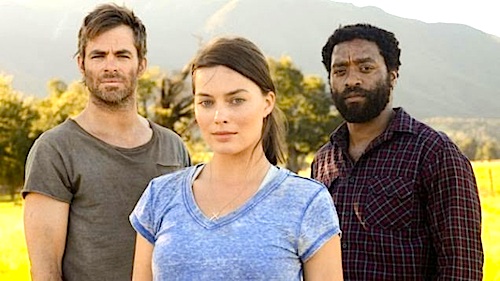
From "Z for Zachariah."

Still, Z is notable in one respect. It makes a major career statement for Margot Robbie, in a radical departure from her sexpot roles. It is a sensitive performance that presents Burden’s faith in a respectful manner, while also convincingly portraying the slow awakening of her long dormant sexuality. As usual, Chiwetel Ejiofor exudes wounded dignity as the new and improved Loomis, but evidently Chris Pine has seen as many apocalyptic films as the rest of us have, because he just looks bored out of his mind as Caleb.

If you are not going to preserve its themes, why pretend to adapt a book in the first place? Obviously, Modi’s adaptation is an attempt to cash in on the craze for dark futuristic YA projects, but the final product is guaranteed to disappoint fans of the novel (and the earlier 1984 BBC adaptation). As a point of comparison, J.C. Schroder’s Forever’s End has a similar feel, but is far more compelling. Only recommended for fans of Robbie who want to see her take her craft to the next level, Z for Zachariah screens again tonight (1/25) at the Sundance Mountain Resort, tomorrow (1/26), Thursday (1/29), and Saturday (1/31) in Park City, and Friday (1/30) in Salt Lake, as part of this year’s Sundance.

LFM GRADE: C-

Posted on January 25th, 2015 at 2:58pm.

LFM Reviews Natan @ The 2015 New York Jewish Film Festival

Natan – Trailer from screenworksfilmandtv on Vimeo.

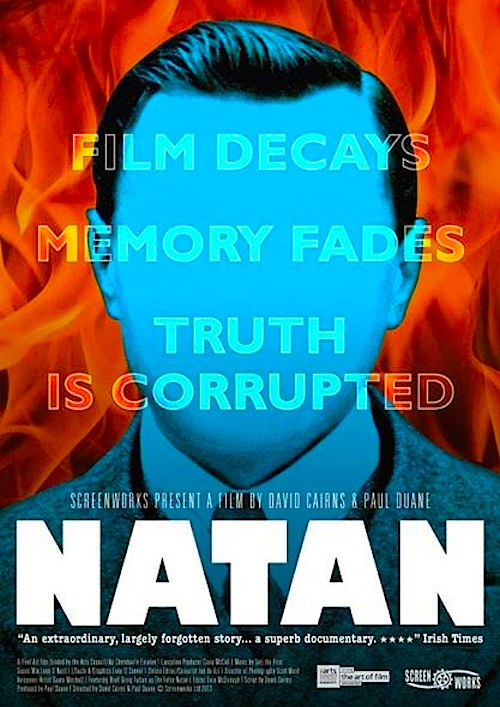
By Joe Benel. Bernard Natan (born Natan Tannenzaft) should have been the Louis B. Mayer of France and for a while he was. Unfortunately, a Jewish mogul helming the storied Pathé film studio was more than the French establishment could handle. With the help of a dubious “whistleblower” and an unfortunate secret in his past, the French media destroyed Natan’s reputation and largely erased him from the cinema history books. David Cairns & Paul Duane defend the groundbreaking producer from malicious slander and historical neglect in their expressionistic documentary Natan, which screens during the 2015 New York Jewish Film Festival.

Since Natan lived in 1930s France and his doc was selected by the NYJFF, you can probably guess why he is not capable of defending himself. He did indeed perish in a German concentration camp, after the French authorities eagerly deported him, but there is far more to the story than that.

Natan was a Romanian Jew, who became a naturalized French citizen after honorably serving his adopted country in WWI. He had an instinctive affinity for motion pictures, scuffling his way from a projectionist and lab technician to a scrappy mini-magnate, who acquired the famous Pathé brand when Charles Pathé decided to liquidate rather than deal with the advent of sound. Unfortunately, while he was still a desperately poor immigrant, Natan was convicted of peddling dirty movies. Much will be made of this later, to the detriment of Natan’s historical standing.

Even though it is the last thing Natan would probably want, his docu-exoneration will make you despise the French. It will not do much for most viewers’ estimation of film historians either, particularly those that specialize in “stag films.” Frankly, as screenwriter, Cairns thoroughly persuades the audience to consider Natan a mid-Twentieth Century Job, who was done wrong by nearly all quarters.

Especially mind-blowing is the role of a rather unsavory figure named Robert Dirler, who wormed his way onto the Pathé board to undermine Natan, despite his criminal record and suspicious German connections. That last part gives one pause, does it not? To their credit, Cairns & Duane do not overplay the conspiracy card, but the shadowy Dirler clearly merits further research.

The film also uses various stylistic strategies that are likely to be divisive. Cairns & Duane often depict exaggerated re-enactments from Natan’s life, featuring the producer with a large papier-mâché head, largely modeled on National Socialist propaganda, including a famous exhibit in occupied Paris, prominently featuring Natan. It is somewhat distractingly surreal at times, but there is an underlying point to it. In fact, it makes Natan considerably more distinctive visually than most documentaries.

The eerily sensitive score by Irish Alt band Seti the First further distinguishes the production. Cairns & Duane also incorporate plenty of clips from Natan’s acknowledged classics, such as Marco de Gastyne’s La Merveilleuse Vie de Jeanne d’Arc, but aside from Serge Bromberg (admittedly quite the fitting expert commentator), the French cinema establishment is largely absent. It just makes them look all the worse. In a mere sixty-seven minutes, the film assembles a damnably convincing case that inspires rage and sorrow in equal measure. Anyone who takes cinema seriously as an artistic and commercial endeavor really should see it. Highly recommended, Natan screens twice this Wednesday (1/28) at the Walter Reade Theater (with How to Break Into Yiddish Vaudeville) as part of this year’s NYJFF.

LFM GRADE: A-

Posted on January 25th, 2015 at 2:57pm.

LFM Reviews The Amina Profile @ The 2015 Sundance Film Festival

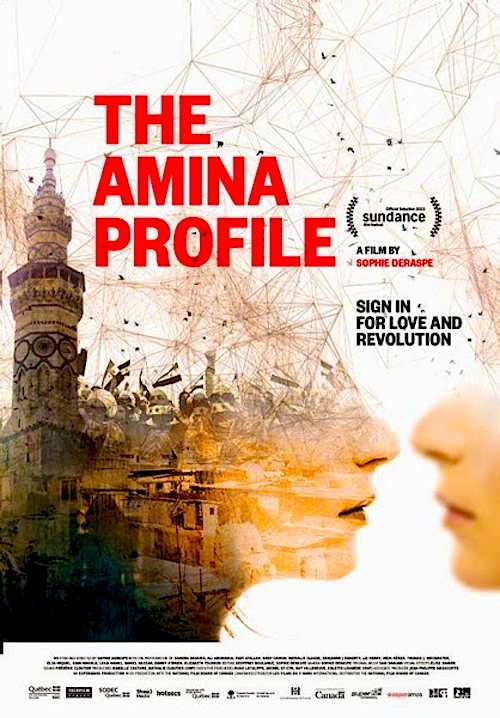
By Joe Benel. Razan Ghazzawi is one of the few Syrian dissident bloggers who posts under her real name. A critic of censorship and an advocate of women’s rights and tolerance for gays and lesbians, Ghazzawi has been arrested twice by the Assad regime and still faces potential prosecution and constant interrogations. This film should have been about her, but it is not. Instead, it chronicles the short but provocative history of Amina Arraf, who was very much like Ghazzawi, except she was a hoax. It is a strange and ultimately unhelpful story told in Sophie Deraspe’s The Amina Profile, which screens during the 2015 Sundance Film Festival.

What started as an online flirtation for French Canadian Sandra Bagaria soon turned very real, except it wasn’t. Perhaps she should have been more suspicious in the age of catfishing, but the ostensive Arraf always had good justifications for her elusiveness, such as the fact Skype is blocked in Syria. With Bagaria’s encouragement, the Arraf persona launched the Gay Girl in Damascus blog, which soon became a retweetable phenomenon. To their credit, the person behind the phony identity had a decent handle on the Syrian situation, but said individual (easily findable online) misjudged badly when they decided to have Arraf kidnapped.

Having been widely cited in credible media outlets, as well as The Guardian, news of Arraf’s abduction ignited an online firestorm of protest. However, as real deal Syrian dissident Rami Nakhla explains, it diverted attention from legitimate known prisoners of conscience, such as Ghazzawi. It also gave an opportunity for the pathologically anti-Israeli Electronic Intifada to do the Assad regime a favor by following the i.p. trail of the person behind the Gay Girl in Damascus.

Ironically, Profile does exactly what it decries, by concentrating almost entirely on the Arraf story, at the near total expense of Ghazzawi and other imprisoned Syrian activists. It would have made much more sense to divide the narrative between the very real perils facing Ghazzawi and the bizarre Arraf narrative unraveling concurrently. However, we have to deal with the film as it is, rather than how it might have been.

From "The Amina Profile."

To an extent, Deraspe justifies Profile’s editorial strategy by following Bagaria’s long-term efforts to process the revelation. It is good to know that she was able to reach some measure of closure, but without the wider Syrian implications, her experience would not be so very different from that of Manti Te’o.

Anyone intrigued by Profile should definitely try to catch it while it makes the festival rounds, because it is hard to see it playing on PBS, given some of its early erotic imagery. Of course, HBO might be a possibility. It is never dull, thanks to Deraspe’s solid sense of pacing and the hot button issues it addresses, but one cannot help wishing she had widened her focus. For those who are fascinated by media hoaxes and feeding frenzies, The Amina Profile screens today (1/25) in Salt Lake and tomorrow (1/26), Thursday (1/29), and Friday (1/30) in Park City, during this year’s Sundance.

LFM GRADE: C-

Posted on January 25th, 2015 at 2:57pm.

LFM Reviews Ratter @ The 2015 Slamdance Film Festival

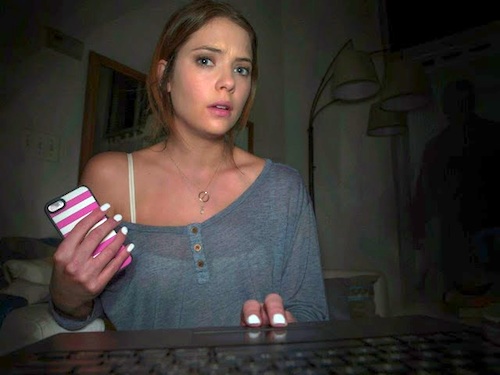
From "Ratter."

By Joe Benel. Surely, even the most tenacious cyber-stalker has to go to work or buy groceries sometime. Somehow, the predator tapping into Emma’s life always seems to be watching. That monomaniacal focus makes it is even more unsettling to watch her through his eyes throughout Branden Kramer’s Ratter, which screens during the 2015 Slamdance Film Festival.

Obviously, we cannot see the man who has maliciously hacked Emma’s computer and assorted internet accessing devices, but he did quite a job on her. Through their web-cameras, he (and we) see just about all of her presumptively private moments. She moved to New York following a rough patch back home, but in retrospect, that seems to be a mistake. When she finally realizes she has been hacked, she immediately suspects her still bitter ex, but he seems an unlikely culprit from our perspective. Unfortunately, the cyber harassment dangerously escalates when the unknown perpetrator starts sabotaging her relationships.

Ratter is the sort of film that will scare viewers into moving a good portion of their lives off-line. Like Bobby Boermans’ more conventionally thrillerish App, it makes retro flip phones look like an idea whose time has come again (they make and receive calls, period). Kramer takes some time to set the scene and flesh out Emma’s backstory, but he steadily builds the claustrophobic tension until you want to scream at her: “get out of the apartment.”

From "Ratter."

Given its online video look and the menacing vibe, Ratter feels somewhat akin to the original V/H/S anthology film. The most notable dissimilarity—and it’s a significant one—is Ratter’s lack of fun.

In a way, Ashley Benson (of Spring Breakers and Pretty Little Liars) is too realistic as Emma. We see her make dozens of mistakes and in just about every unflattering moment imaginable, yet she always seems like a generally decent, somewhat naïve kid. She also develops some surprisingly down-to-earth flirtatious chemistry with her prospective new boyfriend Michael, also nicely played by Matt McGorry. They certainly do not deserve what befalls them.

Kramer exercises commanding control of the film’s twisted mood and psychopathic concentration, while Benson withstands the relentlessly intimate focus remarkably well. However, even mildly sensitive viewers might be disturbed at where it ends up. Recommended for luddites looking for a bitterly black thriller, Ratter screens again this Wednesday (1/28) at Treasure Mountain Inn, as part of this year’s Slamdance.

LFM GRADE: B

Posted on January 25th, 2015 at 2:56pm.