LFM Reviews The Chaperone @ DOC NYC

The Chaperone 3D Trailer from Thoroughbread Pictures on Vimeo.

By Joe Bendel. It is a lot like School House Rock, but with rampaging bikers and Kung Fu. It incorporates retro hand drawn animation, stop motion, live action martial arts sequences, and exploding papier-mâché heads. It is also a documentary. Fraser Munden and co-director Neil Rathbone pretty much have it all in their thirteen minute true-story smackdown The Chaperone, which screens during this year’s DOC NYC.

Ralph Whims is a dedicated teacher and a natural bad-ass. To this day, he remains cult-famous in his Montreal neighborhood for the night he faced down a gang of bikers that crashed the youth social he was chaperoning. High and disorderly, the bikers were knowingly terrorizing the intimidated church kids, until Whims stepped up. He pretty much handled them Bruce Lee-style, but he got a timely assist from the DJ, Stefan Czernatowicz—and they have remained close friends ever since. It was the 1970s, this sort of thing happened back then.

From "Chaperone."

Munden and Rathbone give an animated blow-by-blow of the encounter and it is pretty awesome. They also throw in all kinds of weird interludes and asides, including close-ups of the bikers’ heads going poof. (It’s a symbolically rendered poof.)  They create a wildly funky vibe through the appropriately funky soundtrack, the early ‘70s period details, and the massively cool attitude. However, with his narration, Whims also offers some darned practical advice to anyone facing down a pack of thugs. He knew how to handle himself, that’s for sure.

Nostalgia is rarely as action-packed as it is here. Pound-for-pound, second-by-second, The Chaperone has to be the most wildly entertaining film screening at DOC NYC. Highly recommended for fans of animation, exploitation teen films, and afterschool specials, The Chaperone screens before Rubble Kings this Sunday evening (11/16).

LFM GRADE: A

Posted on November 14th, 2014 at 6:11pm.

LFM Reviews Aberdeen @ The SFFS’s HK Cinema Series

By Joe Bendel. Cheng Tung was once a fisherman in Aberdeen Harbor, but he now works as a Taoist priest, specializing in the “Breaking Hell” ceremony. Unfortunately, the patriarch cannot break the Hell of his own family. Resentments will be nursed and neuroses will run wild in Pang Ho-cheung’s Aberdeen, which screens during the San Francisco Film Society’s annual Hong Kong Cinema series.

All the Chengs have their own problems, particularly little Chloe. She is dealing with bullies at school and her ailing chameleon, Greenie. Her parents are outwardly supportive and engaged, but her father Cheng Wai-tao has come to privately doubt whether he truly is her father. She just doesn’t seem cute enough to be the daughter of the super-slick motivational speaker and his actress-model wife, Cici. At least, she was an actress-model. Gigs have become scarce and getting scarcer, as she proceeds to get steadily older.

Meanwhile, Chloe’s uncle Yau Kin-cheung is having a reckless affair with his much younger but increasingly codependent nurse, while his oblivious wife (Wai-tao’s older sister) struggles with her unresolvable mother issues. Unfortunately, Cheng Tung is not allowed to exercise much authority. Offended by his relationship with a bar hostess, his son has almost completely frozen the old man out.

For HK cinema fans who primarily know Pang for his naughty screwball comedy Vulgaria and the gory satire Dream Home, the sensitive family drama of Aberdeen will be quite a revelation. While there are distinctive fantastical interludes, particularly the Kaiju Greenie rampaging through the scale model streets of Hong Kong, it is still thoroughly grounded and often quite subtle. On paper, the beached whale that becomes a focal point for the Chengs and the unexploded WWII ordinance discovered near Yau’s flat sound like face-palmingly heavy handed symbolism, yet Pang never overplays them.

From "Aberdeen."

Regardless what her father says, young Lee Man-kwai’s Chloe is all kinds of cute and she anchors the film very effectively. However, it is Gigi Leung who really lands the knock-out punch as Cici. There have been a number of films about actresses struggling to maintain their careers as time flies, one of the most notable being Olivier Assayas’s Clouds of Sils Maria. Yet, as great as Juliette Binoche is in that film, the audience never comes to know and understand her character as we do Leung’s Cici. She has a few key scenes that will just cut your legs out from under you. She also looks great, as does Dada Chan who appears in an extended cameo playing a character much like her pre-Vulgaria persona, probably as a thank you to Pang for her award-winning breakout role.

It is rather remarkable how many interconnected relationships Pang and his all-star cast are able to fully flesh out. Surprisingly potent but never overbearing, Pang’s Aberdeen captures the messiness of life with honesty and affection. Highly recommended, it screens this Sunday (11/16) as part of the SFFS’s Hong Kong Cinema series.

LFM GRADE: A-

Posted on November 13th, 2014 at 1:51pm.

LFM Reviews Top Spin @ DOC NYC

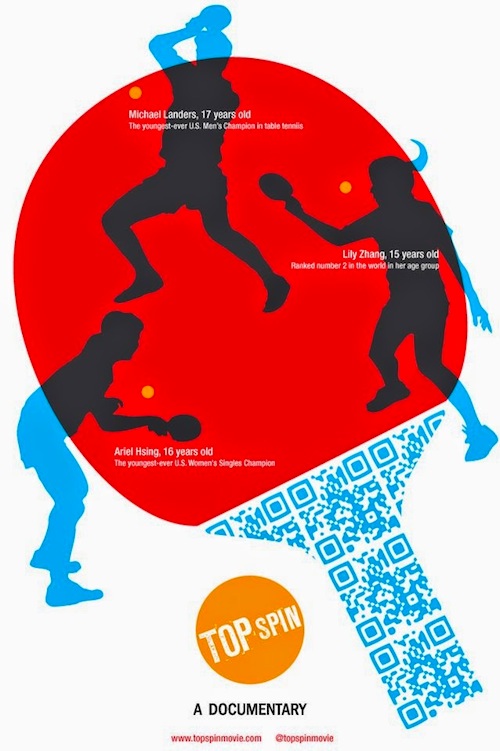
By Joe Bendel. Out of the eighty-eight total Olympic medals awarded for table tennis, China has won forty-seven and North Korea has won three, so do not expect the totalitarian-friendly IOC to drop the sport anytime soon. However, a young generation of players dream of winning the first American table tennis medal. Sara Newens & Mina T. Son follow three promising U.S. Olympic team hopefuls throughout the season leading up to the London Games in Top Spin, which screens during this year’s DOC NYC.

Ariel Hsing and Lily Zhang both live in North California and play an aggressive, attacking style of table tennis. Women’s championships often come down to the two of them. Currently, Hsing is number one, but it is always a pitched battle. Long Island’s Michael Landers is also a leading contender, but the odds might be a bit longer for him to secure a spot on the Olympic team. All three have sacrificed much of the traditional high school experience to pursue glory in the games, but Zhang seems to do a better job balancing a social life with her arduous competition schedule.

Right, so don’t call it ping pong. Clearly, all three young athletes train like mad. Newens and Son give viewers a good sense of the physically demanding work they do, as well as the considerable mental preparation required. Of course, they do it all solely with the Olympics in mind, since there is no professional table tennis circuit to speak of in America.

Happily for Newens and Son, the leading contenders are also highly engaging screen presences. It seems like they were born to be interviewed by Bob Costas. Their parents are also frequently seen throughout the film, coming across as unflaggingly supportive. According to the post-script, Hsing, Zhang, and Landers have all successfully transitioned to college life, so they obviously did something right. However, the film clearly implies the Zhangs gave greater priority to their daughter’s social development, which is a subject worthy of greater exploration.

Viewers definitely get a thorough understanding of the Olympic qualifying process from Top Spin, but it resists getting bogged down in micro-details. Frankly, the various ball-spin strategies remain utterly mysterious. However, Newens & Son were once again fortunate to have a relatively upbeat (if not necessarily Cinderella story) ending. Anyone who sees their documentary will follow table tennis at the 2016 Rio Games much more closely, looking for the return of familiar names to build on their London experience, which should make NBC delighted. Recommended for fans of the Olympics and scrappy underdogs, Top Spin screens this Saturday (11/15) as part of DOC NYC 2014.

LFM GRADE: B

Posted on November 13th, 2014 at 1:50pm.

LFM Reviews Brahmin Bulls

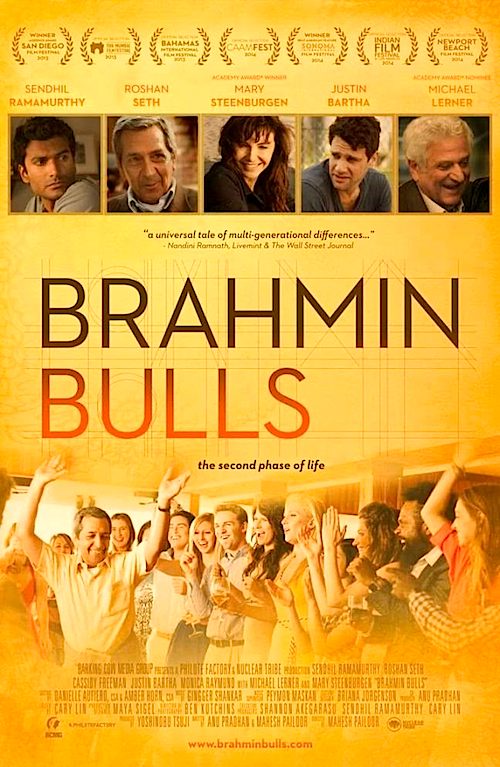
By Joe Bendel. Ashok Sharma once had grand ambitions of winning a Nobel Prize. Father of the Year, not so much. He came up empty on both counts. Sharma will try to reconnect with his grown architect son, but another face from his past will complicate matters in Mahesh Pailoor’s Brahmin Bulls, which opens this Friday in New York.

Sharma lives in Boston, but he doesn’t seem like such a bad guy. Nevertheless, Sid Sharma considers himself more of the heir to Richard Neutra than his father’s son. Unfortunately, that is not what clients are looking for, thereby causing him stress in his firm. (Frankly, he probably ought to feel a little heat, since it looks like he plays tennis all day and gets smashed in hipster bars every night). Dr. Sharma will use an academic conference as a pretext for visiting his more-or-less estranged son, but he might have an additional ulterior motive. It turns out his former mistress, Helen West, will be one of the conference speakers.

As viewers might expect, the reunion starts out massively awkward, but steadily thaws before getting predictably uncomfortable again. However, Pailoor skips the clichéd old world vs. new world clash of cultures. Frankly, the senior Sharma is just as westernized and modernized as his soon-to-be divorced son, if not more so. In fact, one of the most intriguing aspect of this film is the treatment of his arranged marriage (to Sid’s late mother, whom he cheated on). Obviously, it was a difficult marriage and he justly blames himself for the worst of it, but it is not like it was his idea in the first place. Indeed, it is rather complicated.

There is an awful lot of standard issue father-son melodrama in Brahmin (tennis, the game that pulled them apart might just bring them back together). Still, distinguished screen actor Roshan Seth (Nehru in Gandhi and villain Chattar Lal in Indiana Jones and the Temple of Doom) is refreshingly dignified and understated as Dr. Sharma. He and Sendhil Ramamurthy play off each other rather well, as father and son. For comic relief, Michael Lerner is a lot of fun hamming it up as his formerly hard-partying academic colleague, while Mary Steenburgen also hits the right note of graceful resignation as West. On the other hand, Sid’s office and social network seems to be populated with an awful lot of boring characters.

Be that as it may, you have to give credit to a film that loudly proclaims it love for Neutra’s houses. Even if Brahmin follows a formulaic narrative, it is far less manipulative and sentimental than its themes would suggest. There is nothing particularly special about its technical package, but at least the admirably restrained Pailoor keeps it moving along, so it goes down relatively smoothly overall. No cause for fireworks, but those looking for emerging talent might want to check it out, because Pailoor could well be building towards bigger and better things with subsequent films. It opens tomorrow (11/14) in New York at the AMC Empire.

LFM GRADE: C+

Posted on November 13th, 2014 at 1:49pm.

LFM Reviews Love and Terror on the Howling Plains of Nowhere @ DOC NYC

By Joe Bendel. It is not easy to recruit a theoretical mathematician to a small college nestled in the middle of nowhere. You would think the administration and the police would be somewhat alarmed when said math professor turned up missing. However, many of Dr. Steven Haataja’s friends and colleagues were troubled by a perceived lack of urgency during the early days of his disappearance. The mystery only deepened further when Haataja’s body was discovered. The case became the central strand of Poe Ballantine’s eccentric true crime ode to his adopted home town. Inspired by Ballantine’s pseudo-memoir, Dave Jannette’s investigates Chadron, Nebraska’s most notorious missing person case in Love and Terror on the Howling Plains of Nowhere, which screens as a Midnight selection of this year’s DOC NYC.

Theoretical math is a young, socially awkward man’s game, so the forty-six year old Haataja was already over the hill when he arrived at Chadron State College. They were still lucky to have someone with his qualifications. In his short time in Chadron, Haataja seemed to be making friends, despite a history of depression. Then one day he vanished. Months later, he was discovered, bound to a tree and unrecognizably burnt to death. Naturally, the Chadron police eventually determined it was suicide.

Yes, Haataja’s hands were apparently free, but it still just did not add up correctly for Ballantine. In the film’s centerpiece sequence, the author retraces Haataja’s alleged final steps under similar below-freezing, nocturnal conditions, finding it hard going, even without a recently mended broken hip. Unfortunately, there will be no definitive closure, just more questions. There is also an awful lot of Ballantine and his family, who are all quite pleasant, but often feel like a bit of a distraction from the existential mystery at hand. Still, Ballantine obviously feels a kinship with Haataja as outsiders who found an unlikely home in off-the-beaten-path Chadron.

Jannette constantly plays up Chadron’s idiosyncratic characters, including some who have no apparent connection to the case, but look suitably exotic on camera. There seems to be an effort to play to the Twin Peaks audience, while leaving some issues underdeveloped. Frankly, the material presented in Howling raises a red flag regarding known victims of depression who subsequently die under suspicious circumstances. How diligently are they investigated or are they commonly dismissed as suicides for the sake of convenience?

From "Love and Terror on the Howling Plains of Nowhere."

Although it would be quite a tangent to follow-up on, it is also rather disconcerting when a colleague explains his attempt to interest The Chronicle of Higher Education in the then missing Haataja was rebuffed because they constantly received similar reports of vanishing academics. You have to wonder just how many of them really do “turn up later.” Nonetheless, his use of the local newspaper’s Police Beat is undeniably funny and in its way, quite telling.

There is something about the Haataja case that is hard to shake off. It festers in the subconscious, crying out for a conclusive verdict, but remains maddeningly obscure. There is also a lot of anger in Howling that is not misplaced. Better as a true crime expose than an exploration of local color, Love and Terror on the Howling Plains of Nowhere is recommended on balance when it screens this Saturday night (11/15) as part of DOC NYC 2014.

LFM GRADE: B

Posted on November 12th, 2014 at 3:13pm.

LFM Reviews David @ DOC NYC

From "David."

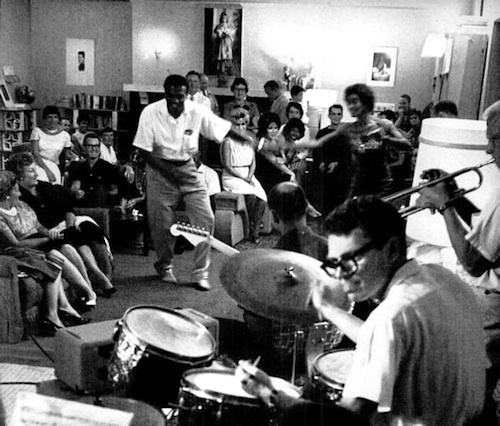
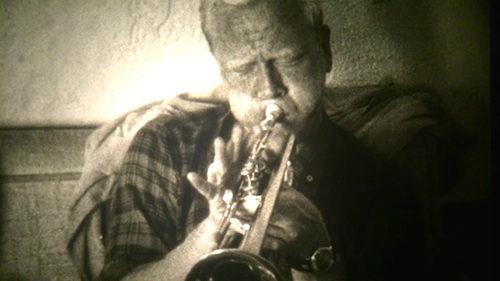
By Joe Bendel. There were at least three LPs and one movie inspired by the Synanon drug treatment center. Before Neal Hefti’s soundtrack album and a weird jazz-rock-chorale piece were waxed, a jazz combo consisting of Synanon patients released Sounds of Synanon, by far the best of the three. While it would launch the career of guitarist Joe Pass, trumpeter David Allan was the focus of a Drew Associates television documentary around the same time. Rarely seen since its 1961 broadcast, Gregory Shuker, D.A. Pennebaker & William Ray’s David screens as part DOC NYC’s tribute to Pennebaker.

In retrospect, it is strange to watch David for many reasons, particularly since its focus falls squarely on the now nearly forgotten Allan rather than the future superstar Pass. Of course, Allan’s surfer good looks probably made much more television sense at the time. Musically, Allan is also featured, sounding pretty good on “All Blues” during the opening and “Georgia on My Mind” (a somewhat ill-fitting thematic choice) over the closing credits. However, it is rather awkward to watch Allan frequently butt heads with Pass, when he really should have done his best to tie his wagon to the guitarist’s star.

Of course, Pennebaker and company’s intimate look inside Synanon is downright eerie, given its later scandals, including the attempted assassination of attorney Paul Morantz through the unlikely mechanism of a rattlesnake snuffed in his mailbox. We see founder Chuck Dederich still holding court before taking flight to Arizona as a fugitive from justice. In fact, his group encounter session with Allan appears to be a forerunner to the notoriously ruckus “Synanon Game,” in which patients tore into each where it would hurt the most, all in the name of therapy.

Given what we now know, it is easy to see warning signs throughout this scene. The insistence with which Dederich and fellow patients discourage visits from Allan’s wife and young child should have thrown up a red flag for viewers, looking dare we say “cultish” to contemporary eyes. In a way though, this demonstrates the merit of Pennebaker and Drew’s approach to documentary filmmaking. What happened, happened. We can see it just as clearly now as then, but the context we bring to it today is radically different.

From "David."

David certainly makes viewers wonder whatever became of Allan. As a time capsule of early Synanon before it completely descended into bedlam and Pass before he became a mainstay for Pacific Jazz and Pablo Records, David is an enormously significant film that merits preservation on the National Film Registry. Pennebaker also documented another “if only” moment in jazz history when he recorded Dave Lambert’s unsuccessful audition for RCA with a prospective new group months before his accidental death. In fact, the two films would make quite a nice pairing at jazz and film festivals.

For now, anyone interested in the early 1960s Pacific Jazz scene should see David when it screens at DOC NYC, because it is likely to remain one of the scarcer obscurities in the Drew Associates catalog. Highly recommended as a fascinating jazz and cultural history curiosity, it screens this Sunday (11/16), with 2014 DOC NYC Lifetime Achievement honoree Pennebaker scheduled to attend.

LFM GRADE: A-

Posted on November 12th, 2014 at 3:12pm.