LFM Reviews Uncertain Relationship Society @ The SFFS’s HK Cinema Series

From "Uncertain Relationship Society."

By Joe Bendel. Li Ling’s social network is stuck in the Bermuda Triangle of friend zones. The interconnected group of former classmates have not just one but multiple ambiguous platonic friendships with each other. Unfortunately, none of it comes with benefits, despite the fact everyone is ridiculously attractive in Heiward Mak’s surprisingly grounded Uncertain Relationship Society, which screens during the San Francisco Film Society’s annual Hong Kong Cinema series.

Ever since high school, Lam Yat Min always had a talent for music and eyes for Li, an aspiring artist. It might be reciprocal, but neither ever takes a chance to find out. He has a similar long-term non-relationship with campus bombshell Kaman Kong, except maybe somewhat less so. For her part, Li has a parallel friendship, or whatever, with Lee Choi-wa, a formerly nebbish student who blossoms into a metrosexual apprentice hairdresser.

Lee’s barely closeted photographer roommate Ho Yip also seems to harbor complicated feelings toward him. At least he does not have an ulterior motive when he uses up-and-coming model Kong in his shoots. Instead, Lam’s not quite rival is her borderline abusive hipster boyfriend, Leung Wai On, whom she can never quite break up with.

So yes, it’s complicated, but somehow Mak avoids a host of potential tonal pitfalls. Her blueprint script and the cast’s largely improvisational method never come across overly glib like an episode of Friends or too precious in a Zach Braff-Noah Baumbach kind of way. Rather it all feels pretty real and even zeitgeisty. While never explicitly political, the main characters’ romantic frustrations are echoes by their professional disappointments and a sense that the system is stacked against Hong Kong’s Generation Y, who have been disproportionately drawn to the recent Umbrella Protests.

From "Uncertain Relationship Society."

As Li, Venus Wong is impressive in just about every way, seamlessly depicting her evolution from a shy student to a mature (but still unfulfilled) woman. Playing it meta-style, HK model Kong is almost painfully vulnerable and emotionally exposed. HK pop idol Anjo Leung is relatively down to earth and musically credible as Lam Yat Min, but Cantopop star Eman Lam often steals scenes right out from under him as the boss of his boutique corporate jingle house.

Just about everyone has had their maddening uncertain relationship, but it is difficult to imagine balancing two of them simultaneously over five or six years. Nevertheless, Mak juggles the numerous characters and the frequent time shifts with relative ease. It is not the sort of annoying film that it surely sounds like on paper. Nonetheless, the constant hashtag commentaries are a mistake, already giving the film a dated time capsule vibe. Recommended for its overall vitality and the exiting work from its stars-in-the-making, Uncertain Relationship Society screens this Saturday (11/15) as part of the 2014 edition of the SFFS’s Hong Kong Cinema series.

LFM GRADE: B+

Posted on November 12th, 2014 at 3:12pm.
LFM Reviews Haunters @ DOC NYC

From "Haunters."

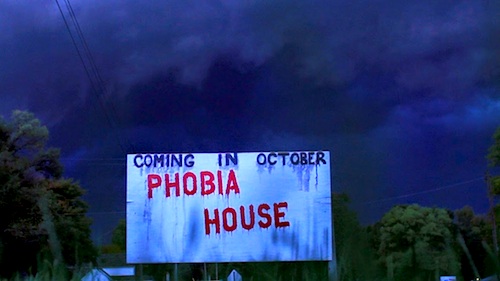
By Joe Bendel. Everyone is scared of something. In magician Antony Gerard’s case, it is the fire marshal. That local busybody shut down Phobia House, his popular Kalamazoo haunted house, on what would have been their ten year anniversary. Determined not to let that happen again, the Gerard family moves Phobia House and the dozens of temp jobs it creates out of the Kalamazoo inspector’s jurisdiction. Anthony Morrison follows their rocky rebound season in Haunters, which screens as a midnight selection of the 2014 DOC NYC.

The year before last, Phobia House was ranked #1 amongst regional Michigan haunted houses. Then the nanny state killed everyone’s fun. The Gerards have built sort of a mini-empire, but Halloween is crunch time for phobia house, their latex mask molding business, and the Timid Rabbit, their magic and costume supply store. They think they have found a suitable space outside of town in a shuttered paintball range, but it will take time and money to convert it.

There is a lot of passion that goes into creating an attraction like Phobia House. For an economically depressed community like Kalamazoo, it also happens to be a welcome source of seasonal employment. Yet, many of the entitled millennials Gerard hires blow off the job days before Phobia House re-opens.

To his credit, Morrison never mocks or gawks at the Gerards. This is a film that respects hard work, especially when it is performed in zombie make-up. It certainly gives viewers an appreciation for haunting as a calling. Frankly, it seems there should be some sort of agreement barring reviews during the first few days of operation, much like a Broadway show, because there will inevitably be kinks to work out.

Morrison also gives viewers an up-close-and-personal perspective on the scaring process through his inspired use of night vision. Phobia House looks genuinely intense, maybe even a little sick, particularly when they add the unsettling special attraction of a woman hanging from her impaled hooks, as a sort of goth geek act.

From "Haunters."

Essentially, Haunters is a film about blue collar Americana and its mounting economic anxiety, but it comes with some very creepy visuals and a bit of insight into why we like to be scared. The title is a bit pedestrian though and might be confused with another Haunters documentary about the haunted house business, as well as the Abigail Breslin supernatural thriller Haunter or the Jacki Weaver horror film Haunt.

It is always nice to see hard work rewarded in the movies and Morrison’s Haunters is no exception. Recommended for fans of live haunted houses, Haunters screens a stroke before the witching hour this Saturday night (11/15) at the IFC Center, as part of this year’s DOC NYC.

LFM GRADE: B

Posted on November 12th, 2014 at 3:12pm.

LFM Reviews Desert Lullabies @ MIX NYC 2014

Desert Lullabies Trailer-HD from Monely Soltani on Vimeo.

By Joe Bendel. It is tough to be a kid in Iran. It is also hard to live with dignity as a woman and hard to live at all as an LGBT Iranian. Human rights for everyone remains a serious issue in the country, but the potential wartime death of innocence has become an increasingly pressing and universal concern throughout global battlefields. However, California-based filmmaker Monely Soltani explores it from a distinctly Persian perspective in the narrative short film Desert Lullabies, which screens during MIX NYC: the 27th New York Queer Experimental Film Festival.

Tara’s mother Homa has a hard time explaining why her dissident father has not yet returned as he promised. She has an even harder time explaining why they must flee their home at dawn. She has just received a last-minute warning the government imminently plans to raze their rebellious village along with all its inhabitants, but that is an awful lot to burden a young child with.

As she slips into a feverish slumber, Tara will be visited by the spirit of her beloved grandmother and the goddess Anahita, but do not expect a happy ending, per se. Despite Desert’s fable-like vibe, reality still is what it is. Nonetheless, simply carrying on constitutes a victory.

Shot on location in Death Valley, but utilizing extensive green screen work, Desert seems to exist eerily out of time, like some sort of near future-Medieval dystopia. Some of the effects might somewhat reflect Soltani’s presumed budget constraints, but the evocative interiors of Homa’s modest home have a Spartan but tangibly lived-in feel.

While Desert is only fifteen minutes long, Shila Ommi’s performance as Homa packs quite a punch. Based on Soltani’s own mother, she vividly conveys all of Homa’s motherly courage and desperation. As Tara, Ariana Molkara’s work is also unusually sensitive and unaffected. Viewers will definitely believe they are family—a tragically incomplete family.

From "Desert Lullabies."

Soltani does not belabor the particulars of the current regime, but there are enough Iranian signifiers, starting with the Persian dialogue, to cue viewers’ pre-existing context. In fact, it could be seen as part the leading edge of an emerging Persian-American cinema, along with Ana Lily Amirpour’s A Girl Walks Home Alone at Night.

Although Soltani’s previous short documentary won an award from USC’s Lambda Association, Desert would not seem to be a natural fit for MIX NYC, but cheers to them for not being stylistically or thematically dogmatic. Highly recommended, Desert Lullabies also looks like one of the more accessible films in the Ancient Futures program, which screens tonight (11/12) at the 27th MIX NYC.

LFM GRADE: B+

Posted on November 12th, 2014 at 1:16pm.

LFM Reviews Miss Tibet: Beauty in Exile @ DOC NYC

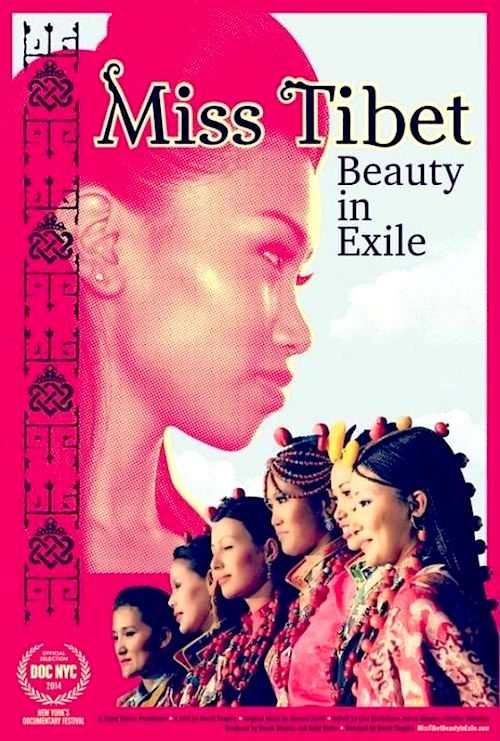
By Joe Bendel. For ten years and counting, second and even third generation exiles have competed in a beauty pageant to represent a country they have never lived in. That nation is Tibet, still held captive by their Chinese Communist occupiers. Obviously, this is no ordinary beauty contest. While their numbers are small, their consciousness is high. Documentarian Norah Shapiro follows Tibetan-American Tenzin Khecheo as she competes for the tenth annual Miss Tibet crown in Miss Tibet: Beauty in Exile, which screens during this year’s DOC NYC.

When most people think of Tibet, their mind’s eye pictures monasteries, temples, and snow-capped mountains—but glamor, no so much. Enterprising “impresario” Lobsang Wangyal sets out to change that with the Miss Tibet pageant, envisioning it as a means of empowering young women and providing a focal point for national pride. Despite his obvious slickness, the pageant seems to be taking hold, even though there is often controversy surrounding the swimsuit competition.

Much of Exile explores that tension between tradition and modernizing influences through Khecheo’s eyes. Initially insecure about her rusty Tibetan, she dramatically reconnects with her cultural heritage. One of the cool aspects of the Miss Tibet contest is the extent to which Tibetan music, customs, and history are integrated into the program. However, there are problems with the pageant that will come to light, adding a note of unexpected ambivalence to the third act (but be assured, all of the contestants are clearly a credit to Tibet).

In contrast, there is no equivocating in Exile when it comes to the realities of China’s occupation. Shapiro’s historical context might come from an illustrated children’s book (quite an elegant one, really), but it is still right on the money. In fact, part of the impetus for the pageant in general and Khecheo’s personal participation is to raise international awareness, since conventional protests have produced no results to speak of. Let’s be honest, how much do you think Obama had to say about Tibet during the APEC summit in China?

Khecheo’s personal development arc and the cultural synthesis the pageant represents are all strong stuff that easily sustain the relatively short (a hair under seventy minutes) Exile. Yet, it raises issues of double standards that could have been explored further. At one point, we learn a previous Miss Tibet might have been allowed to compete in an international pageant, but China insisted “Miss Tibet, China” must have been emblazoned on her sash. She refused. You wonder how often that sort of thing happens. For instance, if a fictitious country like “Palestine” is allowed to submit films for best foreign language Oscar consideration, Tibet should have the same right. Yet, if they put Pema Tseden’s latest film into contention, would the Academy accept it or bow to Chinese pressure? How many other such instances might there be?

Regardless, Exile does what it does quite well. It follows a highly engaging and likable POV figure in Khecheo through a surprisingly dramatic journey. Perhaps most valuably, it offers a fuller, more diverse picture of Tibetan identity, while also providing a timely reminder of Tibet’s captive nation status. Highly recommended, Miss Tibet: Beauty in Exile screens this Sunday (11/16) and Monday (11/17) as part of DOC NYC 2014.

LFM GRADE: B+

Posted on November 11th, 2014 at 7:52pm.

LFM Reviews The Kingdom of Dreams and Madness @ DOC NYC

From "The Kingdom of Dreams and Madness."

By Joe Bendel. For millions of animation fans, Studio Ghibli is like Disney without the weird cryogenic baggage. Year after year, Hayao Miyazaki and his team of animators have produced absolute classics that transcend genre. He has now apparently, by-and-large, for the most part, more-or-less retired, but Mami Sunada documented the master at work on his final masterwork, The Wind Rises. Sunada quietly observes the Studio Ghibli comings and goings, but still captures plenty of drama in The Kingdom of Dreams and Madness, which screens during this year’s DOC NYC.

Studio Ghibli might only continue as a licensing company, but it ended its original productions on artistic high notes. Both Miyazaki’s The Wind Rises and Isao Takahata’s The Tale of the Princess Kaguya are extraordinarily accomplished capstones to their legendary careers. While Miyazaki’s farewell film was a monster hit at the Japanese box-office, Takahata’s was not. They were also supposed to be released simultaneously, but even at the start of Kingdom, everyone realizes that is highly unlikely to happen.

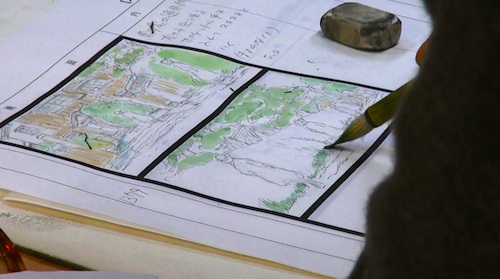
While there is plenty of pencil-sharpening and studious sketching going on in Kingdom, real conflict emerges between the venerable Miyazaki and the largely unseen Takahata, who gave Miya-san his start in the business decades ago at the Tohei studio. They share an awful lot of history together, but their working methods could not be further apart.

Somehow, as Sunada illustrates in detail, Miyazaki is able to put inspiration on a timetable, which you have to respect, because he made Spirited Away. In contrast, it happens when it happens for Takahata, which you have to respect, because he made Grave of the Fireflies—unless you happen to be Miyazaki. Even though Sunada observes events almost entirely from Miyazaki’s perspective, it is clear their relationship is very complicated. While the film consistently shows how comfortable Miyazaki is in his role as part studio task-master and part twinkly-eyed ambassador of goodwill, whenever Takahata’s delays are mentioned, he sounds like Seinfeld cursing “Newman.” Yet, with his next breath, he is likely to praise his former mentor’s past achievements.

From "The Kingdom of Dreams and Madness."

That strange dynamic truly elevates Kingdom above yet another dry process doc, like Farocki’s Sauerbruch Hutton Architects. It also helps that director-editor-cinematographer Sunada is a legit filmmaker with an eye for the telling moment rather than an overawed fan cranking out a DVD extra. As when she chronicled her father’s final days in Death of a Japanese Salesman, she is quite sensitively attuned to the human drama that accompanies any sort of finality.

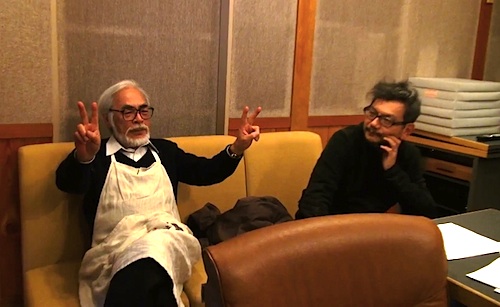
There are very few animated clips seen throughout Kingdom, which speaks highly of Sunada’s confidence in her subjects. It is justified. Miyazaki is a thoroughly engaging presence, as are longtime producer Ghibli producer-peacemaker Toshio Suzuki and Evangelion animator Hideaki Anno, who gave voice to The Wind Rises’ idealistic protagonist. Sunada documents some true cinema history, ultimately marking the end of an era. A fitting coda to a great career, The Kingdom of Dreams and Madness is recommended for all serious students of animation when it screens this Sunday morning (11/16) at the SVA Theatre, as part of DOC NYC 2014.

LFM GRADE: A-

Posted on November 11th, 2014 at 7:52pm.

Jason Momoa Smells Fresh Blood: LFM Reviews Wolves

By Joe Bendel. Evidently, werewolves can be as snobby as anyone. Sure, some humans are turned through bites, but hereditary lycanthropes look down their snouts at them. You will find a large concentration of pure-bred wolves in Lupine Ridge. It might look like hill country, but it is the Philadelphia Main Line for werewolves. It is there that Cayden Richards will go searching for answers in David Hayter’s Wolves, which opens this Friday in New York.

Richards never knew he was adopted until he heard it on the TV news. Having discovered his parents ripped apart wolf-style after an inconvenient black-out, it is now too late for him to ask them any questions. Resigned to live as a fugitive from justice, Richards simply roams the highways, trying to keep his inner beast in check. However, a chance encounter with Wild Joe, a fellow pure-bred werewolf outcast, points him towards Lupine Ridge.

As soon as he blows into town, he seems to rub Connor, the town’s alpha-male/alpha-wolf, the wrong way. However, a wiry old farmer by the name of John Tollerman offers to take him on as a farmhand, no questions asked. Even the television reports about Richards’ previous misadventures do not seem to throw the good-hearted Tollermans. Nor does it scare off Angelina Timmons, who ought to be too young to tend the bar she inherited if she is roughly as old as Richards, the high school senior-dropout. Of course, the authorities never come to Lupine Ridge, because aside from a few humans like Mrs. Tollerman, they are all werewolves.

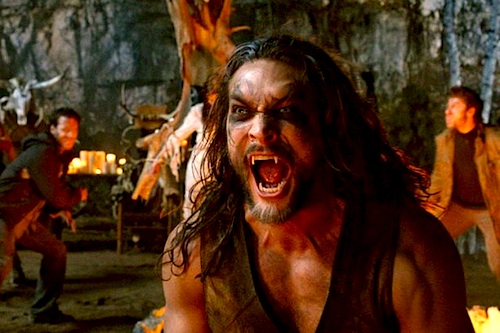
In terms of tone, Wolves aims to be something like the lycanthropic equivalent of The Lost Boys, with hit-or-miss results. On the plus side, Jason Momoa’s Connor makes a terrific hairy heavy and Stephen McHattie has the perfect Lance Henriksen-esque weather-beaten gravitas for Tollerson. Both come into Wolves with genre cred that they only further burnish.

From "Wolves."

The problem is that Lucas Till is horribly dull and awkwardly light weight as Richards. It is hard to see him as a high school quarterback—drama club president, maybe. Hayter had to notice how much verve Momoa and McHattie brought to the table (which they then proceeded to chew) and how slight Till’s presence is in contrast. Granted, dull horror movie heroes are a tradition dating back to mild David Manners in the original Dracula. However, in this case, the film depends on Richards’ fierceness, but it isn’t happening.

Despite the weak vanilla lead, there is a lot of fun stuff in Wolves. The werewolf makeup is not bad and the southern rock soundtrack nicely amplifies Momoa’s super-bad attitude. Unfortunately, too many of Till’s scenes feel like something out of Twilight instead of a werewolf movie with hair on its chest. If only there were less of him and more McHattie, but it is still kind of entertaining in a guilty pleasure sort of way. Recommended for fans of Momoa and McHattie, Wolves opens this Friday (11/14) in New York at the AMC Empire.

LFM GRADE: C-

Posted on November 11th, 2014 at 7:51pm.