He Cometh Anew: LFM Reviews Iceman

By Joe Bendel. He Ying is sort of a Ming era Austin Powers. The disgraced Imperial Guard certainly kicks things off in a similar fashion when he is re-animated amidst modern day Hong Kong. Just why a cabal of shady characters was ferrying about his incubator in the first place is a question that may or may not be answered in Law Wing-cheong’s Iceman, which opens this Friday in New York.

In 1621, He Ying was set up by his comrade Cheung and their sworn brothers Sao and Niehu dutifully believed it. Flashforward to modern Hong Kong, where the truck carrying He Ying, Sao, and Niehu’s cryo-pods meets with a freak accident. He is the first to awaken, but Sao and Niehu soon start tracking him. Initially just as confused by the plot as the audience, He falls in with May, a Mainland immigrant supporting her institutionalized mother as a club hostess. It turns out he happens to have some very valuable knick-knacks on his person that will help pay her overdue bills. He also has some highly motivated enemies on his tail. Further complicating matters, his old nemesis Cheung is apparently serving as the deputy police commissioner.

From "Iceman."

Loosely based on Clarence Fok’s The Iceman Cometh, Law’s Iceman features a couple of awesome action scenes, but they come amid an awful lot of fish-out-of-water dilly-dallying. One thing you won’t find in there is a sense of resolution. Instead, it ends with a tease for the forthcoming part two. Wisely, it promises more action, because the characters and humor of part one may not have a lot of fans clamoring for more.

Of course, Donnie Yen is awesome getting down to business, but he looks about as stiff as a four hundred year old warrior-cycle in his comedic scenes. Fortunately, the always reliable Simon Yam does his villainous thing as Cheung. Since Law is a Johnnie To protégé, you know it is only a matter of time before Lam Suet shows up. In this case, he largely steals the show as Tang, an outrageously crooked politician. Eva Huang Shengyi gives May a bit of an edge, which is nice, but Wang Baoqiang and Yu Kang are largely non-factors as the other icemen.

The big action set pieces will temporarily please genre diehards, but the humor just does not travel well. Still, hope springs eternal for part two. For part one, Yen and Lam fans can safely wait to rent, stream, or demand. Regardless, Iceman opens theatrically tomorrow (9/19) in New York at the AMC Empire.

LFM GRADE: C

Posted on September 18th, 2014 at 9:43pm.
Art and Action in Seattle: LFM Reviews Brush with Danger

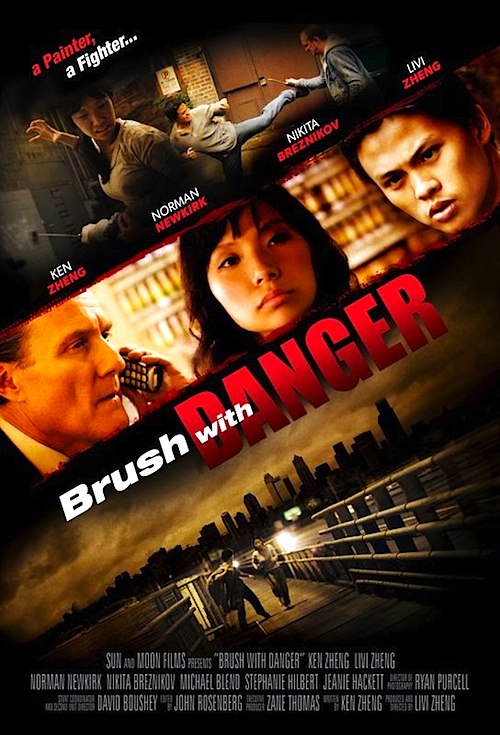
By Joe Bendel. These undocumented siblings do the sort of jobs native-born Americans just won’t do, like forging a Van Gogh and boxing in unregulated after hours bouts. To be fair, she is highly conflicted about the former, whereas he faces plenty of home grown talent in the latter. Their legal status is precarious, but their spirit is indomitable in Livi Zheng’s Brush with Danger, which opens this Friday in New York.

Alice and Ken Qiang were two of the lucky ones, who survived their cargo container transit to America. They came in search of a better life, but they also had to get out of Dodge fast. They have practically nothing to their names, except for some of her paintings that they will try to sell on the streets. They also have skills, which is part of the reason why they had to leave in a hurry. Yet, despite Alice’s reluctance, the Qiangs discover they can quickly fill a hat with their street displays of martial arts and acrobatics. Gallerist Justus Sullivan also notices them doing their act, but it is Alice’s work that really catches his eye.

Playing the role of patron, Sullivan moves the Qiangs into his McMansion, so Alice can finally live up to her potential. To keep Ken busy, Sullivan introduces the impetuous kid to his associate running Seattle’s underground fight circuit. Soon Ken is earning his own illegal spending money, fair and square. However, just when Sullivan asks if maybe Alice wouldn’t mind doing an extremely high quality reproduction—for a terminally ill friend, mind you—Det. Nick Thompson starts snooping around.

Brush is the directorial debut Livi Zheng, an Indonesian-born former stuntwoman and NCAA karate competitor. It does indeed have some of the roughness you might associate with first features, but she and her real life kick-boxer brother Ken are totally convincing in the action scenes. In spite of some narrative slack, Zheng keeps it well paced and Norman Newkirk adds some memorable villainous charm as Sullivan.

Frankly, the problem is it is all too nice. The Zhengs are hugely likeably rooting interests and former cop-turned-wrestler Nikita Breznikov is rather likable as Det. Thompson, in a doofus kind of way. Even Sullivan is kind of nice (although some of his angry associates are definitely not). Still, if you had to choose a movie bad guy to have lunch with, he should be at the top of the list.

So if everyone is nice, does that mean the movie is nice too? Unfortunately, that probably constitutes a fallacy of composition. Regardless, it is impossible to root against the Qiangs and the Zhengs, who are already at work on their next action picture. If they maintain their earnestness and add some narrative edge, they could really get somewhere. For now, Brush with Danger opens this Friday (9/19) in New York at the Cinema Village.

Posted on September 18th, 2014 at 9:42pm.

LFM Reviews Tombville @ The 2014 Fantastic Fest

From "Tombville."

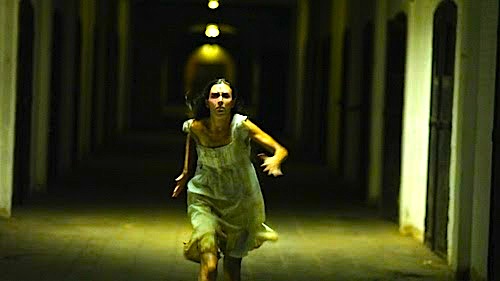
By Joe Bendel. If John-Paul Sartre rewrote Hostel, you sure wouldn’t want to be a character in it. Poor hapless David pretty much finds himself in that position. The horror is menacing and downright existential in Nikolas List’s Tombville, which screens sometime during the 2014 Fantastic Fest (where they don’t trouble themselves over bourgeois things like schedules).

Waking up barefoot with no memory, David is essentially trapped in a strange town, where the sun never shines. After a few vaguely hostile encounters, a cryptic figure reveals to the twentysomething that he will only be allowed to leave when he figures out why he is there in the first place. In between harrowing encounters, including one rather uncomfortable interrogation session, David starts searching his reawakened childhood memories for clues. Needless to say, there are usually very good reasons why the mind represses some incidents, but he seems to be on the right track when he discovers artifacts from his past in this eerie town.

Working with the barest of sets, List creates the most sinister mood and environment you will see on film in a month of Black Sabbaths. It is not a gore-fest or torture porn, but Tombville is still decidedly not for the fate of heart. We are talking dark here, in every sense.

Frankly, this is more of a sizzle-reel for what List and cinematographer Camille Langlois can do with a camera and a flashlight than an actor’s showcase. Still, Pierre Lognay certainly looks convincingly terrified and much abused as David. Frequent French screen heavy Eric Godon also makes a chilling villain, but it would be spoilery to explain how so.

Even though List has a somewhat experimental aesthetic and incorporates elements borrowed from westerns and psychological thrillers like Spellbound, Tombville is absolutely, positively horror. It runs less than seventy minutes, but it would be difficult to maintain such a malevolent vibe much longer. It is impressive work, recommended for hearty genre fans (instead of casual midnight movie dilettantes). It screens sometime over the coming week (9/18-9/25), when this year’s Fantastic Fest commences in Austin, Texas.

LFM GRADE: B+

Posted on September 18th, 2014 at 9:42pm.

Nick Cave Pushing 55: LFM Reviews 20,000 Days on Earth

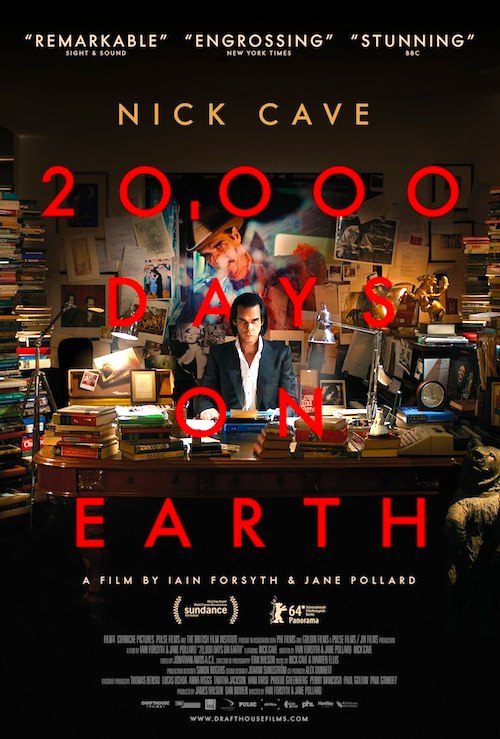
By Joe Bendel. As the reigning Poet Lauriat of hard rock, Nick Cave was the perfect voice to narrate Eddie White & Ari Gibson’s animated noir fable, The Cat Piano. He is also a screenwriter of some note, whose credits include John Hillcoat’s Lawless. The standard talking head and archival footage approach simply would not suffice for Cave, given his cinematic presence and relentlessly idiosyncratic aesthetic sensibilities. However, Ian Forsyth & Jane Pollard (with the knowing collusion of their subject) took an entirely different tact in 20,000 Days on Earth, which opened today at Film Forum.

Ostensibly, the filmmakers will follow Cave throughout what will be his 20,000th day of terrestrial life, but they are not slavishly attached to the conceit. Instead, they are content to follow Cave as he develops the next Bad Seeds album and confronts some of the ghosts from his past in eccentrically stylized dramatic interludes. Former Bad Seed Blixa Bargeld will reveal why he really left the band, which would be a bit of a dramatic letdown, if it did not segue into Cave’s somewhat neurotic theory of songwriting.

In these sequences, 20K is more like performance art than a documentary, providing a platform for Cave’s acting chops when he essentially plays himself. Kylie Minogue also gets into the spirit of things when her reminisces of their unlikely collaboration segue into a meditation on mortality (from the back-seat of Cave’s car, bringing to mind her strange appearance in Holy Motors). It is also appealing to watch the musical camaraderie shared by Cave and Warren Ellis, who clearly emerges as first among Bad Seeds not named Nick Cave.

It is hard to say whether 20K is better appreciated by Cave fanatics or newcomers arriving with a blank slate. This is absolutely not a greatest hits package, somewhat focusing on the creation of the Push the Sky Away album, but mainly just giving Cave a venue for his insights into the music-making process. Those who are interested in questions of method will find many of the sequences fascinating. It should also bolster the reputation of strict Freudian Damian Leader, who is not really Cave’s analyst, but elicits some vivid memories of the singer’s late father.

20K is about as multi-hyphenated as a hybrid documentary can get, but it keeps the stream of interesting stories flowing unabated. Ironically, Ellis probably has the most telling anecdote, suggesting the often violent spectacles that used to accompany Bad Seeds gigs were nothing compared to the force that was Nina Simone (just try to top her).

Yet, it must be granted Cave is enormously compelling appearing as himself, playing himself, or something like that. Fittingly, he now lives in Brighton, where he could pass for a gangster from Brighton Rock with dark suits and menacing swagger. It still seems to kill on stage and it works on camera surprisingly well. Highly recommended for those who appreciate meta-documentaries, 20,000 Days on Earth opened today (9/17) at New York’s Film Forum.

LFM GRADE: B+

Posted on September 17th, 2014 at 11:02pm.

Back When the Future was Groovy: LFM Reviews Space Station 76

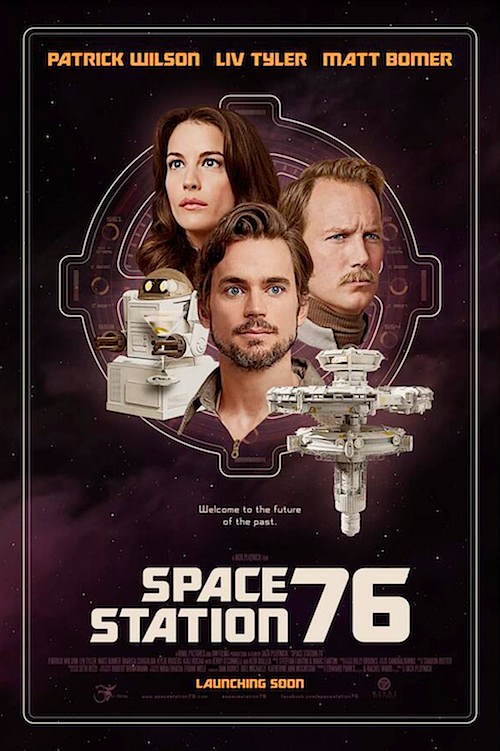
By Joe Bendel. In the 1970s, Skylab represented the future. Today, the International Space Station is an anachronism of the New World Order. Yet, even in the analog future as envisioned in the “Me Decade,” Omega 76 was a sleepy backwater assignment. They still ought to take asteroids more seriously in Jack Plotnick’s nostalgic Space Station 76, which opens this Friday in New York.

Omega 76 is a deep space refueling station, where the crew marks time until they are promoted to more prestigious postings. However, the previous first mate (if you will) was promoted suspiciously quickly. Whenever the obviously closeted Captain Glenn is asked about it, he always gives a slightly different answer. Not surprisingly, he is less than gracious welcoming his new first officer, Jessica Marlowe, who also happens to be a woman.

There is not much to do on Omega 76, so Marlowe is happy to spend time with Sunshine, the brainy young daughter of Misty, the pill-popping peak of the station’s social pyramid. Marlowe also ambiguously befriends Misty’s cuckolded technician husband, but both are too honorable to act on their mutual attraction. When not angsting over the state of her life, Marlowe tries to get Capt. Glenn to pay attention to the asteroid projections generated by her predecessor, but he wants nothing to do with anything associated with his former whatever.

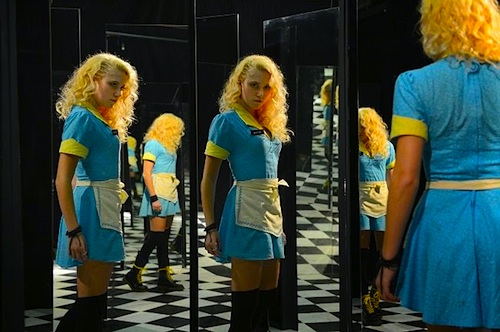
There is no question SS76 was handcrafted by true fans of vintage seventies-era science fiction. Seth Reed’s design team and costumers Sandra Burns and Sarah Brown have created some pitch perfect frocks, sets, and models. The vibe is spot-on, but somehow Plotnick and his quartet of co-writers forgot to include most of the jokes. Essentially, the film’s sequences are like most SNL skits from the last fifteen years. It is all set-up that just peters out without a punchline. At times, SS76 seems fatally determined to channel the spirit of 1970s relationship movies, like Bob & Carol & Ted & Alice, but they have already been better satirized by the criminally under-appreciated Serial.

Weirdly, SS76 represents the reunion of The Ledge co-stars Liv Tyler and Patrick Wilson nobody ever asked for. Needless to say, this is a vastly superior film than that misogynistic polemic disguised as an unthrilling thriller. Tyler is still rather stiff and distant as Marlowe (to put it generously), but Wilson’s Glenn is strangely compelling and ultimately sympathetic, if we adjust for 1970s cultural inflation. Marisa Coughlan and Kali Rocha also seem to enjoy vamping it up as Misty and her self-absorbed best friend Donna, which helps. Also look for none other than Keir Dullea, giving the film extra genre cred in a video-phone cameo.

SS76 is such a great concept, so aptly rendered by Plotnick’s technical collaborators, it is a shame there isn’t more humor or narrative muscle to go with it. Instead, he is content to stage one awkward conversation after another amid the terrific station backdrops. There are chuckles here and there (and the Todd Rundgren soundtrack is a blast), but viewers are really left to wonder what might have been. For diehard fans of Space: 1999 and the like, Space Station 76 opens this Friday (9/19) in New York at the Quad Cinema, with digital and DVD releases scheduled to follow shortly after.

LFM GRADE: C+

Posted on September 17th, 2014 at 11:02pm.

LFM Reviews The Guest

By Joe Bendel. The Petersons should have remembered what Ben Franklin said about fish and houseguests. Initially, the mysterious “David” is so handy to have around the house, he earns more than three days. Unfortunately, the suspicions of their twenty year old daughter will be fully justified in Adam Wingard’s The Guest, which opened today in New York.

When Caleb Peterson was killed in Iraq, it devastated his family, particularly his mother Laura. However, meeting “David,” Caleb’s freshly discharged friend and fellow squad member, offers her some consolation. Despite his humble origins, David is so faultlessly polite and gracious, she immediately invites the former soldier to be their guest, for as long as takes for him to get back on his feet. Her husband Spencer is rather put out by her impulsiveness, until he spends some quality drinking time with David. Soon only their daughter Anna remains uncomfortable with the arrangement.

Within the context of the film, it is easy to understand why the Petersons so readily embrace their guest, at the expense of common sense. After all, he seems to bring good luck. In reality, David starts clandestinely “lending a hand” to the Peterson family, doing the sort of things they always secretly wished would happen, but would never admit. Sometimes Wingard and his screenwriter collaborator Simon Barrett maintain some ambiguity, as to just what David did or did not do, but there is no question about his proactive approach to the high school bullies tormenting the youngest Peterson sibling. Even Anna warms to David, but plot contrivances will interrupt their mounting sexual tension.

The first half of The Guest is absolutely terrific, inviting viewers to vicariously enjoy David’s freelance friend-of-the-family activism. Let’s face it, there are times everyone wished they had a secret benefactor who could make troublesome people disappear, but without any knowledge or culpability troubling our consciences.

Frustratingly, much of what works in the first half is largely lost in the second. Instead of a Nietzschean super-man, we learn David is a veritable super-soldier, thanks to a clichéd top secret government program, following in the tradition of the Universal Soldier franchise and scores of similar b-movies. What was once a very sly thriller becomes a formulaic exercise in comeuppance for a Blackwater-like military contractor in a tiresome by-the-numbers endgame.

From "The Guest."

That is a real shame, because it squanders the intriguing performances and cleverly executed action scenes from the early acts. Formerly of Downton Abbey, Dan Stevens could not get any further from Cousin Matthew than the mysterious David, but he pulls it off (clearly after putting in his time at the gym). He commands the screen with his sociopathic charm. Frankly, his supposedly Kentucky accent often sounds weird, like he is speaking through a Vocoder, but it kind of works nonetheless. As Anna, Maika Monroe generates plenty of heat with Stevens, while maintaining a sense of propriety and intelligence.

The Guest has the right look and soundtrack to appeal to nostalgia for the 1980s action movies that inspired it. It is considerably more entertaining when it allows its title character to be a wildcard instead of a Terminator surrogate. Ultimately, it is a potentially great cult film that is undermined by a screenplay too intent on making statements. The first fifty or sixty percent will be recommended for genre fans when it eventually hits Netflix, but they should probably hold off when the whole uneven thing opens this Wednesday (9/17) in New York at the AMC Empire and Village 7.

LFM GRADE: C

Posted on September 17th, 2014 at 11:01pm.