LFM Reviews Baby Blues; Now Available on DVD & VOD

By Joe Bendel. Known as the “Hungarian Suicide Song,” Rezső Seress’s “Gloomy Sunday” has become the stuff of urban legend, but the only suicide that can be directly linked to it was that of its songwriter. That makes it quite an odd choice for a producer to update for the biggest star on his roster, but it was not entirely Hao’s idea. He had help from the devil doll left behind in his new home. The sinister ragamuffin will be a malevolent influence on Hao’s new family, especially his wife in Po-chih Leong’s Baby Blues, which releases today on DVD and VOD from Well Go USA.

Hao and his pregnant wife Tian Qing have just purchased a spectacular new home for a veritable song. The only drawback seems to be the homeless guy camped across the street, who is always yelling spooky warnings. For some reason, they hardly notice him, but she finds the creepy doll utterly charming. Unfortunately, it seems he is a “Jimi doll,” who drove the previous owners to bad ends. Even though accidents mysteriously follow Hao’s reworked song, now known as “The Intruder,” the mega-popular Ying Lan digs its edginess. Everything seems to be going right for the couple, until it is time to deliver her twins. Adam will make it, but Jimmy will not. However, this leaves a vacuum for the Jimi doll to fill.

Of course, the doctors assure Hao his wife is simply suffering from postpartum depression and perhaps he is, as well. Nonetheless, he and Tian Qing’s tomboy sister Trinket soon suspect something weirder is afoot. Eventually, they even start paying attention to the old cat’s jibber-jabbering.

Yes, Baby Blues owes an obvious “debt” to the Chucky franchise, but it actually has several additional supernatural hooks that often compete with each other. The “Gloomy Sunday” references are actually pretty clever and cool, while the recurring twin motif is rather creepy. Yet, all mixed together they collectively undermine what Poe called the “unity of effect.” There are also loose ends and blind alleys all over the place. Still, one would sort of like to see Keira Knightly and Adam Levine remake the film as “Can a Song End Your Life.”

Beyond the on-screen action, Baby Blues generated considerable interest as the first film co-starring real life couple Raymond Lam and Karena Ng. However, perhaps shrewdly, they do not share any romantic scenes as Hao and Trinket. Without question, Ng gets the better of the deal, proving well suited to the mettlesome sister. In contrast, Lam’s Hao is a bit wooden, saddled with the intuition of cold porridge. At least newcomer Janelle Sing goes nuts pretty convincingly, while Kate Tsui clearly enjoys preening through the film as Ying Lan.

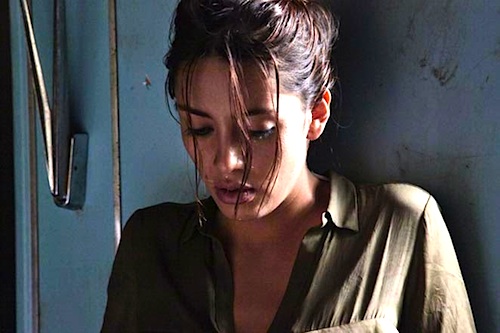
From "Baby Blues."

Baby Blues is also the British-born, Los Angeles-based Leong’s first HK production in two decades. It is odd choice of project to lure him back, but it was probably a guaranteed money maker. There are indeed some surprisingly big names attached to this straight forward genre outing, including Irene Wan, who makes the most of her third act near-cameo.

As horror films go, Baby Blues is certainly presentable. Genre fans will appreciate the ways it tweaks various conventions, but the killer doll effects do not meet the industry standard. Leong does not have a particularly strong feel for the requisite mood either, but the veteran cast knuckles down and powers through. The result is a mish-mash, but it has its moments. For fans of HK horror, Baby Blues is now available on DVD, Blu-ray, and VOD from Well Go USA.

LFM GRADE: C+

Posted on September 2nd, 2014 at 10:54pm.

LFM Reviews Cesare Mori; Now Available on DVD

By Joe Bendel. To this day, there is a reservoir of good will for Mussolini’s Fascist Party in Sicily, thanks in large measure to the “Iron Prefect.” Although he had a checkered personal history with the Fascists, he pursued the Mafia like an Italian Elliott Ness, getting better results for his efforts. After all, they do not give you a nickname like the Iron Prefect for nothing. Gangs will be busted but not permanently eradicated in the historical crime mini-series Cesare Mori, which is now available on DVD from MHz Networks.

Mori was a hard cop to kill. During his first posting in Sicily, he stepped on all the wrong toes pursuing the Carlino Gang and the murder of Count Chiaramonte. Mori succeeds in routing the Carlinos, perhaps too well, leaving a vacuum open for the Mafia factions responsible for the Chiaramonte homicide. Making a deal with the devil, the widow Elena Chiaramonte forges an alliance with the Mafia’s facilitators. She will regret this, but not before she supplies a bogus alibi to her husband’s murderer.

With his prosecution scuttled, Mori is promoted up and out of Dodge. In Bologna, he became the only Prefect to stand up to Black Shirt thuggery. Yet, Mussolini was still willing to return him to Sicily with greater authority when the Mafia’s power started to eclipse that of the state.

Without question, the most intriguing aspect of Cesare Mori the mini-series is Mori’s ambiguous relationship with Il Duce. Conveniently, the real life Mori died before the onset of WWII, so he cannot be implicated in any Fascist war crimes. Still, he was a Party member, who somehow made his peace with Mussolini. Clearly, Pietro Calderoni and his battery of co-screen-writers portray Mori’s fascism much like a reluctant Democrat assistant district attorney in Manhattan. He is keenly aware of the party’s corruption and incompetence, but it is the only game in town if he wants to pursue a career in justice.

On the other hand, the clunkiest storyline in Mori involves Saro, an orphaned mobster’s son temporarily adopted by the Moris until the ambitious future Don Tano Cuccia re-establishes the Mafia’s custody. Watching his high-strung wife pine for the ingrate Saro gets old fast. The production is also rarely helped by Pino Donaggio’s overwrought music, which makes several perfectly respectable dramatic scenes sound and feel unnecessarily melodramatic.

Still, Vincent Pérez (probably best known for the “red cloak” scene in Queen Margot and succeeding Brandon Lee in The Crow: City of Angels) is suitably commanding as Mori. He can also ride a horse, which is important. Evidently, Mori preferred to make his entrances on horseback rather than clambering out of an auto, to cut a more imposing figure with the criminal element. When he swaggers and seethes, Mori works quite well.

From "Cesare Mori."

Comedic actor Adolfo Margiotta is also surprisingly effective as his deputy, Francesco Spanò, who turns out to be more serious and competent than his hound dog looks suggest. As the Countess, Gabriella Pession generates some flirtatious heat with Pérez, but she is saddled with a problematic character that spends most of the decades-spanning production kidding herself about the state of her affairs.

Mori is a fascinating historical and television figure, whereas Saro is just rather sorry. In fact, it is hard to watch Cesare Mori without analyzing what its respective depictions of Mori, Mussolini, and the Mafia say about current Italian attitudes. In fact, it might be controversial with some audiences because dead-ringer Maurizio Donadoni’s portrayal of Il Duce is unflattering on balance, but not so very different from your average politician on the make. Despite its flaws, director Gianni Lepre keeps the 200 minute mini moving along briskly, while Pérez’s performance provides a steely anchor of conviction. Recommended for fans of gangster dramas with minor aesthetic reservations, Cesare Mori is now available on DVD from MHz Networks.

LFM GRADE: B-

Posted on September 2nd, 2014 at 10:53pm.

LFM Reviews Blemished Light @ The 2014 Portland Film Festival

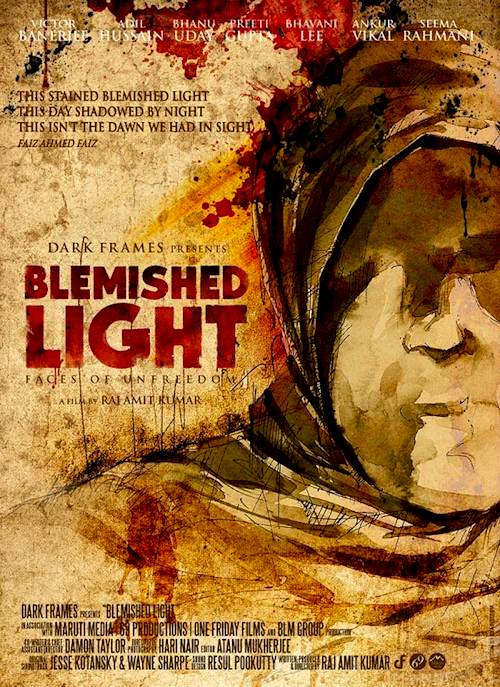
By Joe Bendel. The Indian subcontinent is a fractious, factionalized region, but the criminalization of homosexuality is an unfortunate constant. Of course, there are violent extremists who seek to further impose their strict Islamist agenda on those they deem unbelievers or apostates. In his split narrative following a closeted lesbian’s desperate attempt to find love and a Muslim terrorist stalking a moderate academic, director-co-writer Raj Amit Kumar issues a plea for tolerance and civility, but finds little of either in Blemished Light, which had a special midnight screening at the 2014 Portland Film Festival.

Leela Singh is the apple of her senior police officer father’s eye, but she simply cannot submit to the proper marriage he has arranged for her. The doting but stern Devraj will be scandalized when he learns Singh is a lesbian, who intends to win back her former secret lover, Sakhi Taylor, a bi-sexual Indian-American artist. Taylor holds a downtown hipster image of herself, but she still cares about how she is perceived in Indian society. Their reunion will be uneasy, but for Singh the die is already cast, thanks to the video confessional she left for her father.

Meanwhile, Mohammed Husain has arrived in New York for a grim mission he whole-heartedly embraces. He has been chosen to abduct and execute Fareed Rahmani, a prominent proponent of a more liberal vision of Islam. In his frequent media appearances, Rahmani argues true Muslims do not go about killing people. Husain intends to demonstrate otherwise, but first is supposed to extract a confession of heresy.

While the two discrete storylines never intersect, they are highly compatible thematically and make it difficult to dismiss the film as mere “Islamophobia.” Clearly, Kumar and co-writer suggest prejudice based on religion, gender, and sexual orientation is an issue endemic to the region that transcends demographic categories.

Blemished also benefits from the imprimatur of the legendary Victor Bannerjee (best known in the West for A Passage to India and several Satyajit Ray films), whose mastery of his craft remains unabated. As Rahmani, he fully humanizes the potential martyr figure (in an uncorrupted sense of the term), ultimately delivering a devastating punch to the viewer’s gut. In contrast, Adil Hussain’s Devraj Singh is appropriately intense and decidedly disturbing, credibly laying the groundwork for some otherwise unfathomable choices as a father. Bhavani Lee also demonstrates future star power potential and a vivid screen presence as the complicated and contradictory Taylor.

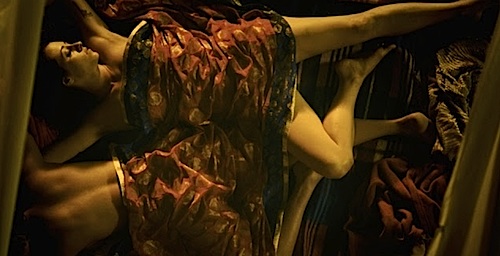
From "Blemished Light."

This is a film rich in telling scenes, such as the stilted interactions between Husain and his Americanized support network, many of whom seem to be trying to preserve their plausible deniability. There are issues here and there, including an underdeveloped subplot involving Singh’s pregnant platonic girlfriend and an excursion into surreal imagery that looks quite striking but clashes with the overall tone of social realism. However, the film’s visceral immediacy demands an audience.

Inspired by the verse of Pakistani poet Faiz Ahmad Faiz, it is a bold and bracing film, featuring an extraordinarily compelling and humanistic performance from Bannerjee. Highly recommended for his fans and patrons of accessible Indian Parallel Cinema (or high-end Bollywood), Blemished Light is sure to generate controversy as well as a long life on the Indian and LGBT festival circuits following its special screening at this year’s Portland Film Festival.

LFM GRADE: B+

Posted on September 2nd, 2014 at 10:52pm.

The Man, The Miniseries: LFM Reviews Houdini on The History Channel

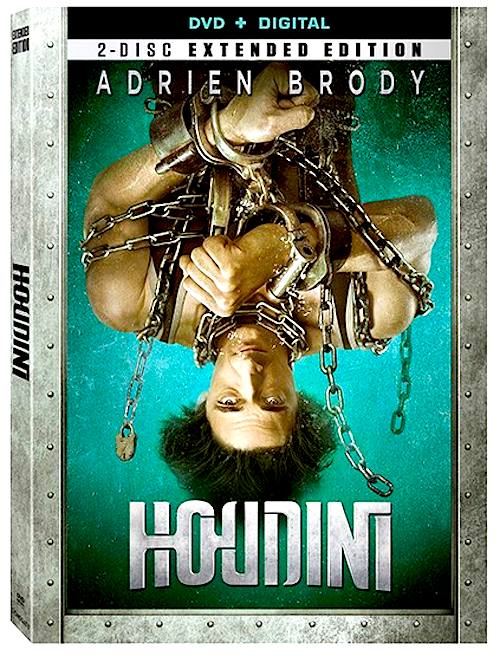
By Joe Bendel. He collaborated with H.P. Lovecraft and became the sworn enemy of Sir Arthur Conan Doyle. In the nearly eighty-eight years since his death, nobody has approached Harry Houdini’s fame and accomplishment as an illusionist and escape artist, while perhaps only the Amazing Randi has equaled him as a debunker of psychic phonies. Yet, despite some vintage stills and a brief flirtation with those new-fangled moving pictures, his live performances were almost solely the stuff of memory. Yet, the fascination with Houdini persists. The man in chains takes center stage once again when the two-night miniseries Houdini premieres this Labor Day on the History Channel.

As we meet young Erik Weisz (soon to be Ehrich Weiss and eventually Harry Houdini), it is clear he is a mother’s boy, with deep-seated father issues. These themes will constantly return over the two nights like swallows to San Juan Capistrano. Due to his youthful confidence, the future Houdini is convinced his facility for magic tricks will bear great fruit eventually. Naturally, he spends years scuffling, but at least he meets his future wife Bess through those down-market gigs. However, when Houdini’s handcuff escape starts generating buzz, he re-invents himself as an escape artist and his career ignites.

Screenwriter Nicholas Meyer (The Seven Percent Solution novel and screenplay) takes viewers on a mostly breezy jaunt through Houdini’s colorful life, largely sticking to the facts, or in the case of Houdini’s supposed work with the American and British Secret Services, well reported suppositions. Whether it is true or not, Tim Pigott-Smith looks like he is having a ball playing British spymaster William Melville, the original “M.” It is also allows for some entertaining intrigue, as when Houdini thoroughly befuddles the Czar and his fellow faker, Rasputin.

The second night is necessarily darker, progressing as it must towards the inevitable, with the bulk of the drama devoted to Houdini’s drive to debunk false mediums using parlor tricks to fleece the grieving. There is very little that could be considered truly genre-centric in the séance sessions, but the trappings will still have a bit of appeal to fans.

Although he is considerably taller than the spark-pluggish Houdini, Adrien Brody’s gaunt, sad-eyed persona fits the escape artist rather well. He also looks like he put in the time when it came to the crunch sit-ups. As Bess, Kristen Connolly’s earthy energy plays off him well, even if their chemistry is a little flat. While he has little dramatic heavy lifting to do, Evan Jones’s earnestness also wears well on Jim Collins, Houdini’s assistant and chief co-conspirator.

There are a lot of fun sequences in Houdini (the disappearing elephant is particularly well staged), but the visually stylized punch-to-gut symbolic motif is way over done and the effects look terrible on screen. Still, the mini addresses Houdini’s Jewish heritage in respectful, sympathetic terms, which must have been a strange change of pace for director Uli Edel, whose highly problematic terrorist apologia Baader Meinhof Complex suggests killing Jews is nothing to get upset about.

Fans with a checklist will be able to tick off just about all of the iconic escapes, from straightjackets to milk cans. Overall, it is a nice blend of fact-based fiction and somewhat more fanciful speculation. However, it feels slightly stretched to cover two nights. Recommended for admirers of Houdini the performer and scourge of spiritualists, Houdini the mini-series airs this Monday and Tuesday night (9/1 & 9/2) on the History Channel.

LFM GRADE: B

Posted on August 29th, 2014 at 12:22pm.

LFM Reviews Road to Ninja: Naruto the Movie

By Joe Bendel. Naruto Uzumaki is a lot like your classic adolescent fantasy protagonist, but the trappings are ninja-related rather than the stuff of sorcery and knight errantry. Growing up as an orphan, he is rash on the outside and sensitive on the inside. Even though fans know his creation story quite well, it will be revisited in detail and perhaps even altered when the junior ninja finds himself whisked into an alternate world in Hayato Date’s Road to Ninja: Naruto the Movie, which opens this weekend in New York.

Uzumaki’s father and mother bravely sacrificed their lives defending Konohagakure from the rampaging Nine-Tailed Demon Fox. Even though his parents are immortalized on the village’s Rushmore-like monument, Naruto is often shunned because they were forced to mystically seal the demon within him. Naruto is usually a pretty plucky kid, but he is going through a rough patch, making the absence of his family particularly acute. In contrast, his crush-rival Sakura Haruno is feeling especially embarrassed of her intrusive, ultra-square parents.

However, before you can say “alternate Star Trek universe,” the malevolent Tobi traps them in the Tsukuyomi world, based largely on their deepest subconscious desires. Much to their surprise, Haruno is now the celebrated orphan of the village heroes, while Uzumaki’s parents are alive and well. Instead of martyrs, they are workaday ninjas and loving parents (who insist on calling him Memna rather than Naruto). Everything looks the same, but most of their friends have reversed their primary character traits. In a way, this makes Road an easy series entry point, since most of the backstory no longer applies.

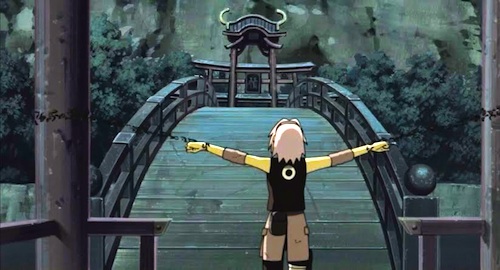
From "Road to Ninja: Naruto the Movie."

The Naruto franchise is classified as Shōnen manga, which usually means a lot of fighting. Road is no exception, but its themes of sacrifice and parental love give it more Capra-esque sentiment than you might expect. Since it was plotted out by series creator Masashi Kishimoto, you know it is legit. It is a rather self-contained story arc, but it arguably offers fans greater character development. Frustratingly though, like many anime features, the big showdown relies on a lot of flash-and-dazzle spectacle that largely becomes a blur of fireballs and fix-demons. It would be more effective to bring things down to a more personal level, like Mel Gibson and Gary Busey duking it out on Danny Glover’s front lawn.

Under Kishimoto’s watchful eye, Date and company maintain the franchise’s quality control. In fact, there are some great images of Konohagakure and its environs, evoking Edo-era Japan and Tolkien-like fantasyscapes in equal measure. There is more heart to Road than you usually find in well established warhorse properties, which might be why it is the Japanese box-office’s top performing Naruto feature thus far. Nevertheless, it requires a predisposition to teenaged ninjas and all the angst and combat they face. Solidly executed but probably not crossing over from the fan zone, Road to Ninja: Naruto the Movie screens this coming Sunday (8/31) and Monday (Labor Day, 9/1) in New York at the Village East. For a complete list of cities and dates, check the Eleven Arts website here.

LFM GRADE: B-

Posted on August 29th, 2014 at 12:11pm.

LFM Reviews The Damned

From "The Damned."

By Joe Bendel. When you see a little girl in a horror movie, run for all your lungs are worth. Unfortunately, the Reynolds family does not realize they are in a fright flick. Sure, they are stranded in an old decrepit hotel in the middle of nowhere, but they are initially too preoccupied with their passive aggressiveness in Victor García’s The Damned (a.k.a. Gallows Hill), which opens this Friday in New York.

Following his wife’s death, David Reynolds’ relationship with his daughter Jill has been strained. She makes no secret of her lack of enthusiasm for his upcoming marriage to Lauren and receives plenty of encouragement for her petulant acting-out from her hot aspiring journalist Aunt Gina. Determined to drag her back to America for the wedding, the Reynolds must take a major detour to retrieve her passport, because roaming around Colombia without papers is such a good idea for international travelers. Of course, a torrential storm and a highway mishap forces them to take refuge in an ominous boarded up resort that now only houses creepy old Felipe and the little girl he has locked in the basement cell.

When they inevitably discover innocent looking Ana Marie, he warns them not to listen to her evil lies, but they do. Needless to say, Felipe is soon proved correct. It turns out the spirit of a witch executed on Gallows Hill was possessing his daughter and is now out for revenge against the descendants of her executioners.

At first, The Damned looks like a Colombian riff on Charles Beaumont’s classic “Howling Man” Twilight Zone episode, but it also takes elements from Gregory Hoblit’s underrated Fallen and gives them a good twist. In fact, the whole system of possession is a rather clever bit of horror movie mechanics. However, the film’s best asset is the incredibly eerie setting. Unlike the Stanley, this is one movie hotel horror fans will not want to visit.

From "The Damned."

Twilight vampire franchise survivor Peter Facinelli is pretty solid as the exasperated father. He makes a convincing couple with Sophia Myles, who adds some welcome grace and class as the eternally understanding Lauren. On the other hand, Nathalia Ramos’ constantly pouting quickly makes Jill a tiresome eye-roller, while Colombian superstar Carolina Guerra is almost distractingly sultry as Aunt Gina, the supposedly scuffling reporter.

Thanks to cinematographer Alejandro Moreno and production designer Asdrúbal Medina’s team, The Damned is a fine example of how much visual style and ambience can add to horror film. Although García and screenwriter-co-producer Richard D’Ovidio never reinvent the supernatural wheel, they keep it spinning quite effectively. Recommended with confidence for genre fans, The Damned opens this Friday (8/29), late night, at the IFC Center and is currently available on IFC Midnight’s VOD platforms.

LFM GRADE: B

Posted on August 27th, 2014 at 9:11pm.