LFM Reviews Snowpiercer

By Joe Bendel. In the future, the world will become a giant allegory. Nothing in this claustrophobic dystopia performs a practical purpose, but serves as a vision of class warfare at its most extreme. At least it all looks cool when the train’s tail-section revolts in Bong Joon-ho’s first English language production Snowpiercer, which opens this Friday in New York.

Seventeen years ago, a climate control experiment went horribly wrong. Now that the Earth is a frozen wasteland, the only surviving humans live in the protection of the globe circling train providentially prepared by the mysterious Wilford. However, instead of assigning productive tasks to each survivor, the Wilford express maintains a rigid and bafflingly bizarre social caste system. The further up you travel, the richer, crueler, and idler the passengers get. It’s all sushi and filet mignon up front, but gelatinous protein bars for the proletarian in the tail-section, who do not really appear to work either, but just sit around waiting to be beaten by the guards (apparently the train’s only productive class).

Curtis Everett has emerged as the leader of the proles in the back of the train, whether he likes it or not. He is still haunted the things he did during his darkest, most desperate hours, but old Gilliam provides encouragement and wise counsel to the budding revolutionary. Everett is biding his time, waiting for a cue from a source ensconced somewhere further up the train, but the arbitrary ruthlessness of Minister Mason, a buck-toothed caricature of an elitist exploiter, forces his hand. Freeing Nam-gung Min-su, the drug-addled Korean security specialist who designed the train’s door locks, and his train-born daughter Yo-na, Everett and his followers plan to fight their way to the engine room. Stopping anywhere short of that will doom their revolt.
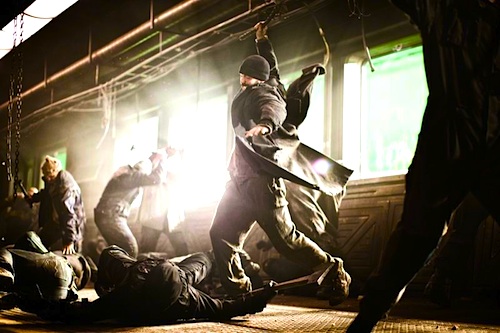
From "Snowpiercer."

Frankly, Snowpiercer is even less subtle than it sounds. Tilda Swinton is a great screen thespian, but her portrayal of Mason is embarrassingly cringey. She is also emblematic of the film’s fundamental problem—this simply is not a believable world. People act mean and savage for no logical reason accept to live up to a class-based stereotype. Nonetheless, production designer Ondřej Nekvasil and art director Štefan Kováčik created a distinctively detailed calling card that ought to earn them a gig on the next Terry Gilliam or Tim Burton film.

If you prefer your movie leads on the sullen side then you will probably be okay with Chris Evans’ turn as Everett. He is a brooding machine, but looks respectable during the well-staged action sequences. John Hurt’s Obiwan shtick also works well enough for Gilliam the sage. However, the only real surprises found in the film come from the characters of Nam-gung Min-su and Yo-na—as well as the respective performances of Korean superstar Song Kang-ho and Ko Ah-sung, his juvenile co-star in The Host. Viewers should keep their eyes on this tandem, because together they nearly redeem all of Snowpiercer’s flaws.

Uncut by the Weinsteins, Snowpiercer is so didactic it will give intellectually sophisticated viewers a headache. Yet, there are fascinating Easter Eggs buried throughout it, thanks to a skilled design team and Bong’s Host alumni. Diverting for those who appreciate spectacle and mayhem, but disappointing on any deeper level, Snowpiercer opens this Friday (6/27) in New York at the Angelika Film Center.

LFM GRADE: C

Posted on June 25th, 2014 at 11:06pm.
Singing Freely in Estonia: LFM Reviews To Breathe as One

To Breathe as One – Film Trailer from Maureen Tusty on Vimeo.

By Joe Bendel. Every five years, Estonia mounts a massive chorale festival called Laulupidu. Do not expect to hear “The Internationale” on the program anytime soon. Traditionally more than a concert, Laulipidu provided a venue for several extraordinary spontaneous acts of defiance during the Soviet years. Today, it continues as a symbol of Estonian freedom and a celebration of its culture. It is a big deal for the small number of international choirs that are invited to participate. For the Piedmont Children’s Choir, it will also be a world-expanding learning experience. With co-directors Bestor Cram and Mike Majoros, Singing Revolution filmmakers James and Maureen Castle Tusty return to Laulupido to follow the Piedmont choir’s journey in To Breathe as One, which premieres on PBS World Channel this Friday.

As the Tustys documented in their previous film, even a heavily armed police state cannot silence thirty thousand voices singing in harmony. Frankly, the Estonians never fully submitted to their Communist occupiers. When cracks started appearing in the Iron Curtain, Estonia’s chorale tradition played a critical role in unifying the renewed resistance. It is an inspiring story chronicled with sensitivity and authority in the Tustys’ The Singing Revolution, but they also provide a fine abridgment in Breathe.

The members of the Piedmont performance ensemble (predominantly high school and perhaps some middle school students) will come to appreciate that history as they learn their Estonian repertoire. The conscientious efforts of their director Robert Geary to connect the difficult pronunciations to their deeper cultural and historic meanings clearly bear fruit. In fact, they probably understand Baltic history better than most of our current foreign policy decision-makers (sadly, a pathetically low bar to clear).

A great deal of Breathe captures the Piedmont Choir’s person-to-person diplomacy, as they befriend and perform with their Estonian counterparts rather easily. It might sound pleasant but rather precious, in a “human interest” kind of way. However, the striking scale of the Laulupidu backdrop is not just photogenic. It provides a constant reminder of the wider significance of the festival.

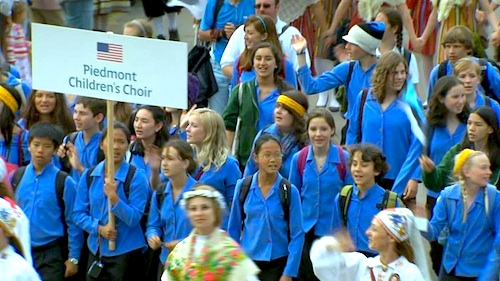
From "To Breathe as One."

Even if you do not think chorale music is your bag, the performances at Laulupidu will make the hair on the back of your neck stand on end. You can literally hear one hundred fifty years of tumultuous history crescendoing in triumph over their Czarist and Communist oppressors. It is also a timely reminder of the precariousness of liberty, particularly in light of Putin’s expansionist ambitions. Does anyone seriously think the Obama administration has a plan of response should the Russians move against our Baltic NATO allies?

While they stand alone, the macro Singing Revolution and micro Breathe would be even better viewed in tandem. Both films are highly recommended for students, but Breathe will likely be somewhat more accessible for young viewers. A must-see for lovers of freedom and chorale music, To Breathe as One airs this Friday (6/27) on PBS World Channel.

LFM GRADE: B+

Posted on June 23rd, 2014 at 11:00pm.

The Angela Mao Ying Collection: LFM Reviews Stoner

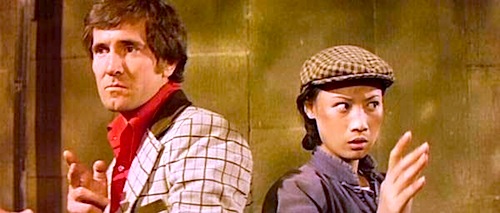
By Joe Bendel. Which is more deadly, Angela Mao Ying’s hapkido or George Lazenby’s mustache? It had better be Mao, because the one-and-done Bond eventually shaves his ‘stache to throw off the bad guys. It is all part of the sex-and-drugs-and-martial arts glory of Feng Huang’s Stoner, which is included in The Angela Mao Ying Collection now available from Shout Factory.

Joseph Stoner is an Australian cop, whose girlfriend was deliberately hooked on a new form of sexually-charged heroin in retribution for his relentless investigations. Sometimes they also say he is American, but that would make him one of those Yankee coppers that drive on the left side of the road. Either way, it’s not worth getting hung up on.

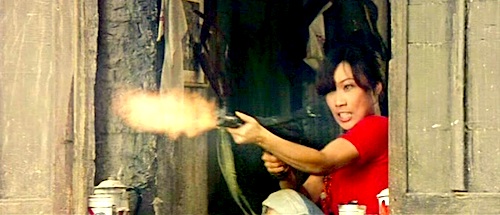
Angela Li Shou-hua is also a cop, who has been sent undercover into Hong Kong from Taiwan to investigate the mysterious syndicate that keeps buying creaky decommissioned freighters at auction for ridiculous prices. They are both investigating the same outfit, but drug lords have no idea the shy young immigrant selling sodas on a desolate stretch of beach is actually a lethal martial artist.

However, they see Stoner coming from a mile away and put Agnes Wong Yen-yen, their designated femme fatale, on the case. After a contrived meeting, they capture a blackmail shot of Stoner in bed with Wong. Yet, it really doesn’t seem to bother him because, A: it’s the 1970s and B: she’s hot.

In fact, you really cannot get much more 1970s than this. Supposedly, the bare bones of Stoner were originally conceived as a vehicle for Bruce Lee and Sonny Chiba, but the latter dropped out after the former’s tragic death. Frankly, it is impossible to glean much of the initial concept from the final film that is Stoner. The irony further compounded with the casting of Betty Ting Pei (in whose apartment Lee somewhat scandalously passed away) as the temptress Wong.

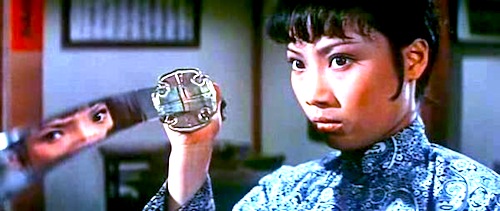
From "Stoner."

Add in an incredibly funky soundtrack and some wild psychedelic interludes (that go on much longer than they should, because they are designed to accommodate bare breasts) and you have cult movie gold. Believe it or not, Stoner is not a perfect film. Huang keeps his co-leads plugging away separately for way too long and he somewhat favors the title character over Mao’s Li. Still, it is wildly entertaining when they take on the collected bad guys (while Stoner fights off a dose of horndog H).

As usual, Mao throws down with grace and authority, just generally commanding the screen in all respects. It is important to remember the love-him-or-hate-him Bond also had skills, which is why the Broccolis hired him in the first place. Ting adds some smart, saucy smolder as Wong and you knew Sammo Hung had to be in here as one of the chief henchmen.

This is the sort of film you can watch over and over and over again. The normal critical standards do not apply—it just delivers. Highly recommended for fans of Mao, Ting, Hung, and Lazenby (you know who you are), Stoner is now available on DVD as part of Shout Factory’s Angela Mao Ying Collection.

LFM GRADE: A

Posted on June 25th, 2014 at 10:54pm.

Bio-Pic Number #1: LFM Reviews Yves Saint Laurent

By Joe Bendel. He was the first fashion designer to be given his own exhibition at the Metropolitan Museum of Art and was recently the subject of a comprehensive retrospective at the Denver Art Museum. However, Yves Saint Laurent did not always act in a manner appropriate for such hallowed institutions. Jalil Lespert gets the first crack at dramatizing Saint Laurent’s storied career and chaotic private life with Yves Saint Laurent, which opens this Wednesday at Film Forum.

Lespert’s treatment reaches international audiences before Bertrand Bonello’s even more simply titled Saint Laurent (sort of like the competing Ip Man films), but they are both trailing Pierre Thoretton’s should-have-been-better documentary, L’Amour fou. Like Thoretton, Lespert set sail with the blessing of Saint Laurent’s longtime life partner, business fixer, and co-collector Pierre Bergé. Ironically, this seems to have given Lespert considerable license to explore some of the darker corners of the designer’s psyche.

We meet Saint Laurent as an earnest young French Algerian, who is too delicate for a settler’s life, but still considers Algiers as French as the Champs-Elysees. Soon he relocates to Paris, working his way up the design ranks at the house of Dior. When it is time for Saint Laurent to strike out on his own, it will be Bergé who raises the necessary funds. As the responsible one, Bergé will also patch Saint Laurent together after his various breakdowns. Yet, despite his efforts, keeping Saint Laurent away from the temptations of fast living becomes a full time losing battle.

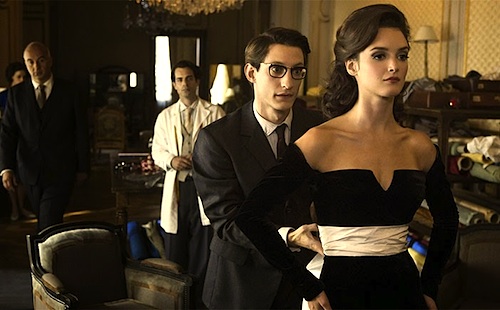
While Lespert offers up plenty of Saint Laurent’s dark nights of the soul, he still knows what most patrons want from a movie like this: pretty clothes and pretty people. Thanks to the YSL archive and Charlotte Le Bon appearing as Saint Laurent’s former favorite model Victoire Doutrelaeu, Lespert’s film has plenty of both. In fact, Le Bon adds a wonderfully melodramatic edge to the proceedings.

Laura Smet is also nicely decorative as Doutreleau’s replacement, Loulou de la Falaise, but she is just overwhelmed by the psychedelic trappings of the late 1960s-early 1970s era. Frankly, the same largely applies to Lespert’s ostensive lead, the feather-light and paper-thin Pierre Niney (of the Comédie Française). Perhaps by design, his Saint Laurent is largely a cipher, unto which everyone else projects the YSL they need or want.

From "Yves Saint Laurent."

Somewhat logically given Bergé’s support, Saint Laurent’s long suffering partner emerges as the emotional center and dramatic anchor of Lespert’s bio-pic. Guillaume Gallienne (also of the Comédie Française) is terrific balancing the YSL CEO’s jealousy and wounded pride, as well as resoluteness and maturity. It really is Bergé’s film and Gallienne carries it, accordingly. In fact, you have to give the real life Bergé credit for having the guts to throw China’s human rights record back in its face when they demanded the return of two Winter Palace bronzes he put up for auction as part of the collection he amassed with Saint Laurent.

There is plenty of scandal and heartache in Lespert’s YSL, but it is a rather pleasant viewing experience thanks to his light touch and spritely pace. Ibrahim Maalouf’s upbeat soundtrack, stylishly mixing elements of jazz and 1960s pop also provides a key assist, as well as one of the film’s most accomplished creative collaborators, Italian alto and tenor saxophonist Stefano di Battista. It all looks and sounds great, which its subjects would most certainly appreciate. Recommended for fans of high fashion and fashionable House of Eliott-style drama, Yves Saint Laurent (the first one) opens this Wednesday (6/25) at New York’s Film Forum.

LFM GRADE: B

Posted on June 25th, 2014 at 10:48pm.

The Angela Mao Ying Collection: LFM Reviews A Queen’s Ransom

From "A Queen’s Ransom."

By Joe Bendel. In 1975, Hong Kong was a Crown Colony that wanted to stay that way. Therefore, do not expect them to have much sympathy for an Irish assassin. The HK police will do everything in their power to protect the Queen during her royal visit, but they are already stretched thin dealing with the massive influx of immigrants from Vietnam and Cambodia. There is also some business about a gold shipment in Ting Shang-hsi’s A Queen’s Ransom, which is included in The Angela Mao Ying Collection now available from Shout Factory.

Poor police chief Gao already has more than he can handle, but when Jenny the bargirl’s tip regarding a Filipino client pans out, he assigns Det. Chiang to watch over her. She is relentlessly cute, but also ethically flexible, so it is not just for her protection. It turns out her thuggish customer is part of a team recruited by IRA splinter-group leader George Morgan to assassinate the Queen during her state visit.

Meanwhile, in what seems like an entirely different film, a former Cambodian princess has arrived in a refugee camp, where she stoically accepts her fate. She hardly ever speaks, but she still has her dignity and martial arts skills. The latter will come as quite a surprise to Ducky, the working class HK laborer who befriends her.

Ransom was clearly conceived as an HK version of the 1970s Alistair MacLean film adaptations that usually featured dozens of tiny little boxes of cast photos running across the bottom of their one-sheets. True to form, Ting compulsively introduces new characters throughout the film. Yet, somehow he successfully ties up all his rangy subplots, but not exactly with an elegant knot a salty seafarer would admire.

Frankly, the first two acts are somewhat slow and the interconnectedness of many scenes is not readily apparent. However, it provides an intriguing time capsule of mid-1970s Hong Kong. As go-go as times then were, it probably still seems quaint to residents of today’s mega-mega HK. Ting also cleverly integrates archival footage of both the Queen and the real life refugee camps.

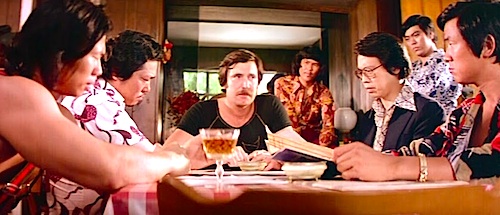
Just as notable is the assembled rogues’ gallery of evil, which one would not even see in American films of the era. In addition to his IRA roots, Morgan hires Jimmy, an HK expat who had become a specialist in guerilla warfare with the North Vietnamese. Like a good Viet Cong, he is only interested in money. Morgan also recruits an African American clearly inspired by the Black Panthers. To create sexual tension Judith Brown (a women-in-prison cult movie favorite) duly taunts him into some rough sex as Black Rose. However, the most ideologically driven members of the gang are unquestionably are the Japanese Red Army terrorists, who also turn out to be the dumbest.

From "A Queen’s Ransom."

At least Ransom finally delivers a showdown between George Lazenby and Angela Mao. Without question, it is the best choreographed fight of the film. Mao still brings all kinds of grace and presence as the Princess, but Ting criminally under-employs her. During Stoner, his previous Golden Harvest film, George Lazenby was clearly inspired to hold up his end by Mao and their fight choreographer-co-star Sammo Hung. In contrast, here he mostly just seems to be playing out the string as Morgan. Even legend-in-the-making Jimmy Wang Yu’s namesake seems a bit lost in the convoluted backstories and digressions. Still, there is no denying future HK horror maven (Tanny) Ni Tien lights up the screen as Jenny.

Ransom is an odd mishmash of elements, but it is likely to excite the curiosity of HK film fans. It is not a great showcase for Mao, but it is not a bad filler film to go along with more representative outings like the seriously cool Broken Oath, so it is sort of recommended as part of the value-packed Angela Mao Ying Collection, recently released by Shout Factory.

LFM GRADE: C+

Posted on June 25th, 2014 at 10:42pm.

The Angela Mao Ying Collection: LFM Reviews When Taekwondo Strikes

By Joe Bendel. Where could you find a heroic film treatment of a European Christian missionary? Hong Kong in 1973. Father Lewis (Lu Yi) is a true humanitarian who supports Korea’s aspirations for liberation. Unfortunately, the Japanese occupation does not cotton to his interference and acts accordingly. However, his allies are not nearly so prone to turn the other cheek. Angela Mao will get some serious retribution in Feng Huang’s When Taekwondo Strike, which is included in The Angela Mao Ying Collection now available from Shout Factory.

Wan Ling-ching is Chinese, but she has always identified with her oppressed Korean comrades. She can also fight, but her hapkido is different from the taekwondo practiced by Li Jun-dong, the leader of the local resistance. Li has masqueraded as the good Father’s servant, but the jig is up. Initially, the Imperial enforcers are a bit circumspect dealing with Father Lewis for fear of antagonizing his embassy, but then they realize that he is French and proceed to torture him with impunity. Things really look bad when Li is also captured, but Wan tries to keep his hot-headed apprentice and Mary, the Father’s kung fu kicking nun-niece, focused and together.

Taekwondo is a rather fascinating manifestation of Angela Mao’s international superstardom, obviously produced with an eye towards the Korean market. In addition to the setting, it is the only martial film starring taekwondo grandmaster Jhoon Goo Rhee (dubbed “the Father of American Taekwondo”), who is all kinds of steely awesome as Ji. Mao’s Wan is also terrifically cool, charismatic, and lethal. Unfortunately, throughout Strikes, they are surrounded by spectacularly bad decision-makers with insufficiently established motivations, especially the rather dazed looking Anne Winton as Mary. She’s got the moves, though, as we would expect from “Jhoon’s best student,” as the trailer tells us.

From "When Taekwondo Strikes."

Indeed, what Strikes does well, it does tremendously well. That would be the fight scenes choreographed by Chan Chuen and Sammo Hung, who naturally appears as a Japanese enforcer. The climatic all-hands-on-deck throw-down is a massively satisfying genre pay-off that will have fans yelling and cheering at the screen.

Even though Mao shares the beat-down duties with Rhee quite equally, her star-power is clearly driving the bus. If you are looking for straight forward adrenaline-charged martial arts with a few awkward line-readings, it is tough to beat. It is also rather strangely in-line with the recent bumper crop of WWII-era anti-Japanese action films coming out of the Chinese language territories these days—aside from the sympathetic portrayal of western Christians. Recommended for fans of Mao and Hung, When Taekwondo Strikes is now available on DVD, as part of The Angela Mao Ying Collection.

LFM GRADE: B

Posted on June 25th, 2014 at 10:37pm.