LFM Reviews The Casimiro Effect @ The 2014 Brazilian Film Festival in New York

From "The Casimiro Effect."

By Joe Bendel. They appreciate an excuse to party in Brazil, especially when it comes hot on the heels of the military regime’s fall from power. First contact would certainly fit the bill. Clarice Saliby chronicles the would-have been close encounter that turned into a gathering in the short documentary, The Casimiro Effect, which screens during the 2014 Brazilian Film Festival in New York.

After years of military authority, the Brazilian media apparently threw out their filters and ran any story that caught their fancy. As a result, a rather rustic gentleman in Casimiro de Abreu got tremendous pick-ups claiming his was the aliens’ advance man. Supposedly, they were coming to Casimiro at an appointed hour. He could even predict some cosmic activity, claiming it was alien reconnoitering.

So what happened? Every Brazilian with a guitar packed up their VW van and headed to Casimiro. Obviously, the aliens never came but it was a heck of a party. Saliby tracks some of the leading witnesses of the party-slash-hoax, who try to keep the extraterrestrial dream alive, but give us a break. Who needs aliens if you have good music?

Even if it takes itself a tad too seriously, Effect is entertaining time capsule, capturing a moment in Brazilian history when hope and joie de vivre were looking for any old outlet. The alien mythology will also interest genre diehards, adding another incident to their grand conspiracy theories. Recommended for fans of UFO Hunters and wild parties in general, The Casimiro Effect screens this coming Monday (6/2), before the feature The Invisible Collection, at the Tribeca Cinemas, as part of this year’s Brazilian Film Festival in New York.

Posted on May 29th, 2014 at 9:08pm.

Revisiting Camp Restrepo: LFM Reviews Korengal

By Joe Bendel. Stationed in a remote outpost in the Korengal Valley dubbed Camp Restrepo (in honor of a late, beloved medic), the men of the Airborne Brigade’s Battle Company, 2/503 were supposed to be the tip of the spear for the American military in Afghanistan. However, in 2010, the administration decided the spear no longer needed a tip and closed all the American outposts in the deadly Korengal. Through new interviews and previously unseen footage, Sebastian Junger revisits the men featured in his Academy Award nominated documentary Restrepo, analyzing the impact of war on those who fight it in Korengal, which opens this Friday in New York.

Tragically, Junger completed Korengal without his late partner Tim Hetherington, who shot his share of the footage and served as co-director of Restrepo and the subject of Junger’s elegiac tribute documentary, Which Way is the Front Line from Here? In fact, they had always planned a more reflective companion film to Restrepo that would allow audiences to become better acquainted with the men of Battle Company.

So now that Restrepo has been decommissioned, do they miss it? More than you might think. War can be shocking and profoundly unfair, as Junger’s first film with Hetherington documents, but it can also be bracing. Nothing clears the head like a morning fire fight, especially for the athletically inclined. (In a rueful aside, one Airborne infantryman casually observes the Korengal mountain ridge would be “sports paradise” were it not for all the warfare going on.)

However, Junger will not allow ideological viewers to conveniently dismiss the men as adrenaline junkies. That might play a part in their adaptation to the harsh duty conditions, but the men form a strong camaraderie with one another and consciously shield their loved ones from the realities of their service as best they can. They also develop unromanticized opinions of the assorted clan leaders operating within the Korengal. Frankly, they probably have a much better understanding of the country than their current civilian leadership (not that that is a particularly high standard to surpass). Indeed, they sound remarkably grounded, all things considered, despite all they have witnessed.

It is very clear why Junger made his Afghanistan films, including Front Line. They vividly capture the soldiering experience, very definitely including the sudden loss of a brother-in-arms. However, it is fair to wonder what was the purpose of the events they documented, if the strategy can be reversed at the drop of a hat? To Junger’s credit (and Hetherington’s too), the films scrupulously avoid politics, but once the house lights come back up, we exit into a political world.

Always fair to the men who appear in it, Korengal covers the full gamut of human emotions, while opening a window into one of the least forgiving corners of the world. Recommended for general audiences, perhaps even more highly than Restrepo, Korengal opens this Friday (5/30) in New York at the Landmark Sunshine.

LFM GRADE: A-

Posted on May 27th, 2014 at 2:03pm.

The Latest from Manoel de Oliveira: LFM Reviews Gebo and the Shadow

By Joe Bendel. Reportedly, Raul Brandão’s 1923 play was a strong influence on Samuel Beckett’s Waiting for Godot, but it will strike most contemporary viewers as being downright Dickensian. Regardless, probably no filmmaker is better suited to adapt it for the screen than 104 year old Manoel de Oliveira. He was around when it premiered and has seen its critical reputation evolve over time. The dean of world cinema continues to polish his craft with Gebo and the Shadow, which opens tomorrow at the Anthology Film Archives.

This is the part of the review where we all marvel at Oliveira’s productivity and longevity. Pushing 105, Oliveira has multiple projects in development and at this point there is no reason to doubt he will see them through. Given the exquisite elegance of The Strange Case of Angélica (which hit theaters when Oliveira was the tender age of 102), we can also expect them to be quite good. While Shadow is a relatively minor work, it clearly shows the hallmarks of a master at work.

Old Gebo should be retired by now, but he labors on as a debt-collecting clerk for his callous employers. He has no choice. Gebo is the sole support of his beloved wife Doroteia and daughter-in-law Sofia, since his son João absconded eight years ago, under ominous circumstances. Gebo struggles to preserve the illusion João might someday return to protect Doroteia’s fragile psyche. Yet, he fears their son’s homecoming might lead to more harm than good, should it actually come to pass. Unlike Godot, the prodigal (the metaphoric shadow of the title) will indeed suddenly darken Gebo’s door at the end of the first act.

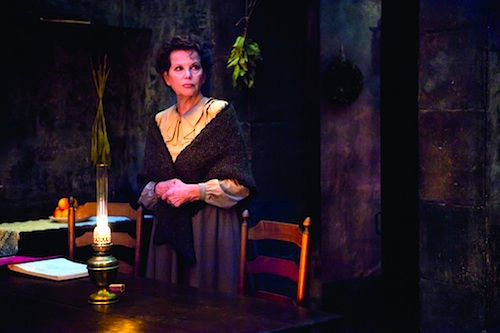
Claudia Cardinale in "Gebo and the Shadow."

Shadow’s theatrical roots are highly conspicuous, but Oliveira tries to make a virtue of its staginess—for understandable reasons. He might be 104, but Micheal Lonsdale looks at least that old as the much abused Gebo. It is a striking performance, marked by palpable physical exhaustion and acute world weariness. Yet, it is his tender moments with Leonor Silveira as the sensitive Sofia that really give the film its soul. Claudia Cardinale is perfectly fine as the high strung Doroteia, but it is not a great showcase role. For further art house appeal, Jeanne Moreau makes her presence deeply felt when appearing briefly as the mystical neighbor, Candidinha, like the veteran screen diva she is. In contrast, Ricardo Trêpa is rather stiff and shrill as Dostoyevskian João.

Oliveira and cinematographer Renato Berta absolutely love the soft, smoky light given off by the era’s oil lamps. The entire film glows like the chiaroscuro of the Old Masters. At times, Oliveira tries to enhance the mystery surrounding João, the shadow, but he still maintains an overriding mood of melancholy. Despite the big name international cast, Shadow is a small film in the grand scheme of cinema history, but it certainly demonstrates Oliveira can still do his thing. Respectfully recommended for those who appreciate chamber dramas, Gebo and the Shadow opens tomorrow (5/28) in New York at the Anthology Film Archives.

LFM GRADE: B-

Posted on May 27th, 2014 at 2:02pm.

America’s Most Famous Jewel Thief: LFM Reviews The Life and Crimes of Doris Payne

By Joe Bendel. To be a jewel thief, you have to talk the talk and walk the walk. Even though Doris Payne was born into a life of poverty and segregation, she never had trouble passing for an elegant society lady. Criminals also have a saying about not doing the crime if you can’t do the time. She takes issue with that one. Nonetheless, she finds herself on trial facing a de facto life sentence in Matthew Pond & Kirk Marcolina’s The Life and Crimes of Doris Payne, which opens this Wednesday at Film Forum.

Doris Payne has been doing this for sixty years. It is easy to forgive, or even applaud her first score, perpetrated solely to finance her mother’s escape from her abusive father. Initially, she capitalized on the “invisibility” of an African American woman from clerks eager to wait on presumably more affluent customers. However, she soon adopted the role a woman of means and position, literally taking her act global.

Some of Payne’s exploits would sound fanciful if she did not have the arrest records to prove them. She has seen the insides of many a prison cell in several countries, but somehow providence always intervened. Unfortunately, providence seems to be running late at her current trial.

Frankly, there is a bit of a disconnect between the heists Payne gleefully describes and her protestations of innocence this time around. Essentially, she falls back on snobbery as a defense, claiming she would never steal from such a gauche store as Macy’s. Yet, from time to time, Pond & Marcolina catch her playing them. As charming and innocent looking as Payne might be, viewers will eventually understand that truth is a movable goalpost for her.

Arguably, Pond & Marcolina could have and should have challenged her more in their interview segments, but it is clear they preferred to print the legend, for good reason. There is something very appealing about Payne, the international woman of mystery, romancing Damon Runyonesque accomplices and evading the Swiss police (all of which is true). We want to enjoy her adventures, investing them with the spirit of a racially conscious Raffles, so it is hard to fault the filmmakers for not following up with the various sales associates who might have been fired or the smaller stores that might have been shuttered due to increased premiums and loss of valuable inventory. Nonetheless, the absence of such deeper digging is conspicuous.

Still, by doc standards, Life and Crimes is unusually entertaining, even when Payne’s sociopathic tendencies peak through. Pond & Marcolina keep the pace brisk, getting a nice assist from Mark Rivett’s retro-groovy score. When it’s over, audiences will definitely keep their hands firmly on their wallets as they file out of the theater. Recommended for fans of true crime and too-true-to-believe documentaries, The Life and Crimes of Doris Payne opens this Wednesday (5/28) at Film Forum.

LFM GRADE: B

Posted on May 27th, 2014 at 2:01pm.

LFM Reviews The Infinite Man @ The 2014 Rooftop Films

By Joe Bendel. Do not expect Somewhere in Time or any Rachel McAdams time travel film. An obsessive compulsive scientist will invent a means of jumping through time to win back his girlfriend, but he, or rather different versions of himself, will sabotage his efforts at every turn. The time paradoxes will compound massively and it will all be his collective fault in Hugh Sullivan’s The Infinite Man, which screens this Friday, summer-style under the stars, as part of the 2014 season of Rooftop Films.

Dean probably loves Lara too much. For their anniversary, he takes her back to the tucked away motel where they spent their last anniversary, intent on recreating every last detail. Unfortunately, the motel has since been shuttered, throwing quite a spanner in the works. Lara also resents his habitual need to plan and relive the past. Initially, she tries to be a good sport, but when her crude ex-boyfriend crashes the party, the festivities completely bottom out. Through an odd chain of events, the miffed Lara ends up leaving with Terry the hothead.

For an entire year, Dean holes up at the abandoned inn, licking his wounds and perfecting his time travel device. On the day of their former anniversary, Dean convinces Lara to go back in time with him, so they can undo their past mistakes. Of course, this is easier said than done. In fact, Dean will make this trip several times, as he struggles to win Lara back from other versions of himself.

Infinite is a little slow out of the blocks, but it has to establish at least one straight lap around Dean’s year at the motel, before it starts turning everything inside out. Once it gets going, it’s off to the races. With each successive go-round, Sullivan completely changes the context of every scene, showing us what is now also happening simultaneously outside our prior field of vision.

It is an exceedingly clever screenplay that required very little special effects, beyond the trick photography allowing Dean to talk to other Deans. Still, the basic choreography determining who goes where when is rather impressive.

Frankly, Josh McConville is so cringey as Dean, it pushes viewers away during the set-up rather than pulling us in. Still, he creates a distinctively neurotic portrait and doggedly stays in character. He also has some very effective scenes playing with and off himself, so to speak. Hannah Marshall is a good sport as Lara, nicely maintaining the ambiguities in each scene while staying in the (ever recurring) moment. Although it is a small role, Alex Dimitriades brings several shots of energizing madness to the film as Terry.

Infinite is not quite as wildly entertaining as Nacho Vigalondo’s Timecrimes but it constructs a similarly dazzlingly complex time-bender narrative, with hardly any visible seams. Richly inventive, it is smart science fiction rendered on a very human scale. Recommended with enthusiasm, The Infinite Man screens Friday night (5/23) in Gowanus, Brooklyn, presented by Rooftop Films.

LFM GRADE: B+

Posted on May 23rd, 2014 at 12:05pm.

LFM Reviews Frequencies

By Joe Bendel. If a name conveys a child’s future potential then Marie-Curie Fortune’s is indeed apt. Conversely, Isaac Newton Midgely is more of a Midgely than a Newton. The slogan of their near futuristic world is “knowledge is destiny,” but in practice your bio-metric “frequency” really determines your lot in life. Midgely will try to alter his hard-coded destiny in Darren Paul Fisher’s Frequencies (a.k.a. OXV: The Manual), which opens in New York this Friday, hitting iTunes the day before.

Sort of like The Force or just plain luck, one’s frequency measures how well you fit into the world around you. Someone with a high frequency is never late or klutzy. Everyone responds to them positively. However, Fortune’s abnormally high frequency almost entirely crowds out her capacity for emotions. In contrast, Midgely is a genius, but he has a negative frequency. Whenever they meet at school, sparks fly, much in the manner of matter encountering anti-matter. Things become so chaotic a sixty second limit is imposed on their presumably random meetings. Of course, Midgely happens to be smitten with Fortune, who sort of leads him on, out of scientific curiosity and a lack of empathy.

Flashing forward to adulthood, we find Midgely still has not gotten over Fortune, but he may have developed a means of moderating frequencies, with the help of his old school chum, Theodor Adorno Straus. By lowering her frequency, Fortune is finally able to take pleasure from life. She even thinks she has fallen in love with Midgely, but when the nature of Straus’s breakthrough device becomes apparent, all bets are off.
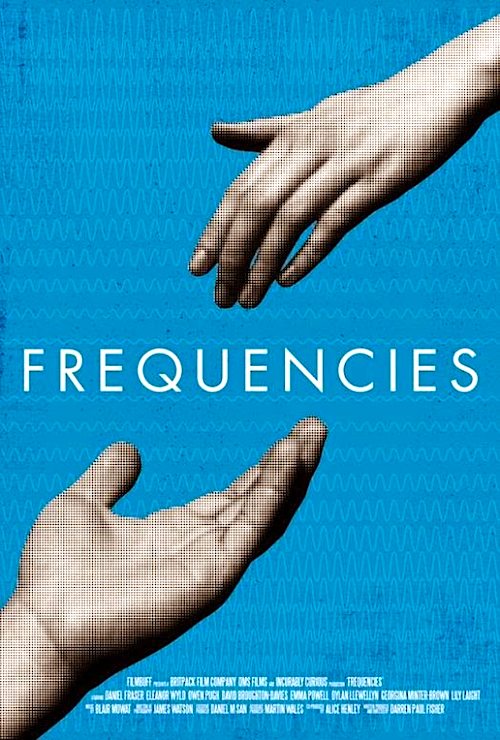
Many decent genre films are built around a good gimmick, but become increasingly conventional as they progress. Frequencies is the rare film that begins with an intriguing Macguffin, the social predetermination of frequencies and Midgely’s attempt to change them, but morphs it into something even bigger and archetypal, uniting science fiction and fantasy, while raising the stakes for everyone.

Granted, post-Tarantino, temporal shifts are annoyingly over-used and often distractingly unnecessary, but Fisher’s triptych structure heightens the significance of each big revelation. This is a film with genuine logical integrity that fits together remarkably well. Those familiar with the Marxist sociologist Adorno’s boneheaded criticism of jazz might have a leg up discerning his namesake character’s ultimate significance. Regardless, Frequency’s combination of social science fiction and philosophical inquiry set it worlds apart from most star-crossed love stories.

As the teen-aged Fortune and Midgely, Georgina Minter-Brown and Dylan Llewellyn give remarkably assured performances. Although we cannot properly call it chemistry (given the circumstances), the way they play off each other totally pulls the audience in. Fortunately, they have nearly as much screen time as their adult counterparts, who are the film’s real weak link. Their drab lack of charisma might make sense in the case of Daniel Fraser’s Midgely, but it leads to credibility problems in the case of Eleanor Wylde’s Fortune. Fortunately, some key supporting players help carry them, especially David Broughton-Davies as the mysteriously wise Mr. Straus. Keep your eye on him.

It would be spoilery to explain why, but Frequencies is also a wonderful valentine to classical music. Smart and engaging, it is one of those inventive science fiction films that have no need of splashy effects or fancy set pieces. Instead, it relies on the power of its ideas (how novel). Highly recommended for science fiction fans and musicians, Frequencies opens this Friday (5/23) at the Cinema Village and will be available from iTunes on Thursday.

LFM GRADE: A-

Posted on May 19th, 2014 at 12:07pm.