LFM’s Govindini Murty at The Huffington Post: Talking With Director Steven Knight About His Innovative and Enthralling Film Locke

[Editor’s Note: the post below appeared this week at The Huffington Post.]

By Govindini Murty. Locke may just be one of the best films of 2014. Superbly written and directed by Steven Knight and featuring a dazzling performance by Tom Hardy, Locke is a must-see for anyone who believes that human character is still the most compelling subject of the cinema. I saw Locke earlier this year when it played to rave reviews at Sundance, and spoke with Knight about his innovative and deeply personal film which is expanding this week to theaters nationwide.

In the film, Tom Hardy plays construction engineer Ivan Locke, a man who takes as much pride in the firm foundations of his buildings as he does in his unshakeable code of personal responsibility. One night, Locke leaves a construction job to drive from Birmingham to London to fulfill a mysterious promise. Along the way, he makes and receives a series of wrenching phone calls that bring his sense of personal duty into conflict with everyone and everything he loves.

I’m a big fan of films that use new digital tools to experiment with the traditional structure of the movies. , Locke succeeds at being both formally inventive and emotionally gripping. The entire movie, with the brief exception of the opening and closing shots, takes place in the interior of a car and features only one actor on-screen, Tom Hardy. At the Sundance premiere of Locke, director Steven Knight told me that he and his talented team used Red digital cameras to shoot the film continuously from beginning to end each night, like a stage play.

Stripped down to the bare essentials as a result, Locke focuses on what matters most: character, emotion, and story. The film proves that even in the contemporary cinema, with its obsession with surface visual effects, movies can still delve below the surface and capture something essential about human nature in much the same way literature can.

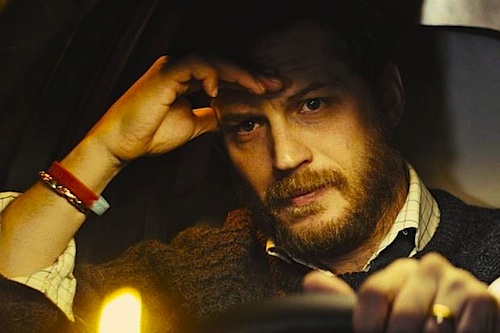
In Locke this is largely done through the power of the close-up. In the best movies, the close-up serves to bring emotional transparency to a film, whereby the candor of an actor and the attentiveness of a director work together to draw out the inner life of a character onto the big screen. And it’s there on the big screen that the human face takes on mythic qualities, elevating specific human experiences into universal truths. On the big screen there’s no place to hide as an actor – but if one is as talented as Tom Hardy, one doesn’t need to. Hardy sensitively pulls off Ivan Locke’s volatile and heartbreaking mixture of machismo, passion, humor, anger, and doubt – depicting Locke like a bear trapped in a cage of his own making.
2014-05-08-Locke1.jpg
From "Locke."

I spoke with Steven Knight (Academy Award nominated screenwriter for Dirty Pretty Things) at the Sundance premiere of Locke and asked him how he pulled off such a technically complicated and emotionally wrenching film. The interview has been edited for length.

GM: I’d like to ask you about the innovative way you made the film. Why did you choose to do such a tight character study and film it in these continuous takes? Tell me about your process.

SK: I just finished making a film with Jason Statham the conventional way [2013’s Redemption]. And two things occurred. One was: anything we shot from the car at night was beautiful, and I thought the thing to do would be to make an installation of that – make it as a piece of art with just the moving traffic patterns.

And then, I also asked the question of myself: the basic task here is to get a lot of people into a room, turn the lights off, and get them to look at a screen for 90 minutes. That’s the basic job you’re doing. [But] are there other ways of doing it? So I thought that maybe that beautiful frame of the moving road could be the theater. And … it would need to be one man, and if you’re going to get one man, it better be Tom Hardy. So I approached him and I said I want you to do a play, effectively. I want to shoot it as a play, but in the environment of a car. He was really keen, read the script and the next weekend we were shooting it. The whole point all the way through was to shoot it in sequence so that it’s an actor’s performance. Don’t split it up, don’t turn it into a conventional way of shooting it. And I think the rewards are immense, because the actors feel like they are in control of their own performances. Continue reading LFM’s Govindini Murty at The Huffington Post: Talking With Director Steven Knight About His Innovative and Enthralling Film Locke
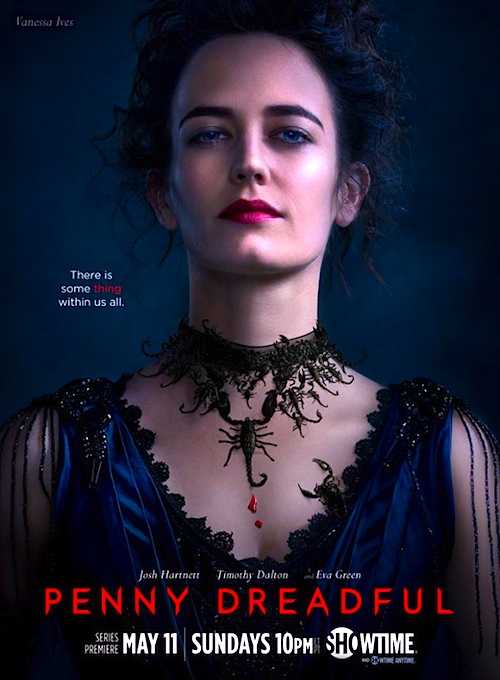
Victorian London by Night: LFM Reviews Penny Dreadful on Showtime

By Joe Bendel. George Sanders played Dorian Gray for MGM, so he never could have guest-starred in one of Universal’s multi-monster meet-ups. Showtime’s newest series hints at what strange cinema that might have been. It also makes you wonder how anyone survived Victorian London, with its vampires, re-animated corpses, and generally unsanitary living conditions. The former will be the most pressing issue in the first two episodes of writer-creator John Logan’s Penny Dreadful, which premieres this Sunday.

When a mysterious woman offers American Wild West performer Ethan Chandler some “night work,” he agrees, because she is played by Eva Green. Unfortunately, it turns out turns out she really needs his sharpshooter skills. Vanessa Ives and Sir Malcolm Murray require some back-up when they venture into a vampire’s lair, in search of his long missing daughter. Frustratingly for them, the search will continue, but at least Murray recruits an intense young anatomist to perform all his vampire autopsy needs: Victor Frankenstein.

Needless to say, what Chandler witnesses is a bit unsettling. It is the sort of thing that requires a lot of binge drinking to process in episode two. Proceeding accordingly, Chandler makes the acquaintance of Brona Croft, an Irish working girl, who will soon count Dorian Gray as a client. Since this is premium cable, Gray and his appetites will clearly be supplying most of the sex and nudity quota each week.

Representing a quarter of Dreadful’s initial eight episode run, “Night Work” (currently available online) and “Séance” are definitely hooky-grabby and absolutely loaded with macabre atmosphere. Helmed with style by J.A. Bayona (director of The Orphanage), they get a lot of mileage from their classic horror tropes. In a few cases, you basically know what is coming, but jump anyway. However, the second episode is further distinguished by the titular séance, which gives Green an opportunity for a massive William Shatner level freak-out. It is not quite at the level of Isabelle Adjani’s supernatural paroxysms in Possession, but that will probably be never be equaled by anybody.

For the most part, Green does her slinky, smarter-than-thou thing and it works like a charm. Timothy Dalton, the criminally underappreciated Bond (after all, Pierce Brosnan succeeded him and we know how that worked out), is appropriately steely as Murray, with a spot of mature dash. While not exactly a naturally strong screen presence, Henry Treadaway’s Frankenstein compensates with plenty of twitchy scenery chewing. Frankly, Josh Harnett broods rather effectively as Chandler, but the jury is still out regarding just what Reeve Carney’s Gray brings to the party. Conversely, even though we hardly meet him in the first two installments, Danny Sapani is clearly poised to become a potential fan favorite as Murray’s imposing majordomo.

It feels like Dreadful will soon be a binge-watching favorite, making good on the unfulfilled promise of the Van Helsing film. With Skyfall’s Sam Mendes on board as executive producer, it has the quality period trappings of BBC historicals, but its heart is closer to late period Hammer films. So far, so good, Penny Dreadful is definitely recommended for vintage horror fans, when it premieres tomorrow (5/11) on Showtime.

LFM GRADE: B+

Posted on May 10th, 2014 at 11:09am.

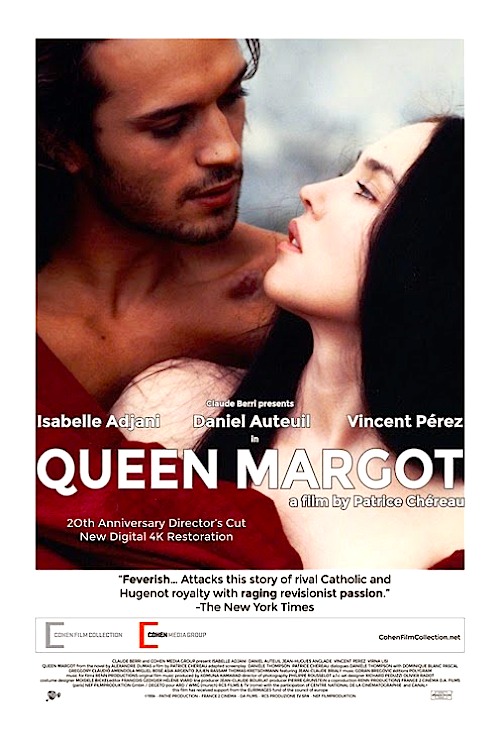
LFM Reviews The Newly Restored Queen Margot

By Joe Bendel. Think of it as a Sixteenth Century Game of Thrones without the fantasy elements. For first act starters, viewers will meet a queen engaging in truly eyebrow-raising affairs and witness a bloody wedding massacre. France’s religious wars vividly rage in a new 4K restoration of Patrice Chéreau’s Queen Margot director’s cut, which opens this Friday at Film Forum.

Marguerite de Valois is Catholic, but you would hardly know it from her behavior. Notorious for her indiscretions, Margot is less than thrilled with her arranged marriage to the Protestant Henry de Navarre. Supposedly, their union will bring peace in their time, but nobody really believes that—least of all Navarre. Although he has tacitly agrees not to pursue consummation, he visits her on their wedding night anyway, hoping to forge an alliance. Frustrated by the encounter, Margot secretly leaves the palace, seeking a masked distraction. She finds it with La Môle, a destitute young Huguenot with a distant family connection to King Charles IX’s Protestant military advisor.

A mere six days after the ceremony, as Paris sleeps off its revelries, a sudden crisis culminates in the St. Bartholomew’s Day Massacre. Ostensibly ordered by the submissive King, the deadly business is planned by Margot’s mother, Catherine de Medici, and executed by her ambitious brothers. More out of defiance than principle, Margot manages to save both her husband and her lover, but becomes a de facto prisoner of the palace as a result. Much intrigue will follow.

Queen Margot is one of the great modern historicals. This is not a polite drawing-room story of men in tights and women in ruffled collars. While boldly operatic in sweep, Chéreau has an eye for grimy naturalistic details. He also serves up generous helpings of blood and sex. Twenty years later, his St. Bartholomew’s Day sequence remains an overwhelming example of bravura filmmaking. As sheer spectacle, it is an orgiastic maelstrom of confusion and violence that has yet to be equaled on-screen.

Although a good twenty years older than the young Margot, Isabelle Adjani still looks the part, rocking the low cut wardrobe and scorching up the screen during her love scenes. Ironically, she has better screen chemistry with Daniel Auteuil as her (mostly) platonic husband Navarre than Vincent Pérez’s La Môle. Similarly, Pérez comes across somewhat boy-toyish when playing opposite her, but his scenes with Claudio Amedola as Coconnas, his sworn Catholic rival, crackle with heat and archetypal significance.

When Queen Margot was originally released, the shockingly serpentine-looking Virna Lisi received the lion’s share of the film’s award attention—and she is rather chilling. Yet, in retrospect, the young Asia Argento often steals the show as Charlotte de Sauve, one of de Medici’s spies, who falls in love with her target: Navarre.

As is sometimes the case, Queen Margot is better cinema than a French history lesson. When adapting Dumas père’s fictionalized novel, Chéreau and co-writer Danièle Thompson frequently chose to print the legend rather than the fact. If you want dry dates and details, google the characters. For those who prefer to sink their teeth into a big, lusty, pungent costume drama, the restored director’s cut of Queen Margot opened today (5/9) in New York at Film Forum.

LFM GRADE: A-

Posted on May 9th, 2014 at 11:59pm.

One Jesse Eisenberg Too Many: LFM Reviews The Double

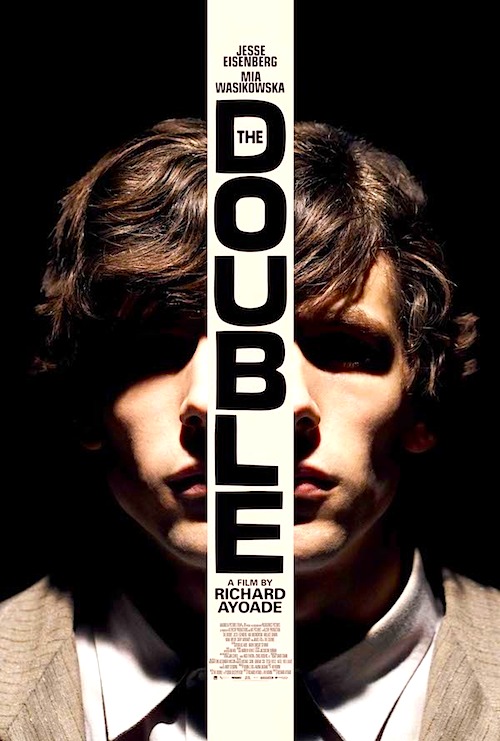
By Joe Bendel. It was Nabokov’s favorite Dostoevsky work, but he might not have recognized this vaguely British, boldly dystopian adaptation. Simon James is about to meet a new co-worker with a familiar face, who will turn his drab little life upside down in Richard Ayoade’s The Double, which opened today in New York.

James is a mousy Winston Smith toiling away in a soul-deadeningly bureaucratic data processing firm. He works like a mule producing mountains of reports, but the boss, Mr. Papadopoulos, constantly belittles him, never even properly remembering his name. Simon James initially befriends James Simon, his relentlessly confident doppelganger, even completing his paper-pushing assignments in exchange for advice on wooing Hannah, a pale young woman in the copy department. Even though she lives across the courtyard from his Soviet-style apartment building, she has only the barest awareness of James’ existence.

Naturally, Simon soon starts pursuing him for his own satisfaction, while insidiously undermining James’ already tenuous position with the company. As the put upon James’ Orwellian world becomes increasingly Kafkaesque, he starts to act out of desperation.

For those who were less than charmed by Submarine, Ayoade’s sad-eyed moppet coming-of-age tale, The Double will come as a pleasant shock. Even though it often feels like the unauthorized sequel to Terry Gilliam’s Brazil, there is a real vision thing going on here. Specifically, the strategy of recasting Dostoevsky in a dystopian setting is a brilliant way to still connect to the original story’s Russian-ness, while striving for universality. After all, novels like 1984 were conceived as Stalinist critiques, which suddenly seems highly relevant again given Putin’s re-commencement of Russian May Day parades.

Similarly, it is nice to see Jesse Eisenberg step outside his sheepish hipster comfort zone to create two very distinctively pathological personas as Simon and James (or vice versa). His two-handed scenes played single-handedly crackle with tension and bite. Mia Wasikowska’s Hannah is rather drearily demure, but at least she is a convincing blank slate for James to project his yearnings upon. In contrast, Wallace Shawn and Kobna Holdbrook-Smith ham it up something fierce as the company president and security guard, but the effect is much more unsettling than funny-ha-ha.

Ayoade and co-adapter Avi Korine have created a rigorously consistent, dark, and dank vision of an analog future that almost was and maybe will be again. Production designer David Crank and his team did incredible work making it all feel (uncomfortably) lived in. It is an admirably disciplined film that never trafficks in empty surrealism merely to score points with cult movie fanatics. Recommended for devotees of literate urban fantasy, The Double opened today in New York at the Landmark Sunshine.

LFM GRADE: B+

Posted on May 9th, 2014 at 11:52pm.

The Righteous Diplomats: LFM Reviews The Rescuers

By Joe Bendel. Typically, it is the most privileged elite who serve in a nation’s diplomatic corp. They should be the ones who could most afford to follow their consciences’ dictates, yet career preservation and general CYA-ing are more often the norm. British historian Sir Martin Gilbert and his Rwandan research associate Stephanie Nyombayire profile twelve exceptional diplomats who bent the rules and in some cases risked their lives to save Jews from the National Socialists in Michael King’s The Rescuers, which opened today in New York.

Without question, Gilbert is the preeminent historian of the Holocaust. For Nyombayire, who lost one hundred family members in the Rwandan genocide, crimes against humanity are not just an academic issue. Together, they accompany Jewish survivors as they revisit the various stops along their flight to freedom, paying tribute to the diplomats who interceded on their behalf, often in defiance of their nation’s policies. Pointedly, Nyombayire asks where were similar such rescuers in Rwanda, while Gilbert wonders why were there not more of them during World War II?

Essentially, Rescuers becomes a buffet of heroism, profiling both the well known and the unjustly forgotten alike. While the work of Swedish diplomat Raoul Wallenberg and American Varian Fry are relatively well known, thanks to television dramas (starring Richard Chamberlain and William Hurt, respectively), Gilbert and Nyombayire also give due credit to American diplomat Hiram Bingham IV, who supplied thousands of visas to asylum-seekers and gave Fry’s mission the deceptive veneer of official State Department sanction.

From "The Rescuers."

However, the most extraordinary examples must be Chiune Sugihara, the Japanese counsel to Lithuania, and German National Socialist Party member Georg Ferdinand Duckwitz. In open defiance of his instructions, Duckwitz facilitated the safe passage of 7,200 Jews from occupied Denmark to neutral Sweden, rather than deporting them to Germany.

Rescuers never constitutes ground-breaking filmmaking, but it is highly informative and deeply reverent of its subjects. Granted, some of the staged conversations are indeed stagey, but they also offer real substance. The cynical might also accuse Rescuers of manipulation, but when Gilbert recounts the parable of the Good Samaritan to Nyombayire, if you cannot appreciate the heaviness of the moment, you really ought to have your soul checked.

As a dramatic lesson in history, ethics, and even geography, The Rescuers will be ideal for classroom viewing. Yet, the courageous case studies it chronicles should fascinate viewers of any age. Recommended for general audiences, The Rescuers opened today (5/9) in New York at the Quad Cinema.

LFM GRADE: B+

May 9th, 2014 at 11:36pm.

Break a Leg, Campers: LFM Reviews Stage Fright

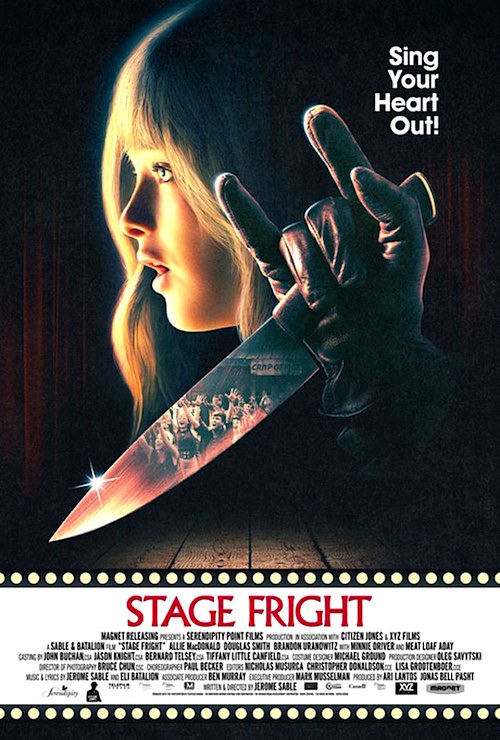
By Joe Bendel. These drama camp kids might as well learn the hard truths of show business at an early age. They will watch as the seniors deal with the casting couch, a manipulative producer, and a psycho-stalker. Nonetheless, they keep singing and dancing all the way through Jerome Sable’s musical horror mash-up, Stage Fright, which opens today in New York.

The Haunting of the Opera would have been a triumph for its star-diva Kylie Swanson, had she not been brutally murdered by a knife wielding maniac dressed as the Phantom after her opening night performance. It’s a setback. Roger McCall, Swanson’s producer and one-time lover takes in her young children, Camilla and Buddy, but falls on hard times after the show’s closing. He tries to make a go of it as the director of the Center Stage Camp for Performing Arts, where the siblings work as kitchen staff. Yet, despite a loyal student body, the camp is teetering on the brink of bankruptcy.

In a last ditch comeback attempt, McCall decides to stage the Andrew Lloyd Weber-ish Haunting as their annual production. In violation of camp policy, Camilla auditions for her mother’s part. Naturally, she nails it, but she will still have to finesse the lecherous student director. News of her involvement even attracts the interest of a career-making producer, but once again a psycho in a Phantom mask starts carving up cast-members. Yet, the show will go on, don’tcha know.

Sable and musical collaborator Eli Batalion were team behind the musical horror short The Legend of Beaver Dam, which is rather amusing, largely because the brief format allows it to just hit-it-and-quit-it without a lot of phony drama. Frankly, Sable might be too pre-occupied with the psychological angst. Yes, character development is generally a good thing, but Camilla’s little orphan complex is not very deep or compelling. Yet, it takes space that could otherwise be used for gory gags.

None of the individual tunes are particularly memorable either, but they are performed by the cast and company with admirable conviction. Fright will probably hold considerably more novelty appeal for midnight movie fans outside of New York, because we can see legit stage productions in this spirit Off-Broadway and Off-Off-Broadway fairly regularly. (In fact, it might have helped Sable to have someone like Rachel Klein on-board as a consultant or whatever.)

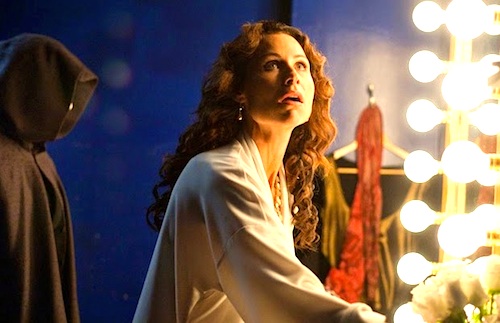
From "Stage Fright."

Still, when Fright goes all in, Grand Guignol style, it is a pretty awesome spectacle. Essentially, the opening and closing deliver on its promise, whereas the long midsection merely serves to get us from here to there. For Rocky Horror fans, it also has Meat Loaf (Aday) singing and thesping as McCall. While her character is not long for the world, Minnie Driver dies great in the prologue. Unfortunately, the twentysomething cast playing teenagers are largely undistinguished. Arguably, the best numbers feature the full company rather than the solo spotlights.

The film has its moments, but there should be more subversive glee, so to speak. Recommended eventually as a VOD or DVD pick for horror fans who do not have a lot of genre theaters options in their hometowns, Stage Fright opens today (5/9) in New York at the Cinema Village.

LFM GRADE: C+

Posted on May 9th, 2014 at 11:31pm.