LFM Reviews Bends @ MoMA’s ContemporAsian 2014

By Joe Bendel. Anna Li is a lady who lunches. She is not Marie Antoinette. She simply is unprepared for the speed at which fortunes can reverse in Hong Kong. Her Mainland chauffeur is not a revolutionary. He simply wants a safe delivery for his pregnant wife, but they cannot afford the punitive second child fee. Each will face an economic crisis, but Fai’s will be exacerbated by geography in Flora Lau’s Bends (more sensibly known as “Crossing the Border” in Chinese language territories), which launches the new season of ContemporAsian at MoMA.

Li organizes charity events and looks good on her husband’s arm at business functions. She seems quite satisfied with how things have turned out, even if her spouse is a bit of a shark and a player. The fact that he has not been home for several days does not seem to raise any red flags for her, but she definitely takes notice when her credit cards are declined. Finding their accounts drained or frozen, Li starts hocking the family art collection to keep up appearances in her social circle.

Meanwhile, Fai has his own problems. Although he has been granted HK citizenship, his wife Ting is still Mainland PRC. To hide her advanced pregnancy, she becomes a veritable prisoner in their Shenzhen flat. It is all very confusing for their little girl Haihai. Fai needs money to smuggle her across the border and a hospital admission letter to secure her a bed for delivery, but both are hard to come by for a man of his position.

Bends sounds about as hot-button as it gets, indicting HK’s laissez-faire economy on the right and the Communist Party’s unforgiving family planning on the left. Yet, the execution is decidedly quiet and intimate. Happily, Lau offers viewers character studies rather than white papers, but the first time director’s sense of pacing is still a bit flat. However, she gets a key assist from superstar cinematographer Christopher Doyle, who makes it all look coolly elegant.

From "Bends."

Yet, it is unquestionably Carina Lau who makes the film. Approaching legendary status, Lau still makes a convincing trophy wife, but it is her chops that truly impress in Bends. Despite Li’s outward reserve, Lau clearly expresses her mounting confusion and anxiety. At the risk of belaboring the point, Lau brilliantly pulls viewers into Li’s inner turmoil rather than resorting to the sort of bug-eyed arm-flailing Meryl Streep over-indulged in throughout, for example, Osage. What else can we say? Lau is simply much better at her craft.

Understatement is all very well and good, but Chen Kun nearly wilts into the background as Fai. Nevertheless, a strong supporting cast keeps him propped up in key scenes. Even with limited screen time, Stephanie Che makes a lasting impression as Lulu, Fai’s old HK flame, who now works as a maternity nurse. As Ting and Haihai, Tian Yuan and young Tu Jiamen also humanize the story rather compellingly.

There is no denying the wider issues raised by Bends, but it is only zeitgeisty after the fact. In the moment, it is unflinchingly intimate in its focus. Recommended for fans of Lau and those who appreciate films helmed by women, with great roles for women, Bends screens tonight through Sunday (4/21-4/27) as part of MoMA’s regular ContemporAsian film series.

LFM GRADE: B+

Posted on April 21st, 2014 at 8:50pm.

LFM Reviews Last Passenger

By Joe Bendel. Driving is the American way to commute. It suddenly does not look so bad for a handful of Brits trapped on a runaway train. The end of the line looms ominously in Omid Nooshin’s surprisingly spry thriller Last Passenger, which opens this Friday in New York.

Lewis Shaler tries to be a conscientious single father, but the demands of his emergency room practice often tax his young son Max’s patience. They are headed home from London on a redeye express, so Dr. Shaler can perform an emergency operation. At least they have a volunteer to help them pass the time. There might even be a halting attraction brewing between Shaler and the charming Ms. Sarah Barwell.

Unfortunately, events will interrupt them when Shaler starts to suspect something is amiss. Initially, nobody wants to get involved in matters like the disappearance of the porter. However, when the train starts blowing through scheduled station stops they quickly start to care. It turns out a mystery man has barricaded himself in the control room and disabled the emergency brakes. Of course, the outside authorities are slow to react, but it hardly matters. This is a diesel train, so there is nothing they can do to cut the power.

Perhaps transportation safety engineers could poke dozens of holes in Nooshin and Andrew Love’s screenplay, but its internal logic holds together pretty well for mere mortals. Obviously, there is a massive ticking clock counting down in the background, but the quiet moments work just as well. Nooshin vividly captures the eerily detached vibe of a late night train whooshing through nocturnal blackness. The mix of personality types and tics amongst Shaler’s fellow passengers also nicely follows in the tradition of great train suspense stories, going all the back to Hitchcock’s The Lady Vanishes.

From "Last Passenger."

Dougray Scott has become something of an overlooked leading man since the days of Ever After and MI: 2, but he anchors the film with understated strength and sensitivity. He definitely comes across as the sort of surgeon who would inspire confidence in patients. He also develops some relaxed but convincing chemistry with Kara Tointon’s Barwell. The supporting cast also feels right, particularly Iddo Goldberg (in a complete change of pace from Kat Coiro’s And While We Were Here) as an Eastern European immigrant transit worker.

Obviously, the question of who would do such a thing is hard to ignore, despite the narrative’s considerable tension. Nooshin & Love suggest (and never refute) a hypothesis that evades hot button ideological issues, but might be even more disturbing for what it implies regarding human nature. Regardless, they keep the train hurtling down the track. Frankly, there is something refreshingly old school about the smaller scope and corresponding emphasis on character. Recommended with unexpected affection for general thriller audiences, Last Passenger opens this Friday (4/25) in New York.

LFM GRADE: B+

Posted on April 21st, 2014 at 8:42pm.

LFM Reviews When The Garden Was Eden @ The 2014 Tribeca Film Festival

From "When The Garden was Eden."

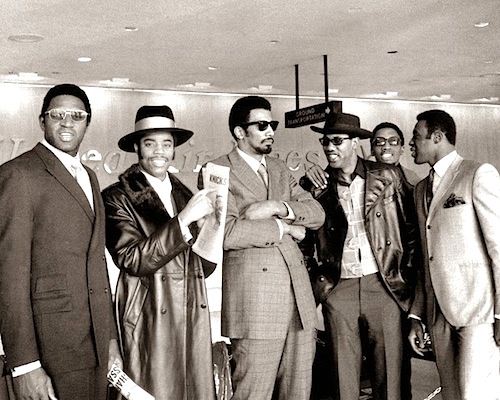
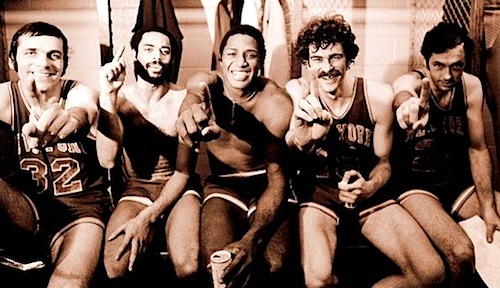
By Joe Bendel. In New York, we applaud defense, because we have seen how it is meant to be played. That is why it was so painful to watch the dysfunctional teams of the Isaiah Thomas era. Even today, the teams of Walt “Clyde” Frazier, Willis Reed, and Earl “the Pearl” Monroe cast a long shadow over Madison Square Garden. The glory years of the New York Knicks are chronicled in Michael Rapaport’s documentary When the Garden Was Eden, which screens during the 2014 Tribeca Film Festival.

New York has always been a basketball town, but the Knicks played second fiddle to the Big East during the early 1960s. It was not just the Knickerbockers. At the time, the NBA had less prestige than Arena Football at its nadir, but the Knicks were especially bad. However, they had a scout named Red Holtzman who had an eye for talent. Players like Frazier and Reed gave the team some credibility just as the league’s prospects were improving, but the highly touted Bill Bradley captured the City’s imagination—at least until his deferred Garden debut.

Although still better known as an actor, Rapaport is building a nifty body of work as a documentarian. Beats, Rhymes, and Life, his compulsively watchable rise-and-fall profile of A Tribe Called Quest deserved to breakout beyond the obvious hip-hop audience, but Eden, based on Harvey Araton’s national bestseller, is probably playing to the fanbase more. Still, isn’t everyone a Knicks fan when you get right down to it?

From "When The Garden Was Eden."

If so, the 1970 and 1973 teams are a major reason why. Rapaport talks with just about all of the surviving starters and role players, getting some classic Clydisms from Frazier and some ironic reminiscences from Cazzie Russell (the final L.A. Laker the wear #32 before Magic Johnson) regarding his rivalry with Bradley (whom he also faced as a National Guardsman when the politically ambitious small forward was protesting in the streets).

Along with plenty of New York attitude, Rapaport provides some historical context regarding the state of New York City and professional basketball in the late 1960s, but probably not to an extent that would win over non-basketball enthusiasts. It is well put together, sporting a funky soundtrack, but it is a bit fannish. Regardless, it is the perfect way to kick off the Tribeca/ESPN sports programming, especially considering Madison Square Garden just bought a fifty percent stake in Tribeca Enterprises. It premiered Thursday night at the BMCC with Rapaport, Frazier, Russell, Dick Barnett, returned prodigal Phil Jackson, and other championship team members in attendance. Recommended for New Yorkers, When the Garden Was Eden screens again this afternoon (4/19) and next Saturday (4/26) as part of this year’s Tribeca Film Festival.

LFM GRADE: B

Posted on April 21st, 2014 at 3:36pm.

LFM Reviews Lucky Them @ The 2014 Tribeca Film Festival

By Joe Bendel. Matthew Sweet is the Grunge version of Eddie Wilson from Eddie and the Cruisers. He only cut one classic album, but many fans still believe he faked his own death to avoid the onslaught of fame. After all, no corpse was ever recovered from his misadventure on that fateful bridge. His former girlfriend has sort of moved on, in a wounded, self-destructive kind of way. However, she will have to seek some closure whether she wants to or not in Megan Griffiths’ Lucky Them, which screens during the 2014 Tribeca Film Festival.

Music critic-journalist Ellie Klug has a bad reputation for sleeping with musicians and blowing off deadlines. She has managed to get by on her street cred as the woman who was there when the Seattle scene exploded, but the editor of Stax is finally ready to cut her loose (really, an alt rock magazine named after one of the all time great soul record labels?). She has one last chance. Her assignment (that she must accept) will be to follow-up on a new lead on Sweet’s whereabouts and hopefully score a reunion for her readers. Reluctantly partnering up with a wealthy old flame who now fancies himself a documentary filmmaker, Klug sets off in search of Sweet.

From "Lucky Them."

Lucky Them largely follows the conventions of road movies, but it has a good handle on the witty and insightful people who practice music criticism. Tough and earthy, yet also vulnerable, Toni Collette’s work as Klug follows vaguely in the tradition of Rosalind Russell in His Girl Friday. She also develops some appealing comedic chemistry with Thomas Haden Church, whose trademark deadpan delivers consistently scores solid laughs. Lucky Them also features a surprise cameo from a genuinely big name who typically commands a pay check greater than the film’s presumed budget. Even more impressively, Joanne Woodward (real Hollywood royalty) served as an executive producer, which probably explains the mystery guest’s participation. You do not say no to Ms. Woodward if you have any understanding of the history of your craft.

To its considerable credit, Lucky Them is much smarter and funnier than skeptical viewers will expect. Griffiths keeps it snappy, but also recognizes when to give a moment time to breathe. Recommended for general audience and jaded music journalists alike, Lucky Them screens Monday (4/21), Wednesday (4/23), and Saturday (4/26) as part of this year’s Tribeca Film Festival.

LFM GRADE: B

Posted on April 21st, 2014 at 3:20pm.

Mud & Soul: LFM Reviews Muscles Shoals; Premieres Tonight (4/21) on PBS

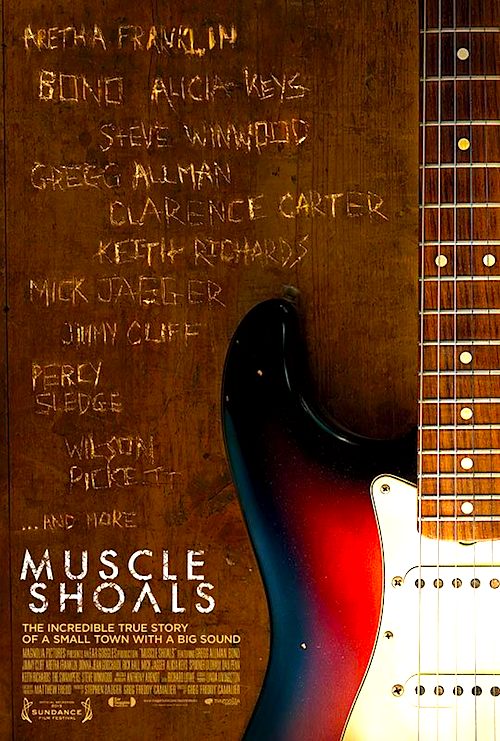
By Joe Bendel. Record collectors are prone to strange fetishes. A vintage Blue Note with an “ear” impressed in the dead wax can still fix ridiculous sums. It probably makes more sense to innocent bystanders when we obsess over recording studios. After all, that is where the magic originally happened. FAME Studios is one such storied shrine. It was there producer Rick Hall fostered a distinctive sound that made soul so much more soulful and midwifed what we now consider “Southern Rock.” Greg “Freddy” Camalier chronicles the man, his studio, and the sound in Muscle Shoals, which airs this Monday on PBS as part of the current season of Independent Lens.

Ironically, many fans do not realize Hall and his original studio ensemble, The Swampers, were all white cats. Regardless of listeners’ racial preconceptions, they directly contributed to some of the greatest hits waxed by artists like Wilson Pickett, Aretha Franklin, Candi Staton, Clarence Carter, Etta James, and Percy Sledge. When we talk of hits, we are referring to classics like “When a Man Loves a Woman” and “Land of 1,000 Dances.”

While many of the great Muscle Shoals recording artists grace Camalier’s film, he focuses on Hall as his protagonist. His producing touch might be golden, but Hall’s formative years were just as hardscrabble as that of any delta bluesman. Abandoned by his mother early on, Hall has faced more than his share of adversity throughout his life. Although he is clearly reserved by nature, when Hall opens up, it is heavy stuff. In fact, his resilience becomes a source of inspiration.

Camalier integrates enough historical context to establish the wider cultural significance of FAME Studios without belaboring the point. He also scored some pretty impressive sit-downs with the likes of Franklin, Carter, and Keith Richards, which he stages in visually intriguing settings. However, the interstitial music never sounds very Muscle Shoalsy. He also over-indulges attempts to explain the local sound in spiritual terms. Sometimes poetic, these often descend into New Aginess corniness (to quote Jobim: “it’s the mud, it’s the mud”).

Muscles Shoals tells an important story with more style than the average music documentary. It is entertaining in a jukebox kind of way, but also compelling on a human level. Recommended for fans of soul, swampy R&B, and the Allman Brothers (who will probably not be seeing Midnight Rider anytime soon), Muscle Shoals premieres on most PBS stations this coming Monday (4/21), courtesy of Independent Lens.

LFM GRADE: B

Posted on April 21st, 2014 at 3:18pm.

LFM Reviews In Order of Disappearance @ The 2014 Tribeca Film Festival

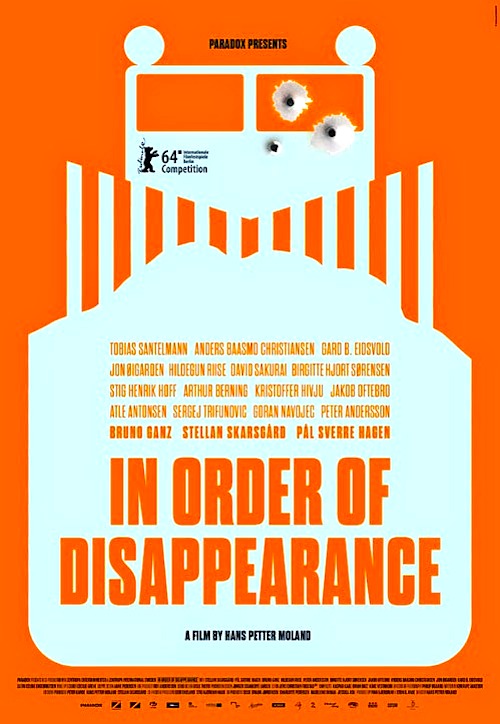
By Joe Bendel. If revenge is a dish best served cold, then provincial Norway is the perfect place for it. Technically, Nils Dickman is Swedish and he will serve up payback with Ikea-like efficiency in Hans Petter Moland’s comic noir In Order of Disappearance, which screens during the 2014 Tribeca Film Festival.

Dickman (yes, there are comments made regarding his surname) is not a gangster, he is a snowplow driver, but he becomes a very put-out snowplow driver when his son is murdered by a drug gang. Maybe it is in his blood. His older brother was once a gangster, nick-named “Wingman” in honor of Top Gun. Dickman’s anger and initiative are sufficient to ice the low level lackeys who administered his son’s fake overdose, but he will need some help getting to their boss, a legacy kingpin known as “The Count.” As Dickman works his way up the food chain, The Count responds by igniting a gang war with the Serbian mob he assumes is responsible for his underlings’ disappearances.

For some reason, Tribeca programmers have a soft spot for films about snowplow drivers. Even though Emanuel Hoss-Desmarais’s Whitewash won last year’s best new narrative director award, Disappearance is the film to see. Screenwriter Kim Fupz Aakeson (who also wrote the radically different Perfect Sense) neatly balances moody revenge drama (in the tradition of the original Death Wish) with generous helpings of dry, black comedy. In fact, there is a running visual gag that gets funnier and funnier through repetition.

On the other hand, Stellan Skarsgård plays it scrupulously straight as Dickman. He is about as Nordic as a vigilante can get. Despite his severe reserve, viewers get a sense he is so tightly wound, he might shatter if he tipped over. It takes a couple beats to realize the ever-reliable Bruno Ganz appears as the grieving Serbian godfather (known simply as Papa), but his sly turn adds the icing to this frozen ice-cream cake.

On paper, Disappearance would sound like a grim and slightly gory story, but it is great fun on the screen. Moland’s subtle touch and Aakeson’s inventive but rigorously logical plot developments keep the audience locked in every step of the way. Highly recommended for fans of gangster movies with a sardonic attitude, In Order of Disappearance screens again Sunday (4/20) and Wednesday (4/23) during this year’s Tribeca Film Festival.

LFM GRADE: A-

Posted on April 18th, 2014 at 11:11pm.