LFM Reviews Draft Day

By Joe Bendel. Nobody wants to draft the next Ryan Leaf or JaMarcus Russell, but they often look like sure things at the time. Of course, nobody ever understood the Knicks’ Frédéric Weis debacle, especially when Artest was still available. Granted, that is a basketball digression, from 1999, but the point is we still are not ready to forgive and forget. The stakes are consequently high for Cleveland’s GM when he makes a costly trade for the number one pick. He had better choose wisely, but the clock is ticking throughout Ivan Reitman’s Draft Day, which opens today pretty much everywhere.

Sonny Weaver basically has one season left to turn things around. He largely inherited the current team, but he did little to endear himself to fans when he fired their legendary head coach, who also happened to be his father, now deceased. With the owner pressuring him to make a big move, he reluctantly agrees to a deal, trading away their next three years of first round drafts for the upcoming number one pick. (Ironically, it is your 2014 Super Bowl champion Seattle Seahawks who have that coveted #1 spot.)

Weaver quickly develops buyer’s remorse, but the trade is done. Everyone assumes he will opt for the presumptive number pick, Bo Callahan, the Heisman winning quarterback from Wisconsin. His owner is delighted with the prospects of a marquee player like Callahan, but Weaver cannot shake the Leafy vibe he gets from him. Further complicating matters, Weaver’s front office colleague and not so secret lover has just informed him she is pregnant.

You really have to hand it to Kevin Costner. After some pretty lean years, he has clawed his way back to leading man status in major Hollywood releases. Going back to the sports well obviously makes sense in theory and it works ably enough again in practice. Since it is all about wheeling and dealing, Draft Day is bound to be compared to Moneyball and not unfairly so. The truth is there is something oddly cinematic about watching the respective GMs’ hard bargaining, firing off lines like: “that offer already expired, it’s a different world than it was thirty seconds ago.”

Frankly, the only sports action we see are the teams’ research tapes and there are no surprises there, because Weaver will explicitly tell them to show the footage of Callahan getting sacked. Still, there is something very sporting about Draft Day’s persistent faith in next season.

From "Draft Day."

Without question, Costner is the film’s lynchpin and he still has what it takes. He convincingly gives Weaver darker shades than his Bull Durham, Field of Dreams, and Tin Cup characters, but he remains undeniably charismatic. While they do not burn down the joint with their passion, he and Jennifer Garner develop some relatively likable and believable romantic chemistry together. Denis Leary and Frank Langella both do their shtick as the Browns’ head coach and owner, respectively, but it is the latter veteran thesp who really gives the film some sly zip. Football fanatics will also dig the scores of real life NFL cameos, mostly notably including Jim Brown (as far as old school cineastes are concerned).

Reitman keeps it all moving along briskly, capitalizing on the draft’s constantly ticking clock. While it ends up somewhere not wholly unexpected, getting there is a surprisingly satisfying trip. A well conceived and nicely executed comeback star vehicle, Draft Day is easily recommended for fans of football or Costner rom-dramedies. It opens today (4/11) across the country, including the AMC Loews Lincoln Square in New York.

LFM GRADE: B

Posted on April 11th, 2014 at 9:21pm.

LFM Reviews Mad Dog: Inside the Secret World of Muammar Gaddafi on Showtime

By Joe Bendel. Muammar Gaddafi was responsible for the mass murder of man and camel alike. Never shy about executing those unfortunate enough to have their loyalty questioned, Gaddafi also once ordered the wholesale extermination of all camels within Tripoli, believing they were incompatible with his vision of a modern city. Yet, during his final years, Gaddafi traveled internationally with representative camels along with his ostentatious, bullet proof tent, and extensive entourage of female bodyguards. Even the animals never knew where they stood with the Libyan tyrant. The cruel and erratic nature of his dictatorship is documented in shocking detail throughout Christopher Olgiati’s Mad Dog: Inside the Secret World of Muammar Gaddafi, which premieres on Showtime this Friday.

It was President Ronald Reagan who dubbed Gaddafi a “mad dog” and history has vindicated him once again. Gaddafi initially charmed his neighbors and the regional media, but as the years progressed, his grandiose ambitions to become a modern day Saladin were largely derided within the Arab world. Instead, he tried to “re-brand” himself as the once-and-future “King of Africa,” launching a good will offensive aimed at Africa’s crowned royalty, despite his explicitly racist beliefs. At least, he always maintained mutually cordial relations with just about every terrorist group operating around the globe, including Carlos the Jackal, the PLO, and the IRA.

Nearly everyone will go into Mad Dog with the general understanding that Gaddafi was a bad guy, but the depths of his sadistic perversity are truly shocking. Olgiati thoroughly exposes Gaddafi’s crimes as a sexual predator, targeting young girls and boys alike, in a manner befitting Uday Hussein as immortalized in Lee Tamahori’s The Devil’s Double.

Indeed, Mad Dog uncovers many more truly bizarre revelations that are mystifyingly macabre (you could say he had a habit of keeping his political opponents on ice). To his credit, director-producer-cameraman Olgiati pushes his interview subjects to be precise and supply specifics. He never accepts vague implications, forcing them to spell out each and every incident under discussion. While most of the talking heads are surviving Libyan dissidents, there are a few hidden camera sequences with former regime insiders that are highly illuminating.

From "Mad Dog: Inside the Secret World of Muammar Gaddafi."

Perhaps the least substantiated passages within Mad Dog are the rather gossipy charges of CIA support for Gaddafi during his early days as a mini-mart for terrorists. However, Olgiati is on solid ground criticizing the overly optimistic campaign to rehabilitate Gaddafi (who by the way, was sitting on top of vast oil reserves). He also notably details ways in which Gaddafi exploited Islam to serve his propaganda purposes.

Olgiati paints a comprehensively damning portrait of Gaddafi, but it is also a well paced, compelling viewing experience. He certainly appreciates the spectacle of Gaddafi’s flamboyant vanity, but never loses sight of his brutal despotism. Recommended for anyone seeking insight into the Libyan revolution, Mad Dog: Inside the Secret World of Muammar Gaddafi airs this Friday (4/11) on Showtime.

LFM GRADE: B

Posted on April 9th, 2014 at 11:21pm.

LFM Reviews The Second Game @ The Film Society of Lincoln Center’s Art of the Real 2014

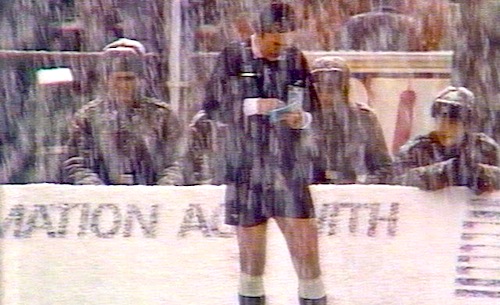
By Joe Bendel. It was sort of like the Romanian equivalent of the Army-Navy Game, but with bizarrely ominous implications. Dinamo was affiliated with the secret police, while Steaua was the Army team, handpicked by Ceausescu’s son. Corneliu Porumboiu’s father refereed a moderately memorable meeting of the two football (soccer) teams. He will revisit the videotapes of that snowy 1988 match with his filmmaker son throughout the low-fi un-doc-like The Second Game, which screens during the Film Society of Lincoln Center’s Art of the Real film series.

Adrian Porumboiu was clearly the sort of ref who believed in putting the whistle in his pocket during pivotal moments of a game. Of course, it made a lot of sense to just let teams like Steaua and Dinamo settle it on the field, rather than risk deciding matters himself. Many aspects of the game have changed since 1988, including an EU mandate requiring the privatization of government agency affiliated teams. The fact that this match-up takes place a year before the fall of Ceausescu would seem to be highly symbolic, but neither Porumboiu overplays that card.

Instead, we hear far more regarding the senior Porumboiu’s thoughts on how to properly officiate a game, which is sort of interesting, for a while. Still, the less than pristine archival footage occasionally opens up a small window into the mechanisms of the Communist police state. Given the teams’ social-political significance, the cameramen never show the fighting or bouts of poor sportsmanship that periodically erupted on field, panning the crowd instead. Of course, this would leave home viewers inevitably confused when televised coverage finally resumed.

From "The Second Game."

It seems like there ought to be more there there to Second Game than there really is. While the circumstances surrounding the match are fascinating on paper, viewers are really just watching a twenty-six year old football match with occasional bits of color commentary. Frankly, the Porumboius do not pace themselves well, or even bother to turn off their cell phones.

If you cover film, Second Game offers a handy opportunity to examine how the totalitarian Socialist state manipulated mass media. If you actually want to immerse yourself in a cinematic experience, Porumboiu’s latest is a tough go. Of more interest to film students analyzing Porumboiu’s life and work (such as the deliberately paced but more rewarding Police, Adjective and 12:08 East of Bucharest) than those intrigued by the Cold War era, Second Game is odd programming choice for Art of the Real. For those determined to partake, it screens this Friday (4/11) and the following Monday (4/14) at the Francesca Beale Theater.

LFM GRADE: C+

Posted on April 9th, 2014 at 11:13pm.

Scarlett Johansson vs. Scotland: LFM Reviews Under the Skin

By Joe Bendel. Fifty-some years after the classic Twilight Zone episode, aliens are still devising ways to serve man, with a little butter and garlic. However, viewers of Jonathan Glazer’s much anticipated new film will be forgiven if they do not realize that this is the extraterrestrials’ reason for visiting Scotland. Mood and composition take precedence over petty bourgeoisie concerns, like narrative and pacing, throughout Glazer’s Under the Skin, which opened Friday in New York.

Fortunately, Skin is ostensibly based on the novel by Michel Faber, so we can infer some exposition from the original source material. It seems aliens have a taste for human muscle, so the woman visitor has been sent to harvest some from the brawniest knuckle-draggers she can entice into the back of her van. Sometimes she appears to have a counterpart escorting her on his motorbike, but he disappears for long stretches (probably because he gets bored).

At first, she seems ruthlessly efficient, but as she encounters the less fortunate, she starts to change. Yet, becoming more “human” leaves her increasingly vulnerable to man’s inhumanity towards his fellow man. Or something like that.

There is not a heck of a lot of plot in Skin, but what there is manages to be both slow and confusing. About the third or fourth time she lures another man-dog into her cosmic pool of black goo, you start to wonder how this film ever got made without Tangerine Dream on-board. There are more wide shots of cloud draped forests than both seasons of Twin Peaks combined. Frankly, it is hard to believe this is the work of Glazer, arguably the most lauded television commercial director of our time and the man who helmed the breakout hit, Sexy Beast.

It is also hard to get one’s head around the wildly unflattering wig Scarlett Johansson sports as the primary alien. Frankly, this is Johansson as we have never seen her before: naked, yet boring. There is no question Skin is more closely akin to experimental cinema than science fiction genre films, but it sounds deceptively commercial: “nude alien chick puts men through the interstellar meat-grinder.” It will surely attract a loyal band of critical champions who will defend it with terms like “hypnotic” and “trance-inducing,” which sounds seductive, but really means you will be paying fourteen dollars to fight off the head-nods.

In many ways, Skin feels like a throwback to the sort of weirdly cerebral 1970s science fiction forays (such as Robert Altman’s Quintet and Nicholas Roeg’s The Man Who Fell to Earth) that were green-lighted by clueless studio heads caught flat-footed by the Star Wars phenomenon, but Skin is more openly contemptuous of mainstream sensibilities. For a while, Daniel Landin’s gauzy cinematography is rather effectively dreary, in a way befitting Scotland’s backwoods, but the film simply becomes a chore to watch. Not recommended for anyone except Johnasson stalkers and the most pretentious hipster cineastes, Under the Skin opened Friday (4/4) in New York at the AMC Empire.

LFM GRADE: D

Posted on April 7th, 2014 at 6:05pm.

The Family that Plays Together: LFM Reviews Brothers Hypnotic on PBS

By Joe Bendel. One would expect the sons of a Sun Ra Arkestra veteran would naturally take to music. Their somewhat unconventional upbringing is hardly surprising either. Yet, the members of the eight-brothers strong Hypnotic Brass Ensemble both honor and reject their father’s musical legacy in ways that generate real tension throughout Brothers Hypnotic, Reuben Atlas’s behind-the-scenes look at the brassy jam-band, which airs this Monday on PBS, as part of the current season of Independent Lens.

After early stints with the Jay McShann and the U.S. Navy bands, Phil Cohran signed up with the Arkestra while it was based in Chicagoland. When Sun Ra continued on his galactic journey, Cohran helped co-found the AACM. For a while, he was also the director of the Phil Cohran Youth Ensemble (which could have passed for the Arkestra’s children’s auxiliary), but as soon as one Cohran brother left the fold, the entire ensemble deflated.

In a sense, they were reborn as Hypnotic, a jazz and funk influenced jam-band somewhat in the tradition of the Hot 8 Brass Band and their New Orleans contemporaries, but utilizing a strictly brass-only instrumentation. They have a great sound (particularly when they are not incorporating just okay raps into the mix). You can hear a bit of their father in there, but there are plenty of other elements in the mix as well.

From "Brothers Hypnotic."

Atlas does an excellent job documenting the ironic realities of a jazz (or jazz-ish) musician’s life. One minute you are eating cold Spaghetti-O’s out of the can, but the very next day you might be off on a seat-of-the-pants European tour. The filmmaker caught the Ensemble at a fortuitous time, when they were still giving street performances (which are highly cinematic), but were also fielding offers from legitimate labels. Musicians who tune in might get a nasty case of heartburn when they turn down Atlantic Records, but you have to give them credit for staying true to the convictions they inherited from their father. Unfortunately, the broadcast edit of Brothers H never allows a musical performance to continue long enough to give viewers a truly vivid sense of the ensemble’s full force.

Atlas captures some intimate moments with a band that is on the way up, but shrewdly trying to avoid a harsh burn-out. The Brothers must have seen their share of music docs before appearing in their own. It is nice to know some musicians are trying to learn from others’ mistakes. While Atlas also includes enough intra-family drama to avoid accusations of PR flakery, the film never feels intrusive or gossipy. Recommended for fans of funky brass (and who isn’t?), Brothers Hypnotic debuts tonight (4/7) on PBS’s Independent Lens.

LFM GRADE: B+

Posted on April 7th, 2014 at 5:59pm.

LFM Reviews Dream Team 1935 @ MoMI’s 2014 Panorama Europe

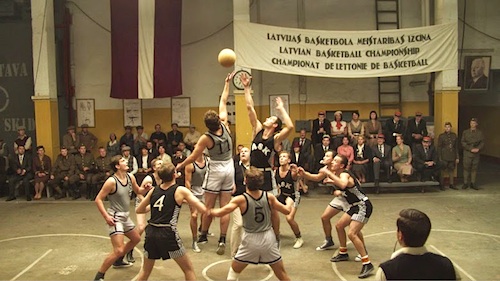
By Joe Bendel. Evidently, they come pretty tall and well coordinated in the Baltics, considering their success in the European Basketball Championship (now known as EuroBasket). Lithuania won twice in the 1930’s and took gold again in 2003, but the very first champion was Latvia. Profoundly unheralded, the scrappy long-shots shocked the continent in 1935. It was a great Latvian triumph on the eve of great tragedy for many nations, Latvia included. With Russia once again menacing its neighbors, it is a fitting time to revisit one of the greatest moments of Latvian sporting history in Aigars Grauba’s Dream Team 1935, which screened during Panorama Europe at the Museum of the Moving Image.

It was a different game in 1930’s Europe. A jump ball followed every successful bucket and free throws were shot granny-style, but it was still handy to have an enforcer on the team. Vlademars Baumanis understands this only too well. Initially, the player-coach loses the Latvian championship because of some thuggish play. However, the victorious coach declines to take his team to the European championship, because the corrupt national sports committee has already squandered the ear-marked funds. While protesting to anyone who will listen, Baumanis accepts an instantly regretted dare to cobble together his own national team, trading in his uniform for a suit and tie.

Bitter rivals from both the Army and University Clubs will come together to represent Latvia, but it will take time to congeal as a true team. At least they will be in the best shape of the careers, thanks to relentless conditioning coach Rihards Deksenieks. Baumanis is a master strategist (at least by 1930’s standards) and the Latvia team has considerable skills, but just getting to Geneva will be an adventure thanks to the obstructionist sports committee.

Dream Team is a reliably entertaining underdogs-triumphant sport story, with some nicely rendered period details and a peppy big band soundtrack. Many basketball fanatics will probably be amused by the decidedly less glamorous style of play. Yet, Dream Team features one of the most devastating series of what-happened-to post-scripts of nearly any film. It turns out nearly every coach and player met a tragic end either as Soviet or National Socialist conscripts (sometimes both) during the war or in Soviet gulags afterward. (Nearly eighty years later, history threatens to repeat itself, as Russia once again casts a covetous eye on the Baltic Republics.)

From "Dream Team 1935."

Janis Amanis is a bit stiff as Baumanis, but he certainly looks earnest. In contrast, Vilis Daudzins plays Deksenieks with hardnosed charisma, while Marcis Manjakovs convincingly portrays the maturation of Latvia’s star player, Rudolfs Jurcins. Unfortunately, there is not much for Inga Alsina to do as Baumanis’s wife Elvira, except for sitting around, having faith in him.

As a sports film, Dream Team is more successful than most. Despite the end never being in doubt, it moves along briskly and captures the tenor of the game as it was then played. It also suddenly feels uncomfortably topical given the ultimate fate of most of the team. It would make a good narrative companion to Marius Markevicius’s uplifting documentary, The Other Dream Team, chronicling the 1992 Olympic run of newly independent Lithuania’s men’s basketball team. Recommended for basketball fans and those who closely follow political and cultural developments in post-Soviet Eastern Europe, Dream Team 1935 screened Sunday at MoMI as part of Panorama Europe.

LFM GRADE: B+

Posted on April 7th, 2014 at 5:41pm.