LFM’s Jason Apuzzo & Govindini Murty at The Huffington Post: Young Man on the Run: Catching Up with Shia LaBeouf and Charlie Countryman

[Editor’s Note: the post below appears today at The Huffington Post.]

By Jason Apuzzo & Govindini Murty. Shia LaBeouf can’t keep still.

That’s what stands out when you meet the voluble 27 year-old star of the new indie thriller-romance Charlie Countryman, which opens in limited theatrical release and on VOD this Friday, November 15th. The hustling young man we’ve gotten to know in the Transformers and Indiana Jones movies – the fast-talking, nebbishy tough guy with a big heart, always improvising, always on the move – is very much the same guy in person.

Charlie Countryman premiered at Sundance earlier this year (back when it was called The Necessary Death of Charlie Countryman), where we talked to LaBeouf, co-star Evan Rachel Wood, and director Fredrik Bond at the film’s press day.

Govindini Murty and Shia LaBoeuf at Sundance 2013.

Charlie Countryman takes LaBeouf in a direction familiar to anyone who remembers him playing impulsive teenager Sam Witwicky in 2007’s Transformers: that of a sentimental hot-head on a hopeless quest for a girl, comedically improvising his way into and out of one scrape after another.

“It’s not a humongous departure from my real life,” LaBeouf said at the press day. “This is a guy who thinks with his heart, rather than his mind … and who doesn’t show a lot of caution toward consequences, which isn’t far from who I am.”

Charlie Countryman follows LaBeouf on a wild, hallucinogenic vision-quest through post-communist Bucharest as he pursues a world-weary femme fatale cellist named Gabi (Evan Rachel Wood), while battling over her with a pair of unhinged Euro-mobsters (Mads Mikkelsen and Til Schweiger). Infused with heart-on-your-sleeve sentimentality by director Fredrik Bond, the film is both a coming-of-age story for Charlie and a picaresque, ‘everyman’-style thriller reminiscent of the novels of Eric Ambler (The Mask of Dimitrios, Journey into Fear).

Rounding out the film’s impressive cast are Rupert Grint as one of Charlie’s drug-crazed buddies, Vincent D’Onofrio as Charlie’s depressive brother, and Melissa Leo as Charlie’s hippyish mother – with LaBeouf’s Indiana Jones co-star John Hurt providing narration.

Charlie Countryman‘s biggest star, however, may be Bucharest itself – which the film presents as an exotic, old world blend of high culture and low-life gangsterism, still adjusting to the post-Cold War world. LaBeouf’s nocturnal adventures in Bucharest – a darkly glamorous city that somehow seems trapped in a 1990s time warp – often feel like an MTV version of Joseph Cotton’s nighttime journeys through crime-ridden, post-War Vienna in Carol Reed’s The Third Man.
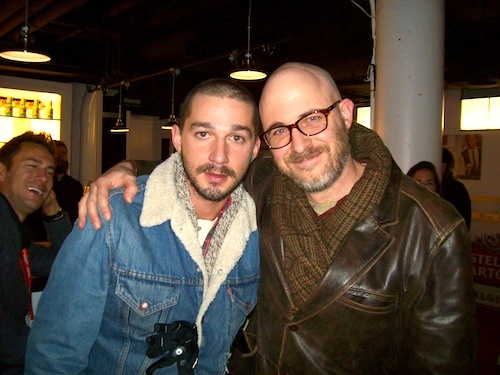
Shia LaBeouf and Jason Apuzzo at Sundance 2013.

LaBeouf lights up on the subject of Bucharest, gesticulating and going into one of his typical, animated riffs. “I arrived quite ignorant, you know – I’m an ignorant American,” he quips. “I haven’t really done much traveling beyond my work life. I never really picked up a Romanian book, or decided to study Romanian.

“But you get there, and you hear about [former Romanian communist leader Nicolae] Ceaușescu, you get to the [Revolution] Square, you see where the blood fell, talk to these people – you know, some people who still want communism, who are upset that it’s gone – and you don’t quite understand what that‘s about …

“I’ve heard people say that we have dated villains [in Charlie Countryman] – that’s because … Romania is dated – it’s 10 years behind. They’re still playing the ‘Thong Song’ in clubs,” he cracks. “It’s no joke, so this is part of the world of these dudes [the film’s gangster villains]. It’s not artificial – this is what we ran into.

“And it’s very sexy,” he smiles. Continue reading LFM’s Jason Apuzzo & Govindini Murty at The Huffington Post: Young Man on the Run: Catching Up with Shia LaBeouf and Charlie Countryman

The Story of Calvin & Hobbes: LFM Reviews Dear Mr. Watterson

By Joe Bendel. Bill Watterson is sort of like the Salinger of syndicated comic strips. Despite the popularity of Calvin & Hobbes, he has shunned the media spotlight and steadfastly refused to license merchandise (even including stuffed Hobbes dolls). Yet, years after he inked his final panel, people still feel like they share a deep personal relationship with his characters. Director-editor Joel Allen Schroeder proclaims his love for the comic characters and invites others to do the same in the tribute-documentary, Dear Mr. Watterson, which opens this Friday in New York.

There will probably never be a Calvin & Hobbes Christmas special, so devotees of the Christopher Robin-like boy and his probably imaginary tiger will have to settle for Schroeder’s doc. Do not hold your breath waiting for the titular Mr. Watterson to sit down and remember when, either. Instead, Schroeder talks to a number of fans and fair number of Watterson’s fannish-sounding fellow cartoonists.

While that is all very good, it is not exactly earthshaking stuff. More interesting are the behind-the-scenes reminiscences of Watterson’s professional colleagues at his newspaper syndicate and his book publisher. What emerges is a portrait of an art form bordering on e-driven extinction. Sadly, viewers get a sense C&H was not the peak of daily comic strips, but the last great hurrah.

It is too bad Watterson’s participation was such an “as if,” because he rather sounds like someone with something to say. He is still remembered for a blistering and some say prescient address to a professional cartoonists’ assembly warning of the consequences of the commercialization of comic strips and the erosion of creators’ control. Bloom County cartoonist Berkley Breathed sort of fondly discusses the pointed letters Watterson once set him, not so gently calling him out for his Opus plush toys and other merchandising.

One of the open questions of Dear is whether the now defunct C&H strip will retain its cultural currency without the TV specials and various toys to drive awareness for younger readers. Schroeder and his talking heads are sure it will, because it is just so darn good, but clearly they are speaking out of optimism and affection.

Dear is a gentle film that celebrates the wholesome values and artistic integrity of Calvin & Hobbes, which is refreshing, but not particularly cinematic. At times, it almost plays like the DVD extra to a non-existent C&A animated feature. Pleasant and well intentioned (but almost terminally nice), Dear Mr. Watterson is mostly recommended for Calvin & Hobbes diehards and those who harbor daily cartooning ambitions when it opens this Friday (11/15) in New York at the Cinema Village.

LFM GRADE: B-

Posted on November 14th, 2013 at 3:32pm.

In Honor of Veterans Day, Learn More About History

By Govindini Murty. This Veterans Day, please take the time to thank our veterans for their service – and also think about how you can honor the ideals of freedom, civilization, and democracy that they fight for.

The first and best way to do this is by learning about history. Knowledge of history is critical for providing a sense of context to our lives and for also offering fascinating parallels that can illuminate the present day.

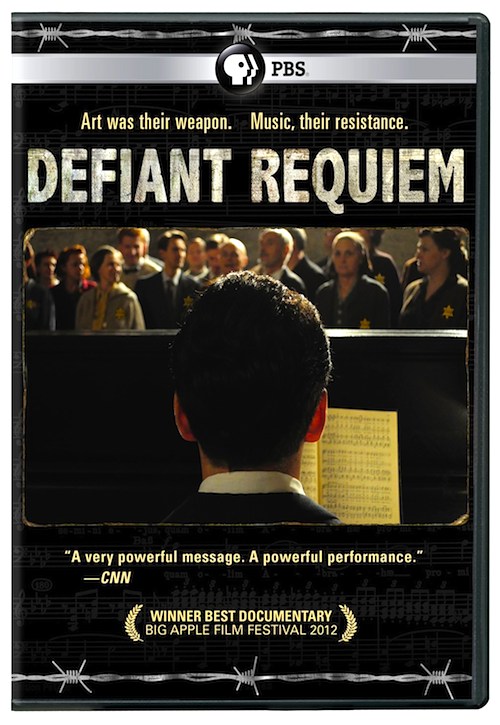
One of the best WWII historical documentaries I’ve seen in recent years is Murry Sidlin’s Defiant Requiem, which screened earlier this year on PBS and has just become available on Netflix. Defiant Requiem tells the heartbreaking story of the Jewish prisoners of the concentration camp Terezin who, led by conductor Rafael Schächter, defied their Nazi captors by performing Verdi’s Requiem.

The documentary brings home in the most powerful way why it was so important that the free nations of the world fought so valiantly in WWII to defeat the Nazis and Axis powers – and why we must continue to fight for freedom today to make sure such atrocities never happen again.

The courageous prisoners of Terezin themselves might not have fought with arms, but they fought for the human spirit under the most difficult of circumstances by preserving the arts, humanities, and all the civilized values that the Nazis worked so hard to extinguish. They did this by creating an “accidental university” at Terezin, giving thousands of lectures on history, art, philosophy, religion, and science; by writing literature, poetry, and plays; and by creating numerous paintings, drawings, and artworks – and by giving concerts, most notably of Verdi’s Requiem, with its powerful, universal message of justice and redemption.

Renowned conductor Murry Sidlin, who founded the Defiant Requiem Foundation and its Rafael Schächter Institute for Arts and Humanities to bring light to the history of the Terezin prisoners, was honored earlier this year with the Simon Wiesenthal Center’s Medal of Valor for his efforts.

We had the chance to speak with Murry Sidlin earlier this year about Defiant Requiem and his extraordinary work to keep alive the memory of Rafael Schächter and the prisoners of Terezin. Every year, the Defiant Requiem Foundation carries out reenactments of the Verdi concert at Terezin and a multitude of other locations. The foundation’s Rafael Schächter Institute also hosts educational activities every summer at Terezin to keep alive the memory of the prisoners’ artistic and humanistic efforts.  As the institute’s website states, these activities “honor the prisoners’ act of choosing to learn, to listen, to discuss, and to be educationally and artistically enriched, amidst brutality, impoverishment, terror, and inhuman deprivation.”

You can seen Defiant Requiem on Netflix and can read more of our Huffington Post interview with Murry Sidlin.

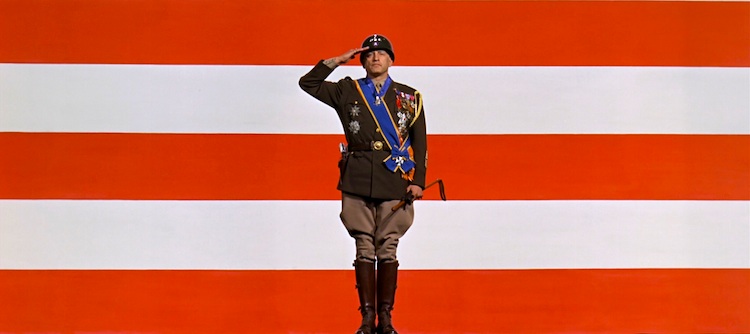
Other excellent historical films worth viewing this Veterans Day include Patton, The Longest Day, The Battle of the Bulge, and Bridge on the River Kwai. These films have an epic scope and intelligence that continues to make them compelling viewing. Watching them has also inspired me to learn more about history. This summer I finally sat and read Ladislas Farago’s superb biography Patton: Ordeal and Triumph, and came to a much better understanding of WWII and how crucial the brilliant tactics, speed, and daring of generals like General George S. Patton were to winning the war. Continue reading In Honor of Veterans Day, Learn More About History

La Dolce Vita: LFM Reviews The Great Beauty, Italy’s Oscar Submission

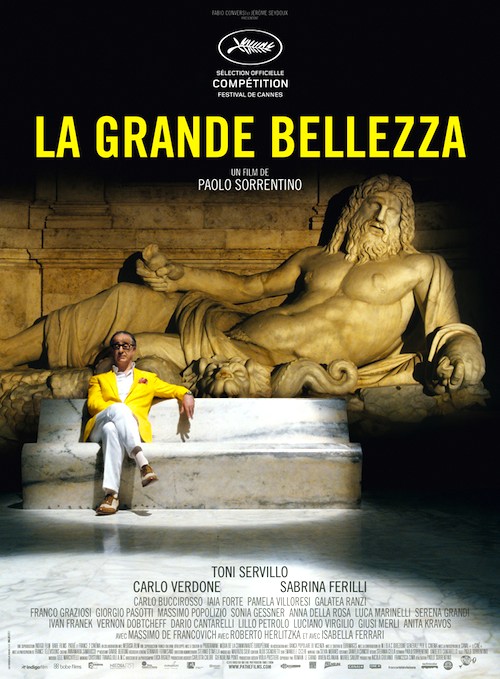
By Joe Bendel. Writers write, that’s what they do. Jep Gambardella still qualifies, just barely. After the publication of his acclaimed first novel, he chose to spend the rest of his career penning Vanity Fair-style celebrity profiles. It was much easier, but far less satisfying. Gambardella belatedly realizes this holds true for all aspects of his life in Paolo Sorrentino’s The Great Beauty, Italy’s official foreign language Oscar submission, which opens this Friday in New York.

It is Garbardella’s sixty-fifth birthday and his social circle is ready to party like they are really his friends. The magazine writer is in his element. However, he turns uncharacteristically pensive when he learns his great lost lover has passed away, perhaps still harboring undiminished feelings for him. Hoping to experience a similar passion, Gambardella commences a relationship with Ramona, the daughter of his old strip-club owner crony, who still works in the family business at the impressive age of forty-two. Perhaps there is some substance to their affair, but at the very least, her presence on his arm thoroughly scandalizes Rome’s high society.

A rapturous viewing experience, Great Beauty must be the most elegant looking and sounding film since Luca Guadagnino’s I am Love. Frankly, it takes considerable guts to make a film that so perilously invites comparison to Fellini’s La Dolce Vita, but Sorrentino has boldly gone there nonetheless. He masterfully maintains a mood that is palpably seductive and elegiac. Indeed, Great Beauty is likely to induce a midlife crisis in viewers, regardless of their age or accomplishments. Yet, it is an elusive cinematic statement that slips through your fingers whenever you try to analyze it.

Sorrentino’s frequent collaborator Toni Servillo gives the career performance of an accomplished career as Gambardella. Wonderfully urbane and devilishly witty, he nonetheless acutely expresses Gambardella’s each and every regret. This is Academy Award caliber work, but Great Beauty is so refined and mature it will probably be lucky just to make the foreign language cut.

Of course, Servillo is not laboring alone. As Ramona, Sabrina Ferilli’s earthy vulnerability perfectly complements Servillo’s cerebral angst, while the manic melancholy of Carlo Vendone as Gambardella’s writer-associate further heightens the Fellini-esque vibe, whereas Giovanna Vignola is simply incomparable as his acerbic editor, the diminutive Dadana.

Clearly, nobody shoots statuary and architectural edifices like cinematographer Luca Bigazzi. Similarly, the themes composed by Lele Marchitelli, as well as several shrewdly licensed selections from the likes of Arvo Pärt, provide a rich feast for the ears. Altogether, Great Beauty is a powerful and assured film on every level. Very highly recommended (especially to Academy members), it opens this Friday (11/15) in New York at the Lincoln Plaza Cinemas.

LFM GRADE: A

Posted on November 11th, 2013 at 2:48pm.

A Homecoming for Russians Artists: LFM Reviews Enter Here

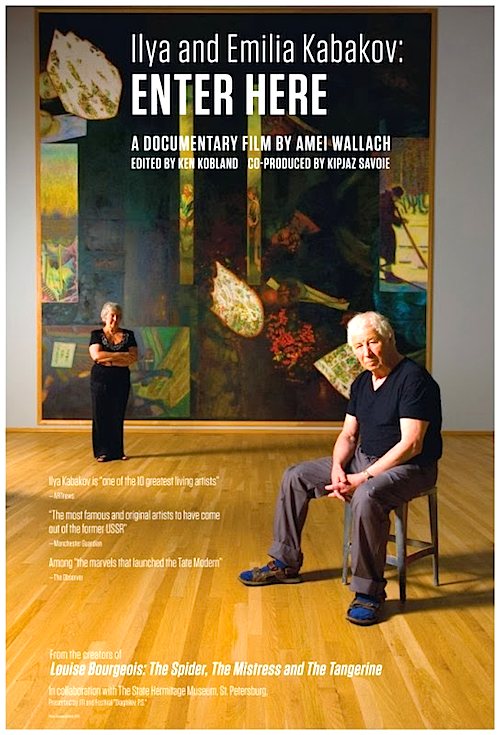
By Joe Bendel. Ilya Kabakov does not really care how many millions of people Stalin murdered—more relevant to him is the way the Soviet state treated his mother like dirt. His intensely personal experiences under Communism profoundly shaped his conceptual work, created in collaboration with his wife, Emilia. After twenty years in the West, Kabakov finally returns to Moscow for an ambitious series of installations. Amei Wallach documents their mostly triumphant homecoming in Ilya and Emilia Kabakov: Enter Here, which opens this Wednesday at Film Forum.

Kabakov’s contemporaries all acknowledge the Moscow Conceptualists started with him. Like most of his colleagues, Kabakov paid the bills illustrating children’s books. It allowed him plenty of free time to pursue to pursue his own work – in secret, of course. Arguably, the young Kabakov was rather fortunate when the Leningrad Art School accepted him, at a time when both pupil and institution had been evacuated to Samarkand. However, his formative art school years remain a source of pain and anger for Kabakov.

Years later, Kabakov’s mother agreed to his request for a written account of her difficult life. The narration of her words form the film’s strongest sequences, chronicling her hand-to-mouth years, working as the night watchman at his art school, living illegally in a converted water-closet, because she lacked the proper residency papers. Constantly evicted by bureaucrats and snitches, Kabakov’s mother was essentially homeless and shunned in the workers’ paradise. Her missive-memoir became the framework for Labyrinth, My Mother’s Album and its influence on other pieces is unmistakable.

While Ilya Kabakov clearly emerges as the senior partner, Emilia Kabakov seems perfectly content to serve as the more practical liaison with the business side of the art world. Twelve years his senior, Emilia Kabakov carries far less personal baggage from the Soviet years. However, it is rather eye-opening for her coming across an old informer’s journal with her family somewhat ominously identified as “the Jews.”

The Kabakovs’ brand of conceptual art is far more accessible than what might come to mind after watching the Herb & Dorothy documentaries. Unlike some of their colleagues, the Kabakovs’ work is clearly both intellectually and emotionally engaging, with their ironic use of Soviet symbols and the trappings of crummy everyday Russian life speaking volumes. Kabakov frequently incorporates his paintings into their so-called “total installations,” which further heightens their visual impact.

With an eye for telling details, Wallach and her crew nicely capture a sense of the viewing experience of the Kabakovs’ installations. Likewise, she also catches the artists, particularly Ilya, in reflective moods. Executed with sensitivity, insight, and a dash of style, Ilya and Emilia Kabakov: Enter Here is recommended for those who appreciate fine art and Russian history when it opens this Wednesday (11/13) at Film Forum.

LFM GRADE: B+

Posted on November 11th, 2013 at 2:45pm.

The Iranian New Wave: LFM Reviews Tall Shadows of the Wind

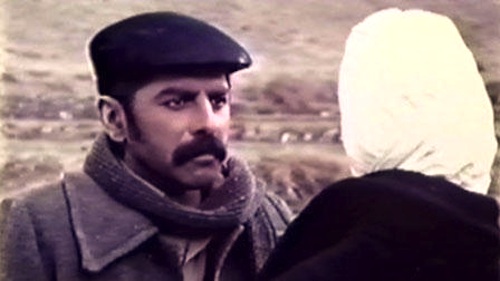
From "Tall Shadows of the Wind."

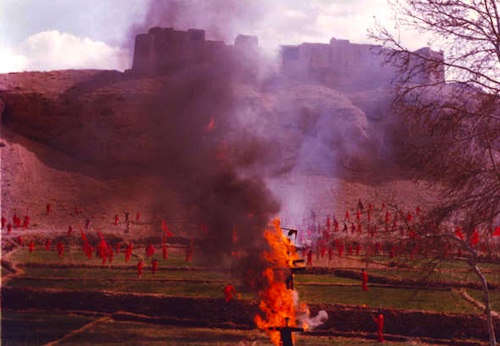
By Joe Bendel. It could be world cinema’s most iconic scarecrow after The Wizard of Oz, but this severe figure definitely lacks a heart. Conceived as a protest against the Shah’s rule, it eerily foreshadowed the tragic disappointments of the Islamic Revolution, thereby earning it the distinction of being banned by both regimes. Fittingly, Bahman Farmanara’s Tall Shadows of the Wind screens next week during the Asia Society’s Iranian New Wave 1960’s-1970’s film retrospective.

Produced in 1979, the timing for Wind was profoundly unlucky. Right from the opening sequence, one can see how the new authorities would take issue with Farmanara’s heavily symbolic adaptation of Houshang Golshiri’s short story. A hardscrabble village has assembled in the fields to chant their prayers to their long awaited deliverer. It is a primal scene with a vaguely pagan character, feeling rather out of place in the Abrahamic tradition.

Clearly, life is desperately hard for the village, due to reasons only vaguely alluded to. A scarecrow has been erected in the fields, which should be a positive development. However, when Abdullah the bus driver draws the rough approximation of his own features on the straw man, it starts to exert a malevolent influence on the local populace. Anxiety and general feelings of dread run rampant through the hamlet, leading to some very real physical repercussions. As the indirect cause of it all, the somewhat eccentric Abdullah is further marginalized within the community. Yet, he remains the one member of the tight-knit group inclined to take action.

From "Tall Shadows of the Wind."

Even with Wind’s otherworldly vibe, the significance of a new progressive guardian bringing even greater misery is impossible to miss. Likewise, its pointed depiction of the nonconformist’s troubled place within society did not exactly fit the new government’s playbook, either. Causal relationships can get a little sketchy, but the mysterious uncertainty is part of what makes it so unsettling. Farmanara creates an impossibly hard to describe vibe, combining gritty naturalism and a feverish sense of supernatural oppression. Although Wind is a decidedly cerebral allegory, it could have easily been converted into a horror film with a handful of re-shoots and a different score.

Evidently finding a clean print of Wind is a bit of a challenge, but even in imperfect formats, Farmanara’s visuals are unusually powerful and loaded with meaning. A compelling fusion of the unreal and the too real, Tall Shadows of the Wind defies comparison to other films. Since it will be projected from a DVD, the Asia Society will not charge admission to Wind this coming Tuesday (11/12). Highly recommended regardless, Farmanara’s film has never been as widely screened as it deserves to be (especially in Iran), so any showing is an event to take advantage of.

LFM GRADE: A-

Posted on November 11th, 2013 at 2:38pm.