LFM Reviews A Man’s Neck @ The Cine-Simenon Retrospective

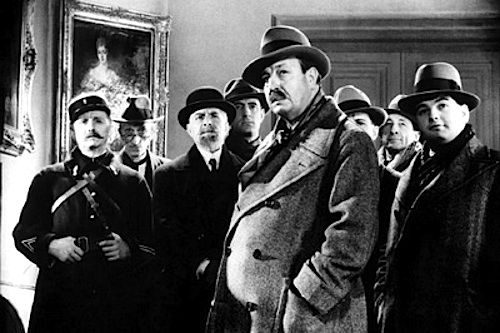
From "A Man’s Neck."

By Joe Bendel. Georges Simenon led a colorful life. There might have been a few women and some fast living. After the war, he also faced allegations of collaboration, but his defenders always maintained he was too self-absorbed for such matters. Harry Baur was one of a multitude of actors to play Simenon’s signature detective, whose wartime experience is tragically above suspicion. Imprisoned and roughly interrogated after ill-advisedly appearing in an early 1940’s German film, Baur either succumbed to injuries sustained or was helped along the way shortly after his release. His biographic details add further tragic context to Julien Duvivier’s A Man’s Neck, which screens during the Anthology Film Archives’ Cine-Simenon retrospective.

Willy Ferrière has a rich aunt who refuses to die, but a mystery pen-pal offers to help the old dear along for 100,000 francs. The freelance killer also has a scapegoat lined up to take the fall: the clueless Joseph Heurtin. Yes, this is the Maigret case Burgess Meredith later adapted as The Man on the Eiffel Tower, but it is simultaneously similar and different in intriguing ways.

As it happens, both films also serve as time capsules of Paris, pre- and post-war. Not surprisingly, though, the earlier French film is darker and somewhat franker than the RKO production. The stories run along parallel lines, but diverge on key points, such as the complicity of Ferrière’s mistress in Duvivier’s film. Indeed, there is little innocence per se in this distinctly dark crime drama.

Both Baur and Laughton look like world weary civil servants, but the latter could not help playing the part with panache. He was Charles Laughton, after all. In contrast, Baur’s Maigret is a down-trodden bureaucrat often at risk of fading into the background, until roused to outrage by the psychotic Radek. It is a close call, but in a head-to-head match, Laughton probably takes it by a jowl.
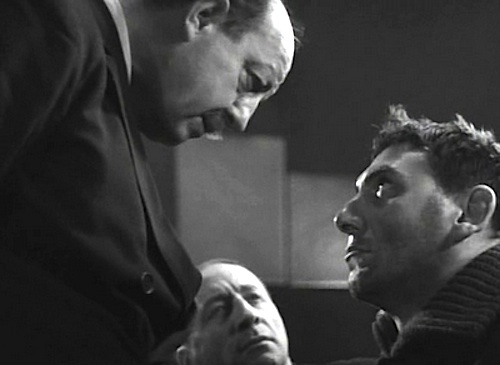
From "A Man’s Neck."

Likewise, Meredith’s Heurtin is a truly unique portrait of a man made vulnerable by his acutely anti-social nature. Alexandre Rignault’s Heurtin is also quite effective, but we have seen such simple-minded hulks before and since. However, Valéry Inkijinoff’s frenzied and lusty Radek is something else entirely. Franchot Tone exceeds expectations in Eiffel Tower, but the Russian Inkijinoff is truly creepy.

In fact, both are very good films.  Duvivier shows an eye for procedural detail, giving viewers an unromanticized look inside the Paris gendarmerie. While more naturalistic and generally jaundiced in his portrayal of human nature, Duvivier also shoehorns in small, elegantly telling moments, as when Maigret and Radek take time out from their verbal sparring to listen to his Chanson-singing neighbor.

Neck is a lean, mean film noir that packs surprising punch. It depicts a deeply flawed world, but not one in which moral judgments are impossible. Recommended by itself or in conjunction with Meredith’s Eiffel Tower (showing separately), A Man’s Neck screens this Saturday (8/10) and next Wednesday (8/14) as part of Cine-Simenon, now underway at Anthology Film Archives.

LFM GRADE: A

Posted on August 8th, 2013 at 1:36pm.
LFM’s Govindini Murty Talks with Elysium‘s Diego Luna @ HuffPost Live

LFM’s Govindini Murty participated in a HuffPost Live segment yesterday with Mexican actor Diego Luna, who co-stars with Matt Damon and Jodie Foster in this weekend’s new sci-fi spectacle Elysium, directed by Neill Blomkamp.  Luna was first introduced to American audiences in the critically acclaimed Y Tu Mama Tabien.

Govindini comes on to the segment about 23 minutes in, and asked Luna several questions about what it was like for him to work in the sci-fi genre, and how he prepared for Elysium.  Our thanks to the HuffPost Live team for inviting Govindini to participate.

Posted on August 7th, 2013 at 1:06pm.

David Tennant Investigates: LFM Reviews Broadchurch; Premieres Wednesday (8/7) on BBC America

By Joe Bendel. It is the drama that made Twitter explode in the UK. Fox has plans for an Americanized version for the 2014-15 season, but intrigued viewers only have to wait eight weeks to find out who did it. The ensuing investigation might just cost the investigating detective a sizable chunk of his soul. Nevertheless, all will eventually be revealed when the eight week Broadchurch airs on BBC America, beginning this Wednesday.

Young Danny Latimer has been murdered. His body was found dumped at the beach, but the Socos (CSI) quickly determine that this is not the original crime scene. Beth and Mark Latimer did not realize that their son is missing until it was too late, merely assuming he was off on his morning paper route. Dogged Detective Inspector Alec Hardy soon discovers other family secrets that kept certain Latimers preoccupied.

Hardy is either the best or the worst DI for this investigation. In his last posting, the detective worked an eerily similar case. Precise details will emerge over time, but it clearly ended badly. Hardy had come to the small Jurassic Coastal town of Broadchurch to escape the media spotlight and recuperate his ailing body and psyche. While fraught with career perils, the Latimer case represents possible redemption for the controversial copper. However, he will have to work it with the distinctly resentful Detective Sergeant Ellie Miller, who came back from her vacation to find Hardy in place of her anticipated promotion.

There will be no shortage of suspects in Broadchurch, including Danny’s father; his friend and colleague Nigel Carter; Jack Marshall, the local newsagent; the insomniac vicar Rev. Paul Coates, and a nasty late middle-aged woman living in mobile home not far from the crime scene. DS Miller’s own son Tom also acts rather oddly upon learning of his friend’s murder. Series creator Chris Chibnall will focus suspicion on just about everyone before the big finale, but Broadchurch is just as much about the grief and guilt resulting from the Latimer murder as it is a mystery procedural.

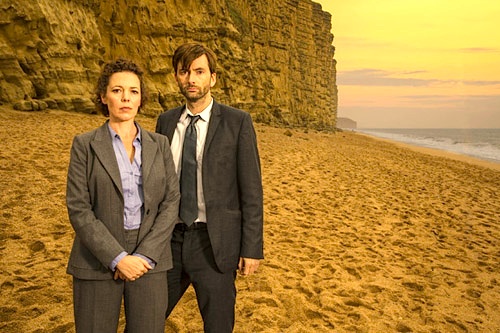
From "Broadchurch."

Broadchurch will be of particular interest to Doctor Who fans, starring former Doctor David Tennant as DI Hardy, former companion Arthur Darville as Rev. Coates, and guest star Olivia Colman as DS Miller. Frankly, Broadchurch might just eclipse the Doctor as Tennant’s career defining role. Again, he makes a convincingly intelligent screen presence, but where the dashing figure he supposedly cut in Spies of Warsaw was a bit of a stretch, he is darkly compelling as the haggard, sullen, world-weary, angst-ridden Hardy. Yet Colman also holds her own in their scenes together quite well as the increasingly disillusioned DS Miller.

To their credit, both Darville the actor and Chibnall the writer make Rev. Coates a legitimate suspect, while still avoiding all the easy clergy clichés. They even allow him some surprisingly powerful sermons that essentially function as the conscience of the series. Yet it is Jodie Whittaker who really personifies Broadchurch’s emotional devastation as the distraught Beth Latimer.

Broadchurch is grabby right from the start, but it is written with greater depth and psychological insight than conventional mystery series. Doctor Who alumni James Strong and Euros Lyn helm their installments with admirable sensitivity and the music of hardcore drummer-turned contemporary classical composer Ólafur Arnalds sets an unusually elegiac tone. Quality television in every way, Broadchurch is highly recommended for fans of ambitious mystery series, like The Killing, Twin Peaks, and Top of the Lake. It commences its American premiere this Wednesday (8/7) on BBC America.

LFM GRADE: A

Posted on August 5th, 2013 at 11:37pm.

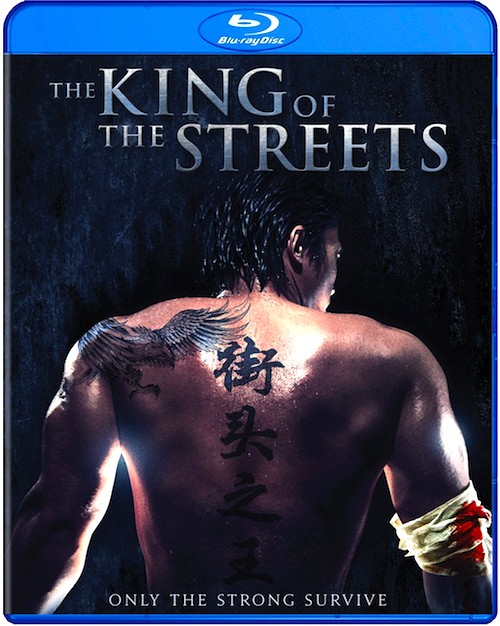
Redemption Leaves a Serious Mark: LFM Reviews King of the Streets; Available Now on Blu-ray/DVD

By Joe Bendel. Yue Feng’s specialty is facing down large gangs of lead pipe wielding toughs. He is so good at it, he has done time. There is a reason they used to call him “the Street Fighter.” He would like to put his old life behind him, but obviously that is not going to happen. Billed as China’s first mixed martial arts movie, writer/action director/lead actor/co-director/co-editor Yuen Song & co-director Zhong Lei bring it old school in The King of the Streets, which is now available on DVD and Blu-ray from Well Go USA.

Yue Feng has just been released from prison, but the death of a rival gang member still troubles his conscience. Yes, the punk had it coming, but he is a sensitive street fighter. Resolving to go straight, he takes a job with a moving company. While delivering some donated equipment to a private orphanage, Yue Feng meets Li, an attractive volunteer. She has a few moves herself, but nothing like the Street Fighter. Soon he is volunteering regularly. At first, he is just helping out with the kids and lifting heavy things, but soon he is fighting off the hired muscle trying to run the orphanage off its prime piece of real estate.

King, the throwback throwdown, mixes generous helpings of no holds-barred street melee with old fashioned melodramatic angst. It is impossible to miss Yue’s themes of redemption and loyalty, but he sure can mix it up. To be fair, he also develops respectable romantic chemistry with Becki Li. Yue’s fellow professional fighters Hou Xu, Kang En, Yang Jianping, and the Chang Long Stunt Team also clearly know how to give and take a punch. Nobody was really hired for the acting chops (except maybe Li), but so be it.

Almost entirely staged in abandoned warehouses and back alleys, Yue’s film has a Spartan vibe and a dramatic simplicity that is frankly rather aesthetically appealing. Co-cinematographers Liu Zhangmu and Li You earn style points with the black-and-white flashback interludes, while consistently maintaining an icy slick look.

While not exactly Crouching Tiger, Hidden Dragon, King’s gritty action and earnest, straight forward delivery is likely to make it a sentimental favorite for genre fans. Kind of awesome in a low budget, rough around the edges, doggedly striving sort of way, The King of the Street is recommended for meatheads with heart. It is now available on DVD, Blu-ray, and VOD from Well Go USA.

LFM GRADE: B-

Posted on August 5th, 2013 at 11:36pm.

LFM Review The Tiger Mask @ The 2013 Fantasia International Film Festival

From "The Tiger Mask."

By Joe Bendel. To give credit where it is due, the underground bouts produced by a shadowy criminal syndicate are not fixed. On the other hand, they often end with a fatality. Three of their up-and-coming wrestlers have a distinct advantage. After all, they are not wearing that headgear for Lucha Libre style points. The cult 1960’s wrestling manga and anime series gets a darkly super-heroic facelift in Ken Ochiai’s The Tiger Mask, which screened yesterday as part of the 2013 Fantasia International Film Festival.

After watching the landlord bully the gentle director of his beloved orphanage, young Naoto Date resolves to stop being a victim. Unfortunately, this makes him ripe for recruitment by the mysteriously powerful Mr. X, who whisks him away to train in the Tiger’s Lair, too, as a wrestler. Most of the boys arriving with him will not make it, but the top three will be awarded Tiger Masks. Either through science or black arts, these strange accessories amplify the natural powers of those who wear them, but leave them drained after their matches.

Ten years later, Date receives the Black Tiger Mask and duly triumphs over his first opponent in the ring. His friend Dan will grapple as the Gold Tiger Mask and the final White Tiger Mask will go to Jo, the mean-spirited trouble-maker. Obviously, there is a grudge match brewing between him and Date, especially when the disillusioned wrestler decides to go rogue.

Evidently, Tiger Mask is a beloved franchise in Japan that spawned a succession of real life Tiger Masks in Japanese pro-wrestling. Even by cartoon standards, the ring action in Ochiai’s reboot is pretty crazy, with the Masks’ opponents looking more like Dick Tracy villains than underground athletes. It definitely follows in the darkly stylized Sin City tradition, but it carried the seal of approval of its late producer Hisao Maki, the younger brother of Tiger Mask creator Ikki Kajiwara, who passed away shortly before the film was created. Obviously, there must be hopes this will be the start of a new franchise, but uninitiated viewers might be somewhat frustrated by the limited ground covered by the narrative, basically giving viewers the temporary closure of a ninety minute TV pilot rather than a feature tent-pole.

From "The Tiger Mask."

Still, there is some unapologetically meathead action in Tiger, staged with relish. Yet the film also has some heart, especially from Gantz’s Natsuna Watanabe, pleasingly upbeat and idealistic as Ruriko Wakatsuki, the grown-up daughter of the old orphanage headmaster. Cross-over pop-star Eiji Wentz also broods decently as Date, but perhaps the considerable amount of time he spends masked it not such an unfortunate thing.

Ochiai keeps the energy level nicely pumped-up and never lets the quite presentable special effects overwhelm the human element. In terms of tone and themes, it is like a fusion of Ender’s Game, Battle Royale, and Rikidozan. Despite the more contemporary sensibility, Tiger Mask will probably still be best appreciated by those familiar with the original series, as well as Japanese (non-sumo) wrestling. Recommended for fans of action films based on manga and anime, The Tiger Mask screened during this year’s Fantasia Festival.

LFM GRADE: B-

Posted August 5th, 2013 at 10:38am.

LFM Reviews The Great Passage @ The 2013 Fantasia International Film Festival

From "The Great Passage."

By Joe Bendel. Remember when Microsoft was in the ink-and-paper reference business? Now the Encarta seems like a relic from a past era. In contrast, the new dictionary a diligent Japanese publishing team develops might just live up to its hype in Yuya Ishii’s quietly nostalgic The Great Passage, which screens today up at the 2013 Fantasia International Film Festival.

In the mid 1990’s, the publishing industry had barely progressed beyond a stylus-and-stone level of technology. CD-Roms were projected to be the next big thing. Mitsuya Majimme, a socially awkward former linguistics student, performs poorly as a sales rep, but he finds his niche when he is transferred to his company’s sleepy reference imprint. Obsessively detail-oriented, he is the perfect editor for the director’s ambitious new dictionary, The Great Passage.

Over the next fifteen years, Majime will compile a definitive dictionary of the Japanese language as it is truly spoken, identifying and defining scores of new words, while refining the definitions of words that have evolved over time. It is an arduous, time consuming process, involving note-cards more than computers. Frankly, it is not the sort of investment his publishing conglomerate is inclined to make. Fortunately, Majime has a high-placed ally in Masashi Nishioka, a former dictionary colleague transferred to the corporate marketing department. As Majime invests years of his life in the dictionary, he also slowly but surely develops a romantic relationship with Kaguya Hayashi, his landlord’s granddaughter. An apprentice chef and compulsive knife-sharpener, she is the same but different from Majime in all the right ways.

From "The Great Passage."

Based on Shion Miura’s novel, Passage can stake a strong claim to be the great Japanese reference publishing movie we have all been waiting for. Its operational understanding of the dysfunctional business is almost scary. Yet, there is something aesthetically pleasing about its affection for language and book people. It is also refreshing to see a film with a sufficient attention span to follow the in’s and out’s of the fifteen year editorial and production process. While Passage’s one hundred thirty-three minute running time is not exactly breakneck, the consistently absorbing film never feels slack or padded. Rather, it pulls viewers along with its own gentle rhythms.

In a radical change-up from his work in I’m Flash, Ryuhei Matsuda is terrific as Majime. Without the benefit of a big epiphany moment, he vividly portrays the editor’s subtle but steady personal and professional growth. Likewise, Aoi Miyazaki is genuinely engaging as the spirited yet only somewhat more outgoing Hayashi. Yet it is Shingo Tsurumi and Kaoru Yachigusa who really lower the emotional boom of time’s passage as the reference director and his devoted wife.

Yes, this is definitely the sort of film that will choke viewers up. Let’s face it, there’s nary a dry eye in the house when that blasted dictionary finally comes out. However, Ishii never indulgences in cheap manipulation, earning his sentiment the hard way. At every turn, he opts for small, telling scenes over big melodramatic show-pieces. The cumulative impact is deeply satisfying. Highly recommended for fans of Japanese cinema and anyone connected to the book business, The Great Passage screens today (8/2) and Sunday (8/4) at the J.A. De Seve Theatre as part of this year’s Fantasia Festival.

LFM GRADE: A-

Posted on August 2nd, 2013 at 4:16pm.