Working Class Caper: LFM Reviews Wasteland

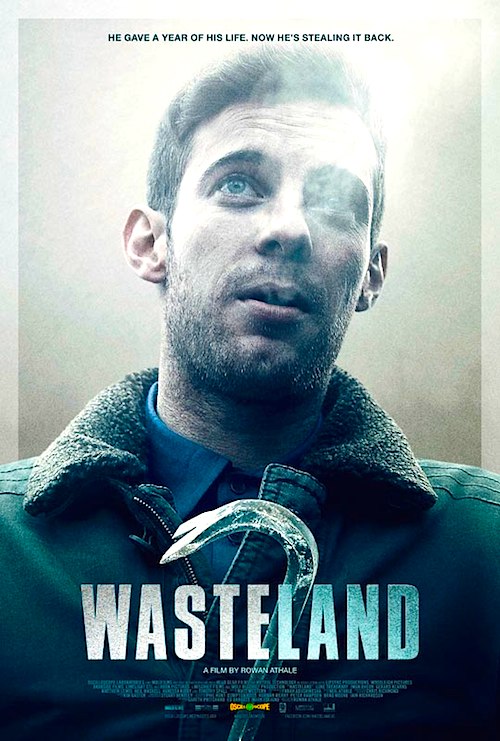
By Joe Bendel. These scruffy lads are nothing like Raffles the gentleman thief, but their intended target is a real knuckle-dragger. A recently released ex-con and his mates put a working class spin on the movie caper in Rowan Athale’s crackerjack Wasteland (trailer here), which opens this Friday in New York.

Given that the film starts in media res with our protagonist in a police interrogation room, it would seem that the caper wasn’t very successful. However, there will be several twists to the tale the black-and-blue Harvey tells Detective Inspector West. Six weeks ago, he was released on parole. Framed on drug charges by Steve Roper, poor Harvey was a bone the local gang lord threw to the coppers to distract them from his own narcotics business. None too happy about it, Harvey plans to use information he overheard in prison to get some payback and seed money for a new life abroad.

Ostensibly, Roper has no connections to the neighborhood social club, making the basement office safe the ideal place to stash his illicit cash. Of course, Harvey cannot take it alone. He will recruit three friends: Dempsey the fast talker, Dodd the hard drinking goon, and Charlie the momma’s-boy welder. He makes a point of not involving his ex-girl friend Nicola, but he still rekindles their relationship in spite of his better judgment.

Although Timothy Spall only appears as DI West in the wrap-around narrative device, his rumpled gravitas lends the film instant credibility right from the start. In fact, Athale has assembled quite an accomplished cast of recognizable but not necessarily famous faces. Despite his unprepossessing screen presence, Luke Treadaway is suitably world weary as Harvey, whereas Iwan Rheon’s Dempsey is a slyly roguish standout (even if some of his dialogue is hard for American viewers to catch without subtitles). Again projecting a sense of banal menace, Kill List’s Neil Maskell makes another beefy but intense villain as Roper, looking quite at home in this gritty milieu.

As caper movies go, Wasteland is decidedly moody, but it is never slack. For a first time helmer, Athale ushers in each reversal and revelation with an assured touch. Frankly, it turns into an out-and-out crowd-pleaser, while staying true to its working class roots. Thoroughly satisfying, Wasteland is highly recommended for caper fans and viewers of Ken Loach’s more accessible films (like Angels’ Share). It opens this Friday (7/26) in New York at the Cinema Village.

LFM GRADE: A-

Posted on July 22nd, 2013 at 11:27pm.
LFM Reviews Keye Luke, More Than a Face in the Crowd @ The Asian American International Film Festival

By Joe Bendel. Joe Dante’s Gremlins has a strange significance at this year’s Asian American International Film Festival. Two docu-shorts profile actors who worked on the film. In a way, Keye Luke and Jane Chung represent opposite sides of the same coin. Both did their best to navigate the studio system at a time when Hollywood was not particularly hospitable to Asian American talent. While Chung worked steadily but anonymously in small roles, Luke became famous as Kato and Charlie Chan’s Number One Son. Timothy Tau allows Luke to speak for himself in his short docudrama, Keye Luke, which screens as part of the Into the Penumbra short film program at this year’s Asian American International Film Festival (AAIFF).

Reflecting on his life, Luke addresses the audience in a manner akin to a stage play. As he reminisces, we see episodes of his life, starting with his early home life, progressing through the double-edged Charlie Chan films, his continuing sidekick-gigging as Kato to the Green Hornet, finally reaching his first starring role in the final Mr. Wong film. Mixing irony and realism, distinctly Anglo actors portray Warner Oland and Sidney Toler, the Swede and the Scot who portrayed Charlie Chan. However, Tau does not hate on the Honolulu detective, acknowledging the franchise represented an opportunity for Asian actors like Luke and his older brother Edwin, albeit a flawed one.

Essentially, Tau argues that Luke did what he could with what the system would give him, eventually becoming a widely respected and recognized character actor, whose credits include quality films like Woody Allen’s Alice. It is quite a reasonable, pragmatic perspective, under-pinning a film that revels in the goofy idiosyncrasies of 1940’s b-movies and serials (the Secret Agent X-9 scene is particularly inspired). Keye Luke also boasts a surprisingly big name cast by short film standards, including ER’s Archie Kao and Bang Bang’s Jessika Van, who all clearly enjoy the retro tribute to the late great Luke.

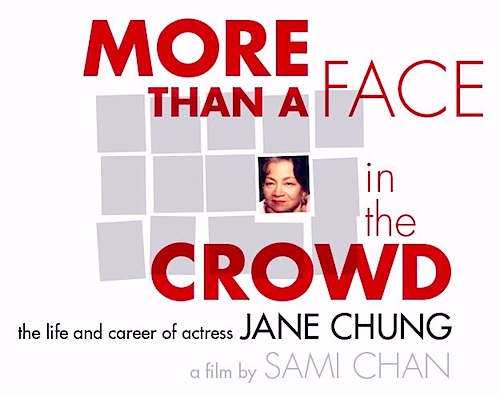
Fame always eluded filmmaker Sami Chan’s great aunt Jane Chung, but she still enjoyed the business according to those who speak fondly of her in More Than a Face in the Crowd, also screening as part of the Penumbra block. Chung had walk-on or small speaking parts on probably more films and television shows than Michael Caine, but finding her in the frame is usually a challenge. Supposedly, she had a shouting match with Ricky Ricardo, but her family can never find it during their I Love Lucy marathons.

Again, Chan describes how Chung made lemonade out of lemons, finding extra work much more entertaining and rewarding than the sort of part time jobs available to most homemakers in the 1960’s. With credits that include Chinatown, Funny Girl, Flower Drum Song, and When Harry Met Sally, she was a small part of many cinematic milestones.

Although still alive during the production of Crowd, the circumstances of old age prevented her from participating. It is too bad she could not enjoy a taste of wider recognition during her lifetime, but Chan’s short doc is a fitting tribute that also covers some under-examined cinema history with economy and authority. Clocking in just under half an hour, Crowd would be an appropriate programming choice for PBS sometime down the road. For now, it is quite a shrewd selection for AAIFF, especially considering the way it speaks in dialogue with Tau’s Keye Luke. Recommended for movie lovers, More Than a Face in the Crowd and Keye Luke screen this Thursday (7/25) at the Anthology Film Archives during the 2013 AAIFF.

LFM GRADES: B+, B+

Posted on July 22nd, 2013 at 11:26pm.

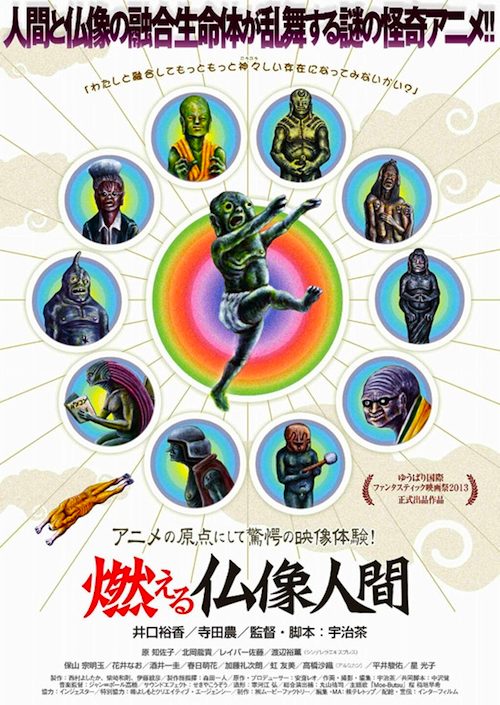
LFM Reviews The Burning Buddha Man @ The 2013 Fantasia Festival

By Joe Bendel. Where was the Seaddattha when the Bamiyan valley Buddhas were destroyed Afghanistan? Instead, the secret society is plundering Kyoto’s Buddha statues, supposedly for their own protection. However, a young girl quickly learns things are not as they seem in Ujicha’s mind-bending animated feature, The Burning Buddha Man, which screens today as an official selection of the 2013 Fantasia Festival.

Young Beniko is suddenly alone in the world. Her parents, or at least their torsos, disappeared while protecting their temple’s Buddha statue from an uncanny intruder, while the grandmother she never really knew remains in a mystical catatonic state. Enju, a monk who claims to be a friend of the family, welcomes her into his retreat. He explains to the baffled girl how the Seaddattha have perfected matter transference to enable their crime spree. He also introduces her to his son Enji, a carver of Buddha statues, whose techniques might just prevent the sort of fusion tragedies that befell her parents. Then things get really, really weird.

Rendered through a mix of the “gekimation” style of paper cut-out animation and live action (largely reserved for spurting vomit and blood), Burning has an absolutely bizarre look and vibe. Think of it as equal parts H.R. Giger, René Laloux, and South Park. You have never seen a film like this, particularly considering how seriously it treats its Buddhist subject matter, notwithstanding the scatological bits. As Beniko raises her consciousness to battle her powerful nemesis, she seeks not to kill but to reform his corrupted soul. That is a noble sentiment, so good luck with that.

In Burning, the themes and visuals trump bourgeois characterization and narrative cohesion, and it is a massively archetypal head-trip. You would not consider it traditional anime by any stretch, yet one can see hints of shared old school elements when the forces of good and evil fuse themselves into Golem like creatures for the final cosmic battle.

Even though Burning features a resilient young heroine and a respect for both religion and the sanctity of life, it is not exactly appropriate for family viewing. Sure, an occasional head explodes, but the film’s motifs and implications would just be too challenging for mortal parents to explain. Recommended for fans of animation and cult cinema with a taste for the profound and the eccentric, The Burning Buddha Man screens this Monday (7/22) at the J.A. De Seve Theatre as part of this year’s Fantasia Festival. Anyone remotely near Montreal who is in any way intrigued should see it when they can. Those attending the fest should definitely also check out Big Bad Wolves, Black Out, Confession of Murder, Drug War, Ip Man: the Final Fight, It’s Me It’s Me, The Last Tycoon, The Rooftop, Thermae Romae, and When a Wolf Falls in Love with a Sheep. More to come.

LFM GRADE: B+

Posted on July 22nd, 2013 at 3:05pm.

LFM Reviews The Samurai that Night @ The 2013 Japan Cuts

From "The Samurai That Night."

By Joe Bendel. Japan gave the world one of the greatest revenge stories of all time. Sadly, Hollywood is reportedly returning the favor by butchering Keanu’s 47 Ronin into some kind of cheesy Frankenstein’s Monster. It turns out vengeance-taking is a trickier proposition than people realize. A grieving husband understands this only too well in Masaaki Akahori’s The Samurai that Night (trailer here), which screened last night as part of the 2013 Japan Cuts: The New York Festival of Contemporary Japanese Cinema.

Kenichi Nakamura was always socially awkward, but the hit-and-run death of his wife Hisako reduces him to a scant shell of a man. Nearly five years later, Hiroshi Kijima, the violent petty thug responsible for her death, has been released from jail. He is neither reformed nor remorseful, but he is a little unnerved by the daily death threats he receives from Nakamura promising to kill him on the fast approaching anniversary of Hisako’s death. Yet, he still has the presence of mind to use the poison pen letters to extort money from Nakamura’s earnest brother-in-law.

A moodier, slower burner than even the original, misunderstood Death Wish, Samurai hardly gives viewers any consolation whatsoever. Nakamura is a profoundly damaged soul, Kijima is absolutely rotten to the core, and neither is likely to change. Still, agonizingly touching moments spring up in the most surprising places, such as when the rough hewn employees of Nakamura’s metal works express affection for their disintegrating boss.

From "The Samurai that Night."

Far from a genre crowd-pleaser, Samurai vividly depicts the ugly, awkward, and messy realities of violence. Viewers are not likely to forget the climatic showdown, precisely because of the ways it undercuts expectations and payback genre conventions.

As the sweat-drenched, tighty-whitey wearing Nakamura, Masato Sakai fearlessly put himself out there. At times, he is absolutely painful to watch, like a huge open sore picking itself apart on-screen. In contrast, Takayuki Yamada’s Kijima is a study in fiercely controlled aggression. Mercifully, Kinuwo Yamada and Tsutomu Takahashi add a deeply humane dimension to the film as bystanders sympathetic to Nakamura.

You have to admire the integrity of writer-director Akahori’s vision. His unforgiving depiction of human nature never gives his characters anyplace to hide. It is a world of drab colors and humdrum homes that loses nothing in the translation. This is a writer’s film much more than a director’s film, matter-of-factly presenting the angst and cruelty of his characters. Powerfully brought to life by an accomplished cast, The Samurai that Night is highly recommended for those not intimidated by everyday tragedy, as this year’s Japan Cuts concludes at the Japan Society.

LFM GRADE: B

Posted on July 22nd, 2013 at 3:04pm.

LFM Reviews Only God Forgives

By Joe Bendel. Evidently, expat Julian Thompson had a spot of legal trouble back home. He and his drug-running brother Billy now assume Bangkok is their oyster and act accordingly. However, Thompson might just miss those coppers with their due process. The family business will get ugly in Nicolas Winding Refn’s Only God Forgives, which opens today in New York.

Julian is the sensitive Thompson brother. He runs the legit side of their Muay Thai boxing club front and keeps his regular prostitute Mai on-call, even though he never fully avails himself of her services, if you get the drift. Billy Thompson was always his mother’s favorite. Unfortunately, he is now dead, but he sure had it coming.

After raping and killing an under-aged prostitute, the elder Thompson brother was locked in a room with her guilt ridden father, who knew what to do. Chang was the one who told him to. The mysterious retired police officer still seems to call all the shots on the Bangkok force. Although he sometimes appears eerily bad-assed, Chang is probably just a metaphorical “Angel of Death.” Of course, Thompson is just as dead either way.

Given the circumstances of his brother’s death, little Julian has trouble ginning-up sufficient outrage to seek vengeance. This is not the case for their Oedipus Complex-on-wheels mother, Crystal. She blows into town like a hurricane, determined to avenge her preferred son. Crystal will also take every opportunity to mess with Julian’s head, while re-asserting control of her far-flung illicit businesses. Killing a cop is no big deal to her, but Chang is no ordinary flatfoot.

For what it’s worth, Only is nowhere near the train wreck Cannes reviewers made it out to be. The film has its memorable moments and performances. Yet there is no denying Winding Refn’s approach is rather self-indulgent. There are so many long slow David Lynchian shots of empty hallways, viewers will half expect a giant and a dwarf to eventually pop out of a door. There is also an oppressively misogynistic vibe to the film. Thai actress Ratha Phongam is a lovely woman, who does what she can with Mai’s pencil thin character, but the way the Thompsons treat her is rather appalling—and she gets off easy compared to others.

From "Only God Forgives."

Of course, some might call Crystal Thompson a strong female character. That is certainly true, but a foul mouthed, sexually manipulative, woman-hating, sociopathic mommy-monster should not exactly constitute a feminist role model. Kristin Scott Thomas is rather awe-inspiring in the role, hardening her tart-tongued imperious image in a forge of hellfire.

To the film’s credit, it finally finds Ryan Gosling’s comfort range: sullen and emasculated. The film also delivers vicarious payback during Julian’s massive beatdown scene. Audiences will start to cheer in their heads “that was for the interminable Blue Valentine and that was for the pretentious The Place Beyond the Pines, and that was for its ridiculously awkward title.”

Frankly though, Vithaya Pansringarm is the star of the film, following-up his breakout performance as the murder-solving Buddhist monk in Tom Waller’s Mindfulness and Murder. An intensely righteous screen presence, his Chang is like a Dirty Harry with a divine mandate. As the president of the Thailand Kendo Club, he also swings a sword with authority.

Throughout Only, Winding Refn’s directorial hand is so heavy it nearly crushes everyone on screen, except KST and Pansringarm—they never wilt. Too laborious and too stylized, it still serves as a dramatic showcase for its fine supporting players. Only recommended as a curiosity piece for cult film veterans, Only God Forgives opens today (7/19) in New York at the Angelika Film Center.

LFM GRADE: C

Posted on July 19th, 2013 at 11:34am.

LFM Reviews I Have to Buy New Shoes @ The 2013 Japan Cuts

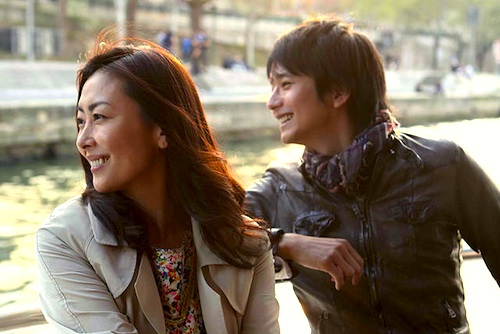
By Joe Bendel. A young photographer finds romance where he least expects it: Paris. Sure, it is the City of Lights, but he assumed his short sight-seeing trip would only entail some brotherly chaperoning. Instead, he spends some ambiguous quality time with an attractive older Japanese woman in Eriko Kitagawa’s I Have to Buy New Shoes, which screens tonight as part of the 2013 Japan Cuts: The New York Festival of Contemporary Japanese Cinema.

Sen Yagami only came to Paris at the insistence of his younger sister, Suzume. However, she contrives a way to ditch her indulgent brother along the banks of the Seine before they even reach their hotel. She has plans of her own, involving her long-distance artist boyfriend. This is rather inconvenient for Yagami, since he does not even have their hotel information. Fortunately, a broken heel precipitates a meet-cute with expat magazine editor Aoi Teshigahara, at the expense of his ground-up passport.

Initially, Teshigahara helps him navigate Paris as a friendly fellow countryman abroad, but a mutual attraction slowly grows between them. Surprised and confused by their feelings, Teshigahra and Yagami engage in a halting courtship dance that is refreshingly chaste compared to most films. Nonetheless, Yagami will not see much of his hotel, wherever it might be.

Following in the tradition of Brief Encounter, Shoes has already been widely compared to Linklater’s Before trilogy as well as the 1990’s Japanese television work of Kitagawa and producer Shunji Iwai. Yet, this is a much quieter film, saying more with a look than a page self-consciously clever dialogue. The title may sound like chic lit, but Kitagawa maintains a vibe of mature sadness that is anything but.

From "I Have To Buy New Shoes."

It is impossible to overstate what Miho Nakayama brings to the film as Teshigahara. A long time Paris resident herself, she is a smart, sophisticated, and beautiful presence throughout the film. Yet, when she lowers the dramatic boom, it is simply devastating. Poor Osamu Mukai’s Yagami is just no match for her, even though he has some nice moments expressing the younger man’s very real disappointments in life. He is no boy toy, not by any stretch. Mirei Kiritani also brings unexpected depth to seemingly coquettish Suzume late in the third act.

Just about every scene of Shoes has a subtle surprise, yet invariably rings true. It is a classy package, capitalizing on the Parisian backdrops and sparingly incorporating Ryûichi Sakamoto’s evocative piano themes in just the right moments. Above all else, it is a stunning showcase for Nakayama that would elevate her to the absolute top tier of international stardom in a more just world. Very highly recommended for those who appreciate intelligent, grown-up relationship films, I Have To Buy New Shows screens tonight (7/18) as this year’s Japan Cuts continues at the Japan Society.

LFM GRADE: A

Posted on July 18th, 2013 at 1:19pm.