LFM Reviews Pieta

By Joe Bendel. Evidently, times are tough for Korean mom-and-pop machine shops and hardware stores. Turning to a predatory lender only makes things worse. It is Lee Kang-do’s job to collect, which he does in the worst manner possible. It is soulless work, but it suits him. However, there will be a reckoning in Kim Ki-duk’s Golden Lion Award winning Pieta (trailer here), opening this Friday in New York.

Lee’s boss plasters the depressed Cheonggyecheon neighborhood with flyers for his loan service, but he never mentions the four figure interest rate. When borrowers inevitably fall behind on payments, they are forced to take out insurance naming his dodgy company as their beneficiary. Shortly thereafter, Lee arrives. He maims instead of killing. It is easier to collect that way. In proper loan shark fashion, he has left a long string of broken bodies in his wake.

Not exactly a people person, Lee is rather annoyed when a middle-aged woman starts following him. He is even less impressed when she claims to be his long lost mother seeking to make amends for abandoning him during his early childhood. Initially, he wants nothing to do with Mi-sun. Yet he slowly gets used to the idea of finally having a mother. Then things really start to get dark and twisted.

Seriously, it is hard to figure why Pieta is being released the weekend after Mothers’ Day. Who wouldn’t want to take Mom to a bleakly naturalistic, sexually charged religious allegory? Like classical tragedy, it tackles some heavy themes, such as maternal love, redemption, and retribution, which Kim quietly and methodically strips them down to their stone cold essences. As a result, Pieta’s payoff is so bracing, it stings, even if viewers anticipate the shoe that drops.

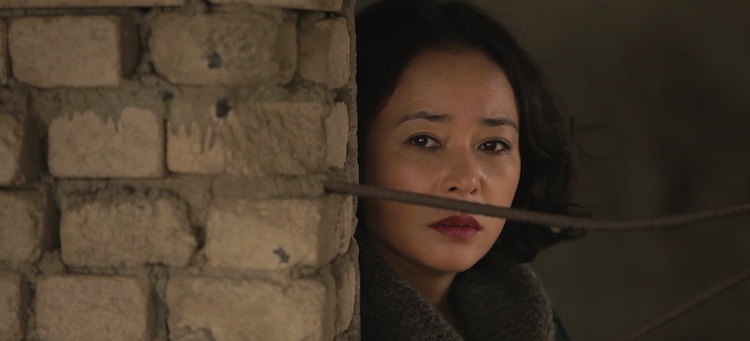
From "Pieta."

As Mother Mi-sun, Cho Min-soo is pretty extraordinary. It is a harrowing and fearsome performance, but also an acutely human portrayal. Yet, in many ways, Lee Jung-jin has the harder challenge, finding pathos and vulnerability in a hardened monster like Lee Kang-do. Nearly a two-hander, their scenes together are genuinely riveting and often profoundly disturbing.

Pieta is a deeply moral film that treats the acts of love and sacrifice with deadly seriousness, suggesting both have intrinsic value. Yet, it would be a mistake to describe it as an optimistic film. Regardless, it is the work of a legitimate auteur with a very personal point of view. Kim directly transports the audience to the dingy back alleys of Cheonggyecheon, creating an overwhelming vibe of spiritual and economic hopelessness. A challenging fable featuring brave and haunting performances from his co-leads, Pieta is recommended for those who do not consider cinema a form of entertainment but rather a matter of life and death. It opens this Friday (5/17) in New York at the Cinema Village.

LFM GRADE: A-

Posted on May 14th, 2013 at 12:59pm.
LFM Reviews Halima’s Path @ The 2013 Bosnian-Herzegovinian Film Festival

By Joe Bendel. Supposedly, Tito held Yugoslavia together as one big happy family. Nonetheless, a late 1970’s episode of ethnic-religious strife eventually causes unimaginable anguish for a Bosnian mother decades later. Her story, inspired by, but not directly based on a documented historical incident, vividly illustrates the painful legacy of war in Arsen Ostojić’s Halima’s Path, which screened last night as part of the narrative feature competition at the 2013 Bosnian-Herzegovinian Film Festival in New York.

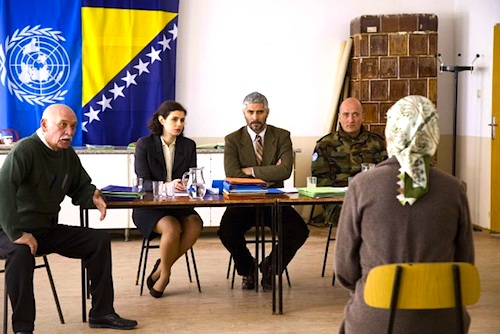
Having lost her husband Salko and son Mirza during the war, Halima has been unable to complete the grieving process while their remains are still unaccounted for. However, a breakthrough appears to have been made. Her husband has been recovered. Perhaps her son will be, too. The international team just needs her DNA to match to her son, but she seems strangely reluctant to comply.

Flashing back to 1977, Safija is also in a very difficult position. She lives in a Muslim village and is pregnant with the child of Slavomir, a Christian boy from the nearest Serb village. Her father does not take the news well, beating her severely. After Slavomir violently intervenes, he is quickly dispatched to Germany, for fear of reprisals. He will return, though. Indeed, everyone’s lives will become knotted together in Halima’s bitter tale.

Given the wartime issues Path addresses, it is important to note that Ostojić is in fact a Croatian filmmaker, working with a Bosnian screenwriter, Fedja Isovic, and a Serbian co-producer. While most of the cast is either Croatian or Serbian, nearly all had family ties to Bosnia-Herzegovina (including Srpska, where the film has yet to screen, for obvious reasons). Yes, Isovic’s screenplay unambiguously depicts Bosnian-Serb war crimes. Yet ironically, during the first act, it is Serbian characters, most notably Slavomir’s father, who exemplify tolerance. Of course, war changes people and countries, as viewers see in dramatic terms.

From "Halima's Path."

It would be a mistake to dismiss Path as just another film about the war and its aftermath. While it is intimate in its focus, the substantial portion set in 1977 gives it a much wider historical scope. Nor does it rely on stock characters or simplistic moralizing. At its moments of reckoning, Path is most closely akin to classical tragedy in the Sophoclean tradition.

Perhaps more to the point, it also happens to be an excellent film, anchored by the devastating power of Alma Prica’s honest and dignified lead performance. It is remarkable, award caliber work. Sarajevo native Miraj Grbić (recognizable to some as Bogdan in Mission Impossible: Ghost Protocol) also gives a finely nuanced performance as Halima’s brother-in-law, a character who suggests it is possible to become more humane with age, even after suffering the loss of loved ones.

Ostojić is best known for the black-and-white neo-noir A Wonderful Night in Split (co-starring Coolio), but with Path he drastically cranks down the auterist impulse, subordinating style to character and narrative. As a result, Path is visually lean and spare, communicating directly to receptive viewers. More commercial than film scouts have heretofore recognized, Halima’s Path has picked up numerous audience awards thus far. Strongly recommended, it was one of the clear highlights of this year’s Bosnian-Herzegovinian Film Festival in New York.

LFM GRADE: A

[Editor’s Note: Halima’s Path won the Golden Apple Audience Award at the festival.]

Posted on May 13th, 2013 at 11:32am.

Eckhart vs. Kurylenko: LFM Reviews Erased; Opens Friday (5/17), Also on VOD

By Joe Bendel. For the CIA, no good deed goes unpunished. When they finally take on a Hollywood-approved villain, it causes the violent destruction of their Belgian station. A former agency operative and his estranged daughter will have to figure out why in Philipp Stölz’s Erased, which opens this Friday in New York.

Ben Logan is a security consultant doing contract work for Halgate, a soulless multinational corporation. Unfortunately, he is too good at his job. After inadvertently uncovering something incriminating, Logan suddenly finds his office has been emptied, his bank account and email wiped clean, and his recent coworkers lying in the morgue as John Does. Only a timely bit of bad parenting saves Hogan and his daughter, Amy, sending them to the emergency room during that fateful night, instead of to their flat.

Logan does not know his daughter very well. He only assumed custody after the death of his ex-wife. Perhaps life on the run will help bring them together. However, he knows Anna Brandt only too well. He used to report directly to the corrupt CIA official—and he wasn’t working as a security analyst. He has “special” skills. That is why she will have to take charge of the manhunt personally.

Despite Brandt’s betrayal, Erased depicts the CIA in a reasonably positive light. As a policy, the agency is conscientiously working against the bad guys, rather than with them. Sure, Logan obviously worked for some kind of CIA hit squad, but based on the events that unfold, the agency seems to have a legit need for such specialists. Even Brandt has her moments down the stretch.

Olga Kurylenko in "Erased."

The fact that Brandt is played by Olga Kurylenko does not hurt, either. Smart and chic, she is more of a super-spy than a femme fatale, but she is always a worthy antagonist. Indeed, this might be Kurylenko’s year, following-up her starring role in Malick’s To the Wonder with a nice villainous turn. Some enterprising distributor ought to pick-up her powerful Chernobyl drama Land of Oblivion.

For his part, Aaron Eckhart makes a credible square-jawed hard-nose, carrying off his action scenes pretty well. As Amy, Liana Liberato is slightly less grating than she was in the clumsy Nic Cage vehicle Trespass. At least that constitutes progress. Unfortunately, Stars War alumnus Garrick Hagon (Biggs Darklighter, sans moustache) largely phones it in as bland corporate baddy, James Halgate.

Erased (a.k.a. The Expatriate, a much cooler title) is indeed a bit of a departure from Stölz’s previous German language historical dramas, the so-so Young Goethe in Love and the superior North Face, but he shows surprising affinity for the material. Granted, screenwriter Arash Amel never cooks up anything truly new and different, but Stölz’s execution is polished and pacey. Not bad by B-movie standards, Erased opens this Friday (5/17) at the Village East and is already available through Radius-TWC’s VOD platforms.

LFM GRADE: C+

Posted on May 13th, 2013 at 11:30am.

Luhrmann Punches Up Fitzgerald: LFM Reviews The Great Gatsby

By Joe Bendel. This is not the Long Island of Ed Burns movies. As everyone should remember from high school English class, East Egg is where the old money elite are ensconced and West Egg is where the nouveau riche frolic the nights away. They are so close, yet so far away. This is still the case in Baz Luhrmann’s brassy 3D adaptation of Fitzgerald’s moody classic, The Great Gatsby, which opens across the country today.

Mystery man Jay Gatsby throws extravagant parties in his West Egg mansion in hopes his old flame will someday wander in. Daisy Buchanan now lives with her husband, Tom, an old moneyed philandering bully. Gatsby hopes her nebbish cousin Nick Carraway, living in the hobbit cottage next to his estate, will help him woo her back. A lot of drinking ensues as the eyes of Dr. T.J. Eckleburg’s faded billboard look down on man’s folly. At least it’s a heck of a party.

Let’s be frank, Luhrmann is a West Egg filmmaker if ever there was one. Once again he empties his kit bag of ostentatious razzle dazzle, anachronistic music, and a singular fusion of pop culture irony with syrupy melodrama. To his estimable credit, Luhrmann never tries to crank up the novel’s modern “relevancy.” Gatsby and his gangster associate Meyer Wolfshiem are not reconceived as sub-prime lenders, nor do any characters’ untimely deaths coincide with the 1929 stock market crash.

Instead, Luhrmann is the sort of director who might step on the set and proclaim: “you know what this scene needs? More dancing flappers.” To an extent, we should all be able to buy into that. You can dismiss Luhrmann’s style as shtick, because it is, but it is his shtick. However, on some level, he still has to hold together a narrative and guide his cast. The latter is rather problematic, starting at the top.

Aside from his gloriously over the top entrance, set to the crescendo of Rhapsody in Blue, Leonardo DiCaprio is profoundly wrong as Gatsby. This is the great Byronic brooder of proper upstanding American literature, but you would hardly know it here. Chipper and shallow, DiCaprio’s Gatsby is like the Gatsby Gatsby always wanted to be. This is rather disastrous given Luhrmann’s surprising faithfulness to Fitzgerald’s storyline.

Perhaps even more head-scratching is the choice of Carey Mulligan to play Daisy Buchanan, especially considering her eerie resemblance to DiCaprio. Is Luhrmann offering a subversive commentary on the characters’ narcissism when they stare into their beloved’s eyes and see themselves reflected back? Or is it just a case of careless casting? Regardless, it is quite creepy to watch them rekindling their romance. Far from a femme fatale, her Buchanan is just plain mousy.

On the other hand, poor Tobey Maguire has been taking it in the shins from critics, but his “gee whiz” persona is perfectly suited to Nick Carraway. Likewise, many were thrown for a loop by the announcement that the great Indian actor Amitabh Bachchan would play Wolfshiem, but that voice could sell anything. Next time, let’s make him Gatsby.

Who would have been better suited for the title role? Seriously, how about Robert Downey, Jr.? Take into account the similarities between Tony Stark and Jay Gatsby: both are conspicuous consumers and relentless re-inventers.  They have rather ambiguous wartime experiences and are smitten with ghostly pale blondes. Of course, we can instantly believe Downey has been to some very dark places. DiCaprio, not so much.

For his next project, Luhrmann ought to do a legitimate Busby Berkeley musical. His big, sprawling musical bacchanals really are a lot of fun to behold. Unfortunately, the rest of the film is sabotaged by the inappropriate leads and a complete abandonment of the novel’s dreamy ambiguity. Big and loud, Luhrmann’s The Great Gatsby is what you would expect, never transcending the Moulin Rouge! template. For those who want to see Fitzgerald this way, it is now playing pretty much everywhere with a movie screen, including at the Regal Union Square in New York.

LFM GRADE: C+

Posted on May 10th, 2013 at 10:26am.

LFM Reviews Children of Sarajevo @ The 2013 Bosnian-Herzegovinian Film Festival

By Joe Bendel. War is not conducive to stronger family values. It is not great for the economy, either. One Bosnian woman will struggle with both aspects of the war’s trying aftermath in Aida Begić’s Children of Sarajevo, which opens the 2013 Bosnian-Herzegovinian Film Festival in New York tonight at the Tribeca Cinemas.

Rahima and her younger brother Nehim are war orphans. Although they spent the better part of the war in separate orphanages, she has temporarily assumed custody. However, busy-body social workers constantly torment her with their condescending intrusions. Working semi-off the books in the kitchen of a mobbed-up restaurant, she is in a difficult position, made more difficult by Nehim’s behavioral issues. Things only get worse when he gets into a fight with a politician’s son.

Begić clearly establishes exactly how Rahima’s tribulations are fundamentally rooted in the recent war, without ever belaboring the point. Slowly, we learn that Nehim only started acting out in response to the mockery he faced at school when she began wearing the headscarf that she adopted as a source of solace. Similarly, we gradually come to understand the severity of Rahima’s post-traumatic stress as she goes about her daily routine.

“Routine” is the correct word. Children is a quiet, intimately observed drama that fully captures the monotony of Rahima’s struggle. We revisit the same stretch of her decaying urban environment, time and again. This might peel off some antsier viewers, but Begić fully captures the realities of life for marginalized survivors like Rahima.

As Rahima, Marija Pikić subtly conveys multitudes of anger and desperation, often relying solely on body language or a fleeting glance. When late in the third act when Rahima privately removes her headscarf, viewers will realize the truly chameleon-like nature of the striking Pikić’s performance. Ismar Gagula certainly makes a convincingly petulant teenager, but Nikola Đuričko leaves a more lasting impression as Tarik, Rahima’s would be suitor of ambiguous character.

Periodically, Begić eerily incorporates archival footage of the Siege of Sarajevo, underscoring the lingering influence of the war. Implying much, she relies on viewers to fill in considerable gaps, yet she methodically leads us into some very dark places. Although Children unquestionably qualifies as “art cinema,” it showcases some powerful work from Pikić and Begić. Recommended for adult attention spans, Children of Sarajevo screens as the feature part of Program 1, launching the 2013 BHFF tonight (5/9) in New York.

LFM GRADE: B

Posted on May 9th, 2013 at 1:27pm.

Open Up a Can of Cultural Exchange: LFM Reviews Java Heat; Available Friday, 5/10 on IFC VOD

By Joe Bendel. Cultural Exchange is a beautiful thing. A Muslim police officer will teach a mysterious American to wear a Batik to formal Indonesian affairs. He will return the favor by indoctrinating his reluctant by-the-book ally in the finer points of American buddy-action movies. Get ready to learn what’s good for you in Conor Allyn’s Java Heat, which screens ‘round about midnight this weekend at the IFC Center.

The Sultana was poised to succeed her father the Sultan as one of Java’s most influential and respected leaders. Unfortunately, she is killed by a suicide bomber. As viewers learn during Lt. Hashim’s interrogation, American Jake Travers was suspiciously close to the action—and he was not wearing his Batik. Hashim scolds the suspect that he ought to know better as a visiting Southeast Asian Studies scholar. “Art history,” Travers counters. Do not be surprised if this exchange is repeated maybe once or twice.

Of course, Travers is not really an academic and the terrorists are absolutely, positively not Muslims. Instead, the bad guy is Mickey Rourke, sporting the most bizarre, ethnically ambiguous accent you will ever want to hear. Give him credit, though – he maintains its impenetrable consistency.

From "Java Heat."

Java is not what you would call subtle cinema. Father and son co-writer-co-producers Rob and Conor Allyn could have easily titled it “Muslims are not Terrorists: featuring Kellan Lutz’s abs.” Before long the term “doth protest too much” should echo through most viewers’ heads.

Still, there is stuff that works here. Ario Bayu totally delivers the intense cop-on-the-edge goods as Hashim. Likewise, Atiqah Hasiholan’s Sultana lends the film some classy charisma. Always a dependable spectacle, Rourke is truly a three-ring circus of villainy as the unclassifiable Malik. Even Lutz soldiers through relatively competently, exceeding expectations for a Twilight franchise alumnus.

Cinematographer Shane Daly gives it all a suitably mysterious sheen, particularly the climax at the great Borobudur temple. In general, the action sequences are credibly produced, if somewhat conventional. Frankly, Java Heat would be an impressively scrappy genre programmer if only it were not so determined to interrupt the flow with teaching moments. Recommended mostly for Rourke’s loyal fans (and God bless them), Java Heat begins a week of screenings tomorrow (5/10) at the IFC Center and is also available via IFC Midnight’s VOD platforms.

LFM GRADE: C

Posted on May 9th, 2013 at 1:26pm.