Kiarostami @ The Lincoln Center: LFM Reviews Five Dedicated to Ozu

By Joe Bendel. Yasujiro Ozu had a deft touch when it came to directing children. It would therefore make perfect sense that the auteur’s work has deep resonance for Iranian filmmakers. Yet, it was the Japanese master’s so-called “pillow shots,” brief but peaceful still life transition images, that inspired Abbas Kiarostami’s tribute Five Dedicated to Ozu, which screens as part of the Film Society of Lincoln Center’s latest retrospective, A Close-Up of Abba Kiarostami.

Also known as Five Long Takes Dedicated to Yasujiro Ozu (or simply Five), Kiarostami’s homage deliberately eschews narrative and characterization in favor of pure composition. Having premiered as a museum installation, it is best considered as part of that experimental genre. Nonetheless, for admirers of Kiarostami and his protégé Jafar Panahi, it carries additional significance as the film the former shot while they were co-writing Panahi’s politically charged Crimson Gold.
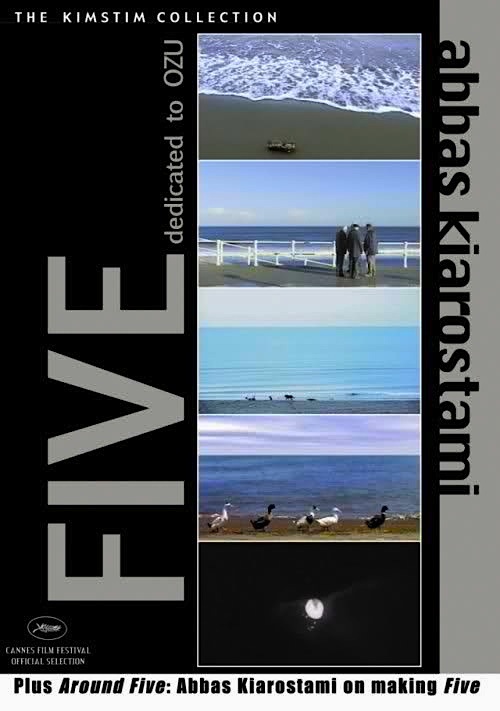
Those five long takes show the Caspian Sea, almost entirely from a fixed vantage point. In the first scene, we watch the tide drag a piece of driftwood back and forth, for a lulling effect. The following boardwalk scene also features repetitive motion as indistinct pedestrians walk through the camera’s field of vision. However, viewers might wonder at various times if perhaps Panahi has just made his reported cameo. While one would think there is nothing conceivably objectionable in Five, the many uncovered female heads in this scene would most likely be problematic in Kiarostami’s native Iran. Of course, the pace and meditative vibe of Five provides plenty of time for the audience to wonder about such matters.

Considering the third take features dogs—unclean animals according to the ruling mullahs—Five probably has two strikes going against it. Presenting the frolicking canines as tiny figures on the horizon, it might be Kiarostami’s most interestingly framed shot, closely resembling an ECM album cover.

For kids who love ducks, Five might just be worth having for the fourth take of duckies waddling across the beach. Without question they are the most entertaining part of the film. For the concluding fifth take, it is frogs that are heard but not seen, as the moon rises and glimmers over the dark sea.

When most Ozu fans watch Five, their thoughts will probably wander to what those great films really mean to them. As pleasant as they might be, his work is not beloved for the pillow shots Kiarostami has so greatly expanded here. It is the exquisite dignity of Chishu Ryu’s many father figures, Keiko Kishi’s endearing sexuality in Early Spring, and most of all the legendary work of Setsuko Hara. To see her in the “Noriko” films is to fall head-over-heels madly in love with her. It is precisely that humanity that is missing from Five.

Regardless, Kiarostami most likely accomplishes what he set out to do with Five, so here it is. At least it presents an opportunity for viewers to reflect on their respect and affection for the films of Ozu and Panahi, which is something. Recommended primarily for patrons of the non-narrative avant-garde, Five Dedicated to Ozu screens this Thursday (2/14) at the Walter Reade Theater, as does his recent masterwork, the highly recommended Certified Copy starring the incomparable Juliette Binoche, as part of the Close-Up on Abbas Kiarostami career retrospective.

LFM GRADE: C

Posted on February 11th, 2013 at 3:19pm.
LFM Reviews The House @ KCS Film Night in New York

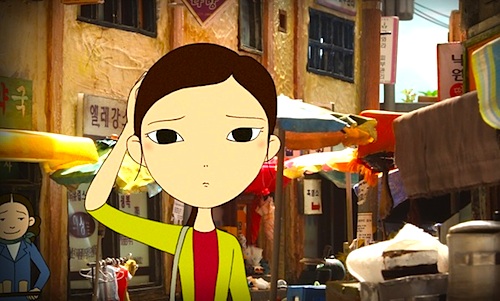
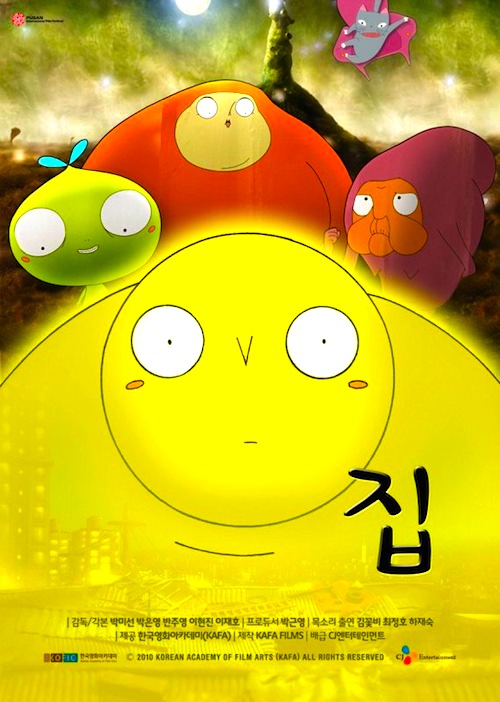
By Joe Bendel. Yuppies don’t get it. Old homes have character. That is because there are spirits intimately connected to each domicile. Much to her surprise, one formerly affluent young woman starts to see the endangered spirits of her run-down new neighborhood in Ban Joo-young’s animated feature The House (trailer here), which screens this Tuesday as part of the Korean Cultural Service’s regular free movie night in New York.

After her hedge-fund was wiped out, Ga-young is forced to move into a school friend’s studio apartment and accept work as a tutor. Not naturally inclined towards graciousness, she is a bit of a pill to live with. Indeed, she is exactly the sort of shallow materialist who could stand to learn a lesson from supernatural beings. An inadvertent encounter with an enchanted cat’s collar will do just that. Suddenly, she can see the Shmoo-like spirits living amongst the studio units of her dilapidated building.

All is not well with the spirits. One of their brethren is profoundly ailing, showing all signs he will soon share the fate of the recently deceased human occupant of his unit. However, the dubious urban renewal project slated for the neighborhood poses an existential threat to all the spirits. Making promises they do not understand, the spirits enlist Ga-young’s help petitioning the earth elemental now residing in that pesky stray for help. Unfortunately, like most felines, the cat is not helpful by nature.

To judge from The House and the previous KCS animated selection, Padak, Korean animation seems to be on a collective mission to prepare children for all of life’s subsequent disappointments. Both films end on rather heavy notes, even for unrepentant American capitalists. Still, House also warns children to be skeptical of politicians and their promises, which is always a worthy lesson.

From "The House."

Somewhat resembling her character in real life, actress and voice-over artist Kim Kkobbi nicely expresses Ga-young’s wide range of emotions and awakening conscience. Ban’s figures are not extraordinarily expressive, but House’s mixed-medium backdrops are often quite striking. While not especially original looking, the spirits are nonthreatening and likably doughy.

For adults, House has a flashback sequence that is unexpectedly moving. Although there is absolutely no objectionable material, for kids raised on Pixar and Disney it might be a real downer, so parents should use their discretion. Easily recommended for animation fans, especially given the price of tickets—free, that is—The House screens this Tuesday (2/12) in New York at the Tribeca Cinemas, courtesy of the Korean Cultural Service in New York.

LFM GRADE: B-

Posted on February 11th, 2013 at 3:18pm.

LFM Reviews The Last Elvis @ 2013 The San Francisco Independent Film Festival

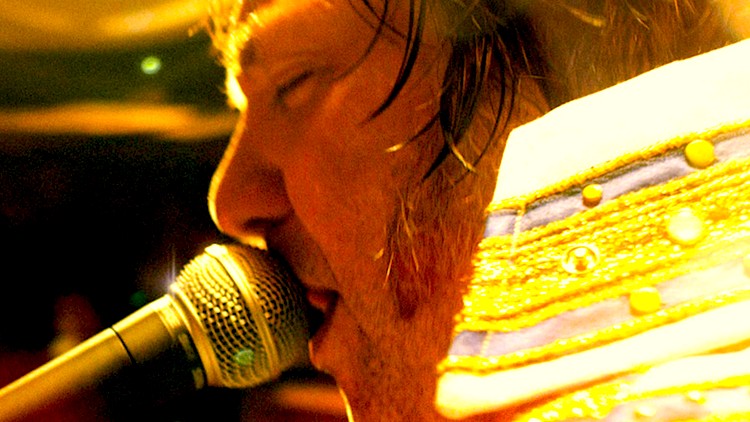
By Joe Bendel. Carlos Gutiérrez’s career is a lot like Nic Cage’s, but not quite as embarrassing. Elvis Presley casts a long shadow over both. In fact, Gutiérrez insists people call him Elvis. The Argentine tribute performer’s lifelong passion veers into dark obsessive territory in Armando Bo’s The Last Elvis (trailer here), which screens during the 2013 San Francisco Independent Film Festival.

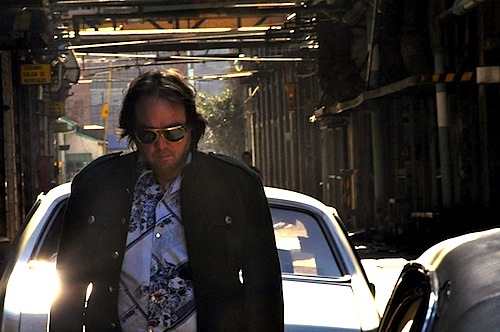
By day, Gutiérrez works on a factory assembly line. Nights and weekends, he performs as an Elvis impersonator. He is actually pretty good at it—arguably, too good. Gutiérrez’s self-identification with Presley has severely strained his relationships with the ex-wife he insists on calling Priscilla and their young daughter Lisa. Frankly, Gutiérrez is poor father material. However, when Alejandro Olemburg (a.k.a. Priscilla) is critically injured in a car accident, Gutiérrez suddenly finds himself caring for Lisa. After some initial awkwardness, Gutiérrez finally starts to bond with his daughter, but he continues preparing for his mysterious tour.

From "The Last Elvis."

In some ways absolutely maddening, Last Elvis is nonetheless a startlingly compelling film, in no small measure due the real life Elvis tribute artist John McInerney’s dramatic and musical performances. He has the voice, rocking heartfelt showstoppers like “You Were Always on My Mind” and “Unchained Melody.” McInerney also wrings every possible ounce of pathos out of the tragically “gifted” Gutiérrez, despite actions that should profoundly challenge audience sympathy on paper. His father-daughter chemistry with Margarita Lopez’s Lisa Marie is quite affecting, as well.

Last Elvis is about as stark and murky as music-driven films ever get. Bo co-wrote Alejandro González Iñárritu’s Biutiful and it is not hard to see a kinship between the films. Yet Last Elvis’s commanding use of Presley/McInerney’s music hits home even harder, especially for anyone who has been close to a struggling musician or tried to make a go of it themselves.

The Last Elvis screened at last year’s Sundance and LA film fests, but largely flew under the radar. That is a shame, because it really packs a punch. Audiences will be completely unprepared for the power of McInerney’s work, especially given his late Elvis look. Good for SF Indie Fest for selecting it. Recommended rather strongly for Elvis fans and patrons of Latin American cinema, The Last Elvis screens Sunday (2/10) and Tuesday (2/12) at the Roxie Theatre and Thursday (2/14) and the Shattuck Cinemas.

LFM GRADE: B+

Posted on February 9th, 2012 at 10:32am.

Bela Lugosi Gets His Voodoo On: LFM Reviews The Restored White Zombie on Blu-ray/DVD

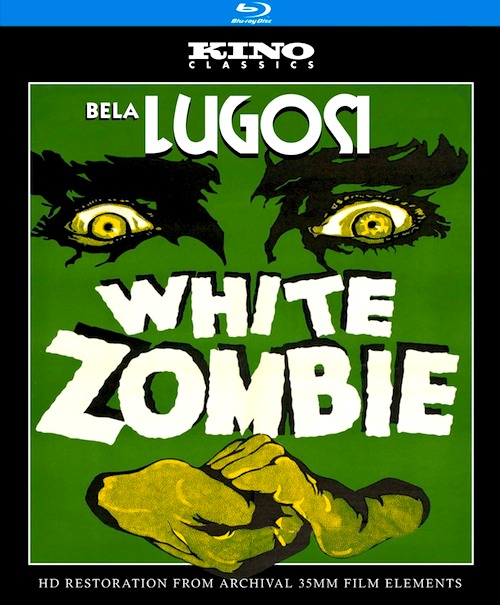
By Joe Bendel. Bela Lugosi got there first—before Val Lewton, George Romero, or the AMC network. Yet when he appeared in what is considered the very first zombie film, it was thought to be a rather odd career choice at the time (the first of many, as it turned out). Of course, Victor Helperin’s White Zombie would look like a prestige picture compared to his Ed Wood films. In fact, the Haitian voodoo chiller has always had its champions, very definitely including Rob Zombie, but the state of the public domain prints has made it difficult for mere mortals to embrace it. In a welcome turn of events, Kino Classics has released a crisp new restoration (produced by Holland Releasing) on DVD and Blu-ray, now available from online retailers everywhere.

Madeleine Short and Neil Parker are to be married in the manor house of Charles Beaumont, but they really shouldn’t. The plantation owner is really interested in taking Short for himself. Not exactly a seductive figure, Beaumont seeks the help of Murder Legendre, a voodoo master who runs his sugar mill entirely with zombie labor. With a name like that, Legendre has to be evil, but whether he has supernatural powers is a debatable point.

Unable to win over Short, Beaumont slips her Legendre’s zombie mickey on her wedding day. Soon after tying the knot, Short passes away—or so it seems. Of course, Legendre has her up on her feet and shambling about Beaumont’s estate in no time. Much to his disgust, the wealthy old planter finds her soulless body to be poor company. Can Parker save her, once he pulls himself out of the bottle? He will have some help from the missionary, Dr. Bruner, whose constant need of matches serves as the film’s annoying comic relief.

Lugosi is pretty darn sinister as Legendre, who does some really cool voodoo business with candle fetishes. Presumably the price of sugar is down, since he cannot seem to afford a full set of buttons for his tunic (even with a horde of unpaid zombie laborers at his disposal). Nonetheless, we should not let pedantry stand in the way of our appreciation of a great Lugosi performance.

While Lugosi delivers for his fans, his co-stars often sound like the former silent stars they were. At least, as Parker nee Short, Madge Bellamy spends a good portion of the film in the form of a speechless zombie. Likewise, fellow silent veteran John Harron’s over-acting will make viewers miss the mannered David Manners (the WASP-ish protagonist of Dracula, The Black Cat, and The Mummy).

So White Zombie offers Lugosi and zombies, which should be enough for viewers any day of the week. There is also an original rumba composed for the film by Xavier Cugat, heard in the unusually expressionistic scene of Parker’s mournful binge-drinking. Such sequences can be more fully appreciated when seen as part of the restoration, which looks tremendous on Blu-ray. Although independently produced by Edward Helperin, White Zombie could be considered an honorary Universal monster movie, since it was filmed on U’s back lot, with richly detailed sets and props leased from the studio. It also features the work of one of Universal’s biggest stars, Lugosi, and the studio’s make-up wizard, Jack Pierce.

It is ironic that Lugosi would lend his support to a comeback vehicle for former silent stars Bellamy, Harron, and Robert Frazer (who maintains his dignity as Beaumont) when his later filmography consists of one dubious attempt to re-ignite his career after another. He deserved better karma for appearing in White Zombie. It also happens to be nearly as stylish a horror film as The Black Cat. Affectionately recommended, White Zombie is a film any zombie fan or Lugosi admirer should know. It is now available in its fully restored glory, thanks to Kino Classics, with a vintage Lugosi interview included as a bonus.

LFM GRADE: B+

Posted on February 5th, 2012 at 2:03pm.

New York Overrun by Mutant Soviet Insects: LFM Reviews Spiders 3D

By Joe Bendel. New York’s subway rats have finally met their match. That is a bad thing. When mutant spiders crash to Earth with some old space junk, they take roost throughout the lower Manhattan tunnel system in Tibor Takacs’s creature feature Spiders 3D (trailer here), which opens in California theaters this Friday.

Who knew downtown stations still took tokens? Probably not for long, though. They are about to be renovated the hard way. Jason Cole is just starting his shift at the transit command center, when the “Noble Street” stop is rocked by the remains of a Soviet space station that somehow carefully threaded its way through the surrounding buildings, into a perfect man-made lair. Since the spiders are not viral, initial tests give Cole the go ahead to re-open the station. However, when waves of rats start freaking out and dying, even the MTA (or NYT as they are called here) can tell they have a problem on their hands.

It turns out the Soviet-era brain-trust spliced some ancient alien DNA together with some spiders because that seemed to be the thing to do at the time. The resulting mutants cast some wicked webs that supposedly have all kinds of military applications. That is why the American armed forces have set up shop somewhere just north of Battery Park City with the original scientist who masterminded the Soviet experiments.

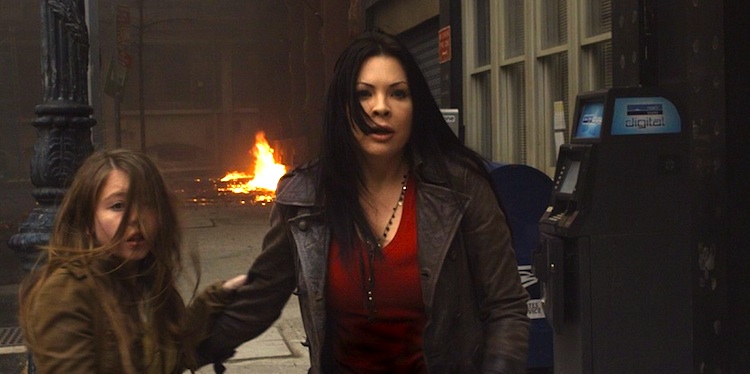
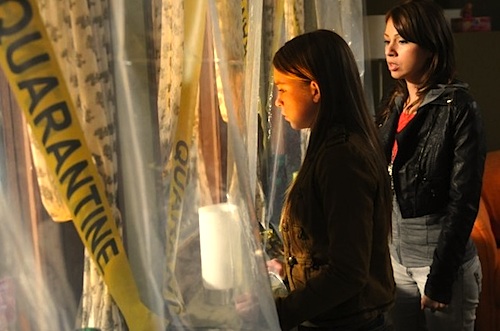
Spiders indulges in the annoying fantasy that a former Soviet scientist has the standing to give a high ranking American military officer a lecture on morality. Indeed, the clichéd villainy of Col. Jenkins is a real buzzkill in what could have been a perfectly pleasant exercise in campy bug-hunting. Let’s be honest, if mutant spiders really do start falling from the sky, we’ll be praying to see the American troops arrive.

From "Spiders."

Not surprisingly, Spiders works best during its most Cormanesque moments. The special effects are a decidedly mixed bag, but the creepy way their legs move looks good on camera and jut out well for 3D presentations. For the most part, though, it is glaringly obvious this is a B-movie, which is not necessarily a bad thing.

Starship Troopers’ Patrick Muldoon, who previously co-starred in Takacs’s Sci-Fi Channel movie Ice Spiders, is pretty credible as a transit bureaucrat under extreme stress. By now, he and Takacs must be real experts on surviving a mutant spider attack. Christa Campbell also shows some screen presence amid the bedlam as his ex-wife Rachel, a researcher with the city health department. As one would expect, Spiders follows in the long genre tradition of couple’s therapy through monster rampage. British actors William Hope and Pete Lee-Wilson largely embrace their characters’ stereotypes, chewing a fair amount of scenery as Col. Jenkins and Dr. Darnoff, respectively.

While watching Spiders, it is hard not to think of Rick’s line in Casablanca: “there are certain sections of New York, Major, that I wouldn’t advise you try to invade.” Sure, the mutant spiders terrorize lower downtown, but if they tried coming uptown we’d see who’d be crying then. Spiders should have been a lot more fun, but the anti-military bias is just a tired bummer. For giant mutant genre diehards, it opens this Friday (2/8) in the Golden State, including the Burbank Town Center 8 and the AMC Atlantic Times Square in Monterey Park.

LFM GRADE: D+

Posted on February 5th, 2012 at 2:02pm.

When California was a Land of Opportunity: LFM Reviews Silicon Valley on PBS

By Joe Bendel. They made the space program and the personal computer possible. They were not just brilliant scientists. They were the original venture capitalists. The far-reaching scientific and economic revolutions initiated by Robert Noyce and his colleagues are explored in The American Experience’s first-rate Silicon Valley, which airs on most PBS stations this Tuesday.

A bright student at Grinnel College, Noyce happened to get an early look at two of Bell Labs’ first ever transistors, through his professor, Grant Gale. He would remain a foremost expert on the devices and their successors from that point forward. After an unrewarding East Coast corporate stint, Noyce joined soon to be Nobel Lauriat William Shockley’s semiconductor laboratory, in what was then nowheresville California. That was a somewhat gutsy move at the time, but Noyce was just getting started.

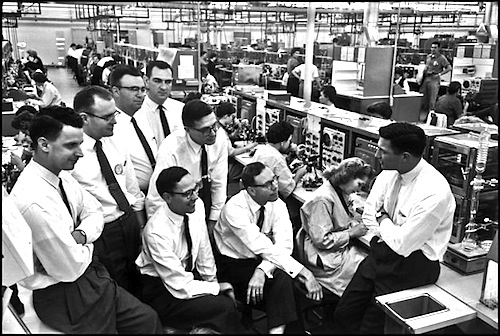
Fed up with Shockley’s erratic behavior and dubious strategic decision-making, Noyce and the rest of the so-called “Traitorous Eight” set out on their own, establishing Fairchild Semiconductor with the backing of Sherman Fairchild’s family of companies. Noyce was the last to join the insurgency, but the one most needed for Fairchild Semiconductors to make a go of it. He understood the science, but he also had persuasive powers the others lacked. Opting to develop a silicon-based semiconductor (a model Shockley had explicitly rejected), Fairchild scored some crucial government contracts right out of the gate. Yet Noyce would eventually pick up and start over once more. Ever heard of a company called Intel?

From "Silicon Valley."

Co-written, co-produced, and directed by Randall MacLowry, Silicon Valley does two things unusually well. It nicely explains the enormous technological benefits offered by transistors, semiconductors, microchips, and microprocessors, in terms accessible for viewers not particularly savvy about the insides of their computers. It also gives Noyce and his comrades full credit for their game-changing entrepreneurship. MacLowry clearly establishes the substantial risks Noyce took, as well as the considerable reward he reaped. As a result, viewers might just find themselves feeling a vicarious giddiness for the up-start success of Noyce’s start-ups. That is a powerful response for a television documentary to inspire, but Silicon Valley is unquestionably the best of the last three seasons for American Experience, at least.

Many Fairchild and Intel alumni share their memories of Noyce and the formative years of Silicon Valley, including Andy Grove and surviving members of the infamous eight, Jay Last and Gordon Moore. MacLowry also incorporates a wealth of archival photos that vividly remind us of what the future used to look like in years past. The film is also a bittersweet reminder that California used to be synonymous with opportunity and new beginnings, rather than bankruptcy and stagnation. As a documentarian, MacLowery is rather diplomatic, completely ignoring Shockley’s later controversial championing of eugenics, simply depicting him as a miserable boss and incompetent businessman instead. Still, it is a reasonable call, considering how such hot button topics are apt to distract public television viewers.

It becomes obvious watching Silicon Valley what a great dramatic feature this story could become in the right hands. Dominic West would be a decent likeness for Noyce. However, in a world where Ashton Kutcher is cast as Steve Jobs, you have wonder whom Hollywood might come up with. Taylor Lautner, perhaps? At least MacLowry did right by the band of pioneers who made Silicon Valley what it is today. Highly recommended as a work of scientific, economic, and cultural history, Silicon Valley premieres this coming Tuesday (2/5) on most PBS outlets nationwide.

LFM GRADE: A

Posted on February 4th, 2012 at 9:59am.