LFM’s Jason Apuzzo at The Huffington Post & AOL-Moviefone: Skyfall & How James Bond Stays Current at 50

[Editor’s Note: the post below appears today on the front page of The Huffington Post and AOL-Moviefone. I had the opportunity to see Skyfall at a screening of the recent AFI Festival in Hollywood, and wish to thank the AFI Festival for making that possible.]

By Jason Apuzzo. How does James Bond do it? He barely seems to have aged a day. The famously overworked British Secret Service agent, drinker of vodka martinis, and seducer of dangerous women (why are Bond’s girlfriends always pointing guns at him?) is now 50 years old in the movies — yet it hardly shows.

With Skyfall, the latest 007 thriller opening this weekend, it’s now been five decades since the Bond character debuted on screen in 1962’s Dr. No. Since that memorable first film, in which Sean Connery saved the world from a megalomaniac with metal hands — while rescuing Ursula Andress from the confines of a white bikini — James Bond has saved the world from nuclear bombs and space lasers, cheated death using jet packs and exploding cigarettes — and even found time to romance women with names like ‘Plenty O’Toole’ and ‘Xenia Onatopp.’

It’s been a busy, full life for the world’s most famous secret agent — which begs the question of why, as currently embodied by Daniel Craig in the latest film, the character suddenly seems so fresh and relevant to the world of today.
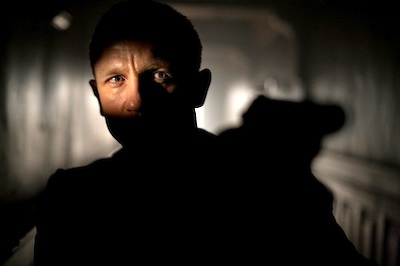
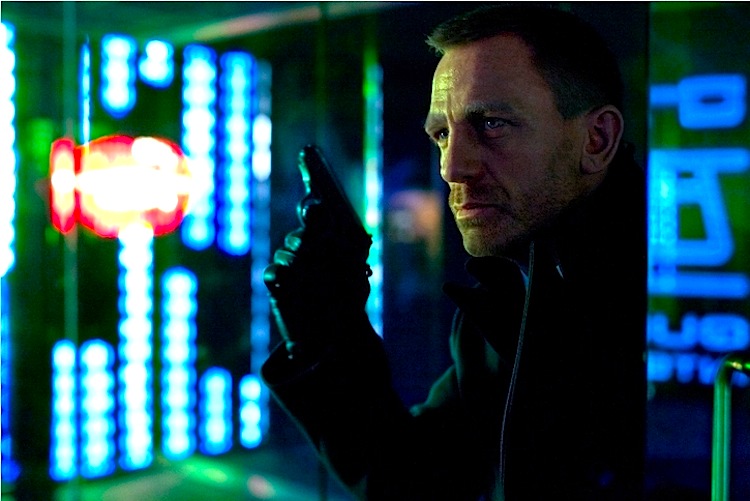
2012-11-09-skyfall0103.jpg
Daniel Craig in "Skyfall."

The question arises because the James Bond of Skyfall no longer seems like an exhausted relic from another era, as he often did during the ’90s and early 2000s. Instead, he now feels like a character who has been fully and (for the most part) successfully reinvented as a merciless, sardonic and lethal warrior for our age of terror.

And although Skyfall isn’t quite the classic some critics are making it out to be, it’s easily one of the best Bond films since the 1970s.

On this point, I must confess to having given up on Bond long ago. Until recently 007 was looking like a tired hero — a guy in a middle-age crisis, a character to put in the next Expendables. M needed to send Bond into retirement — maybe ship him off with a fifth of vodka and a Russian mistress (I recommend Anya Amasova, aka Agent XXX from The Spy Who Loved Me) to James Bond Island off the coast of Thailand. Even SPECTRE would probably leave him alone.

After all, with the Cold War long over (despite Vladimir Putin’s best efforts), Great Britain no longer the force it once was, and with women less eager to play characters named ‘Kissy Suzuki’ or ‘Dr. Molly Warmflash,’ you’d think 007 would be quietly boxed away in the attic by now along with vinyl records and your parents’ fondue pot.

Casino Royale in 2006 seemed to change all that, but director Sam Mendes’ Skyfall really confirms it; Bond now absolutely works as a hero for the 21st century. The question is: why?

There are three reasons, in my opinion:
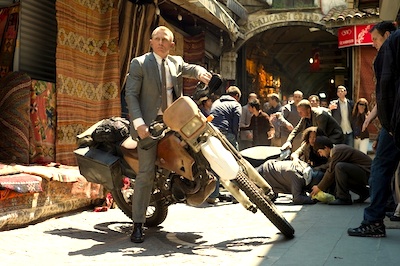
2012-11-09-skyfall0114.jpg
Reinvented to fight the War on Terror.

1) Bond has been fully reinvented for the War on Terror era.

This process began in Casino Royale, but Skyfall digs much deeper into the purpose and mentality of our intelligence agencies in the post-9/11 world — and strongly reaffirms their value. Without giving away too much of Skyfall‘s plot, suffice it to say that the entire purpose of the film is to re-invent the James Bond mythology to fit the current war, which as Judi Dench’s M memorably states is fought primarily “in the shadows” — with our enemies less likely to be nation states with massed armies than shadowy, sociopathic operators working within hidden networks.

And it’s precisely in this environment that Bond thrives.

As Skyfall opens, information pertaining to NATO penetration of worldwide Islamic terror cells has been stolen in Istanbul, and Bond has to get the data back before Western agents are exposed and killed. As the story unfolds, Bond’s value as an experienced field agent — able to make human judgments in murky situations and act, where technology alone is inadequate — is constantly reinforced, even when his physical and emotional resources are depleted.

Bond and his colleagues are also depicted as patriotic and reflexively selfless, to the point of being subtly associated with Winston Churchill and his legacy. (Look for references to Churchill’s wartime bunker along with visual cues of a vintage British bulldog.) In the midst of this, the tone of the film is more sober — and befitting of wartime — than what we’ve seen from the Bond series in a long time. Continue reading LFM’s Jason Apuzzo at The Huffington Post & AOL-Moviefone: Skyfall & How James Bond Stays Current at 50
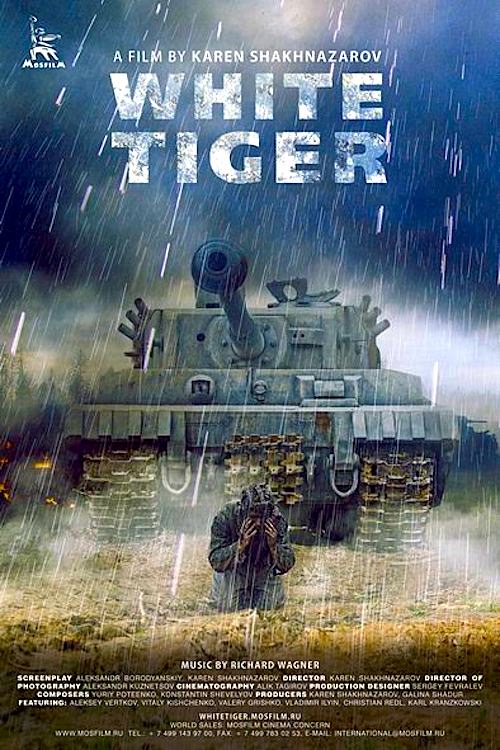
Rolling Russian War Machines: LFM Reviews White Tiger, Submitted By Russia for Oscar Consideration

By Joe Bendel. Ivan Naidyonov could be called the tank whisperer. He seems to have the mystical power to commune with armored vehicles, but his environment is pure blood and guts. War is still war, except more so on the Eastern Front in Karen Shakhnazarov’s White Tiger, which Russia has chosen as their official submission for this year’s foreign language Academy Award.

Hoping to put the debacle of last year’s submission (Friend of Putin Nikita Mikhalkov’s universally panned Burnt By the Sun 2: Citadel) behind them, Russia has opted for another well-connected standard bearer in Mosfilm head Shakhnazarov. However, in this case the quality of the film and the director’s critical reputation represent a considerable step up.

Picking through the remains of a routed Russian tank division, soldiers find a charred driver who is somehow still breathing. Despite suffering severe burns to ninety percent of his body, the tank mechanic makes a full recovery, except for his acute amnesia. Rechristened Ivan Naidoyonov (“found Ivan,” roughly), he is sent back to the tank corps. He is a whiz at fixing and operating tanks, but he is a little spooky. Naidyonov claims tanks speak to him and even starts praying to the “God of tanks” enthroned in the big garage in the sky. Yet he is just the man to track down and destroy the white German super tank that seemingly materializes out of nowhere to wreak destruction on blindsided armored columns.

For Naidyonov it is personal. The spirits of the destroyed tanks have spoken to him about the White Tiger. So perfect are its maneuvers, he is convinced its crew is “dead.” He can sense it before it appears and it seems to be hunting specifically for him.

White Tiger might sound like Life of Pi in a tank, but at every battlefield juncture, Shakhnazarov chooses grit over woo-woo. Everyone thinks Naidyonov is nuts, but they secretly suspect there might be something to him – particularly Major Fedotov, the counter-intelligence officer in charge of the hunt for the White Tiger. The resulting vibe is like The Big Red One as re-written and Russified by Melville.

With his studio’s resources at his disposal, Shakhnazarov stages some fantastic tank battles, vividly conveying their force – and also their limitations. During the first two acts, White Tiger is a completely original, totally engrossing war film. Strangely, though, the final third is largely dominated by completely unrelated scenes of the German surrender and Hitler’s ruminations in the face of defeat. It is like White Tiger won the war, but lost the peace. Still, since it is a war movie, the former is more important.

When Naidyonov and his obsession are center stage, White Tiger is genuinely riveting, with a good measure of credit due to its primary leads. Aleksey Vertkov is perfect as Naidyonov. Refraining from distractingly ticky or showy behavior, he is compellingly “off” in a way that could believably be recycled back into the Soviet war machine. Even though in reality his character would have probably been purged halfway through the film, Vitaliy Kishchenko’s work as the square-jawed Fedotov is similarly smart, understated, and intense.

It is hard to understand why Shakhnazarov would establish such a powerfully focused mood, only to break it up down the stretch. Still, White Tiger boasts two excellent performances and some impressive warfighting sequences, which is more than many of its fellow contenders can offer. Academy voters certainly love them some WWII, so it is probably worth keeping an eye on. Shakhnazarov has also had American distribution for past films like Vanished Empire, so White Tiger should have international legs. Regardless of its odd flaws, it is a film of considerable merit that ought to find an audience.

LFM GRADE: B

Posted on November 9th, 2012 at 2:20pm.

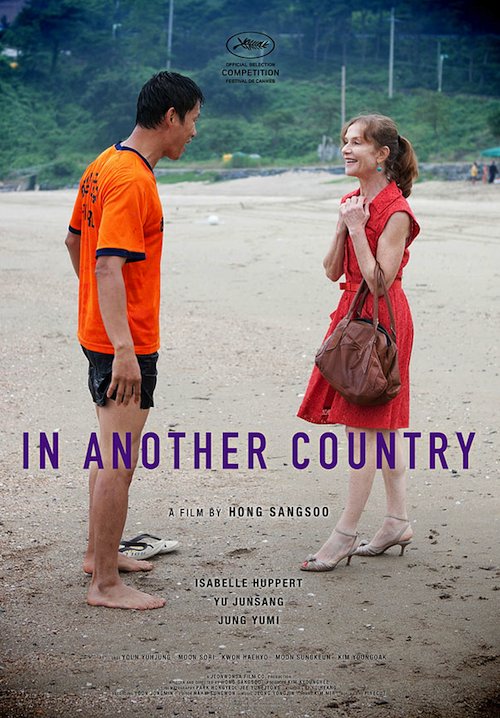
LFM Reviews In Another Country

By Joe Bendel. In the working class seaside village of Mohang, there is not a lot to do except drink. Fortunately, that is what Hong Sang-soo’s characters do best. Intimacy, on the other hand is a problem – especially for a trio of French women stumbling through cultural and linguistic barriers. Isabelle Huppert plays all three of them in Hong’s sort-of English language debut, In Another Country, which opens today in New York.

Dodging debt collectors, film student Wonju and her mother are laying low in a sleepy Mohang inn. To pass the time, she starts writing a screenplay very much in the style of Hong Sang-soo. It is a triptych in which the French expat Anne comes to the very same hotel under different circumstances, yet has similar experiences each time.

The first Anne is an accomplished filmmaker, who tries to discourage the attentions of a drunken colleague with a very pregnant wife. The second Anne is cheating on her wealthy husband with an almost-famous film director. The third Anne bitterly resents her ex-husband leaving her for a Korean woman, but it is not hard to understand why he dumped her. In each case, she flirts with the meathead lifeguard with varying degrees of ambiguity, half communicating through their broken English.

Country is just so Hong Sang-soo, but the tone is a bit lighter than Oki’s Movie or The Day He Arrives. Nor is it as self-consciously post-modern in its approach to narrative. Each of the three Annes’ stories are discrete and completely self-contained (though take 2 includes a dream sequence that could almost count as a fourth strand). In fact, it is a rather sunny film, taking long walks on the beach and chatting amiably with the cute but shy Wonju, who also appears in each arc as the daughter of the hotel proprietor.

Still, it is rather fascinating to watch how Huppert brings successively darker shades to each Anne. Frankly, the third is a bit of a pill, whereas the flawed but self-aware second is the most fully developed. Yu Junsang, the only other constant besides Jung Yumi’s pleasant but rather inconsequential Wonju, is a perfectly believable lunk, but his best dramatic moments come during the first go-round. However, Youn Yuh-jung, the veteran leading lady of Korean television and cinema, is absolutely perfect as Anne #3’s academic friend Park Sook (and appearing as Wonju’s mother in the opening segment as well). Smart, somewhat tart tongued, and likably world-weary, she brings some real verve to the talking and drinking.

Indeed, Country is a chatty film, utilizing English as a second language, so communication is always an issue. The manner in which Hong repeats certain key phrases is often very droll, but there are no great profundities to be found here. That is not necessarily a bad thing. Watching Hong’s latest is like falling in with a group of strangers at a party who are amusing for an evening, but you don’t really want to make a habit of seeing afterward. Again, if they are good for some laughs, that is not so terrible. For Hong and Huppert’s fans, it works quite well. Recommended accordingly, In Another Country opens this Friday (11/9) at the Lincoln Plaza Cinema.

LFM GRADE: B

Posted on November 9th, 2012 at 2:20pm.

LFM Reviews Wonder Women! @ DOC NYC

By Joe Bendel. The last few years have been tough for Wonder Woman. While her Justice League colleagues have gotten big screen treatments, she suffered the embarrassment of a network rejection for her pilot. Considering it was from David E. Kelley, maybe it was just as well. The heroic Amazon will always have her fans, several of whom explain her personal significance and lasting cultural influence in Kristy Guevara-Flanagan’s Wonder Women: the Untold Story of American Superheroines, which screens as a Midnight selection of the 2012 DOC NYC.

Psychologist William Moulton Marston created Wonder Woman to embody feminine virtue – but Wonder Woman also found herself frequently bound-up, like a comic precursor to Bettie Page. Wonder Woman might imply much about her creator’s subconscious, but her self-reliance struck a chord with many readers. Unfortunately, when the Comics Code Authority began nannying the industry, Wonder Woman was amongst the hardest hit, effectively becoming a costumed Ally McBeal.

Lynda Carter as Wonder Woman.
Guevara-Flanagan incorporates many talking head interviews with self-identifying feminists who celebrate the 1940’s era Wonder Woman and bemoan her subsequent watering down. Frankly, she would have gotten much the same response had she interviewed conservative cultural critics, as well. The old school Wonder Woman might have been an Amazon Princess, but she also adopted the American cause – fighting the Axis tooth-and-nail. That’s a role model.

Yet, when addressing Wonder Woman’s cultural influence, the doc is rather hit-or-miss, by any standard. Guevara-Flanagan and her experts draw a straight line from Lynda Carter’s Wonder Woman to Buffy the Vampire Slayer and Xena the Warrior Princess, who serve as the sole representatives of a smallish, contemporary golden age of strong women action figures. Yet they ignore, for example, a huge chunk of Michelle Yeoh’s intervening filmography, in which she made a practice of playing strong butt-kicking women. (She still does.)  Furthermore, Wonder Women largely ignores recent developments for the character, including her comic book reboot in conjunction with the 2011 re-launch of the DC universe, the 2009 animated direct-to-DVD animated feature (featuring the voice of Keri “Felicity” Russell), or the much hyped but ill-fated pilot. That’s too bad, because the film is at its strongest when tracing Wonder Woman’s early evolution.

Too politicized for the natural comic fan audience, Wonder Women is expressly intended for those who fondly remember her appearance on the first issue of Ms. Magazine. For the rest of us, the film is quite uneven, reflecting a rather insular perspective. It screens at the IFC Center this coming Sunday night (11/11) and the following Tuesday (11/13) as part of DOC NYC 2012.

LFM GRADE: C-

Posted on November 8th, 2012 at 11:57am.

LFM Reviews A Girl and a Gun @ DOC NYC

By Joe Bendel. It is a real Rorschach test. When people see a gun in the hands of a woman, they might see it as an equalizer, an instrument of empowerment, or as a fetish object. None of these is mutually exclusive. Indeed, the many perspectives on women gun-ownership often overlap and conflict with one another in Cathryne Czubek’s A Girl and a Gun (see excerpt above), which screens as part of DOC NYC 2012.

Although many of G&G’s talking head experts hail from the general neighborhood of feminist thought, just about everyone acknowledges women’s relative physical vulnerability compared to men – especially liquored up stalkers. This was particularly true for one middle aged tai chi instructor who broke up with her abusive body-builder boyfriend. Realizing that the police operate almost entirely reactively rather than proactively, she came to the somewhat reluctant conclusion that she needed a gun.

She is not the only one to rely on guns for protection of life and limb. One young widow living on an isolated farm with her young baby used her late husband’s shotgun to blow a home-invading predator to Kingdom Come. Part of her remains troubled by the incident, but she will do it again if need be to protect her child. Similarly, sex columnist Violet Blue has seen her fair share of death threats. However, letting would-be stalkers know she keeps a loaded gun handy has had a deterrent effect. She also thinks armed women are hot (and we’re not about to argue with her).

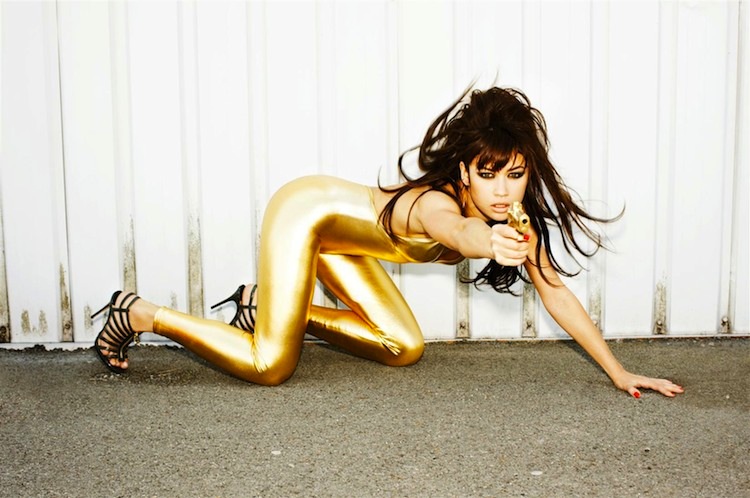
More than meets the eye: former Bond girl Olga Kurylenko, with gun.

Naturally, G&G takes great efforts to show the other side of the coin, such as the prison interview with a woman who fatally shot her ambiguous roommate. Somewhere in the middle, we meet an Upper Westside social worker, who became an accomplished recreational shooter – but refuses to keep a firearm in her apartment.

When supposedly exposing the ways the gun industry has attempted to exploit the women’s market, G&G is rather underwhelming. In truth, it is hard to imagine a better informed group of consumers than women gun-owners. Still, the fact that Czubek’s film will even entertain the notion some women have a legitimate and pressing need to own a gun for reasons of self-defense is rather bold. That she bends over backwards to present cases of accidental and criminal gun deaths is to be expected. Yet, it is impossible to watch the Oklahoma farm widow’s segment and argue she would be safe without her guns.

Given its somewhat balanced approach, G&G is probably in for a rocky reception at DOC NYC. However, it could have earned Blue a whole new fanbase were it not for some gratuitous political material on her site. For New Yorkers and her Bay Area neighbors, A Girl and Gun offers some eye-opening moments. Recommended accordingly for local audiences, it screens this coming Sunday (11/11) and the following Wednesday (11/14) at the IFC Center, during DOC NYC ’12.

LFM GRADE: B-

Posted on November 8th, 2012 at 11:56am.

Chinese Women on Screen: LFM Reviews Ruan Lingyu in New Women

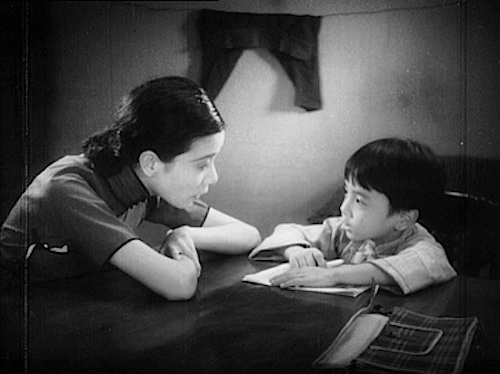
From "New Women."

By Joe Bendel. Could a woman have it all in 1930’s Shanghai? Not even close. Wei Ming will try, but a vindictive former lover and an exploitative press will cost her dearly. An eerie case of art foreshadowing life, Cai Chusheng’s New Women became one of Ruan Lingyu’s best known films, partly for reasons of tragic symmetry. Appropriately, it screens this Sunday as part of the Asia Society’s new film series Goddess: Chinese Women on Screen, largely inspired by Ruan herself.

Often called the “Chinese Greta Garbo,” Ruan appears to be something like the Chinese Joan Crawford in New Women’s early scenes. A music teacher at a progressive women’s school, she has written a debut novel so promising, a publishing house actually buys it – even though she is a woman. Her only problem is Dr. Wang, a well-heeled but unwelcomed suitor, who already happens to be married. Stung by her rejection, Wang bribes Wei’s headmistress, hoping sudden unemployment will force her into his arms. For Wei, it could not have come at a worse time.

Like anyone, Wei Ming made mistakes in her life. Eloping with the wrong man was one of them. When he abandoned her and their baby, Wei was forced to send Wei Xiaohong to live with her aunt. After years apart, Wei is finally about to take custody of the daughter she loves but never met. However, when the young girl arrives, she exhibits rather worrisome symptoms. Though quickly diagnosed, Wei and her sister lack the funds to pay for her hospitalization.

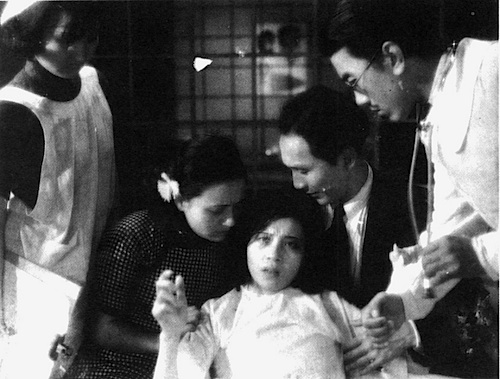
From "New Women."

It is hard to imagine anything as narratively manipulative as a dying child – and Cai duly milks it for all it is worth. He is innocently abetted by Chen Sujuan, who is absolutely heartbreaking as the young girl. Yet it is Ruan’s extended final exit that truly dominates the film, ranking with Garbo’s famous scene in Camille.

In some ways, New Women is surprisingly modern for a silent film, employing some rather feverish montages and displaying an unmistakable sexual frankness. Moreover, its unflattering depiction of scandal-mongering journalists is just as timely here and now as it was in Republican China, but this led the press to vociferously turn against New Women and Ruan, by extension. It is also an example of one of Cai’s more overtly leftist films, ending with a Soviet style march of women workers, not so subtly warning of things to come. Sadly, it would be co-star Zheng Junli, a lifetime progressive, who was most in need of that warning, considering how greatly he would suffer during the Cultural Revolution.

Ruan was a beautiful, hauntingly expressive artist, with a presence of orchid-like fragility. While Goddess is a fuller, more satisfying film, her gifts are readily apparent throughout New Women.  Recommended for silent movie buffs, students of early feminist film, and those who just appreciate a good weepy tragedy, New Women screens this Sunday (11/11) at the Asia Society as part of their must-see Goddess series, which starts with the title film this Friday (11/9).

LFM GRADE: B

Posted on November 8th, 2012 at 11:56am.