Monty Python’s Graham Chapman is in There Somewhere: LFM Reviews A Liar’s Autobiography in 3D

Narrating "A Liar's Autobiography."

By Joe Bendel. He was the one with the pipe. Graham Chapman could be as silly as any of the Pythons, but only he had the noble bearing to portray King Arthur, the would-be messiah Brian Cohen, and a battalion of aristocratic British military officers. He also played the title role in Yellowbeard – but nobody’s perfect. Indeed, that could be the mantra of Bill Jones, Jeff Simpson & Ben Timlett’s A Liar’s Autobiography: the Untrue Story of Monty Python’s Graham Chapman (trailer here), a hyperkinetic kitchen sink of an animated biography, which opens in 3D this Friday, day-and-date with its 2D premiere on Epix.

Viewers of Jones (son of Terry) & Timlett’s Monty Python: Almost the Truth will know Chapman was the tragic Python, who struggled with substance and sex addictions, before succumbing to cancer at the terribly early age of forty-eight. Chapman was also perfectly open, if rather ambivalent, about his sexuality. Such a dramatic life offers plenty of grist for a biopic treatment, and it’s all in Liar’s Autobiography—somewhere.

Fourteen different animation houses using seventeen different animation styles illustrate the events of Chapman’s life, as narrated by the subject himself from the memoir that would inspire the film. Given the relative brevity and rapid succession of each constituent episode, it is hard to keep them all straight. At least they proceed in a somewhat orderly narrative fashion, depicting Chapman as a rather macabre baby (not unlike Seth Macfarlane’s Stewie), a precocious student, and as one of the gaggle of monkeys co-founding Monty Python.

The thread is easier to follow in his early years, though Autobiography is still prone to distraction – even dramatizing one of the Biggles war stories (strikingly rendered by Made Visual Studio) that captivated young Chapman. However, by the time Autobiography reaches Treat Studios’ Space Pods, the connection to reality has been gleefully severed.
A look at the life of a comic genius.

The greatest irony of Autobiography is that its biggest laughs and greatest emotional payoff comes from the real-life-honest-to-gosh video of John Cleese’s eulogy for Chapman, in which he promises to avoid “mindless good taste.” Most of the Pythons are represented in Autobiography, playing themselves as well as other co-conspirators and innocent bystanders. Fans will be delighted to hear honorary Python Carol Cleveland turns up for old time’s sake, too. Bizarrely, Cameron Diaz, who also used to be famous once, supplies the voice of Freud. However, Eric Idle is MIA, though his song “Sit on My Face” gets the full “Blame Canada” Busby Berkley treatment.

You don’t walk out of Autobiography, you stagger. While the 3D is characteristically hit or miss, the film[s] bombards the audience with wacky, tripped-out imagery. At times it is almost too much, but at least it scrupulously observes Chapman’s wishes regarding gratuitous good taste. You have to give its spirit proper due. Recommended more for the fanatical Python fan than the causal viewer (quick, what is the air-speed velocity of an unladen swallow?), A Liar’s Autobiography will be the first 3D release to play at the Angelika Film Center when it opens this Friday (11/2) in New York, simultaneous with its 2D broadcast on Epix.

LFM GRADE: B-

Posted on October 30th, 2012 at 1:15pm.

Vertigo in Southern India: LFM Reviews Akam (Palas in Bloom) @ The 2012 South Asian International Film Festival

By Joe Bendel. They are known as Yakshis in southern India, but we would think of them as succubi. Every culture has their equivalent, but one architect fears he married one. Yet, his perception of reality may or may not be so reliable in Shalini Usha Nair’s Akam (Palas in Bloom; trailer here), which screened at the 2012 South Asian International Film Festival in New York.

Srinivas seemed to have his life laid out perfectly, until an accident left the young architect visibly disfigured. Abandoned by his girlfriend, he descends into a deep existential depression. It is only the chance late night meeting with a mysterious woman that snaps him out of his lethargy. Just what Ragini was doing at his construction site at that hour is a question that will bother Srinivas in months to come, but it concerns him little during their brief courtship.

For a while everything is great, and then just as suddenly things are terrible again. Srinivas finds himself besieged by minor misfortunes and ailments that he is convinced Ragini has caused. He is convinced she is a Yakshi, who seduced him in order to torment and eventually murder him, because that is what Yakshis do.

If Ragini is a Yakshi, Nair isn’t telling. There is evidence in the film to support either conclusion, but none of it is trustworthy, because of the manner in which Srinivas’s obviously warped POV skews the film’s narrative. Indeed, Akam’s open-endedness clearly gave some SAIFF patrons fits, just as Nair intended.

Loosely based on Malayattoor Ramakrishnan’s novel Yakshi, Akam could have featured a spot of gore here and there, but Nair elected to keep it off-screen – which will further frustrate genre fans. That simply is not the tradition the film flows out of. However, there are enough hat-tips to Vertigo to inspire an angry missive from Kim Novak. Present day Kerala might seem worlds and centuries removed from Puritan New England, but Srinivas could almost be considered a Malayalam Hawthorne character, whose outward disfigurement corresponds to a spiritual disfigurement. The real horror of his story is the uncertainty over whether he is the victim or the tormentor, much like a Goodman Brown.

From "Akam."

As Srinivas, Fahadh Faasil vividly portrays a man plagued by inner demons and insecurities, while Anumol K’s Ragini certainly suggests a woman with closely guarded secrets. Freed from traditional genre demands, Nair’s pacing is decidedly patient. Unfortunately, the frequent flashbacks are not well delineated from the present day, often causing viewer confusion. Yet, her sparing use of sound, and the film’s overwhelming sense of darkness and stillness are unusually effective. Akam has a genuinely foreboding atmosphere that makes the ambiguous gamesmanship possible.

This is definitely not Bollywood. Technically it is Mollywood, but do not expect any Malayalam musical numbers. While the austerity of Nair’s style is demanding at times, the overall vibe really gets under your skin. Though not perfect, this is a film more festival programmers ought to consider. Recommended for cineastes who have a taste for the macabre but prefer mood over mayhem, Akam is set to have a limited Indian release this November.

LFM GRADE: B

Posted on October 29th, 2012 at 1:36pm.

India’s Red Corridor: LFM Reviews Chakravyuh @ The 2012 South Asian International Film Festival

By Joe Bendel. Welcome to India’s “Red Corridor.” While referring to the ideology of the militant Naxalite-Maoists who exercise de-facto governing authority in some of the country’s poorest provinces, it applies just as readily to the blood they shed to maintain their power. However, one ambitious policeman is determined to reestablish law and order in Prakash Jha’s Chakravyuh, a selection of the 2012 South Asian International Film Festival, co-starring Bollywood legend Kabir Bedi, who participated in a special intimate on-stage conversation at the Helen Mills Theater this past weekend.

SP Adil Khan is so by-the-book, he must be headed for a fall. He is in for a rude awakening when he accepts his newest posting, replacing a fallen friend and colleague in the Red Corridor. Just like his predecessor, Khan is lured into an ambush by false Naxalite informants. At least Khan lives to tell the tale and change tactics. Unlike his colleagues, Khan tries to win over the poor villagers’ hearts and minds, but whenever one reaches out to the copper, they are publicly executed by the ruthless Rajan. It looks bad for the home team until Khan’s academy drop-out buddy, Kabir, volunteers to go undercover. With no formal ties to the cops, he is the only one with a puncher’s chance of surviving the vetting process.

Rhea Menon in "Chakravyuh."

Thanks to their cover story, Kabir fits in with the Naxalites rather easily. He feeds Khan breakthrough intel, turning the tide against the Maoists. Yet, as Kabir starts to go proletarian, Khan realizes he may have made a mistake sending an impressionable hothead prone to snap decision-making on a sensitive infiltration mission.

This film would give Debbie Schlussel a conniption fit. Basically, it features the Muslim cop Khan (the only character whose religion is expressly identified, at least to western eyes) waging war against an increasingly sympathetic terrorist cult. Indeed, Chakravyuh is problematic in multiple ways, but also fascinating in much the same manner as the best Soviet propaganda films. There is no doubt that India’s rural poor have a hard lot in life, but it is pretty clear by now that the shining path offers no salvation. Perversely, Kabir and Rajan spend most of the film fighting the steel plant Kabir Bedi’s evil industrialist is trying to build, doing nothing to increase local employment opportunities.

Obviously, the irony of China allegedly supporting the Naxalites – while explicitly repudiating the Maoist excesses of the Cultural Revolution – is an irony lost on director Jha. At least he can stage rousing gun battles and spectacular massacres. Jha also integrates the musical numbers into the action in a manner that is more organic than one might expect. Yes, this is most definitely Bollywood.

Jha gets a critical assist from Arjun Rampal, who is an appropriately forceful presence as Khan. Had Jha belived in his mission, Rampal’s Khan might have joined The Raid’s Iko Uwais as the second great Muslim action hero of the year. Unfortunately, we are clearly meant to identify more with Abhay Deol’s Kabir, but his brooding is more petulant than Byronic. Still, Chakravyuh has the beautiful and well-armed Esha Gupta as Khan’s fiancée and comrade, Rhea Menon. SAIFF special guest Kabir Bedi also chews the scenery in a manner befitting a former bond villain (the lethal Gobinda in Octopussy).

Chakravyuh is simplistic and didactic, but it is never dull. Suitable for action fans who are able to discern and discount propaganda and dogma, Chakravyuh is now playing at the AMC Loews Newport Centre in Jersey City, following its North American premiere at the 2012 SAIFF.

Posted on October 29th, 2012 at 1:35pm.

Pyramid Head Takes Another Hack: LFM Reviews Silent Hill: Revelation 3D

By Joe Bendel. Heather Mason’s teenaged years have been difficult. Her name is actually Sharon Da Silva, but she and her father Christopher, currently known as Harry, constantly move to new towns under assumed identities. Supposedly he is on the run from the law, but it is really to keep a step ahead of a bizarre death cult. They constantly call Sharon/Heather back to their shunned ghost town through supernatural means, and there will be a macabre homecoming in store for her in Michael J. (Solomon Kane) Bassett’s Silent Hill: Revelation 3D (trailer here), which opens today across the country.

Considered one of the better film adaptations of a video game, the first Silent Hill struck some chords with viewers by seriously addressing themes of faith and sacrifice. To save her daughter, Rose Da Silva accepted banishment on the other side of Silent Hill’s dimensional portal. Her husband has done his best to protect Sharon/Heather alone. However, when Rose sends him a Candyman-style inter-dimensional warning, it may already be too late. In order to save her father, Sharon/Heather resolves to give her tormentors the showdown they want.

Those who have played the survival game will know that there is a complicated backstory to Silent Hill, involving Alessa, the all-powerful witch-girl, whose curse holds the cult’s powers in check. There are also a number of bizarre entities living in this netherworld, including fan favorite Pyramid Head. Apparently one of the knocks on the first film was his relative lack of screen time, so it is rather odd Revelation also uses him rather sparingly again. However, Malcolm McDowell has a long and unpleasant scene as blind bogeyman Leonard Wolf, the former cult leader committed by his own daughter. (Gee whiz, it has been quite a while since his career-defining work with Lindsay Anderson, hasn’t it?)

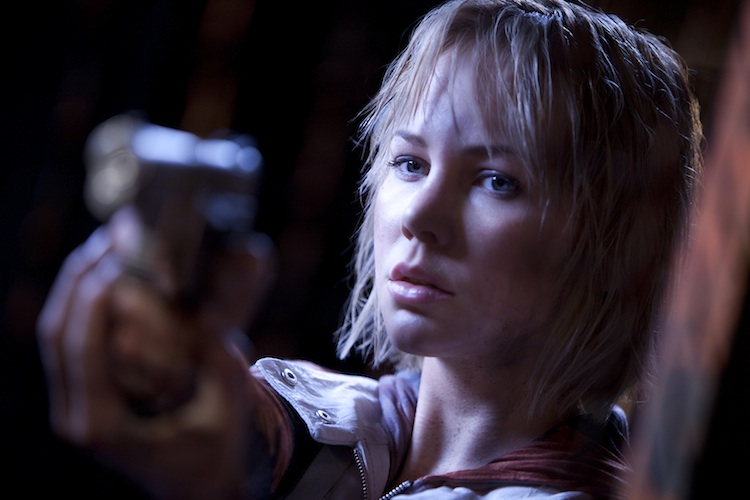
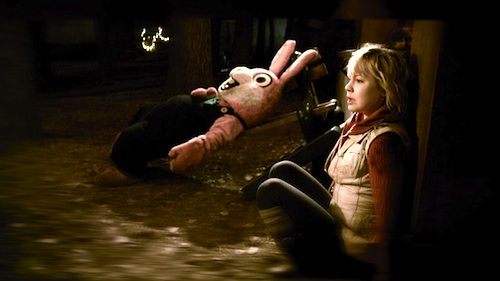
Adelaide Clemens in "Silent Hill: Revelation."

Frankly, it is pretty easy for non-gamers to follow Revelation’s first two acts, but once Sharon/Heather arrives at Silent Hill, all bets are off. Sure, there is a clear narrative chain of events, but the underlying logic of the how’s and why’s is rather vague. In fact, it is rather like watching someone playing a videogame when you do not understand the rules.

Adelaide Clemens is perfectly credible horror heroine, even delivering a promo-reel worthy speech early in the film. Of course, Sean Bean certainly knows his way around a special effects-driven production by now. As Da Silva, he helps elevate the proceedings with his earnest everyman presence. In contrast, McDowell and Carrie-Anne Moss do not exactly make classic villains as the Wolf family cultists.

In all honesty, Revelation still probably represents the high end of the bell curve for video game adaptations. Good and evil have very real meaning here. While as a gamer Bassett was reportedly already steeped in the game’s mythos, he loses control of the third act, letting the film descend into poorly lit mayhem. There is a measure of payoff, but it comes after a head-scratching sojourn through the titular town’s sub-basements. Only for diehards franchise fans, Silent Hill: Revelation 3D opens today (10/26) in New York at the AMC Kips Bay and Regal E-Walk, obviously scheduled with Halloween in mind.

LFM GRADE: D+

Posted on October 26th, 2012 at 11:30am.

A Bad Year to be an Orphan: LFM Reviews The Secret of Crickley Hall on BBC America

By Joe Bendel. On the anniversary of their young son’s disappearance the Caleighs try to heal their grieving family by renting out the most haunted house in England. Most of the former orphanage’s charges supposedly died in the great flood of 1943, but the truth is far more sinister. It might also have very personal implications for the Caleighs in The Secret of Crickley Hall, a special three hour adaptation of James Herbert’s novel, which airs this Sunday on BBC America.

Eve Caleigh blames herself for the apparent loss of their son, Cam. So does everyone else, but they try not to say so. She was the one who dozed off at the playground and woke up to find him missing. She used to have a pseudo-psychic connection with her son, but since Cam vanished she has not felt his consciousness—until they move into Crickley Hall.

Convinced her son is still alive and in danger, Caleigh starts investigating the old house. It is not pretty. Most of the orphans were supposedly sucked into the well dug into the cellar during the tragic storm, but two remain unaccounted for. Her best source of information is the old gardener, Percy Judd, who understood the grim realities of Crickley that the rest of the town was unwilling to face. He knew the headmaster was badly abusing the children – particularly a shy Jewish refugee – despite the heroic efforts of his potential girlfriend (the new teacher at Crickley), as viewers witness during the frequent flashbacks to 1943.

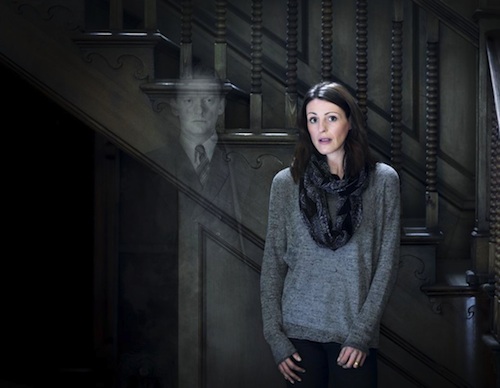
Suranne Jones in "The Secret of Crickley Hall."

Thematically similar, Crickley is sort of like the TV miniseries version of Nick Murphy’s The Awakening. Considering that they still have two perfectly good daughters to lose, it is hard to believe the Caleighs do not turn on their heels as soon as they take a gander at that ominous looking well. (What more do they need, a desecrated cemetery in the backyard?) Yet Gabe Caleigh stubbornly refuses to accept his wife’s ghost talk, despite all the spookiness going on around them. Certainly director-adaptor Joe Ahearne wrings plenty of chills and suspense from the eerie setting.

Although the ensemble does not have a lot of big names by the standards of Hollywood television magazines, it holds plenty of geek interest. Suranne Jones, (co-star of a fan favorite Doctor Who episode) is compellingly guilt-ridden as Eve Caleigh. Playing another mournful husband much like his character in The Fades, Tom Ellis is about as sympathetic and convincing as possible as the frustratingly incredulous Gabe Caleigh. However, it is reliable veteran David (Tron, Time Bandits) Warner’s Judd who really gives the film heart, while Game of Thrones alumnus Donald Sumpter also bears watching as the mysterious old parapsychologist come to allay everyone’s fears.

Even though none of the revelations are shockingly original, Ahearne still pulls it all together rather effectively in the third hour. He plays the old dark house card for all it is worth and juggles the two narrative time periods fairly adeptly. Still, the well produced, half-period Crickley’s three hours could have easily been condensed into two without losing much. Of course, it is important to bear in mind that Herbert is a major best-seller in the UK, so a longer Crickley would make sense for the BBC over there. All told, it is fairly scary stuff for an early Sunday evening. Recommended for fans of British supernatural programming, The Secret of Crickley Hall premieres this Sunday (10/28) on BBC America.

LFM GRADE: B-

Posted on October 26th, 2012 at 11:29am.