A Grindhouse Classic Restored: LFM Reviews Wake in Fright

By Joe Bendel. The good citizens of Bundanyabba (“The Yabba,” like The Bronx or The Hague) will be happy to buy a drink for any visitor. It is a matter of civic pride. However, The Yabba seems to amplify the worst in human nature throughout Ted Kotcheff’s long lost grindhouse for the art-house Wake in Fright, which opens in all its restored glory this Friday at Film Forum.

John Grant’s heart would not be in teaching, even if he were posted to a school in Sydney. Unfortunately, he is financially bound to the outback during his term of service. With the semester break starting, he will finally be able to visit his attractive girlfriend in  the city. He just has one night to kill in the Yabba before continuing on his way. Oh, but there will be complications.

After losing his term’s pay in a glorified game of heads-or-tails, Grant falls in with a gang of lowlifes led by the town’s unapologetically boozy doctor, Tydon. A whole lot of alcohol will quickly hasten Grant’s slide into the dark side. At least he isn’t a kangaroo – because when Grant’s dubious new mates set out on a hunting trip, the carnage is famously disturbing.

Not exactly a thriller or a horror film, Wake is a brutally pessimistic morality play. In the Yabba, the veneer of civilization is rather chipped and faded. An intellectual like Grant ought to be a model of man’s progressive perfectability, but Doc Tydon and his running mates reduce him to his nasty, brutish core in a matter of days. Yet, it is never clear whether the Yabba yobs are really out to break him down or if he is just a puppet of fate.
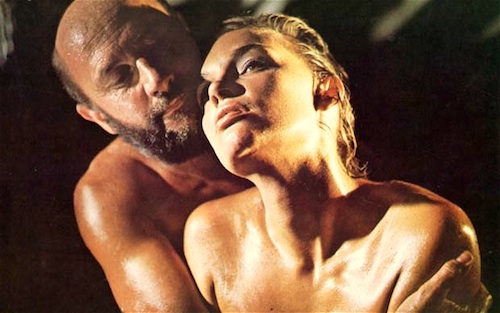
Donald Pleasence and Slyvia Kay in "Wake in Fright."

Whether it is the blinding sun, the hallucinatory kangaroo hunt, or the stone cold humiliations meted down on Grant, Kotcheff maintains a visceral intensity throughout Wake, controlling the vibe like a master puppeteer and framing some powerful visuals. One of only two films to be twice selected for Cannes, it makes a convincing argument Kotcheff might just be the world’s most underappreciated auteur. Indeed, his oeuvre also includes Rambo: First Blood, Uncommon Valor, The Apprenticeship of Duddy Kravitz, and Weekend at Bernies, which is what we call a career in mi casa.

The late Gary Bond, who would eventually become an Andrew Lloyd Webber regular on the West End, sure looks like a tool who needs to be taken down a peg or two. Still, he takes his character to some pretty scary depths. Donald Pleasance plays his doctor-tormentor – which is so perfect, there is no need to explain further. In his last screen appearance, Chips Rafferty also adds further authentic flavor as Jock Crawford, the ostensibly welcoming local peace officer.

It is important to bear in mind no ‘roos were hurt for the sake of Wake. Kotcheff just tagged along with a regularly scheduled commercial hunting outing. The results stand in sharp contradiction to the Paul “Shrimp on the Barbie” Hogan image, assiduously crafted by the tourism bureau. Of course, for fans of Ozploitation the restored Wake is a can’t miss release. A surprisingly challenging work, Wake is recommended for all patrons of cult cinema when it opens this Friday (10/5) at New York’s Film Forum, with Kotcheff on hand to receive his overdue ovation at the 7:30 screening.

LFM GRADE: A-

Posted on October 5th, 2012 at 11:56am.
The Surveillance State & Civil Rights: Watch the New Sci-Fi Short Plurality

We like to keep an eye on short films here at Libertas, so check out this interesting new short above from director Dennis Liu and writer Ryan Condal called Plurality. It went live earlier this week and as of this post has already received over 110,000 views.

Here’s the official synopsis of the film: “After the state of New York gives the police access to ‘The Grid,’ a new technology that allows people to purchase anything with a quick scan of their fingerprint, crime drops almost instantly. However, they also discover that certain people are popping up in two places at once.”

Although the film’s references to Michel Foucault and Jeremy Bentham are a bit on-the-nose (somebody’s been reading Discipline and Punish), Plurality otherwise does a nice job of illustrating how technology may already be leading us down a road to dystopia. Congratulations to the filmmakers, and a hat tip to the folks at io9.

Posted on October 5th, 2012 at 11:55am.

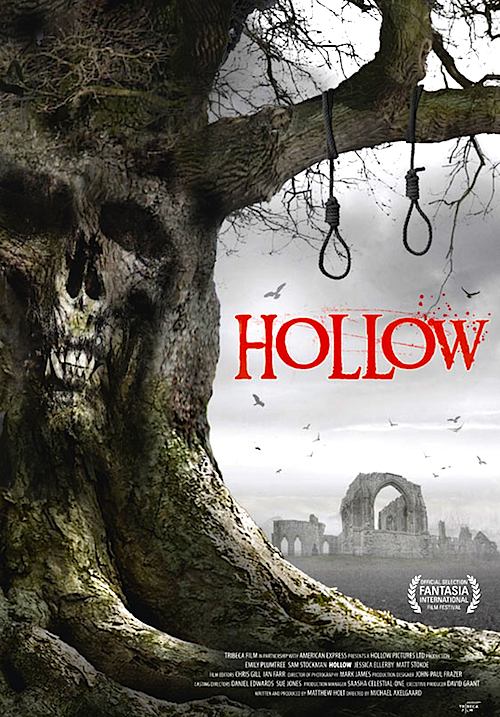
Fear the Tree: LFM Reviews Hollow on Tribeca VOD

By Joe Bendel. For W.G. Sebald, Suffolk was the perfect place for the famous walk and literary digressions that became The Rings of Saturn. For two dysfunctional couples, it will become a place of supernatural menace. The hanging tree will get its due in Michael Axelgaard’s found footage shocker, Hollow, which is now available through Tribeca Films’ VOD platforms.

Emma has come to close the country cottage of her beloved late minister grandfather. For company, she has brought along her smug fiancé Scott, her torch-carrying childhood chum James, and Lynne, the girlfriend he hardly seems to know. Evidently for estate reasons, Emma wants James to document the process as her videographer. Considering we are watching footage recovered by the East Anglia constabulary, it is safe to say their weekend does not go well.

James’ camera was found in a large hollow tree that always gave Emma the creeps—and for good reason. According to legend, a monk and his illicit lover hung themselves there centuries ago. Ever since it has attracted suicidal couples like an evil magnet. Obviously, circumstances will lure the quartet back to the notorious spot, but not before they get high and indulge in a spot of strip poker. However, the power has already been shut off at the cottage, so they will rely on candles and the spotlight on James’ camera for illumination.

Frankly, the full backstory of Hollow is pretty distinctive and the sequences shot in the ruins of the nearby monastery are genuinely creepy. The James’ increasingly apparent instability further cranks up the tension. However, Axelgaard hews too closely to the Blair Witch playbook during the rather predictable third act. Still, producer-screenwriter Matthew Holt’s dialogue has a little snap to it (that’s a little, not a lot).

Whitechapel co-star Sam Stockman decently portrays James’ ambiguously off mental state without doing the full Norman Bates. As Scott, Matt Stokoe unleashes his inner cad, which is something. While Jessica Ellerby’s Lynne is not a total victim waiting to be strung-up, Emily Plumtree’s Emma sort of is, making the female characters a wash overall.

It is important to know Hollow is not exactly tactful in its treatment of religious themes. The late grandfather’s successor is definitely not portrayed in a sympathetic light. Likewise, Scott the hedonist shows a disrespect for the cross that would probably cause riots throughout the Muslim world had it been directed towards the Koran. Yet somehow, Americans will be able to shrug it off and get on to their lives (of course, there is also a strong likelihood he will pay for his excesses in proper E.C. Comics fashion).

Despite its flaws, Axelgaard shows a decent command of horror movie mechanics throughout Hollow. Flawed but watchable, it is now available for voracious genre fans via Tribeca’s on-demand services.

LFM GRADE: C-

Posted on October 5th, 2012 at 11:54am.

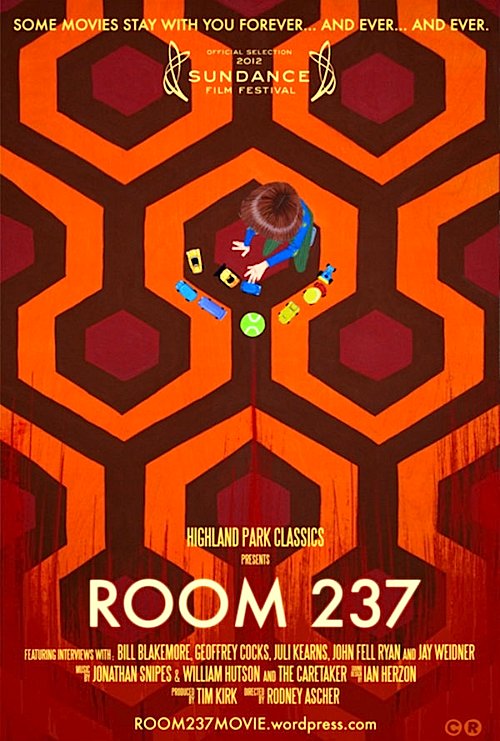
LFM Reviews Room 237 @ The New York Film Festival

By Joe Bendel. The demarcation between unconventional online commentary and outright crackpottery is thin and porous. Five enthusiastic experts on Stanley Kubrick’s The Shining swerve back and forth over that line like a politician at a sobriety check in a documentary examination of the film and those who over-analyze it. People truly say the darnedest things about the 1980 horror classic in Rodney Ascher’s Room 237 (trailer here), which screens as part of the 50th New York Film Festival’s Cinema Reflected sidebar.

We never see Ascher’s five experts, but seriously, that is probably just as well. Several claimed to have been initially underwhelmed by the film on their first viewing, but started teasing out strange hidden meanings in the years that followed. Yes, Kubrick was known for his painstaking attention to detail, but some of Room’s disembodied voices often seem to be obsessing over continuity errors healthy viewers would never notice. At one point, Ascher holds a freeze frame, double-dog daring viewers to see the subliminal portrait of Kubrick the auteur supposedly embedded in the opening credit sequence.

Some commentators are truly masters of the logical quantum leap, arguing amongst other things, that The Shining is an allegory for the Native American genocide – due to the presence of a Calumet baking soda tin in the film. Yes, the Overlook Hotel is well appointed with Native American themed paintings and such, but that is not unusual for a mountain lodge in Colorado. Indeed, we know full well it was built atop a Native burial ground, generating all kinds of bad karma, in a manner predating Poltergeist. Nonetheless, perhaps Occam’s razor suggests that the spirits are just restless.

Still, some of the mysterious analysts make some intriguing points. Most notably, Juli Kearns mapped out every shot, proving the physical impossibility of the Overlook as the audience sees it. In effect, the hotel is just as much a labyrinth as the notorious shrubbery outside, but a malevolent, ever-shifting one.

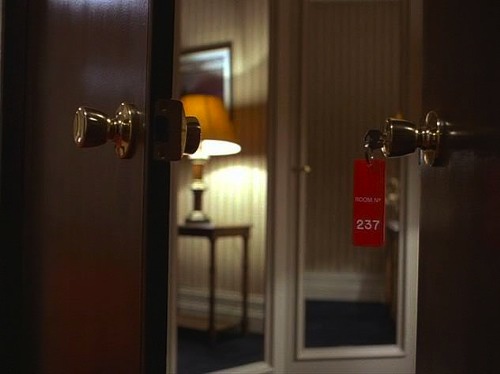
Room 237 in Stanley Kubrick's "The Shining."

Room 237 is an amusing but affectionate tribute to cult film geekery. Ascher’s approach is simultaneously subversive and nostalgic, similar in tone to The S from Hell, his short film homage to Screen Gems’ hideous logo. His strategy to eschew talking heads also works rather well, relying instead on the visuals of The Shining, as well as other related films, such as the master’s Eyes Wide Shut.

One would not exactly call Room 237 convincing per se, but it is quite provocative and engaging, in a scruffily eccentric kind of way. Somewhat tricky to classify, it debuted at Sundance as part of their vaguely experimental New Frontiers track, was acquired by IFC for its Midnight line, but quite logically screens during NYFF as part of the Cinema Reflected sidebar. Recommended for all serious cult film fans, it plays today (10/4) and next Monday (10/8) as the 50th New York Film Festival continues.

LFM GRADE: B

Posted on October 4th, 2012 at 10:36am.

Afghanistan Drama The Black Tulip Available on iTunes, Amazon & VOD on October 26th

The Black Tulip, Afghanistan’s entry for the Best Foreign Language Film at the 83rd Academy Awards, comes to Comcast, Time Warner, Cox, iTunes, Amazon, Xbox, Vudu, and Google Play on October 26th.

Set after the Taliban was routed from Afghanistan in early 2001, The Black Tulip tells the story of how the Mansouri family took advantage of the new window of freedom by opening a restaurant called “The Poet’s Corner” – with an open microphone and an inviting platform for all to read poetry, perform music and tell their stories. A modern portrait of Afghanistan that captures the current plight and resilience of its people, The Black Tulip gives a voice to the people of Afghanistan by telling their story through the eyes of an everyday family from Kabul, who remain hopeful despite constant struggle and tragedy.

Watch the trailer for The Black Tulip above, and read here what LFM’s Joe Bendel said about the film.

Posted on October 4th, 2012 at 10:35am.

New Clips from Ben Affleck’s Argo on the 1979 Iranian Hostage Crisis; Film Opens Oct. 12th

Courtesy of Collider, six new clips have been released from director/star Ben Affleck’s new thriller Argo. Based on a true story, Argo centers on a CIA agent (Affleck) who attempts to rescue six Americans trapped in the home of the Canadian ambassador during the 1979 Iranian Revolution. The rescue mission went in under the auspices of filming a bogus science fiction movie entitled Argo.

Argo co-stars John Goodman, Alan Arkin and Bryan Cranston and opens October 12th.

Posted on October 4th, 2012 at 10:35am.