LFM Reviews 10+10 @ The 2012 New York Asian Film Festival

By Joe Bendel. Taiwan is a country with a tragic history and rich legacy of pop music. Both factor prominently when ten established Taiwanese filmmakers and ten emerging new talents were commissioned by the Taipei Golden Horse Film Festival to create a five minute films expressing the country’s unique character. The resulting anthology 10+10 screens this coming Thursday as an official selection of the 2012 New York Asian Film Festival.

Viewers going into 10+10 should not get hung up on consistency. These twenty filmmakers will cover a lot of emotional and thematic ground. The tension between tradition and modernization will be a recurring motif, beginning with Wang Toon’s opener, in which a bickering pair of cousins treks up to a remote shrine. They intent to curry favor with the spirits by showing them the 3-D DVD of Avatar. It is a quiet but clever piece.

Nostalgia is also on tap in Wu Nien-jen’s A Grocery Called Forever. Depicting a spirited elderly woman who insists on keeping her family’s corner store open, it is a pleasant slice of life. Taiwan’s aging population play central roles in several constituent films, perhaps most touchingly in Cheng Wen-tang’s Old Man and Me. Told from the persona of a now deceased man suffering from Alzheimer’s, it serves as his thank-you to the townspeople who searched the countryside for him when he wandering off to his demise.

Given the approximate five minute durations, many of the installments are rather sketch-like. Indeed, entries like Wang Shaudi’s Destined Eruption and Yang Ya-che’s The Singing Boy seem to end just as they are getting started. However, several pack quite a bit of narrative into their limited running times. Somehow, Chang Tso-Chi’s Sparkles shoehorns the entire 1949 Battle of Kinmen Island into less than ten minutes. A powerful war film, it follows an innocent girl being escorted to the island’s doctor by the Nationalists, as they desperately try to hold off the invading Communists.

From "The Debut."

Featuring plenty of explosions, Sparkles is probably one of the most NYAFF-esque films in 10+10. The other would be Chung Mong-hong’s satisfyingly dark Reverberation. What starts as a teenaged bullying drama takes a dramatic u-turn into gangster territory. Karma will be a hard thing.

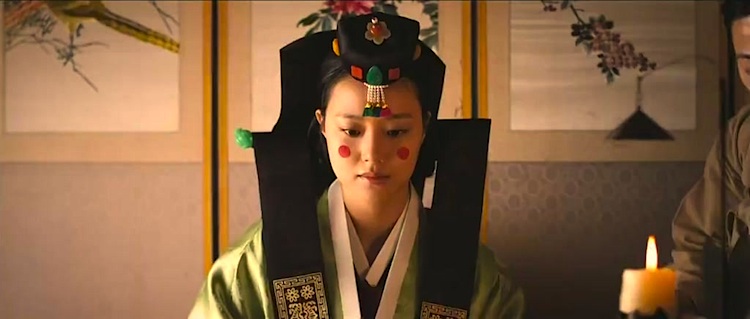
Easily the strongest shorts are those directly inspired by music. Chen Kuo-fu’s The Debut is a lovely ghost story, portraying the spectral encouragement offered to a discouraged pop ingénue by one of the great torch singers from yesteryear. Likewise, Rendy Hou Chi-jan pays tribute to the sentimental ballads of the 1960’s, depicting one song’s power to transcend time. Ranking just a notch below the lyrical pair, Cheng Yu-chieh’s Unwritten delivers some ironic laughs satirizing the concessions made by the Taiwanese film industry to the mainland market. Frankly, it is increasingly relevant to Hollywood as well.

Not every film works particularly well. Wei Te-sheng’s Debut ought to be a DVD extra for his aboriginal war drama Seediq Bale, essentially following his first-time actor Lin Ching-tai as they take the epic to the Venice Film Festival. Arguably, the low point comes with Kevin Chu Yen-ping’s uncomfortably manipulative and awkwardly didactic The Orphans.
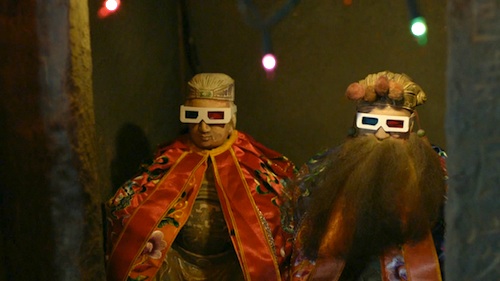
From Wang Toon’s opening short in "10+10."

Surprisingly, there is a fair amount of star power in 10+10, including Shu Qi looking typically radiant in marquis contributor Hou Hsiao-hsien’s slight but nonetheless engaging closer La Belle Epoque. Kwai Lun Mei also graces Leon Dai’s oomph-lacking Key. Despite attempts to glam her down, she remains a vivid screen presence.

By their nature, anthology films are inherently uneven. Yet there are enough good things going on in 10+10 to satisfy connoisseurs of either short films or Asian cinema. On balance, it is an effective sampling of Taiwanese cinema, well worth a look when it screens this coming Thursday (7/5) at the Walter Reade Theater, as part of this year’s New York Asian Film Festival.

LFM GRADE: B-

Posted on July 2nd, 2012 at 1:31pm.
Thai Bikini Zombie Attack: LFM Reviews Dead Bite @ The 2012 New York Asian Film Festival

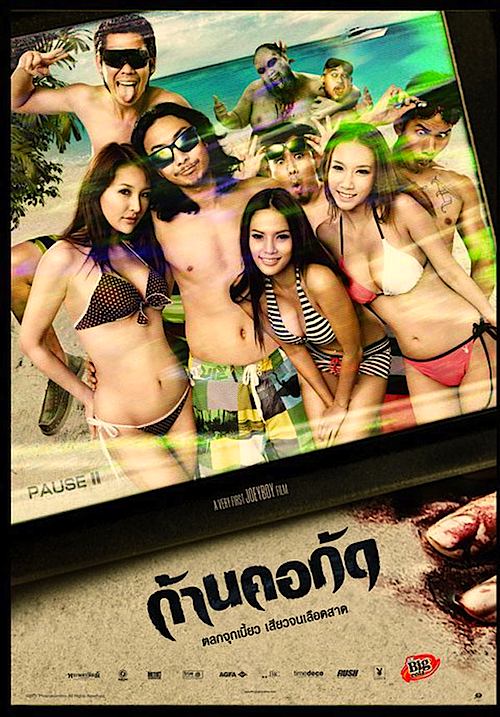
By Joe Bendel. If a group of bikini-clad women are attacked by marauding zombies, you are apt to see a lot of bikini-clad zombies before long. That inescapable logic is pretty much the guiding principle for Joey Boy’s Dead Bite (trailer here), which screens with authority during the 2012 New York Asian Film Festival.

Joey Boy is a Thai rapper, who convinced his group, Gankor Club, to play themselves in his scrappily independent zombie-mermaid religious cult movie, probably with the help of their co-stars’ wardrobe. Due to the framing device, we know Gankor Club’s latest gig went profoundly wrong. Basically, it was supposed to be the old three hour cruise, shooting promotional videos while partying with some gorgeous women. Unfortunately, they chose the wrong isle: Mermaid Island.

The first clue would be the marine zombies shambling out of the waves. Trying to take refuge inland, they run smack into the Forest Goddess, who rules her Mermaid sect through fear and sexual tension. Of course, Joey Boy and his mates had no idea what they were stumbling into. Yet, for some reason inexplicably connected to WWII, Japanese tourist Miyuki intentionally came to Mermaid Island to plunder a mermaid mummy. It might hold the secret of immortality or something. Meanwhile, the Gankor dudes are dying like flies and then popping up again as the undead.

Dead Bite is sort of like a Piranha 3D, except it is 2D and Thai, both of which make it way cooler. Evidently, Joey Boy and Gankor Club are the real deal in Thailand and also have major cred with their American counterparts. As actors they certainly do not seem very self-conscious, throwing themselves into their Scooby and Shaggy roles with admirable energy.

Thai zombie girls.

As an auteur, Joey Boy keeps it all quite snappy. There is also a strange postmodern aspect to his self-referential story that might be purely accidental. Of course, Dead Bite would not be possible without its game supporting cast of attractive women, including Kumiko Sugaho and Lakana Wattanawongsiri as Miyuki and the Forest Goddess, respectively, whose contributions are obvious. Despite all the lunacy and ogling, they more or less maintain their dignity throughout. Surely their next stop will be Cannes with Joe “Uncle Boonmee” Weerasethakul.

It is nice to see a director’s vision up on-screen, knowing he made exactly the film he intended. Gleefully manic and unabashedly randy (in a PG-13 sort of way), Dead Bite is everything a zombie beach movie ought to be. Just good, clean, blood-splattered fun, it is highly recommended for fans of a wide array of B-movies when it screens next Friday (7/6) and the following Wednesday (7/11) as this year’s NYAFF continues at the Walter Reade Theater.

Posted on July 2nd, 2012 at 1:29pm.

LFM Reviews The King of Pigs @ The 2012 New York Asian Film Festival

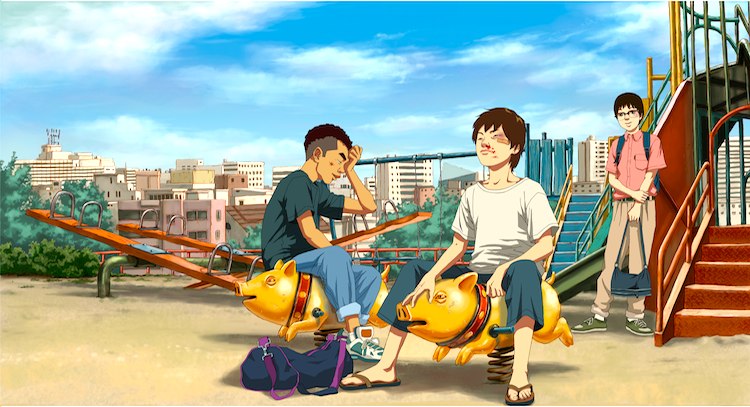
By Joe Bendel. If the professional worrywarts really wanted to end bullying, they would start subsidizing karate lessons for the small and less assertive, but it seems they’d rather wring their hands—on national TV. Yes, it is a problem in many cases, but the peculiarly American disinclination toward hierarchy is a positive countervailing influence. This is not necessarily the case in Korea. What we might call bullying is the institutionalized order of things in Yeun Sang-ho’s thematically mature animated feature, The King of Pigs (trailer here), which screens during this year’s New York Asian Film Festival.

As King opens, it appears safe to say two formerly bullied grown adults have not broken the chain of abuse. Both Hwang Kung-min and Jung Jong-suk are having bad days—lives might be more accurate. Finding himself at a particularly low point, Hwang reaches out to Jung, whom he has not talked to in years. Eventually, we will learn why they drifted apart.

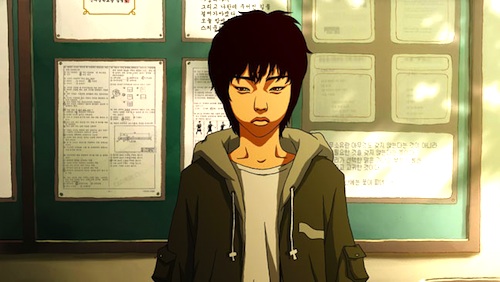
Hwang wants to talk about Kim Chul, the mysterious transfer student they befriended in their middle school years. Though they came from different backgrounds, Hwang and Jung were both “Pigs,” the proles of their school, who were merciless picked on by the ruling “Dogs,” by virtue of their superior social status or brute strength. An outsider in every sense, Kim threatens their established order like a violently rage-stoked James Dean.

From "The King of Pigs."

For obvious reasons, Hwang and Jung fall under the spell of their rebellious protector. However, the deck is stacked against Kim by the Dogs and their enablers. As he realizes the futility of his position, Kim really starts to get dark and stormy.

This is no after school special. King easily features some of the festival’s most brutal beatdowns. Playing the Battle Royale would be like a reprieve for these kids. Yet, as surely exaggerated as it must be, one cannot help but feel that Yeun is tapping into something very real and deep in his countrymen’s collective psyche.

While at times hallucinatory, Yeun’s animation is mostly straight forward and in the viewer’s face, keeping the film rooted in a sense of urgency. His characters are profoundly flawed and painfully human. Actions have consequences that ripple outward, impacting others, years after the fact. There is also no small degree of class warfare at play, notwithstanding Hwang’s relatively well-to-do, but socially shunned Karaoke owning family. Yet viewers can also see how Jung’s class envy metastasizes into something quite ugly and anti-social.

Holding the distinction of being the first Korean animated feature to screen at Cannes, the angry but cinematic King is absolutely not for children. It lands a heck of a punch though. Despite the somewhat inconsistent pacing, it is viscerally effective. Recommended for hardy animation fans, The King of Pigs screens as part of the 2012 NYAFF this coming Saturday (7/7) and Sunday (7/8), with screenwriter-director Yeun in attendance both dates.

LFM GRADE: B+

Posted on July 2nd, 2012 at 1:25pm.

Mythic Themes in Pixar’s Brave

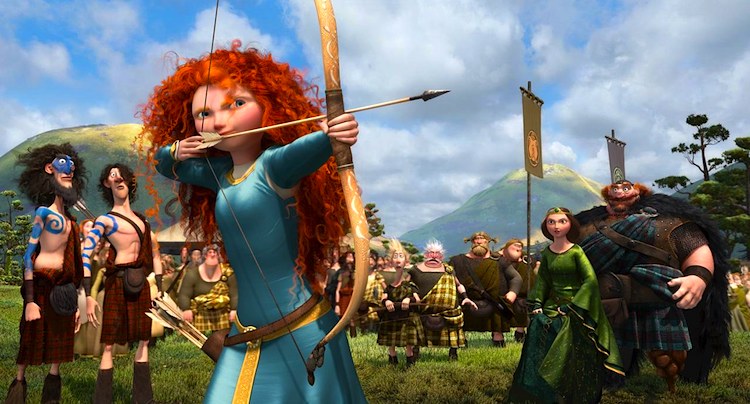
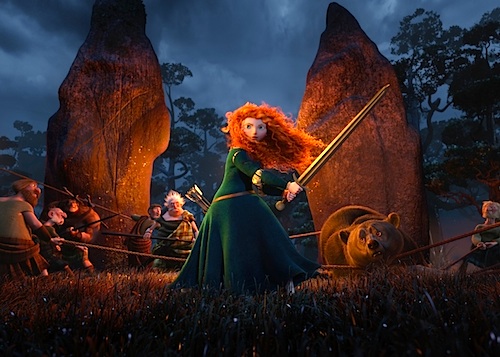
By Patricia Ducey. In a magical Celtic kingdom far, far away, lovely queen Elinor and her consort king Fergus are choosing a suitable husband for their daughter – but their sassy tomboy princess is one of those grrls who thinks she needs a man about as much as a fish needs a bicycle. In Pixar’s Brave, little Merida, our headstrong princess, rebels and hies to the forest on her trusty steed, her flaming red curls flying in the wind. Like many cinematic young female protagonists before her — Princess Ann in Roman Holiday, Princess Mia of The Princess Diaries, or even Wendy in Peter Pan — Merida craves independence and adventure as much as any boy or any commoner, and an arranged, political marriage inspires nothing but dread and an overwhelming urge to flee.

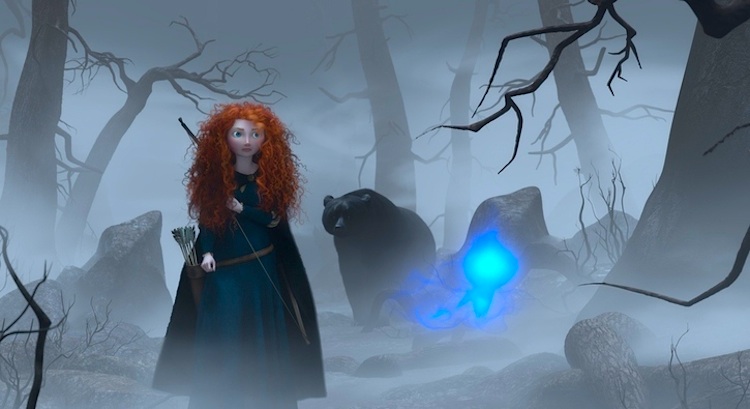
Merida’s effort to avoid marriage, which constitutes the first half of the movie, does not muster up much interest or suspense from an adult point of view. But at the midpoint, when Merida escapes into the forest to avoid her fate, the movie enters classical psychoanalytic symbol territory and becomes infinitely more compelling. A tiny CGI creature (think Tinkerbell) leads her deep into the forest, to the hut of an old crone who appears to be a wood carver. Merida soon discovers she can also cast spells, and begs the witch for a spell to help change her mother’s mind about the marriage issue. The witch warns her off – spells are tricky things and can go awry — but Merida brashly insists, and is soon on her way back to her castle, magic cake in hand. She tricks her mother into eating the toxic cake but is stunned when her mother suddenly transforms into a giant bear. The spell indeed has gone tragically wrong — and if Merida cannot break the spell in two days’ time, the transformation will be permanent. Merida has ignored the warning of the crone, and now she could lose her mother, as surely as if she had killed her, and ruin her kingdom, too — as the fragile peace treaty of the clans hinges on the alliance her marriage will create. In addition, the king has vowed revenge on Mordu, a huge killer bear, who had earlier chomped off his foot. Merida knows that Fergus will kill Elinor if he finds her in her bear form, thinking she is Mordu. Now, those are stakes.

Gory, frightening fairy tales are believed by many theorists (Bruno Bettelheim in particular) to be the material manifestations of the issues that children are consciously and subconsciously dealing with. And so Brave deals with Merida’s anxieties at the prospect of growing up, of maturing into a sexual being, and of relinquishing some of her freedom for the bond of love. As in Brave, fairy tales often insist on the need for just that: bravery, to overcome evil and teach children that these difficulties can be overcome. Brave also delves into the Oedipal/Electra conflict, where the child competes with the mother for possession of the father, or of an independent, public life. It is telling that in Merida’s family dynamic, her father Fergus is a bit of a clown (think Braveheart meets Fat Bastard) and plays but a peripheral role in the family. And so Merida’s primal bond, and conflict, rests with her mother. Her mother oversees Merida’s life; she teaches a bored Merida the geography and history of her kingdom, when she really wants to go out hunting; she teaches Merida the proper grooming and deportment of a queen, which Merida ignores to engage in rough sports. In a final betrayal, Elinor plans Merida’s betrothal, but Merida despises what she views as the lowly position of her mother and has no intention of becoming her. The fierce giant bear that Elinor morphs into is thus a symbol of what Merida fears most: a terrible grownup life as a mature woman and queen. Will she kill the mother, so that she can escape her abject fate? There must be a way out of this dilemma!

From Pixar's "Brave."

So Merida calls forth the crone, who then appears to tell her that the only way to reverse the spell is to “mend the bond torn by pride.” It’s up to Merida to figure out which bond, or bonds, she has torn asunder and to fix them. If she refuses to marry any of the suitors chosen by the clans, the peace forged by a long ago treaty could collapse. If she wants to save her mother, she must give up her childish ways and assume the responsibilities of a queen.

Brave‘s animation is beautiful: rolling green hills and misty valleys and dappled sunsets, a change from the bold primary colors of, for instance, the Toy Stories. The only discordant note is the snappy modern dialogue style, which works against the movie’s deep chords of myth and emotion so reminiscent of a Disney film. But Brave is a very good movie for the wee bairns, who will probably enjoy the first half more than you, and fear the impending loss of Merida’s mother as strongly as you.

Can you change your fate, without throwing a fatal wrench into the delicate web of life? Brave, like other myths and legends, suggests we can, with a pure and courageous heart. And that lesson, as the good doctors of the psyche have told us, is a good thing.

Posted on June 28th, 2012 at 3:22pm.

LFM Reviews War of the Arrows @ The 2012 New York Asian Film Festival

By Joe Bendel. Sure China invaded Korea, but it was all for the sake of greater regional stability. The year is 1636 and only an unemployable archer with an attitude problem stands between Joseon and an army of Manchurian invaders in Kim Han-min’s War of the Arrows, which screens tomorrow during the 2012 New York Asian Film Festival.

Choi Nam-yi and his sister Ja-in should not be alive. When their father is wrongfully branded a traitor, they barely escape to the home of his lifelong friend, who raises them in secret. Unable to live a productive public life, the grown Choi becomes a sullen slacker, wasting his life with his Falstaffian cronies. He only excels at one thing: archery.

In contrast, his sister has fallen in love with Kim Seo-goon, the son of their protector. Believing they can lead a normal existence together, Kim has convinced his parents to allow their marriage. Unfortunately, the Qing army happens to choose their wedding day for their invasion. They only make one mistake, scooping up Choi’s sister and new brother-in-law along with the rest of their prisoners. Somewhat put out by this, Choi dogs the returning Qing forces, becoming a guerrilla army of one. Of course, the trail of arrow-impaled bodies he leaves in his wake attracts the attention of an elite company of archers led by the seriously hardnosed Jyushinta.

From "War of the Arrows."

A commanding screen presence, Ryoo Syeung-ryong makes quite the villain as the relentless Jyushinta. He seethes with authority and projects a quiet sense of menace perfect for his role as the Qing commando leader. While Park Hae-il’s Choi lacks a similar gravitas, he is a convincing action figure, letting the arrows fly as he careens through the forest.

War is one fierce archery film. Those who considered Hawkeye the biggest take-away from The Avengers are in for a treat. This is warfighting at its most personal level. Though already available on DVD, War of the Arrows is the sort of film that should be a blast to watch with an appreciative NYAFF audience when it finally gets an overdue New York ovation tomorrow. Well worth seeing on a big screen, it would have also made a good 3-D fixer-upper (unlike say, Clash of the Titans), considering how many projectiles come flying out towards the audience. Like the best action historicals, War of the Arrows is both high tragedy and a total blast. Enthusiastically recommended, it screens Friday night (6/29) at the Walter Reade Theater as part of the intrepid 2012 NYAFF.

LFM GRADE: A-

Posted on June 28th, 2012 at 3:21pm.

The Young Inspector Morse: LFM Reviews Endeavour

By Joe Bendel. Consider it a portrait of the curmudgeon as a young man. Inspector Morse would make a name for himself as the prickly but refined Chief Inspector with a taste for opera and poetry. However, in 1965, Endeavour Morse was an Oxford drop-out just hoping to catch on with the Thames Valley force after a stint in the military. His first case will be difficult, bringing him back to his former college in Endeavour, the one-off Inspector Morse prequel, premiering this coming Sunday on PBS’s Masterpiece Mystery.

Mary Tremlett, a local school girl, has been murdered and her former lover, an Oxford student, has committed suicide. It is supposed to look like an open-and-shut affair, but the details do not quite fit. Constable Morse’s inquiry leads him to the faculty member tutoring Tremlett (under questionable circumstances), who happens to be married to Morse’s favorite opera diva.

Though preoccupied on several fronts, Morse doggedly follows the clues leading to sleazy car dealer with half the force in his pocket. To proceed, he will need the career-risking assistance of his prospective mentor, the somewhat Morse-like Detective Inspector Fred Thursday, who drives a Jaguar and has little patience for his colleagues’ corruption.

For a television mystery, Endeavour is fairly successful at misdirecting viewers, despite dropping some fairly obvious clues. It also comes fully approved and vouched for, featuring a cameo appearance from Morse author Colin Dexter, as well as Abigail Thaw, the daughter of the late John Thaw (the star of the original Morse series), appearing briefly as the editor of the Oxford newspaper. Frankly, it seems strange that Endeavour was initially produced as a one-shot, much like the Morse spin-off, Inspector Lewis, but in each case the viewers have clearly spoken. A full four episode season of Endeavour is reportedly already in the works.

Shaun Evans as Endeavour Morse.

In his eponymous first outing, Shaun Evans looks appropriately awkward and earnest as Constable Morse, but it will be interesting to see how the character and his performance evolve over time. Indeed, it is easy to understand how this early case would appreciably contribute to his disillusionment. Fortunately, Roger Allam (who once played a suspect on the flagship Inspector Morse) provides plenty of color as the flamboyant but principled DI Friday. The only real weaknesses on Constable Morse’s maiden voyage are his suspects, who are a rather bland lot, in an English upper crust sort of way.

Sure to please the preexisting base, Endeavour should also appeal to viewers of PBS period dramas. There is definitely a sense of nostalgia here that should help the prequel series establish its own discrete identity. An entertaining feature length murder mystery that has plenty of potential for growth (again, much like Lewis before it), Endeavour is easily recommended for Brit TV fans when it airs this Sunday (7/1) on most PBS stations nationwide.

LFM GRADE: B

Posted on June 28th, 2012 at 3:19pm.