Pulp in the City: LFM Reviews The Girl from the Naked Eye

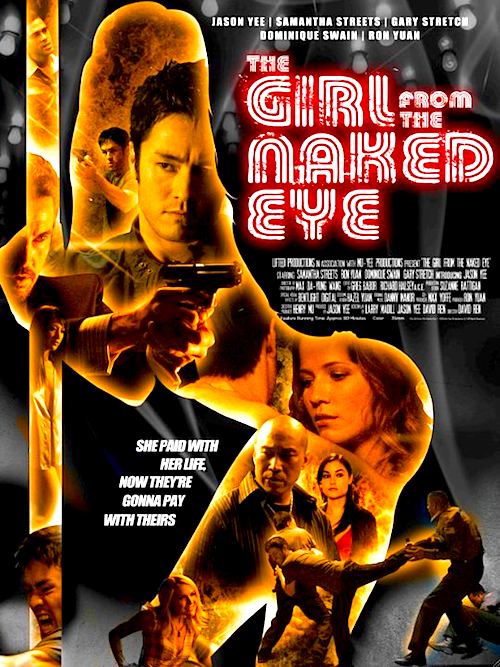
By Joe Bendel. In Neil Jordan’s Mona Lisa, a petty criminal forms an ambiguous bond with the upscale prostitute he is hired to drive. It is a good movie, so try to forget it, temporarily. While their relationship is superficially similar, this tale of a working woman and her schlepper is all about pulp and revenge. Yes, the title character will unfortunately only be appearing in flashbacks throughout David Ren’s The Girl from the Naked Eye (trailer here), which opens this Friday in New York.

A self-described hash-up, Jake is taking the death of his high class call girl associate Sandy rather hard. Deep in debt to the mob, he took a job with the Naked Eye, a strip club whose sleazy proprietor Simon makes his real money running the top girls as prostitutes. Jake used to be Sandy’s driver, but requested a new assignment right before her murder. His feelings for her will become clear from his series of ruminative flashbacks.

In the present day, Jake only has one concern: making the killer pay. Obviously, he wants to know who saw her last, but Simon will not willingly give up her client list. A savage beat-down later, Jake is on the trail, but he will have to contend with Simon’s thugs and his crooked cop partner, who is in serious damage control mode.

This must be strip club week for the indie movie release beat, with Eye hitting theaters along with Mathieu Demy’s more heralded Americano. Ironically, Eye’s lack of pretense earns it a limited nod over its self-serious French competitor. Though far from classic, at least it feels no need to apologize for a little sex and violence.
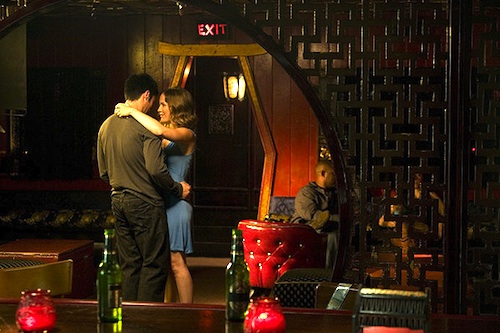
A lurid, grindhouse vibe.

Indeed, action director-co-star Ron Yuan makes several key contributions, including an inventively staged (and decidedly un-Raid-like) fight sequence, in which Jake and four security guards all become increasingly battered and exhausted as it stretches on. He also gives the film a jolt of energy as Simon, delivering a surprising number of laughs and developing real anti-chemistry with Brandy Grace, who makes quite an impression as Angela, his caustic mistress and top earner.

Eye also features two entertaining more-or-less cameos, including Sasha Grey, appearing fully clothed as a bystander in Simon’s hotel for hookers. Dominique Swain has a bit more substantial role as Alissa, a not yet disillusioned lady of the evening, who gives the dense Jake a few helpful tips, via Nancy Drew. Both give brief lifts to the film’s moody luridness. Every bit helps, especially since leads Jason Yee and Samantha Street are bit bland in their dramatic scenes together as Jake and Sandy. Still, the former is quite convincing in his action scenes.

Trying too hard to be noir, Eye is weighed down by narration that would be over the top even for a parody (which it might possibly be). Nevertheless, the colorful supporting cast deserves props for embracing the grindhouse vibe. Clearly a B-movie best saved for late night cable viewing, The Girl from the Naked Eye nonetheless opens tomorrow (6/15) in New York at the AMC Empire.

LFM GRADE: C+

Posted on June 14th, 2012 at 11:28am.
LFM Reviews The Woman in the Fifth

By Joe Bendel. Tom Ricks is a writer, so he must be a little off. With only one obscure novel to his name, the American cuts an underwhelming literary figure, but he has enough issues to earn a restraining order from his French wife. Following her and their daughter to Paris does little for his overwrought state of mind in Pawel Pawlikowski’s The Woman in the Fifth, which opens this Friday in New York.

Less than thrilled to see him, Nathalie Ricks promptly calls in the gendarmerie. Beating a hasty retreat, Ricks finds himself penniless at the flop-house motel run by gangster Sezer. To pay for his room and board, the novelist accepts a job working as a sketchy subterranean watchman for one of Sezer’s criminal endeavors. He figures it will give him time to work, but his writing is definitely not of the healthy variety. The only bright spot are his semi-regular assignations with Margit Kadar, an elegant and alluring widow of a Hungarian novelist perhaps even more obscure than Ricks, living in Paris’s 5th arrondissement.

While his ex shuns his reconciliation attempts, Ricks attracts the romantic attention of Ania, the Polish immigrant waitress at Sezer’s tavern, who also happens to be the mobster’s lover. This profoundly destabilizes the novelist’s situation. It also starts a chain of events leading Ricks to suspect a hitherto unknown force is meddling in his affairs.

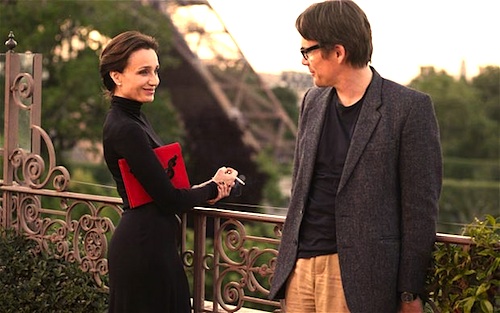
Kristin Scott Thomas and Ethan Hawke in "The Woman in the Fifth."

Based on the novel by Douglas Kennedy, Fifth blends elements of genre cinema in ways that would be spoilery to discuss in detail. However, Pawlikowski is more interested in presenting an extreme psychological study with a distinctly Continental art film sensibility than aiming for mere thrills or chills. Never rushing the revelations, Pawlikowski still deftly creates sense that all is not right with his protagonist and his world.

Leading a multinational ensemble, Ethan Hawke and his terrible French accent are effectively moody and withdrawn as the socially problematic Ricks. Polish actress Joanna Kulig, recently seen (and very much exposed) in Malgoska Szumowska’s Elles, is also quite credible as the glammed-down Ania. Yet, Kristin Scott Thomas is the crucial piece of the film’s puzzle. Always an intelligent presence, she is absolutely perfectly cast as the sophisticated Kadar. The audience instantly shares Ricks’ interest in her—and of course her accent is always flawless, in both French and English.

Fifth’s slow build and emotionally detached approach to Ricks’ existential drama might be difficult for some viewers to whole-heartedly embrace. However, it is a smart, stylish film. Indeed, cinematographer Ryszard Lenczewski’s chilly gray color palette nicely suits the on-screen mystery and alienation. It is the sort of film viewers will kick around in their heads for days after screening it, which is an increasing rarity. Highly recommended for fans of European cinema with a dark twist, Woman in the Fifth opens this Friday (6/15) in New York at the Village East.

LFM GRADE: B+

Posted on June 13th, 2012 at 10:39am.

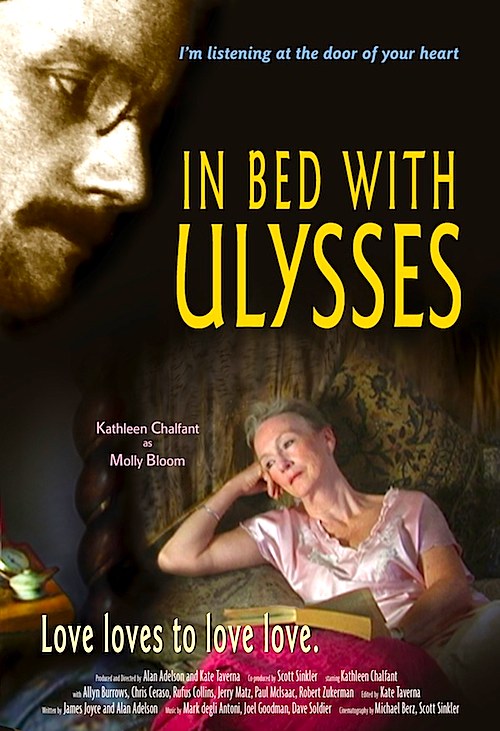
What Better Way to Spend Bloomsday? LFM Reviews In Bed with Ulysses

By Joe Bendel. In addition to its now universally acknowledged literary significance, the effort to publish James Joyce’s Ulysses in the face of widespread censorship was the major publishing story of its day. Actually, the novel’s publishing history is still unfolding. Many scholars recently rejoiced when it – along with most of Joyce’s early works – went into the public domain, liberating them from what they considered an unreasonable and erratic estate executor. It should make this year’s Bloomsday celebration quite lively. Irrespective of Stephen Joyce’s controversial stewardship, Joyceans in Brooklyn will also be able to mark June 16th, that fateful day spent with protagonist Leopold Bloom, by attending the premiere theatrical engagement of Alan Adelson & Kate Taverna’s In Bed with Ulysses, which began this Monday at the Brooklyn Heights Cinema.

Throughout Bed, Adelson and Taverna celebrate Joyce’s language, but not necessarily his personality. Indeed, many leading Joyce scholars make no bones about the author’s self-centered neuroses. They certainly do not make him sound like a particularly pleasant husband, plundering his relationship with wife Nora for his autobiographical novels, while bizarrely prodding her to justify his extreme jealousies. Still, it provides good fodder for documentaries.

Fortunately, his work is something else entirely. In staged readings of Ulysses, performed by established legit actors, including Kathleen Chalfant (known for the original New York production of Wit) reading in the Molly Bloom persona, the film luxuriates in the rhythms and ribald tartness of Joyce’s language. While we do not hear anything to make the typical Brooklyner blush, there might be just enough to make a PBS broadcast, as is, a tad tricky.

All of the performers have a good feel for Joyce’s words and the archival images of 1904 Dublin that often accompany their readings give viewers a vivid sense of where the novel came from. Adelson and Taverna also incorporate a fair amount of focused and on-point expert interviews, the most notable being novelist and Joyce biographer Edna O’Brien, an impressive literary figure in her own right. Of course to nobody’s surprise, grandson-executor Stephen Joyce never makes an appearance.

James Joyce, Marilyn Monroe reading "Ulysses."

In Bed with Ulysses is an easily digestible combination of Joyce biography and Ulysses crib notes, with fair servings of Irish history and theater arts mixed in. Obviously, Irish cultural institutions should be very interested in the film, but its exploration of Bloom’s Jewish heritage and the extent to which Limerick’s 1904 anti-Jewish riots and boycotts informed the novel should expand the demographic audience considerably. Yet, the Joyceans who continue to be intrigued by the literary icon’s revolutionary novels are the real target market.

Informative but never too heavy, In Bed with Ulysses is readily recommended for those who appreciate literary biography or looking for a way to ease into the somewhat intimidating novel. It is also a chance for borough loyalists to support Brooklyn filmmakers at the Brooklyn Heights Cinema, before the scrappy art-house goes into temp space while their current location is redeveloped. It runs there until at least Sunday (6/17), which indeed includes Bloomsday this Saturday (6/16).

LFM GRADE: B

Posted on June 13th, 2012 at 10:38am.

Things Happen for a Reason: LFM Reviews Accident

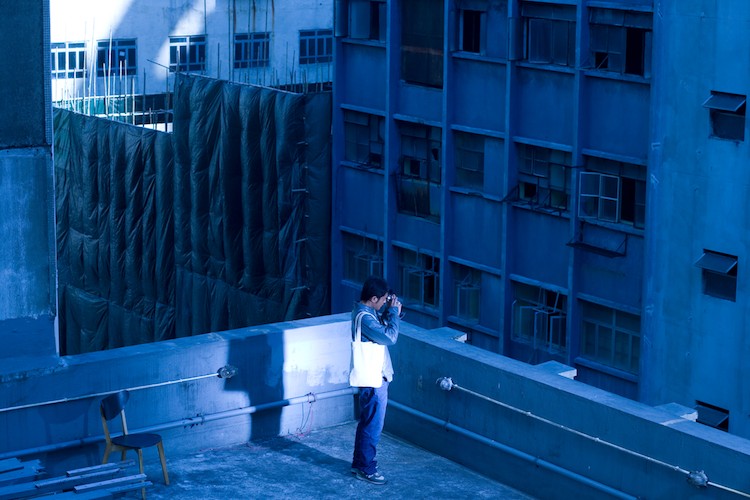
By Joe Bendel. Ho Kwok-fai is not living in a random universe. Accidents happen for a reason: money. He would know. He is the mastermind behind a team of “accident choreographers.” Unfortunately, they have apparently attracted the wrong sort of attention from a competitor in Accident (trailer here), Soi Cheang’s moody thriller produced by HK action legend Johnnie To, which releases this week on DVD and Blu-ray from Shout Factory.

Though not quite as Rube Goldbergian, Ho’s team are like a Final Destination movie unto themselves. Just ask the Triad boss in the opening sequence, while you can. “The Brain” runs the show with tick-tock precision, but a dark cloud seems to hang over their latest gig. “Uncle” starts to show signs of dementia and the necessary rain will not come. Then the wheels come totally off.

Going underground, Ho starts surveilling an insurance executive he suspects played a part in the disastrous non-accident. Already haunted by his wife’s fatal auto crash, his psyche will sink to some pretty low places. Rather than a standard hitman-on-the-run film, Accident treads a more existential path, in the tradition of Coppola’s The Conversation (granted, it is not exactly in the same league).

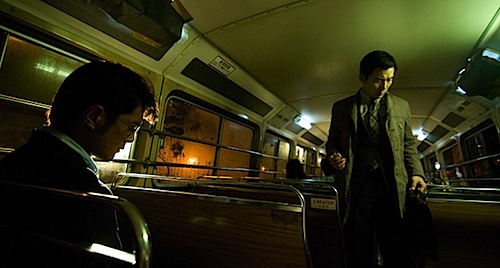
Hong Kong noir.

In the years since To’s Election epic most of what American audiences have seen of Louis Koo were romantic or comedic features, like Mr. and Mrs. Incredible, Magic to Win, and All’s Well Ends Well 2012, 2011, 2010, and 2009. Nonetheless, he shows plenty of screen grit in Accident, brooding like mad, yet getting stone cold medieval when necessary. As a bonus, Lam Suet, To’s regular comic relief specialist, brings his usual energy, but plays Ho’s stout but not shticky henchman “Fatty” with considerable restraint.

Viewers who have seen a lot of Hollywood-produced thrillers will probably be downright shocked by Accident, precisely because of their preconditioning. Indeed, Cheang is willing to take it in a direction studio filmmakers never would, which is cool. Of course, knowing it is produced by To and his Milkyway Image team is something of a seal of approval in and of itself. Enthusiastically recommended for fans of noir thrillers and HK cinema, Accident is now available on DVD at online and quality brick-and-mortar retailers everywhere.

LFM GRADE: A-

Posted on June 13th, 2012 at 10:37am.

LFM’s Govindini Murty at The Atlantic: Decoding the Cultural Influences in ‘Prometheus,’ From Lovecraft to ‘Halo’

[Editor’s Note: the article below and its accompanying slideshow appear today in their entirety on the front page of The Atlantic.]

A guide to the literary, artistic, and political tropes alluded to in Ridley Scott’s sci-fi blockbuster

By Govindini Murty. Ridley Scott’s long-anticipated Prometheus took in $50 million at the weekend box office, and with its heady mixture of sci-fi spectacle and metaphysical speculation is already generating passionate debate.

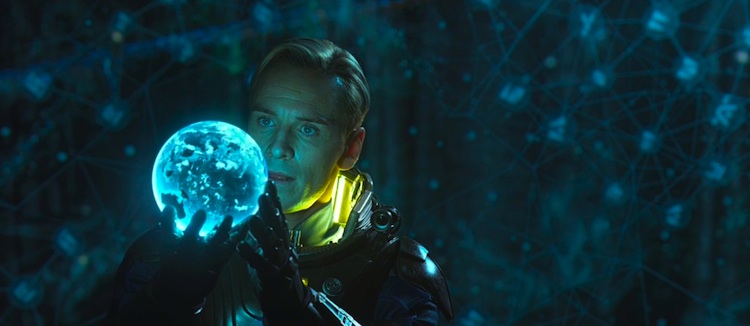
Set in the year 2093, the film depicts the crewmembers of the spaceship Prometheus as they journey to a distant moon to search for the origins of humanity. The team is led by scientist Dr. Elizabeth Shaw (Noomi Rapace), a Christian believer who has discovered a series of ancient pictograms convincing her that the moon is home to mysterious “Engineers” who created the human species. Shaw is accompanied on her vision quest by a robot with ambiguous intentions played by Michael Fassbender, an icy corporate executive played by Charlize Theron, and a crew of scientists and technicians. Once they arrive on the moon, they find a mysterious dome-shaped structure that contains horrifying forces with the potential to destroy humanity.

The striking images Ridley Scott devises for Prometheus reference everything from Stanley Kubrick’s 2001 to Leonardo Da Vinci’s Vitruvian Man and Mario Bava’s Planet of the Vampires. Scott also expands on the original Alien universe by creating a distinctly English mythology informed by Milton’s Paradise Lost and the symbolic drawings of William Blake.

The following guide unveils the cultural mysteries of Prometheus. (Warning: these slides contain plot spoilers.)

The Titan Prometheus.

1) The Greek legend of Prometheus

As the spaceship Prometheus approaches the moon LV-223, Peter Weyland, the wealthy businessman funding the venture, addresses the crew in a video. He explains the myth of Prometheus, and says to them mysteriously, “the time has now come for his return.”

In ancient Greek myth Prometheus was a Titan who helped Zeus defeat his father Kronos. Yet after he was cheated by Zeus of his reward, Prometheus defied the gods by stealing fire from Olympus and giving it to humanity. For this crime, Zeus condemned Prometheus to be chained to a rock for all eternity, with an eagle daily tearing out his liver. Aeschylus’ play Prometheus Bound depicts Prometheus as a mad rebel against divine authority. Prometheus barks to the god Hermes: “In a single word, I am the enemy / of all the Gods that gave me ill for good” (975-976), to which Hermes replies: “Your words declare you mad, and mad indeed” (977). This is later inverted in the Romantic poet Shelley’s Prometheus Unbound, which portrays Prometheus as a sympathetic figure and champion of humanity.

There are multiple Prometheus figures in the movie, from the mysterious race of Engineers who appear to have been struck down after using a lethal biotechnology, to Elizabeth Shaw who defies the limits of science to acquire potentially dangerous information about human origins, to Peter Weyland who wishes to gain forbidden knowledge of immortality to make himself equivalent to the gods. Finally, a scene in which Shaw and her fellow scientists attempt to animate the head of one of the Engineers with electricity appears drawn from Mary Shelley’s Frankenstein—subtitled, “The Modern Prometheus.”

>>>TO READ THE REST OF THE ARTICLE AND SEE THE ACCOMPANYING SLIDESHOW, PLEASE VISIT THE ATLANTIC.

Posted on June 11th, 2012 at 3:19pm.

LFM’s Govindini Murty at The Huffington Post and AOL-Moviefone: “We’ve All Been Brainwashed”: China’s Dissident Bloggers Speak Out in High Tech, Low Life

[Editor’s Note: the post below appears today on the front page of The Huffington Post and AOL-Moviefone.]

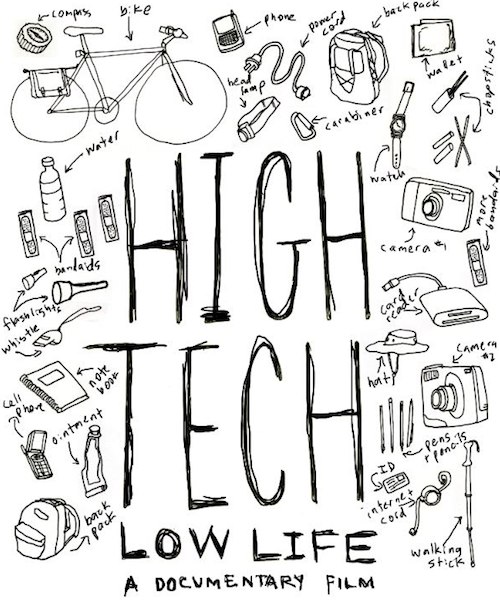
By Govindini Murty. Even as Chinese dissidents like Nobel laureate Liu Xiaobo and artist Ai Weiwei suffer physical imprisonment, hundreds of millions of their fellow Chinese citizens are suffering a form of mental imprisonment thanks to their nation’s system of internet censorship. For example, the Chinese government recently blocked on-line searches for words relating to the 23rd anniversary of the June 4th, 1989 Tiananmen Square massacre, censoring the terms “Tiananmen square,” “June 4th,” the number twenty-three, the words “never forget,” and even images of candles. The award-winning documentary High Tech, Low Life, currently screening at film festivals in the U.S., UK, and Australia, profiles two dissident Chinese bloggers who are working to challenge this Orwellian system.

Directed by Stephen Maing, High Tech, Low Life was in part funded by a Kickstarter campaign publicized on The Huffington Post and was an official selection of the 2012 Tribeca Film Festival. High Tech, Low Life documents the work of 57-year old blogger Zhang Shihe (known as “Tiger Temple”) and 27-year old Zhou Shuguang (known as “Zola”), two of China’s best-known “citizen reporters.” Even as the Chinese government uses internet technology to stifle dissent, these brave bloggers find creative ways to circumvent “The Great Firewall of China” and publish the truth about human rights abuses to the world. Along the way, Tiger and Zola suffer official harassment, familial disapproval, eviction, and arrest.

Blogger Zola describes in the film the vast apparatus of internet censorship that exists in China:

“There are 440 million netizens in China, 40,000 internal police monitor them, and 500,000 websites are blocked in China.” [Despite this,] “if an incident happens anywhere, netizens and citizen journalists will flock to the scene from all over the country. The censors might stop some of us, but they can’t stop all of us.”

Tiger Temple expands on the morally corrosive effect of the government’s censorship: “We’ve all been brainwashed. We’ve been listening to lies for too many years.” Although material prosperity may have improved in China, Tiger argues that life today is as bad as it was under Mao’s dictatorship. As Tiger puts it, the Chinese people are “complacent because they feel powerless.”

Tiger Temple and Zola could not be more different in style. The older, more experienced Tiger is a writer and former publisher living in Beijing who becomes closely involved in his subjects’ lives, bringing them food, money, and legal help. Tiger’s father was a high official in the Communist Party, but the family was persecuted by Mao during the Cultural Revolution in the ’60s. Tiger recalls how he and his family were beaten, evicted from their home, and exiled to the countryside. It was then, as a 13-year old, that Tiger says he started “roaming the country.”

Tiger’s entry into blogging was almost accidental. Returning home one day from viewing an exhibition of Monet paintings in Beijing, he saw a woman being stabbed to death on the street by a man as bystanders watched. Horrified but unable to prevent the murder, Tiger grabbed his camera and documented its aftermath instead. He notes that when the police showed up, they were angrier at him for taking the photos than at the murderer himself, because such scenes would normally be censored from the press. Tiger went on to publish the photos online and caused a sensation, becoming known as China’s first “citizen journalist.” Tiger adds that he calls himself a “citizen” and not a “citizen journalist” because that way the government can’t ban him.

Years later, Tiger makes lengthy journeys on bike through the countryside to report on the lives of the rural poor who have suffered in the rush to urbanization. He is even on occasion tailed by agents of the government. In one trip documented in the film, Tiger bicycles 4000 miles to Er Loa, a village devastated by the illegal flooding of toxic waste by the local government. The floods of waste have caused the farmers’ homes to collapse and have made farming impossible. Villagers tell Tiger that local officials have warned them that if they complain too much they will be arrested. Not only does Tiger take photos and video of the environmental devastation, he also brings the villagers flour and noodles to feed them and tells them he has forwarded their information to a university in Beijing where law students are working to file a legal complaint with the authorities. Tiger interests an NGO in their case, and the farmers are ultimately brought to Beijing to speak at the Civil Society Watch’s Environmental Protection Conference.

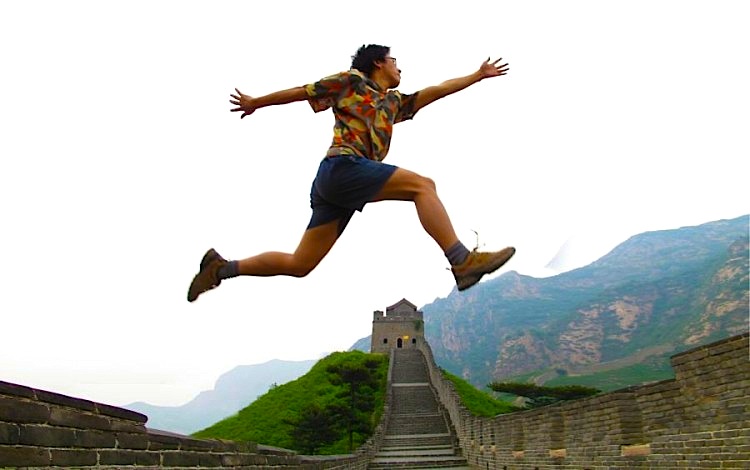
The blogger Zola at the Great Wall of China.

Continue reading LFM’s Govindini Murty at The Huffington Post and AOL-Moviefone: “We’ve All Been Brainwashed”: China’s Dissident Bloggers Speak Out in High Tech, Low Life