LFM Reviews The Tim Burtonized Dark Shadows

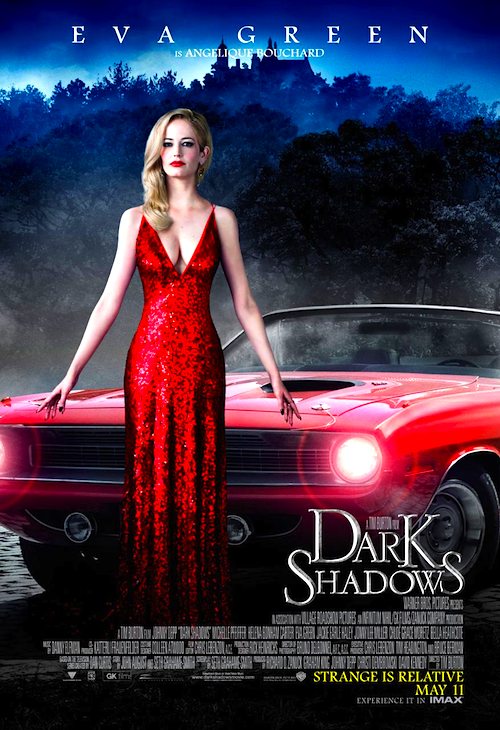
By Joe Bendel. Fans of The Adams Family get psyched. Tim Burton has revived your favorite franchise. He is calling it Dark Shadows now, but the goofy vibe remains the same. Die-hard devotees of the ostensive source material – Dan Curtis’s cult television show – might not be overwhelmed by the results, though. Burton and his regular repertory players certainly do their thing in the latest reboot of Dark Shadows, which is now playing widely throughout the country.

Barnabas Collins was the privileged son of an English fishing magnate, who built the coastal Maine town of Collinsport largely through his industry. Despite his fascination with the occult, the arrogant Collins spurns the love of Angelique Bouchard, a domestic servant who also happens to be a powerful witch. In retrospect, this was a mistake. Seething in fury, Bouchard bewitches Collins and his true love, compelling her to throw herself from the impossibly Burtonesque cliffs and turning him into an undead vampire.

Whipping the village rabble into a frenzy, Bouchard entraps Collins in a coffin, secretly burying him, so he can feel the anguish of his loss and unquenched thirst for all eternity. Then one fateful 1972 night, workmen discover Collins’ burial site. A spot of blood-letting and a liberal supply of fish-out-of-water gags soon follow.

It turns out the Collins family fortunes have suffered during the centuries Collins was away. Of course, the prodigal patriarch sets about righting matters, through the help of his supernatural powers. As per the rules of Tim Burton films, Sir Christopher Lee duly appears in a cameo as a salty dog sea captain falling victim to Collins’ mesmerism. Yes, that is one Burton tradition well worth maintaining.
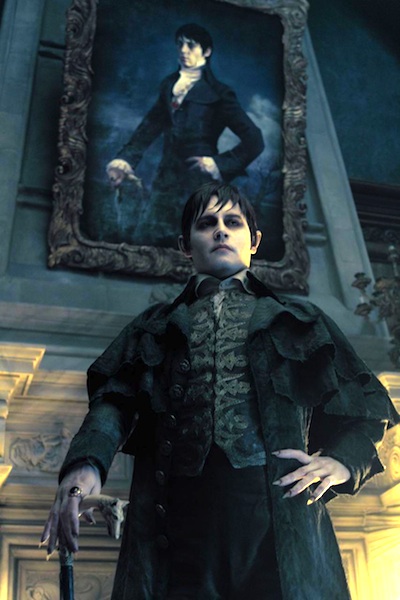
Johnny Depp as Barnabas Collins.

Granted, Shadows looks great. Burton is clearly in his element when exploring spooky old houses and the 1970’s era wardrobe and soundtrack adds the right kind of kitsch. If only the script had benefited from the same attention to detail lavished on the banister in Collingwood, the Collins family manor. Instead, the story is really just a clothesline on which to hang Adams Family-style jokes, while Collins and Bouchard act like the Tracy and Hepburn from Hell.

As Collins, Johnny Depp basically does his shtick. In spite of viewer resistance, he gets laughs (particularly with his old school swearing invoking all manner of hellfire invective), but this is very definitely a one-note performance. At least Eva Green seems to get it. She is gleefully wicked as Bouchard. The fact that she looks like she was poured into her wardrobe does not hurt, either. Michelle Pfeiffer also looks great as Elizabeth Collins Stoddard, the living head of the Collins household. Still, aside from Depp and Green getting their supernatural groove on, the talented ensemble does not have much to do.

While the original cast members, including the recently deceased Jonathan Frid, briefly appear as party guests, the film’s truly inspired cameo features Alice Cooper as himself. Bizarrely, Burton tries to offer olive branches to the traditional fan-base by shotgunning about a half dozen of the revelations from the original show into the final climax. However, it would have worked much better had he sprinkled more of that plot throughout the film.

To some degree, Bruno Delbonnel’s dark and stormy cinematography, combined with Burton’s typically eccentric baroque sets and costumes, helps compensate for a thin screenplay and repetitive jokes. Overall, though, it is just a mildly diverting summer confection filled with empty cinematic calories. For Burton fans, it is now in theaters across the country, including the Chelsea Clearview here in New York.

LFM GRADE: C

Posted on May 15th, 2012 at 3:59pm.

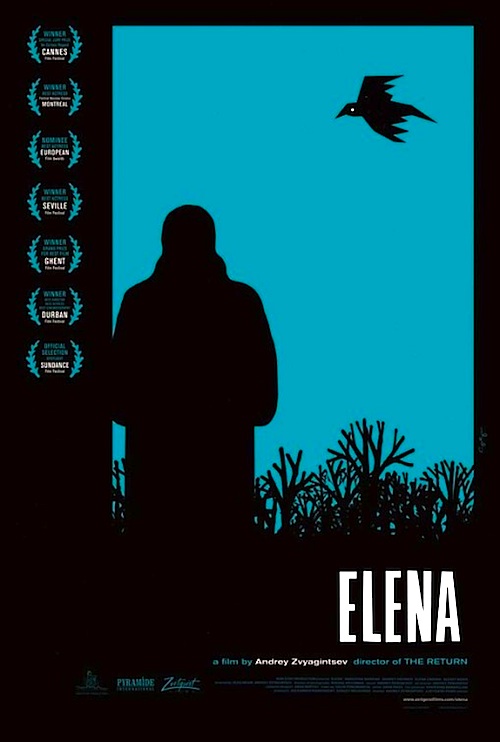
Class Conflict in Today’s Russia: LFM Reviews Zvyagintsev’s Elena

By Joe Bendel. Elena could have been an old world Russian babushka. She even still wears the traditional head scarves. Yet, she has married into the world of oligarchic privilege. It is a pleasant if loveless marriage, but fundamental disagreements with her wealthy husband will take a dark turn in Andrey Zvyagintsev’s Elena, which begins a special two week engagement at New York’s Film Forum this Wednesday.

The working class Elena met the sophisticated Vladimir while working as a nurse during his convalescence two years ago. They have little in common except their dismal records as parents. His grown daughter Katerina is an entitled party girl emblematic of New Russia’s excesses. Elena’s slobby, unemployed son Sergey is only fit for queuing in lines and getting drunk. That might have been perfectly fine during the Soviet era, but it does not cut the mustard any more. While Vladimir readily underwrites Katerina’s high-flying lifestyle, he begrudges any support Elena offers her deadbeat family.

If anything, Elena’s thuggish grandson Sasha is even less accomplished than his father. In order to forestall his military service, Sergey will have to bribe Sasha’s way into college, but Vladimir is not having any of it. After collapsing in the gym, issues of inheritance come to the fore, provoking Elena to action for the sake of her proletariat family.

Such “action” is a relative term in Zvyagintsev’s deliberately paced film. He is much more interested contrasting the dramatic class distinctions of contemporary Russian than engaging in Double Indemnity style suspense. Frankly, viewers need to pay attention throughout Elena, because it is easy to miss the crossing of the Rubicon.

In contrast, it is impossible to not notice the differences between the two Russias. One is a world of glass and steel luxury (perfectly underscored by sparing excerpts from Philip Glass’s 1995 Symphony No. 3), whereas the other is a grubby suburb of Brutalistic socialist era architecture dominated by noxious looking nuclear containment domes. There is also a pronounced psychological difference, as well. Vladimir harshly dismisses Sergey as a lazy drunken slacker, but he is not exactly wrong.

Indeed, a mother’s love may oftentimes be blind (it might have been clever to have opened Elena over the weekend, but it is hard to imagine any son taking mom to see it) and Elena is arguably indulgent to a fault. However, it is her relationship with Vladimir that is most intriguing. Nadezhda Markina palpably conveys a complicated lifetime of struggle as the title protagonist, while developing some ambiguous yet very real chemistry with actor-director Andrey Smirnov’s Vladimir. The precise nature of their union remains hard to pigeonhole, with several scenes supporting disparate interpretations.

Elena certainly shines a spotlight on the inequalities of Putin’s Russian – still a playground for compliant oligarchs. Yet, as a film it is really a showcase for Markina’s remarkable, unadorned performance. Though the tempo is undeniably leisurely, there is a real point to it all, as it heads towards a very specific destination. Recommended for viewers with adult attention spans, Elena opens this Wednesday (5/16) at Film Forum.

LFM GRADE: B

Posted on May 15th, 2012 at 3:57pm.

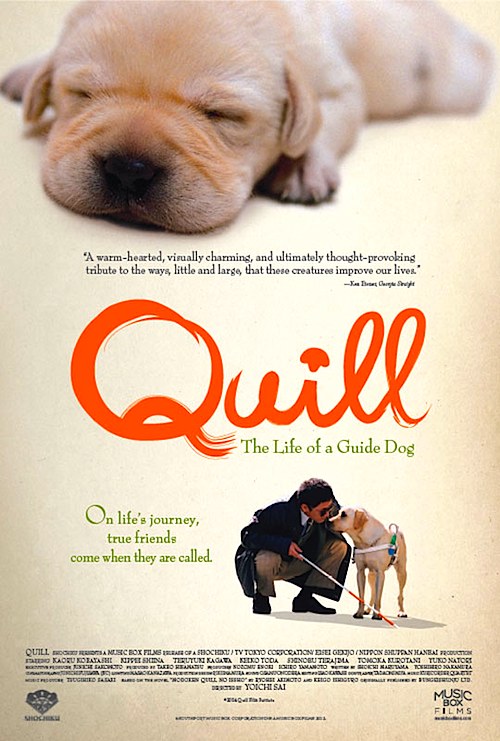
LFM Reviews Quill: The Life of a Guide Dog

By Joe Bendel. As cute as he is, Quill is a dog with a role in life. By virtue of his intelligence and empathetic intuition, the golden retriever will become a guide dog for the blind. His eventful dog’s life is lovingly depicted in Yoichi Sai’s Quill: the Life of a Guide Dog, which opens this Friday in New York.

Out of a litter of five pups, Quill is the shrewdest. His owner wanted them all to become guide dogs, but only Quill makes the grade. As a result, he will experience his first parting, leaving his puppy home to live with the Isamu and Mitsuko Nii, a couple who care for prospective guide dogs until they reach the age training commences. Considering how the Niis dote on him, Satoru Tawada’s training kennel requires quite an adjustment, but again Quill adapts.

Tawada has Quill in mind for Watanabe, the irascible chairman of a local nonprofit support organization, but the middle-aged man is resistant. Of course, Quill wins him over, but Watanabe’s health problems will complicate their time together.

Sai once served as an assistant director to Nagisa Ôshima on In the Realm of the Senses, a film about as dissimilar to Quill as one can possibly imagine. Not afraid of a little manipulative sentiment, Shoichi Maruyama and Yoshihiro Nakamura’s screenplay hits all the dog-lover bases good and hard. However, Quill’s adorableness at all ages is an undeniable ace in the hole. By the time the aged Quill comes full circle back to the Niis, even the brawniest of men will find themselves getting choked up.

No question, the canine cast is truly endearing, with the film’s trainer Tadami Miya maximizing their cinematic charm. The human ensemble is also rather pleasing, including Teruyuki Kagawa (recognizable from far darker Japanese imports, like Tokyo Sonata and the 20th Century Boys trilogy) and Shinobu Terajima (unforgettable in Wakamatsu’s disturbing Caterpillar), who are genuinely touching as the Niis.

Featuring a sensitive soundtrack by the Kuricorder Quartet, Quill has a gentle, humane vibe not unlike the work of Kore-eda. Though Sai’s film has been kicking around the festival circuit since 2004, its belated American release coincides with the dramatic increase in the social and commercial organization of U.S. dog lovers. Frankly, post-Marley and Me, it has enormous crossover potential. Recommended for canine fanciers and Japanese cinephiles, Quill opens this Friday (5/18) in New York at the Cinema Village.

LFM GRADE: B+

Posted on May 15th, 2012 at 3:55pm.

LFM’s Jason Apuzzo & Govindini Murty at The Atlantic: “At the Summer Box Office, a Battle Between Two Ways of Filming”

"The Avengers" was photographed digitally, whereas "The Dark Knight Rises" was shot on film.

[Editor’s Note: the piece below was featured today on the front page of The Atlantic.]

Digital moviemaking is on the rise, but some high-profile directors still shoot popcorn flicks the old way.

By Jason Apuzzo & Govindini Murty. This summer, Hollywood’s blockbusters are engaging in a high-stakes format war between cutting-edge digital technology and old-fashioned, photochemical film. Digitally photographed thrillers like The Avengers, Prometheus, and The Amazing Spider-Man will be battling it out with equally epic movies shot on film such as The Dark Knight Rises, Men in Black 3, and Battleship. Indeed, no summer in recent memory boasts so much variety in terms of how films are photographed and exhibited.

Yet with studios looking to trim costs on increasingly expensive “tentpole” movies, traditional celluloid film—easily the more expensive of the two formats—may be on its way out as the cinema’s medium of choice. Still, advocates of film continue to make compelling arguments about why theirs is the more enduring medium, even as both sides pull out their biggest guns this summer in an effort to prove definitively the commercial value of their respective formats.

Right now, advocates of film have numbers on their side. Of this summer’s major blockbusters, more were shot on film than digitally. Aside from The Dark Knight Rises, Men in Black 3, and Battleship, other summer tentpole movies filmed photochemically include Snow White and the Huntsman, G.I. Joe: Retaliation, and The Bourne Legacy.

But digital technology has the momentum and the prestigious advocates who will likely help it win out eventually.

For the rest of the article please visit The Atlantic.

Posted on May 14th, 2012 at 1:32pm.

The Perils of Life in Communist Yugoslavia: LFM Reviews Easter Eggs @ Tribeca 2012

By Govindini Murty. The best films about Communism nowadays are emerging from countries whose citizens have directly experienced Communist rule. One sees this in the wave of films coming out of Eastern Europe as well as in recent Chinese documentaries like High Tech, Low Life that just screened at the Tribeca Film Festival. Eastern European filmmakers, perhaps having more distance from life under the Communist boot, tend to take a farcical, absurdist approach when it comes to depicting totalitarian oppression. Croation director Slobodan Karajlovic’s narrative short Easter Eggs, which screened at the 2012 Tribeca Film Festival, follows in this tradition by showing what happens when Communist intolerance targets a family’s innocent Easter celebration.

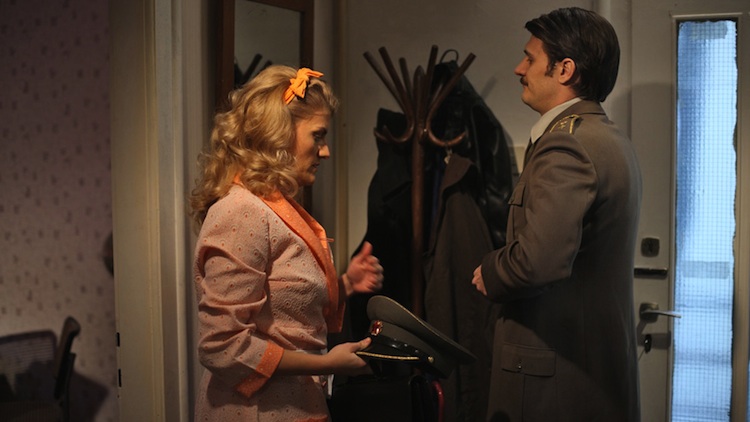
Set in 1970s Yugoslavia, Easter Eggs depicts a mother who is determined that her young son and daughter enjoy Easter the way she did as a child – with an egg hunt, special tea, and commemoration of Christian ritual. The only problem is that her husband is a vehement Communist opposed to all signs of Christianity – even when practiced in the privacy of the home. A career-minded army officer, he is convinced that any sign of ideological deviation in his family will be disastrous for his career. As he rants at his wife when she persists in practicing Christianity: “You work against me, you work against the country.” Their child, the unseen narrator of the film, describes him as “an ingrained and incorrigible Communist.”

Looking forward to Easter.

Nonetheless, the mother secretly arranges an Easter celebration for her children when her husband leaves for work, hiding eggs in the living room, setting up a nice tea table, and placing a cross on the sideboard. In one of the funniest moments of the film, the children look at the figure on the cross and ask if it is Tito, the communist dictator of Yugoslavia. The mother answers “It’s not Tito, it’s Jesus.”

Things then take a somewhat melodramatic turn, but Karajlovic keeps a nice balance between comedy and drama in depicting the horrifying reality of life in communist Yugoslavia. Evoking the drab colors and settings of life in the Eastern bloc, while humorously depicting the army officer father’s obsession with his mustache and his demands for heated underpants, Easter Eggs follows in the absurdist style of such favorite films of ours as the Estonian-Finnish documentary Disco and Atomic War. Like Disco, Easter Eggs shows how average citizens through small or symbolic acts of resistance can subvert apparently monolithic communist and totalitarian ideologies. Recommended for anyone interested in celebrating freedom through film.

LFM GRADE: A-

Posted on May 14th, 2012 at 1:31pm.