By Joe Bendel. There are no participation medals in boxing. One fighter wins and the other loses. Audiences will be acutely aware of this fact while watching Todd Kellstein’s documentary Buffalo Girls (trailer here), an up-close and personal glimpse into the lives of two eight year-old girls who fight to support their families. Be forewarned, it is a real heart-wrencher, which screens during the 2012 Slamdance Film Festival in Park City.
Technically, the child Muay Thai boxing circuit operates underground, but nobody seems too concerned about being caught. Young Stam Sor Con Lek is widely known as a champion in her age and weight division. Pet Chor Chanachai is the leading contender. Both sweet-tempered young girls are their families’ primary breadwinners. In hope of a better life, they train like professionals and give it all in the ring, without the benefit of head-gear.
Although both girls insist they want to fight, one has to wonder. Granted, there are not a lot of options in rural Thailand (where peasants are derogatorily called “buffalo” for their stoic fortitude, hence the title) and a successful child fighter can make thousands of Baht in a match. However, that is an awful lot of stress for an eight year-old to carry, not to mention the physical toll.
Largely filmed observational-style with only the occasional on-camera question asked through interpreters, Kellstein follows the girls through three bouts, culminating with the title fight for all the marbles. Unlike nearly every other boxing film ever produced, it is impossible to pick a side to root for. Stam and Pet are equally bright and engaging. (Their parents are a different matter, though. Some viewers might want to see them go a few rounds with the Klitschko brothers to see how they like it.) Clearly, the young girls ought to be in school studying for a productive future rather than the ring, but in Thailand that is much easier said than done.
Pet Chor Chanachai trains in "Buffalo Girls."
Gaining intimate access to the two girls’ home and training programs, Kellstein gives viewers a visceral sense of their daily living conditions and prospects. It is impossible not to care deeply about them after the first two or three minutes. Hopefully, if Buffalo Girls gains traction, there are mechanisms already in place for Stam and Pet to benefit from, because they unquestionably deserve it. Recommended for those who can handle raw reality, Buffalo Girls screens this Sunday (1/22) and the following Tuesday (1/24) as part of this year’s Slamdance Festival in Park City.
Slamdance also has a full slate of narrative features, including Kristina Nikolova’s sensual and cerebral Faith, Love + Whiskey, which vividly captures a sense of the displacement experienced by a Bulgarian expat on her return home from America. Its depiction of Bulgarian nightlife (with its surprisingly catchy club music) ought to well suit Park City audiences when it screens tonight (1/20) and Wednesday (1/25). Slamdance will also screen Final Curtain, a never before seen television pilot, written, produced, and directed by the now legendary Ed Wood that cries out to be seen with an appreciative and slightly ruckus audience this coming Monday night (1/23).
[Editor’s Note: LFM’s Joe Bendel will be covering the 2012 Sundance Film Festival and also select films from the 2012 Slamdance Film Festival.]
By Joe Bendel. They are no Scarlett O’Haras. As long as these Southern ladies have ammunition, they will never go hungry. Challenging Southern Belle stereotypes, Maria White follows five South Carolinian women as their pursue their game in the short documentary Debutante Hunters, which screens ahead of We’re Not Broke during the 2012 Sundance Film Festival.
Lest there be any confusion, they do not hunt debutantes. They are debutantes who hunt, quite well in fact. The term “debutante” might be overstating the matter for some of the hunters, but regardless of whether they are in the social register, they shoot straight and can acquit themselves with grace in the wild. Indeed, most learned to track and shoot from their fathers, or in the case of Sara Frampton, from her mother Susan.
Unlike many current reality shows, Debutante never plays into cultural stereotypes. Although never asked directly, it seems a pretty safe assumption these hunters are firm advocates of gun owners’ rights to some extent. However, they are all very family-oriented and deeply attuned to the environment. In fact, Susan Frampton is rather eloquent comparing hunters and gardeners as fellow conservators. Never wasteful, the women also always cook what they kill, often feeding their families for weeks with delicious looking venison burgers.
At just a whisker over twelve minutes, the respectful Debutante delivers a fair amount of hunting action along with a measure of psychological insight into its subjects, but it seems to cry out for a longer treatment. Frankly, this would make a perfect series for the History Channel, perhaps following Top Shot. It boasts a telegenic, well-spoken cast shooting guns. There is a certain undeniable appeal to that. They could even do cooking segments. Highly recommended (though the same does not necessarily apply to the film it is paired with), Debutante screens this coming Sunday (1/22), Tuesday (1/24), Thursday (1/26), Friday (1/27), and Saturday (1/28) in Park City and Wednesday (1/25) in Salt Lake as part of the 2012 Sundance Film Festival.
By Joe Bendel. It is a timeless question: which has the upper hand, age and guile or youth and vitality? It usually depends on how you score. One such Spanish generational tête-à-tête takes on a whiff of the zeitgeist, coming after the various coups and political circuses of the immediate post-Franco era. One curmudgeonly columnist has seen it all and has definite ideas about scoring during his encounter with an admiring journalism student in David Trueba’s Madrid, 1987 (trailer here), which screens during the 2012 Sundance Film Festival in Park City.
Miguel is so smugly self-satisfied, he can hardly stand himself. To Ángela, he is a legend. A Spanish Mencken who skewered generals and politicians for years in his daily column, it was something of a coup to land an interview with him. The old soldier has outlived his battles, though. Feeling like a relic, the columnist hopes to regain some youth by seducing the student. He is not exactly the smoothest of old foxes, but he gets an assist from fate when the two are inadvertently locked naked in the bathroom until Miguel’s artist friend returns to his flat. It is certainly awkward, but eventually they begin to talk about nearly everything – but particularly Spain, art, sex, and the passage of time.
Those who think of Madrid as a nude My Dinner with Andre might be right to an extent. Yet Trueba never lets his characters or viewers get too comfortable with the situation. Never completely hot or cold to the older man, Ángela’s emotional responses crest and fall with his near monologues. He can be charming, but he can also be insensitive. He certainly is pleased with the sound of his own voice, though, so he might not be one’s first choice to be locked in a bathroom with.
Yet for those who enjoy a talky movie, Madrid is quite sharply written and delivered. Trueba really digs into some meaty themes. Granted, some topics will have far more resonance for Spanish audiences, but there are plenty of universals any viewer can relate to.
Trueba’s two leads definitely deserve credit for their fearlessness, essentially appearing nude for the bulk of the film with only a handful of strategically placed towels for cover, while chewing on some heavy lines. Guys will surely notice María Valverde is quite healthy, but José Sacristán’s splotchy body is not likely to do much for the ladies. Still, he has a rare flair for pointed dialogue. In fact, it is rather fascinating to watch them play off each other.
Deftly helmed by Trueba (brother of Fernando Trueba, whose outstanding Chico & Rita opens in New York February 10th), the more-or-less two-hander never feels stagey, despite the necessarily claustrophobic setting. Ultimately, this dichotomy of a New Spain without experience or baggage vs. an Old Spain that jealously nurses its bitterness will appeal to a self-selecting audience. It is smartly realized by its two principals, so they will be satisfied with the results. Recommended at this year’s Sundance Film Festival for those who appreciate Spanish cinema or dialogue-driven films, Madrid, 1987 screens in Park City tomorrow (1/20), Saturday (1/21), Sunday (1/22), next Friday (1/27), and Saturday (1/28), as well as Tuesday (1/24) in Salt Lake.
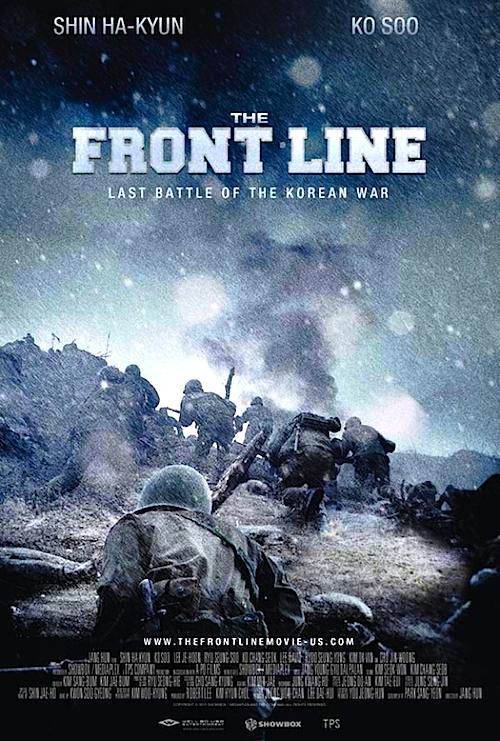
By Joe Bendel. When a South Korean officer is killed with one of his troops’ weapons, someone has to investigate. It is also a convenient way to move a trouble-making lieutenant out of the way. Indeed, war is brutal, messy, and soul-deadening in Jang Hun’s The Front Line, Korea’s official best foreign language Oscar submission, which opens this Friday in New York.
A vocal critic of the drawn-out peace negotiating process, Kang Eun-pyo is assigned to investigate irregularities reported within the “Alligator Company” dug-in around the pedestrian looking but strategically prized Aero.K hill. In addition to the suspicious death of a despised commander, several letters from North Korean soldiers have been posted to family members in the south by someone in the company. A mole is suspected.
However, when Kang arrives, he discovers the situation is murkier than that. There has been a form of communication flowing between the two sides, but it is born of survivors’ fellowship rather than espionage. Still, he maintains suspicions regarding Kim Su-hyeok, a comrade from the early days of the war long presumed to be a POW, but evidently serving as the Company’s lieutenant.
Over the course of the film, Alligator Company will take, lose, and regain the fateful hill over and over again. It would get somewhat repetitive if not for the intense warfighting scenes, rendered by Jang in a take-no-prisoners style. Line’s sense of place is so strong, audiences will feel they know every inch of that crummy nub of a hill.
Do not get too attached to any characters in Line. Jang will call up their numbers at the most arbitrary of times, as befits the nature of war. Nonetheless, there are many strongly delineated characters. In fact, the self-medicating Captain Shin Il-yeong and the darkly brooding Lt. Kim, memorably played by Lee Je-hoon and Ko Soo respectively, clearly bear the spiritual scars of war. As the film’s only substantial female character, Kim Ok-bin also hints at a host of inner conflicts as the soon-to-be not so mysterious woman often seen foraging near the battlefield.
Like Jang’s previous film Secret Reunion (which screens February 15th in New York as part of the Korean Cultural Service’s regular cinema showcase), Line not very subtly advocates for reunification, arguing that divisions are merely an arbitrary matter of hills and parallels. Of course, it ignores the grim reality of the DPRK, in which famine is commonplace and the gulags are so extensive that they are the only features of the country that can be seen from space. While the soldiers could easily lose sight of it in the carnage surrounding Aero.K, there were indeed real stakes and consequences to the war. Whether it was also prosecuted competently, is an entirely fair and separate question.
Regardless, Jang masterly stages some of the most realistic, decidedly unheroic battle scenes viewers will see at the theater this year. It is a powerful, draining statement, recommended for connoisseurs of war movies, including the anti-war variety. Line opens this Friday (1/20) in New York at the AMC Empire and in the Bay Area at the AMC Cupertino.
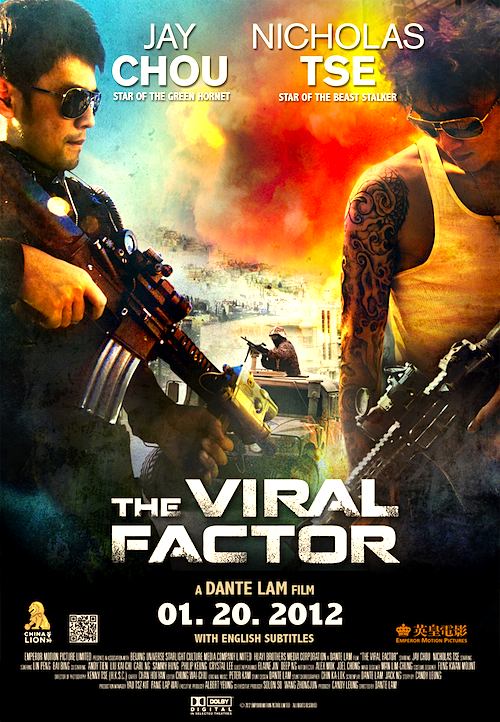
By Joe Bendel. Sure, it is more than 24 hours, but two weeks is not a lot of time for international counter-terrorism agent Jon Wan. That is about how much time he has left before the bullet lodged in his brain finishes the job. During those final days he will have to recover a killer mutant virus and reconcile some tricky family business in Dante Lam’s The Viral Factor (trailer here), which opens this Friday in New York and San Francisco.
The spectacular opening action sequence shows exactly how Wan became a dead man walking. He is part of an ambushed convoy escorting a mercenary germ warfare scientist looking to cut a deal. It was not the rpg’s that got him, but a traitor in his ranks. Unfortunately, the doctor of death and his new smallpox strain were lost to their attackers. Tragically, Wan has several more personal scores to settle with Sean the turncoat (and exposition mouthpiece). However, a brief visit to his ailing mother sends Wan on a detour to Malaysia. It seems he has long lost father and brother there, scratching out a meager living through dubious means.
In fact, Wan Yang is a notorious thug for hire, sub-contracted by Sean’s crooked cops to kidnap Dr. Rachel Kan, a specialist working for the Asian CDC. When the gangster brother is also betrayed by the gang, the two Wans team up to recover the virus, rescue assorted friends and loved ones, and do their best to patch up a fraternal relationship interrupted by their parents’ quarrels decades ago.
Somewhat like last year’s Legend of the Fist, Viral feels a bit unbalanced, because its most ambitious action sequence comes right up front. Of course, that also means viewers do not have to wait for it. Wisely shunning shaky cams, Lam’s action scenes have a refreshing precision and clarity, despite the frequent explosions and whizzing projectiles, so viewers can appreciate the mayhem. Jay (The Green Hornet and True Legend) Chou and Nicolas (Shaolin and Bodyguards and Assassins) Tse have all kinds of action cred, but also handle the familial drama well enough, as Jon and Yang, respectively.
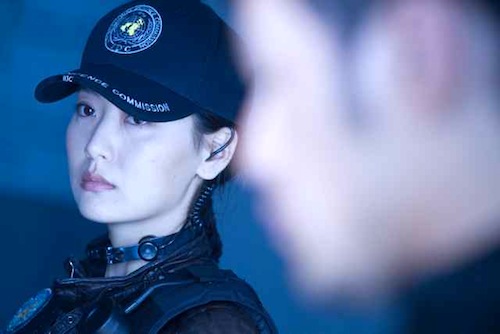
Bai Bing in "The Viral Factor."
While marinated in testosterone and lacking a conventional romantic subplot, Viral also features two strong female characters. Though she appears all too briefly, Bai Bing shows considerable screen presence and action chops as Wan’s former fiancé and fellow agent, Ice. In a somewhat more traditional damsel-in-distress role, Lin Peng at least brings a sense of intelligence and resiliency to Dr. Kan. Young Crystal Lee is also quite poised and endearing as Yang’s responsible daughter, Champ.
Though a big budgeted production, Viral is appealingly old school, with a slick, glossy look reminiscent of Tony Scott’s glory days of high concept action pictures, via the lens of cinematographer Kenny Tse. Lam blows stuff up really nicely and both Chou and Tse certainly know how to handle a fight scene. Add in the cinematically exotic locales of Jordan and Kuala Lumpur and the attractive support of Bai and Lin and you have a solidly entertaining action film. Definitely recommended for genre fans, Viral opens this Friday (1/20) in New York at the AMC Empire and Village 7 as well as in San Francisco at the AMC Metreon and Cupertino, courtesy of China Lion Entertainment.
[Editor’s Note: The post below appears today at The Huffington Post and the newly relaunched AOL-Moviefone site, where LFM’s Jason Apuzzo and Govindini Murty will also now be blogging.]
By Jason Apuzzo. The Cold War is back – at least at the movies.
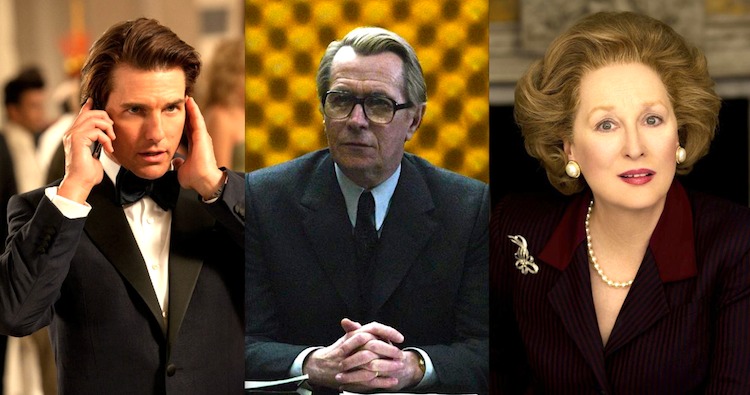
This weekend moviegoers can watch Meryl Streep portray ardent Cold Warrior Margaret Thatcher in The Iron Lady, Gary Oldman root out a dangerous Soviet mole from the British intelligence service in Tinker, Tailor, Soldier, Spy, and Tom Cruise race to prevent a Cold War-style nuclear exchange between America and Russia in Mission Impossible: Ghost Protocol.
These films form part of a major Hollywood trend toward reawakening memories of the Cold War – an era that is suddenly returning with a vengeance on the big screen, with long-term implications for our popular culture.
Currently in the midst of an awards-season run, for example, Clint Eastwood’s J. Edgar tells the story of legendary FBI Director J. Edgar Hoover’s decades’-long confrontation with Soviet infiltration of America. Also in the midst of an awards-season run is the ominous new documentary Khodorkovsky, which depicts how little Russia’s authoritarian governing style has changed since the dark days of the old Soviet Union.
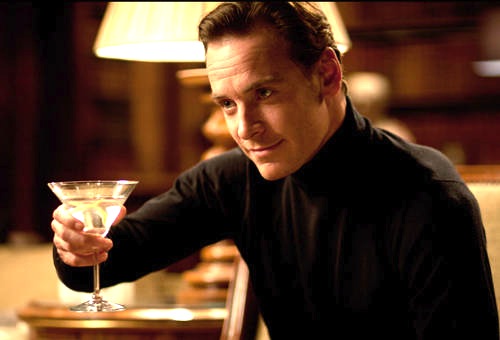
Michael Fassbender in "X-Men: First Class."
And the trend doesn’t stop there. If Santa slipped new Blu-rays of Transformers: Dark of the Moon, X-Men: First Class, Apollo 18 or The Kennedys into your Christmas stocking, you just got another healthy dose of Cold War nostalgia from those films – because 2011 was a watershed year in Hollywood for reviving America’s long-standing rivalry with all things Russian and/or communist.
So, what’s going on here? Why is Hollywood suddenly reviving Russian communists, spies and autocrats as the go-to villains of choice?
The simplest answer may be that the old Soviet Union is gradually replacing Nazi Germany, Imperial Rome and space aliens as Hollywood’s favorite antagonists. In an industry still hesitant to make films about today’s War on Terror, and with memories of World War II fading, Russian authoritarians – including those of the present day variety – are on their way to becoming Hollywood’s safe, consensus villains of the moment.
This trend began in 2008, with of all things an Indiana Jones film. Set in 1957 at the height of the Cold War, Indiana Jones and the Kingdom of the Crystal Skull featured Soviet communists as the villains, and despite grumbling from critics and internet fanboys the film played well in middle America – taking in over $317 million domestically (a figure even Ghost Protocol seems unlikely to match) and $786 worldwide. Perhaps just as significantly, the fact that the film had been made by Steven Spielberg and George Lucas seemingly gave the green light to other left-of-center filmmakers that depicting Reds as the villains was OK again.
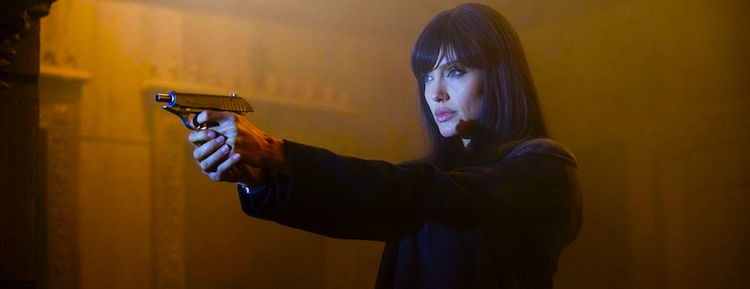
Angelina Jolie in "Salt."
Soon Angelina Jolie was hunting sleeper Soviet agents in Salt (2010), Ed Harris and Colin Farrell were escaping a brutal Soviet gulag in Peter Weir’s extraordinary The Way Back (2010), and even Richard Gere and Martin Sheen were getting in on the act – smoking out a Russian mole in The Double (2011). Released here in the U.S. in 2010, Fred Ward played Ronald Reagan in the French Cold War spy thriller Farewell, and Renny Harlin’s action-drama 5 Days of War (2011) depicted the brutality of Russia’s recent invasion of Georgia.
To be fair, Russians haven’t been the only villains in this trend. MGM’s forthcoming remake of Red Dawn (read a review of an early cut of the film here) depicts a communist invasion of America by the North Koreans and Chinese, similar to the invasion of Australia depicted in Stuart Beattie’s recent thriller Tomorrow, When the War Began (2010). Bruce Beresford’s touching Mao’s Last Dancer (2009) recreated in heartbreaking detail the restrictions in Chinese communist society on artists. And perhaps no recent film captured communist tyranny more vividly than Mads Brügger’s gonzo documentary from 2009 on North Korea, The Red Chapel.
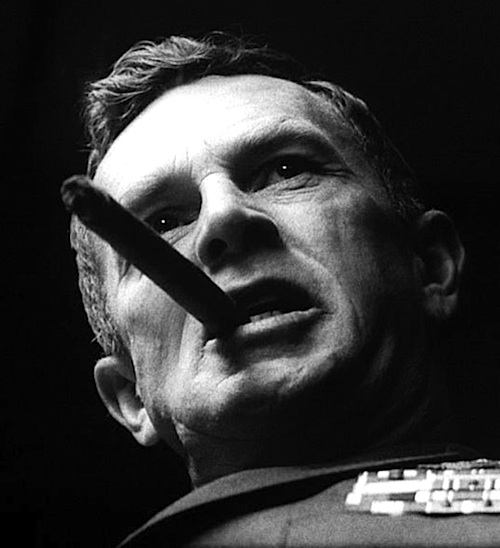
Sterling Hayden as Col. Jack D. Ripper in "Dr. Strangelove."
This movie revival of the Cold War – in its many Russian, Chinese and North Korean variations – has intriguing implications. For the past generation, many left-of-center filmmakers have been deeply invested in the notion that the Cold War was a kind of paranoid mirage, a tragicomic figment of Ronald Reagan and Whittaker Chambers’ imaginations. With few exceptions, the basic image created by these filmmakers of the Cold War – codified in films like Dr. Strangelove (1964), or more recently in Good Night, and Good Luck (2005) – has been one of an artificial conflict fueled by American militarism and bourgeois small-mindedness. The sardonic The Russians Are Coming, the Russians Are Coming (1966) serves as perhaps the sine qua non of this genre.
This vision of the Cold War appears to be changing, however, among younger, less ideologically driven filmmakers. These filmmakers view the Cold War simply as a fertile field of storytelling possibilities about the struggle for freedom, in much the same way an older generation viewed World War II. Filmmakers today seem more eager to tell such stories about the Cold War, unearthing the past and depicting the sharp political divisions between East and West, perhaps because these filmmakers detect a continuity between communist tyrannies of the 20th century and similarly repressive regimes today.
After all, Brezhnev and Mao may be gone – but an ex-KGB man still runs Russia, and communists still run repressive regimes in China and North Korea. And America’s relationship with these nations sometimes seems no better than it was before.
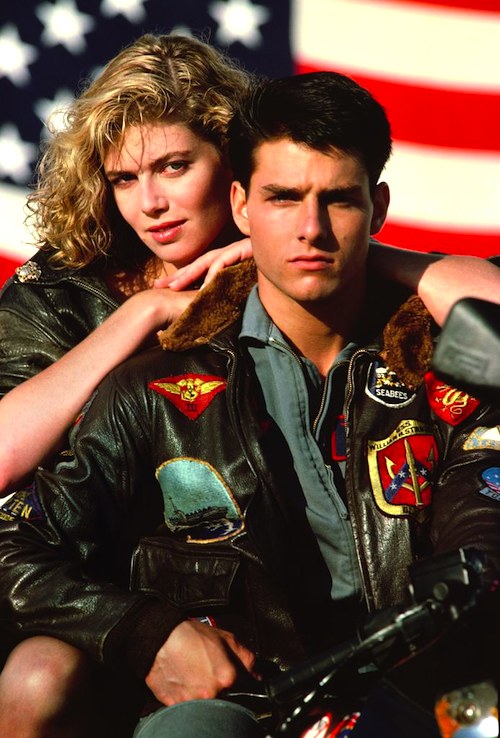
After a 3D re-release, "Top Gun" is slated for a sequel.
Today’s Hollywood seems alive to these realities as never before, as reflected in a slate of new projects in the development pipeline that channel Cold War themes. Along with sequels to Salt, X-Men: First Class, Die Hard (with Die Hard 5 set to take place in Russia), and even Top Gun, work is also underway to re-boot the Jack Ryan franchise with Chris Pine in a new thriller called Moscow. Remakes of famous Cold War properties like Ice Station Zebra, The Man from U.N.C.L.E., and even Colossus: The Forbin Project are also in development – along with adaptations of the books Londongrad, The Reluctant Communist, and the Red Star comic book.
On TV, HBO and FX are working on competing series about ’80s-era Soviet spies in the U.S., and HBO reportedly has another series in development about Cold War spies in Berlin.
As if that were not enough, Gerard Butler and Ed Harris will soon be trying to stop rogue Russian generals and KGB agents from starting World War III in Hunter Killer and Phantom, respectively. Or if your sensibilities run toward the art house, Andrzej Wajda is currently directing a biopic of Polish Solidarity leader Lech Walesa.
Granted, it shouldn’t be assumed that these films will express a uniformity of opinion about the Cold War, or about current international tensions. Indeed, several recent films like The Iron Lady, J. Edgar, and X-Men: First Class express a pronounced ambivalence about the Cold Warriors they depict.
Watching The Iron Lady, for example, you would hardly know why the Soviet Red Army newspaper labelled Margaret Thatcher “the Iron Lady” in the first place. The film is weirdly evasive of Thatcher’s vital role in ending the Cold War – barely alluding to it except in brief moments of Thatcher with Reagan and Gorbachev, or attending an event commemorating the end of the Cold War. The Iron Lady seems more concerned with Thatcher’s current state of physical fragility than in her momentous alliances with Ronald Reagan, Pope John Paul II and Lech Walesa in hastening the collapse of the Soviet state.
Still, the fascination that films like The Iron Lady or J. Edgar have with Cold Warriors of the past is obvious. And certainly none of these recent films bothers to romanticize the communist cause. Indeed, the days in Hollywood of dueling Che Guevara biopics (Che, The Motorcycle Diaries) – or of Katherine Hepburn wearing a frayed Mao jacket to the Oscars – seem long gone.
The Cold War is back in Hollywood, but this time the idea seems to be to support the winning side.
 By Joe Bendel. There are no participation medals in boxing. One fighter wins and the other loses. Audiences will be acutely aware of this fact while watching Todd Kellstein’s documentary Buffalo Girls (trailer here), an up-close and personal glimpse into the lives of two eight year-old girls who fight to support their families. Be forewarned, it is a real heart-wrencher, which screens during the 2012 Slamdance Film Festival in Park City.