First Look 2012: LFM Reviews That Summer

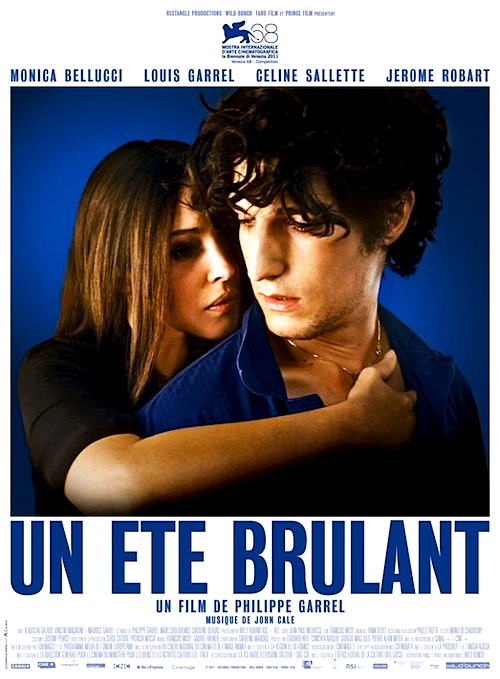
By Joe Bendel. If someone is said to have an artistic temperament, it usually means they are not just creative, but emotionally tempestuous. The term certainly applies to Frédéric and his wife Angèle. They will dazzle and disturb Frédéric’s hanger-on friend and his lover with the sort of emotional games that have become the hallmark of under-sung auteur Philippe Garrel’s work. Presumably his final collaboration with both his son Louis and late father Maurice (1923-2011), Philippe Garrel’s That Summer (trailer here) screens this weekend during the inaugural First Look at the Museum of the Moving Image in Astoria, Queens.

Frédéric is a wealthy and talented French painter, who never sells his work. Angèle is a major Italian movie star, garnering the best reviews of her career. They are everything the penniless and untalented Paul is not. Yet, for some reason the artistic couple befriends the dubious actor and his girlfriend Elisabeth, inviting them into their home in Rome. The needy Elisabeth has attempted suicide in the past, but she will be a model of stability compared to their hosts.

Initially, Frédéric and Angèle seem like a perfectly compatible and loving couple, but over the course of the summer, their mutual contempt degenerates into a repeating cycle of infidelity and petty cruelty. For the most part, Paul and Elisabeth are spectators rather than participants in the proceedings—an audience for the imploding marriage as performance art.

As is often the case with Philippe Garrel’s films, Summer is often uncomfortably intimate. However, it is never as squalid, lurid, or coyly obtuse as some of his previous films, including even (or especially) his arguably best known, I Can No Longer Hear the Guitar. The dolce vita environment of Rome certainly helps here.

Garrel’s son Louis also does some of his best work as Frédéric. More Byronic than petulant for a refreshing change, he is strangely engaging throughout. Unleashing her inner diva, Monica Bellucci radiates sexuality, while reveling in the melodrama of it all. Unfortunately, Jérôme Robart and Céline Sallette are rather dull as the sponging guests. Perhaps that is required of him to serve as the narrator. However, Elisabeth’s established psychological issues are never really conveyed or followed-up on in a substantive way.
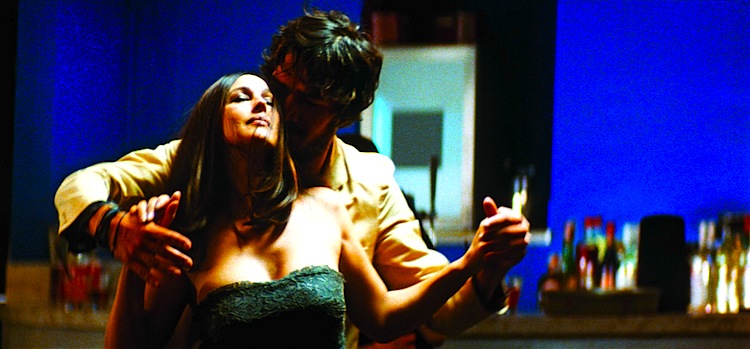
Monica Bellucci and Louis Garrel in "That Summer."

Appearing briefly as Frédéric’s long deceased grandfather, a frail looking Maurice Garrel adds a redemptive coda, bringing meaning to the film. Indeed, it is always interesting to see the son and grandfather interact in the middle Garrel’s films, starting with 1989’s Emergency Kisses, in which all three starred.

Nouvelle Vague veteran cinematographer Willy Kurant’s gives it all a pleasing look, basking in the vivid blues and greens of the couples’ photogenic abode, while John Cale’s piano soundtrack always sounds politely refined. Frankly, Summer might be a good entry point into Garrel’s filmography. Though hardly action driven, it moves along at a reasonable clip for such decidedly arthouse fare. (Bellucci also has an early nude scene, so for some viewers it pays off quickly). Considerably better the response at Toronto would suggest, That Summer is complex and intriguing film, definitely recommended to discriminating viewers when it screens this Friday (1/13) during First Look at the Museum of the Moving Image.

Posted on January 9th, 2012 at 7:36pm.
LFM Review: War Horse

By Patricia Ducey. War Horse opens with a rapturous aerial shot of the rolling Devon hills, dotted with neat farms and hedgerows and so achingly verdant that it takes one’s breath away. Soon that transcendent vision of the land as another Eden or demi-paradise gives way to the more intimate image of a mare giving birth in a meadow below, while young Albert Narricott (Jeremy Irvine) watches spellbound from just outside the fence. As the satin-coated foal finds his legs and gambols about, we realize that in one short minute we, like Albert, have fallen totally in love with the spirited youngster. And we know, sadly, something Albert doesn’t: that this idyll will soon be smashed to smithereens.

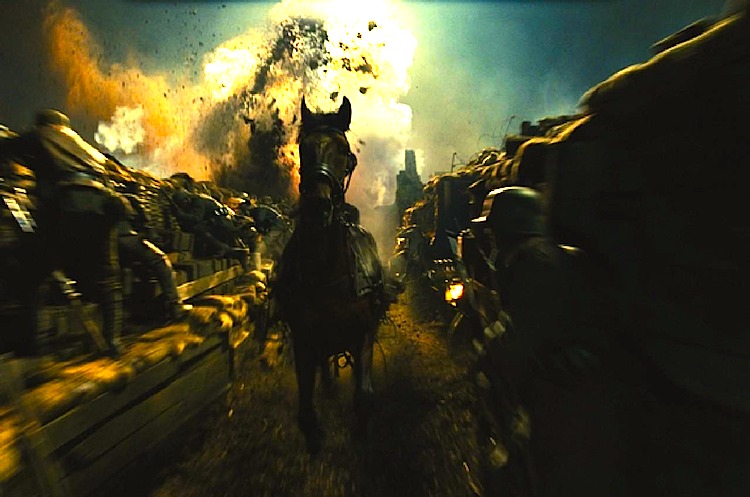
War Horse‘s story is set in England at the moment before World War I breaks out. In one prideful moment, lovable ne’er-do- well tenant farmer Ted Narricott bids against his hated landlord for the now mature horse at auction. His son Albert is thrilled that his father has brought home the object of his years’ affection and names the horse Joey, but mother Rose (Emily Watson) insists that the horse be sold; a horse as fine as this one must be worthless as a working animal. Albert insists he can train the noble half-thoroughbred to pull a plow; in those desperate economic times, they must plow and plant a rocky field to pay the rent on the farm. The horse soon learns his trade and earns his keep, but a storm later destroys the hard won crop. Thus, finally, Albert’s father Ted (Pete Mullan) is forced to sell the horse. War has broken out, and the British Army snaps up the beautiful animal for its officer corps. Albert bids farewell to his beloved horse – and, for the next hour, we see through Joey’s almond-colored eyes his wartime ordeal on the march to the front lines, all the way to the gut wrenching trench warfare and the terrible climax in No Man’s Land.

War Horse was adapted by British writers Lee Hall (Billy Elliott) and Richard Curtis from a young adult novel, and then Tony-winning play, by British author Michael Morpurgo, which told the story of the Great War through the eyes of a horse and the family that owns him and seemingly loses him. Reportedly, Spielberg saw the play and sewed up the movie deal the next day, even though the schedule interfered with his Tin Tin project.

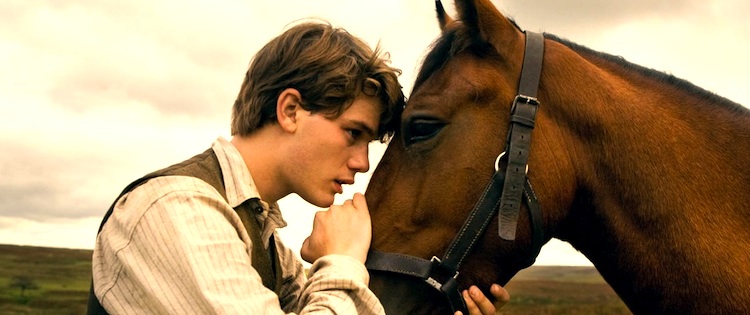
Jeremy Irvine as Albert, with Joey.

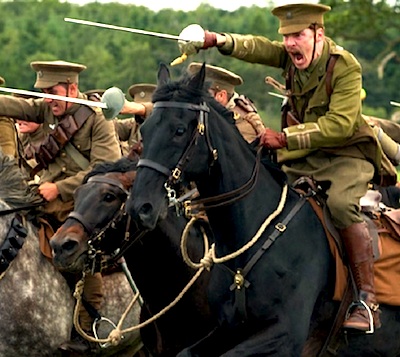
This being a Spielberg film, and a Young Adult offering, sometimes it claws at your heartstrings when a tug would do, and at 146 minutes, is far too long—a few subplots and scenes could be trimmed, to perhaps leave time to explore Albert’s emotional journey as well. The look and sound of the film experience, though, is flawless, thanks in part to Spielberg’s long-time collaborators, cinematographer Janusz Kaminski and production designer Rick Carter, who breathe fire into the director’s storyboards. Their War Horse must be seen as his team’s masterpiece–if 35 mm film is to give way totally to digital, as Kaminski believes, his work here will remain one of its crowning achievements. The magnificent landscapes of Devon, dwarfing its inhabitants, the shimmer of wind through a grove of trees in an eerie pre-battle silence, are but a few of many memorable shots. And special mention must be made of Spielberg’s initial battle scene, when the English mounted battalion charges a German camp. The visual and aural effects are simply spectacular, the sequence a harrowing reminder that men once rode into battle with sabers unleashed, atop steeds at a thundering gallop, straight into an enemy line, and then drew enemy blood in face-to-face combat. And like the classic films he emulates, Spielberg used thousands of extras and hundreds of horses in the battle scenes: no CGI shortcuts here.

Real battle re-enactments: no CGI shortcuts here.

The actors acquit themselves well, and Jeremy Irvine as Albert is affecting. The horse, though, is the star here. Joey is played by several horses, mostly by an American horse named Finder, who also played Seabiscuit. I hope there is an Oscar category for Finder and his trainer, because the horse’s ability to communicate with Albert and with an Army stallion he bonds with is enchanting.

Steven Spielberg delivers here a masterful coming-of-age story, in which the hero’s mettle is tested by war and privation in a world where character is all that remains and all that matters after everything else has been taken. So this is not a cynical or post-modern film; some people may even call the PG-13 War Horse sentimental.  The hipster in your life might insist his sniffles are sniffs of disdain, but in all of history, from the renderings in Chauvet Cave to the little girls (like me once) who sketched profiles of ponies in her notebook in history class, there has always been something about a human that loves a horse. War Horse rightfully earns top tier status in this genre.

So if you or your young adult plans to see War Horse, get thee to the multiplex. This is a film that must be seen in a proper theater, not in a  living room, to appreciate its many gifts.

Posted on January 5th, 2011 at 6:53pm.

Rage in Iran: LFM Reviews The Hunter

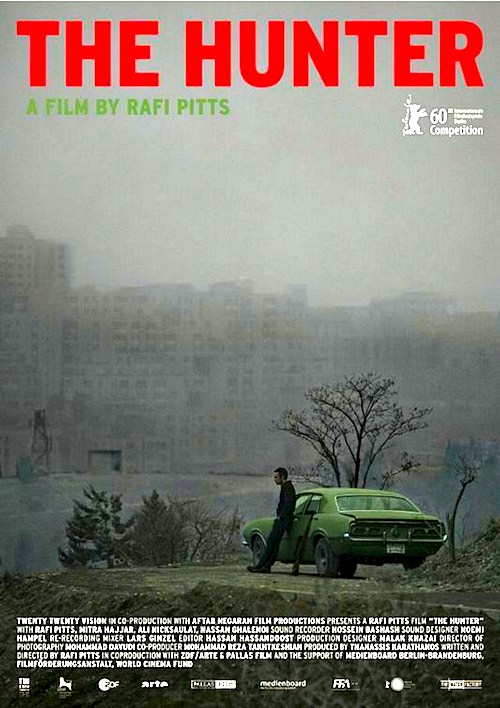
By Joe Bendel. To unwind, Ali Alavi spends his weekends in the forest, relying solely on his hunting rifle to provide sustenance. He is not the sort of man to be toyed with. Indeed, when the repressive Iranian state pushes him to his breaking point, he pushes back in the Iranian-born French-based Rafi Pitts’ quietly incendiary The Hunter (trailer here), which opens this Wednesday in New York at the IFC Center.

Alavi is an ex-con, convicted of an unnamed and therefore dubious crime. Forced to work as a late shift security guard, only his reputation as an expert hunter and marksmen affords him a measure of respect from his coworkers. One fateful day, he returns from his hunting trip to find his wife and daughter missing. Over the following weeks, Alavi endures a Kafkaesque nightmare, as the police and various bureaucrats callously keep him waiting hours on end with little or no information.

According to the official story, his wife was killed in the crossfire between the police and so-called “rebels,” as the government refers to the democratic Green movement protestors. It is clear to everyone with eyes that the despised police are responsible, but they refuse to acknowledge culpability. Only the distant hope of finding his daughter keeps the slow-burning Alavi in check. Once her fate is determined, he commits a shocking act of violence Pitts dares viewers to condone.

At this point, Hunter becomes something like a fugitive thriller with more than a touch of the absurd, as two bickering corrupt cops apprehend Alavi in the woods he knows so well, only to get thoroughly lost. It is actually a masterful third act that never goes where you quite expect it to, while remaining true to the grim realities of contemporary Iranian society.

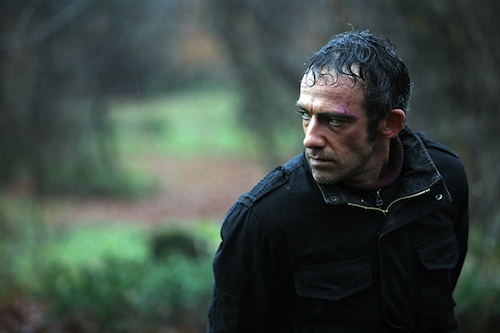
Director Rafi Pitts as Ali Alavi.

Clearly, Alavi’s hunting is a conscious strategy to maintain his masculine self-worth in an emasculating environment. It also makes him dangerous. With his close-cropped hair, wiry build, steely gaze, and 1970’s sports sedan, Pitts, serving as his lead actor, somewhat resembles an Iranian Steve McQueen (the star of 1980’s The Hunter). He is one bad cat, viscerally intense and totally credible in the action-oriented scenes.

Frankly, there is much we can assume about Alavi from what Pitts implies. The greenness of his car and the décor of his home may or may not be coincidental. Yet, unlike many people we observe on the street, he never seems very optimistic about the 2009 election. Perhaps he has seen this all before and suspects what is coming.

Neither a pure thriller nor strictly a naturalistic social protest film, The Hunter could be considered the Iranian version of the Falling Down (the high-water mark of Joel Schumacher’s career). If not an outright call for violent resistance, it explicitly suggests that the pent-up rage of average Iranians is deep and widespread. It ought to chill the Islamist mullahs to their cores. A genuinely powerful and challenging film, The Hunter marks an excellent start to the New Year. Highly recommended, it opens this Wednesday (1/4) in New York at the IFC Center.

Posted on January 3rd, 2011 at 2:42pm.

First Look 2012: LFM Reviews Almayer’s Folly

Aurora Marion as Nina.

By Joe Bendel. Festival season now starts a little earlier. An adaptation of Joseph Conrad’s first novel will be the opening night film of the inaugural edition of the first film fest of the year, and is sure to make critics and scholars sit up and take note. Of course, it is hardly Chantal Akerman’s first film, but it is something of a departure for the Jeanne Dielman, 23 quai du Commerce, 1800 Bruxelles auteur. Fittingly, Akerman’s foray into tropical malaise, Almayer’s Folly, kicks off the first annual First Look series at the Museum of the Moving Image in Astoria.

There is something elusive about Conrad that doggedly resists the transfer to the big screen. Yet his work has been a siren call to filmmakers, resulting in flawed masterworks like Apocalypse Now and Lord Jim. Such is the case with Akerman’s Folly, except less so.

As per Conrad, Kaspar Almayer is an unhappy man. He married the mixed race daughter of his adventurer mentor, Captain Lingard, in hopes of a prospective inheritance. Instead, Lingard has frittered away his fortune and sanity in search of a rumored treasure. Trapped in a loveless and impoverished marriage, Almayer’s only solace is his daughter Nina, but her resentment of westerners’ arrogant and abusive ways very definitely extends to her father.

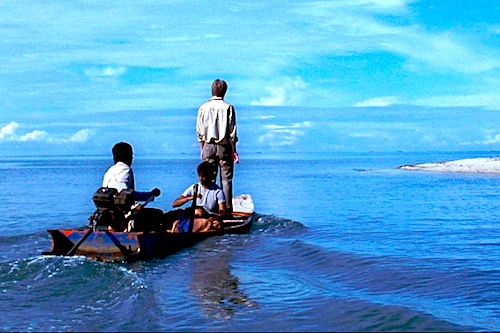
Set in Malaysia, filmed in Cambodia.

Frankly, learning of a new Conrad film adaptation is sort of like hearing an out of shape friend has entered a marathon. You admire their ambition and hope they pull it off, but remain skeptical. If nothing else, Akerman completely nails the atmosphere of exotic alienation. Watching Folly will make viewers feel like a corpulent western expatriate sweating profusely in a cream-colored suit. However, a little of that humid torpor goes a long way.

Clearly, Folly was conceived as a mood piece, but the narrative slack is awfully conspicuous. At times the cast seem more like props for Akerman to pose than actors interpreting characters. Still, Aurora Marion palpably radiates bitterness and contempt as Nina and Stanislas Merhar has some quietly forceful moments as Almayer.

Set in Malaysia but filmed in Cambodia, Folly is indeed something of a mixed bag. Yet it is undeniably intriguing to watch a filmmaker of Akerman’s stature take on the enigmatic Conrad. While it can certainly drag in-the-moment, it is a fascinating film to look back on as a whole. Of note to serious cineastes, Folly is an impressively high profile launch for the first ever First Look. It screens once and only once (second looks are up to somebody else) this Friday (1/6), with Akerman in attendance at the Museum of the Moving Image’s historic Paramount Studio home.

Posted on January 3rd, 2011 at 2:40pm.

The Cinema of Liberty: The Top 10 Pro-Freedom Films of 2011 + LFM’s Jason Apuzzo to Blog at The Huffington Post

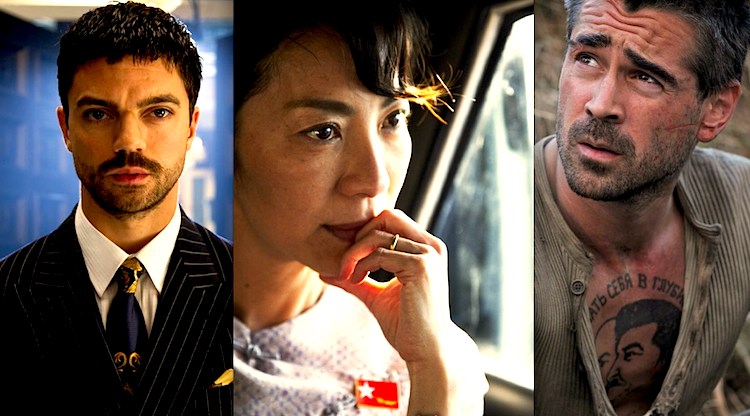
Dominic Cooper in "The Devil's Double," Michelle Yeoh in "The Lady," and Colin Farrell in "The Way Back."

[Editor’s Note: this post appears today on the front page of The Huffington Post. Jason is very pleased to now be blogging at The Huffington Post.]

By Govindini Murty & Jason Apuzzo. Freedom is one of the most important prerequisites of artistic excellence. 2011 was distinctive for producing a number of critically acclaimed films that celebrated the history of the arts and of the cinema itself – from Martin Scorsese’s Hugo and Michel Hazanavicius’ The Artist, to Werner Herzog’s Cave of Forgotten Dreams and Woody Allen’s Midnight in Paris. Yet filmmaking never takes place in a vacuum, and these superb, literate films – which value knowledge, humanity, and civilization – are nonetheless the outgrowth of a free society, and would have had difficulty being made under circumstances of political tyranny.

It’s therefore worthwhile to celebrate the notable movies of 2011 that took the risk of advocating for democratic freedom, the political principle that makes so much film artistry possible. Some of these are foreign films created under the most difficult circumstances, while others are mainstream Hollywood productions made within the freedom of democratic society. Whether spectacular or intimate, tragic or comic, these films dramatized to audiences around the world the importance of liberty. With the revolutions of the Arab Spring, citizen protests in China, and the recent democracy demonstrations in Russia, 2011 was a remarkable year for democratic action and this year’s pro-freedom films often reflected this.

Given that many of these are foreign or independent films with multi-year releases, we thought it fair to include films that had their first theatrical or DVD release in the U.S. in 2011, or that screened in a U.S. film festival in 2011. Also, this is merely a list – not a ranking – so please consider each film on this list to have its own unique value.

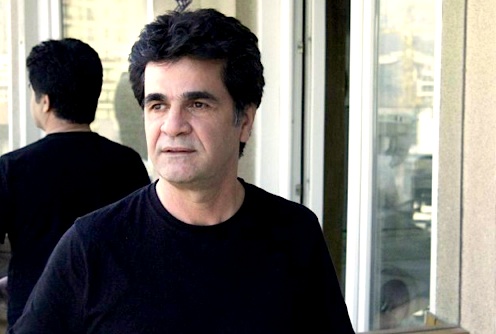
Jafar Panahi in "This is Not a Film."

1. This is Not a Film – Jafar Panahi and Mojtaba Mirtahmasb, Iran

This is Not a Film depicts in heartbreaking detail the house arrest of acclaimed Iranian filmmaker Jafar Panahi, who was accused in 2010 of making a film critical of the Iranian government. Panahi vehemently denies the charges, yet he currently faces six years in jail and a twenty-year ban on filmmaking. Nonetheless, in This is Not a Film Panahi not only documents his own house arrest, revealing how the banal details of daily confinement can crush the human spirit; he also reveals how the creative impulse can survive even the most repressive circumstances, and inspire hope.

2. The Way Back – Peter Weir, U.S.

Starring Ed Harris, Colin Farrell, Jim Sturgess, and Saoirse Ronan and directed by Peter Weir, this epic and moving film based on real events tells the story of a group of Polish, American, and Russian political prisoners who escaped from a brutal Soviet gulag in 1941 and walked 4000 miles from Siberia to India and freedom. An extraordinary paean to liberty, The Way Back‘s courageous protagonists repeatedly affirm their willingness to die in freedom rather than live out their lives in the slavery of Soviet communism. The film’s concluding montage depicting the events of the Cold War is a long overdue acknowledgment from Hollywood of how the fall of European communism freed millions of Poles, Czechs, Russians, and Eastern Europeans.

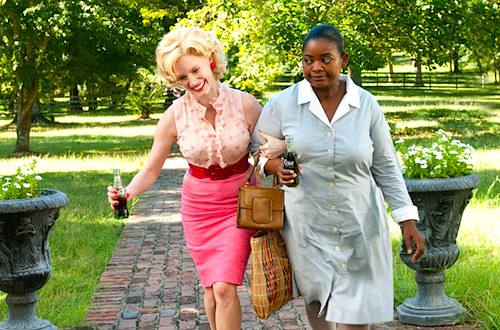
Jessica Chastain, Octavia Spencer in "The Help."

3. The Help – Tate Taylor, U.S.

The civil rights drama The Help reveals how the struggle for freedom is equally urgent when it comes to racial equality in America. With gripping performances from Viola Davis, Octavia Spencer and a powerful ensemble cast, The Help portrays the plight of African-American women who labored as house maids in the American South of the 1960s. The Help depicts the daily humiliations and injustices that grind down the human spirit and that form an ‘internal prison’ of despair that can be as destructive as any war, or act of violence. Taking place within recognizable domestic circumstances, The Help shows that our respect for civil rights in America is as important as our fight for human rights around the world.

4. Petition – Zhao Liang, China

A member of the ‘Digital Generation’ of independent Chinese documentarians, Zhao Liang depicts in Petition the Kafkaesque struggle of the Chinese people for justice from their own government. Petition follows real citizens, often poor and powerless, who travel from all across China to Beijing to petition the government for redress against local injustices. Zhao Liang goes into the petitioners’ shanty towns to hear their tragic tales of official malfeasance: unlawful imprisonment, confiscations of property, torture and death at the hands of local authorities. The petitioners wait months and sometimes years for their cases to be heard, and in the meantime eke out miserable existences in cardboard hovels on the sidewalks of Beijing. Following on Zhao Liang’s powerful Crime and Punishment, Petition is essential viewing for anyone who wishes to understand the abysmal state of human rights in communist China.

From "The Red Chapel."

5. The Red Chapel – Mads Brügger, Denmark

In one of the bravest films in recent memory, director Mads Brügger and Danish-Korean comedians Simon Jul Jørgensen and Jacob Nossell risk their lives traveling to North Korea to tweak/punk that nation’s tyrannical communist regime. Ostensibly visiting North Korea for the purpose of putting on a Danish socialist comedy show as an ‘inter-cultural exchange,’ the filmmakers’ true purpose is to document the censorship and inhumanity of the North Korean government. Referring to the communist dictatorship as “the most heartless and brutal totalitarian state ever created,” Brügger and his comedians repeatedly make fools of the authorities in this blackly satirical, poignant and insightful documentary. All the more relevant after the demise of Kim Jong Il, The Red Chapel follows on the heels of North Korea-themed films like Kimjongilia, Yodok Stories, and The Juche Idea in illustrating how the cinema can advocate for freedom by exposing tyranny. Continue reading The Cinema of Liberty: The Top 10 Pro-Freedom Films of 2011 + LFM’s Jason Apuzzo to Blog at The Huffington Post

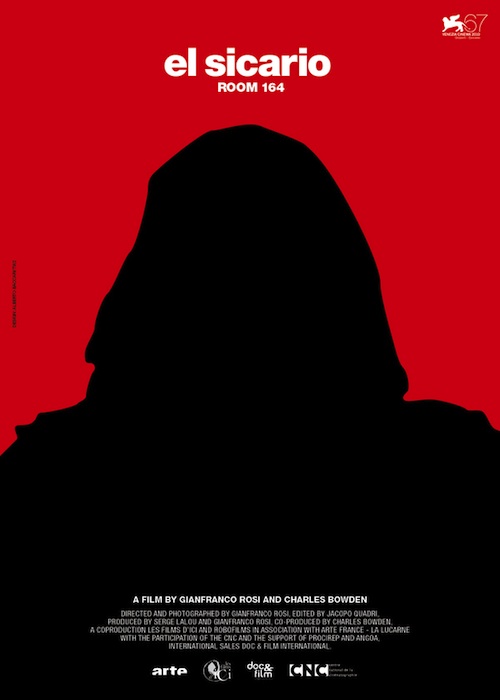
The Man in the Hood: LFM Reviews El Sicario, Room 164

By Joe Bendel. Don’t ask who that masked man is. You don’t want to know. In 2009, a ‘sicario’ (a professional killer working for the Mexican drug cartels) gave an in-depth interview to Charles Bowden for a revealing Harper’s article. Despite the cartel’s $250,000 bounty, he subsequently consented to a lengthy on-camera interview with Bowden’s filmmaker colleague Gianfranco Rosi, who shaped his pseudo-confession into the documentary El Sicario, Room 164 (trailer below), now playing in New York at Film Forum.

Rosi and Bowden are deliberately sketchy about the details, but the film was shot in a border town hotel room (number 164), where the masked sicario once held and tortured someone who owed money to his cartel. Eventually, he turned the battered man over to another team of sicarios. While he does not know his victim’s ultimate fate, he knowledgeably assumes a grisly end. Though this disturbing information seems to lend considerable significance to the location, it quickly becomes apparent the sicario has done such crimes innumerable times before in similar motels and so-called “safe houses” on either side of the border.

The sicario might very well be embellishing a host of individual details, but the broad strokes he sketches out ring chillingly true. Like a talented young baseball player, the sicario was recruited by his cartel at a young age. After serving a drug-running apprenticeship, the cartel greased his way into the police academy. Yes, the killer is also a copper. He estimates about a quarter of the graduates of all Mexico’s law enforcement academies are cartel plants. Not surprisingly, the free access to squad cars greatly simplifies the kidnapping process.

164 is all kinds of scary. Frankly, it makes it pretty clear narco-terrorist warlords have taken over the country. This is not happening in remote Afghanistan, but along our southern border. It is also evident the current administration is not capable of thinking sufficiently strategically over the long term to combat them in any meaningful way. Sending them a bunch of free guns as part of Operation Fast & Furious just is not going to do it. Continue reading The Man in the Hood: LFM Reviews El Sicario, Room 164