The Indie Godfather: LFM Reviews Corman’s World

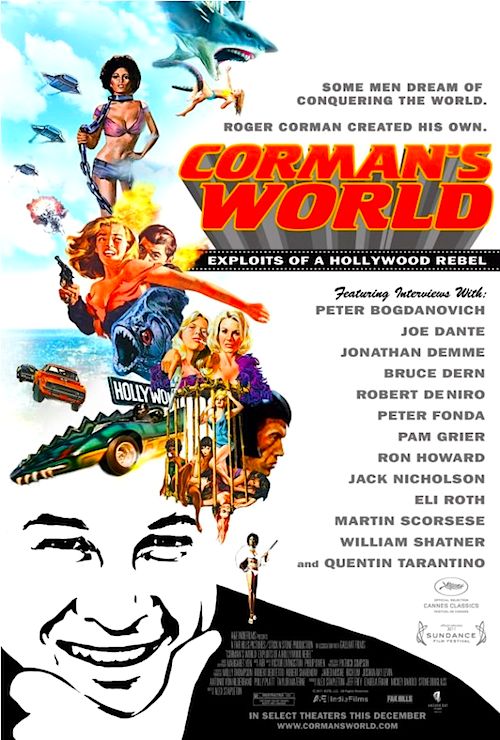
By Joe Bendel. Roger Corman is the Elvis Presley of genre pictures. Before anyone did anything, he did everything—and he did it cheaper. So many stories about the man and his movies have become the stuff of legend, yet they are all true. Tribute is paid to the original independent filmmaker in Alex Stapleton’s affectionately uproarious Corman’s World: Exploits of a Hollywood Rebel (trailer here), which opens this Friday in New York.

Corman has made hundreds of films, anticipating major shifts in the cultural zeitgeist with atomic powered creature features, rebellious teenager melodramas, biker movies, and blaxploitation cult classics. He always brought his films in on-time and under-budget. The one exception came in 1962 with The Intruder, a moody issue-driven drama about school integration and white supremacy filmed on-location in the Deep South. Now hailed as a milestone of independent filmmaking (by those hip enough to hail), Intruder was Corman’s only film to lose money, but the indie mogul is justly proud of it anyway.

After the experience of Intruder, Corman resolved to return to his low budget genre roots, subtly but deliberately insinuating his political statements into his films, rather than trumpeting them from the get go. Once again, Corman blazed a trail the rest of Hollywood would eventually follow.

Corman has appeared in several grindhouse documentaries in recent years, including Mark Hartley’s Machete Maidens Unleashed!, which documented Corman’s love affair with the authentic locations and bargain basement production costs offered by the Philippines in the 1970s. Yet there is very little overlap between the films. Indeed, with literally hundreds of outrageous movies to chose from, Corman documentarians need not fight over material.

From the Roger Corman-produced "Death Race 2000."

Corman’s record of mentoring up-and-coming filmmakers is a major reason why he won his honorary Oscar (a fact Exploits has a hard time accepting, preferring to think of him as an underappreciated B-movie auteur). Peter Bogdanovich explains it more in sink-or-swim terms, but an opportunity is still an opportunity. Stapleton scored some heavy-weight interviews, including Corman school of filmmaking graduates like Bogdanovich, Martin Scorsese, Ron Howard, Jonathan Demme, John Sayles, and Joe Dante. However, the marquee sit-down has to be the animated Jack Nicholson, whom only Corman would hire during his first ten years in the business. They clearly have a lot of history together, which makes for some of the more manic talking head footage you will see in a documentary.

There are plenty of juicy bits of trivia to be gleaned throughout Exploits, especially for those well versed in his filmography. We also watch Corman working behind the scenes of Dinoshark, one of his new Syfy original movies. Considering that network’s track record for original non-series productions, Corman actually represents a quantum step up in quality for them. Most importantly, there are generous clips from his oeuvre, in all their busty, blood-splattered glory.

Frankly, Stapleton probably could have made a film three times as long and the time would still fly by. Combining the joyous gusto of Corman’s films with top-shelf access to Corman and his celebrated alumni is tough to beat for sheer entertainment value. Easily the feel good film of the holiday season, Exploits opens this Friday (12/16) in New York at the Village East.

Posted on December 14th, 2011 at 12:29pm.

LFM Review: Ispansi

By Joe Bendel. Stalin’s Russia was never a safe haven. Unfortunately, many exiled Spanish leftists went from the frying pan into fire when they sought refuge in the Soviet Union. The Eastern Front is decidedly inhospitable to them in writer-director-leading man Carlos Iglesias’s Ispansi (trailer here), which screens today (Friday, 12/9) during the Film Society of Lincoln Center’s Spanish Cinema Now.

Alvaro is not just a Republican veteran. He was a “political” officer, which implies some heavy things for his proletarian companions. Paula is not one of them. Traveling under an assumed working class identity, the former aristocrat came to the Soviet Union with a group of orphans sent to the socialist paradise for their supposed protection. Among them is the illegitimate son she was forced to give up. Since then she has watched over him as an ostensive volunteer social worker. However, she cannot protect him from the arbitrary dangers of war.

Aside from the children, Paula thinks little of her comrades and even less of Alvaro. He also distrusts her, instinctively sensing her insufficient class consciousness. Of course, the sexual tension passing between them is also hard to miss.

Ispansi (Russian for Spaniards) is not exactly Dr. Zhivago, but nothing is. It covers a fair sweep of geography over several decades, while addressing politics with relative nuance. Since under the soon-to-be-former Socialist government any expression of sympathy for the still dead General was effectively prohibited, one would expect the film’s anti-Franco sympathies. Yet, to his credit, Iglesias does not let the Soviets entirely off the hook. In fact, some of Ispansi’s more chilling scenes portray the Soviets’ forced deportation (more or less ethnic cleansing) of the Volga Germans. Continue reading LFM Review: Ispansi

Push the Movement

By David Ross. “These fragments I have shored against my ruins,” writes T.S. Eliot in the waning lines of “The Waste Land.” Just so, Push the Movement, a strictly visual but particularly thoughtful Tumblr blog, shores its own fragments against the ruin of the postmodern twilight. Its endless stream of vintage and contemporary photos constructs an elusive, melancholy narrative that is somehow far more than the sum of its obsessions: Natalie Portman, handguns, jungle cats, neo-classical statues, nuclear explosions, plummeting people (9/11 trauma?), urban sprawl, subversive graffiti, street battles, women in the tub, crashes (trains, planes, whatever), rockets, Bob Dylan (ca. 1966), baroque architectural detail, fires and smoke plumes, Kate Moss, girls in underwear standing at windows (an Alexandrian archive of this oddly moving tableau!), tornadoes, floods, ironic signage and logos, Muhammad Ali….

I realize that there are many likeminded Tumblr blogs, but Push the Movement strikes me as subtler, better eyed, more cliché averse, more clued into a kind of sadness that one finds in the work of postmodern humanists like Don DeLillo and David Foster Wallace: a sense that reality has become an increasingly attenuated and remote spectacle, a ghostly tabloidism. As DeLillo famously says of the supermarket’s myriad coded surfaces, “This is the language of waves and radiation, or how the dead speak to the living.” Push the Movement endlessly parades its miraculous visions yet it seems to know – its own minor key suggests – that this endless stream is an act of desperation, an addict’s exercise in ersatz experience and diminishing return. This is how Wim Wenders’ weary angels see the world in Wings of Desire: as a distant miracle in which they can no longer participate. This is the cinema of the end of the world.

The politics of Push the Movement is a cool and ironic anti-establishmentarianism, but the site seems to understand that there are no real politics amid the new reality of the data ether, and the site’s irony seems to some extent turned on itself. What ‘movement,’ after all, can be ‘pushed’ by endless quotation-marked juxtapositions of other people’s experience? The 1% needn’t fear.

Note that none of the photographs have captions, commentary, or identifying information of any sort. They belong to a disembodied circulatory system in which proprietary considerations, the very notions of origin and authorship, are unsustainable. I find this anti-apparatus of anonymity one of the creepiest and most telling aspects of the site. I once sent Push the Movement an e-mail inquiring about the source of a picture I wanted to show in class (with nobody to contradict me, I call the photo “Postmodern Man on the Shores of Time, with History Weeping on his Behalf”; see below). I should have predicted as much: no response.

I became addicted to Push the Movement earlier in the year. The fineness of its visual eye attracted me initially, but the mystery of its tristesse is the real fascination. I recently reviewed the entire archive for 2011 – thousands of pictures – with my CPU wheezing and finally collapsing under the weight of what amounted to a single vast download. Context matters, but here, out of context, are a few pictures that gave me particular pause and ambivalent pleasure.

Continue reading Push the Movement

LFM Review: It’s Elemental

By Joe Bendel. If you’re going to borrow from Harry Potter, you might as well do it with pretty girls. This seems to be the logic behind Ip Man helmer Wilson Yip’s foray into campus magic. Frankly, it is a hard strategy to argue with, providing at least a baseline of entertainment throughout the unapologetically perky Magic to Win (trailer here), which opens this Friday in New York and San Francisco.

Macy and her cute teammates on Pegasus University’s women’s volleyball team routinely get schooled by their hot, mean opponents. However, when a freak accident transfers the magic of the eccentric Professor Hong to her, their losing days are over. The entrepreneurial ladies quickly open up a lucrative sideline, charging to magically goose underdog athletes to victory. Things get a bit out of Macy’s league, though, when an invisible magician comes asking for her help.

Ling Fung is an earth magician physically dematerialized and robbed of his powers by a renegade fire magician. Despite suffering from amnesia, he has intuitively arrived at the university to seek Hong’s help. He finds Macy instead, which would be a considerable step up if she knew what she was doing. Presumably the fire magician is on his way too, because if he can collect all the forms of elemental magic, something crummy will happen.

After making an international reputation with the Ip Man franchise, Win seems like a radical departure for Yip. It also appears to push the limits of homage in its more than obvious nods to Star Wars and the 1978 Superman movie.  Still, he certainly keeps the proceedings breezy and energetic.

Continue reading LFM Review: It’s Elemental

Smiley Returns: LFM Reviews Tinker, Tailor, Soldier, Spy

Gary Oldman & John Hurt in "Tinker, Tailor, Soldier, Spy."

By Joe Bendel. Five ghosts haunt John le Carré’s most celebrated spy novel. The shadow of the so-called “Cambridge Four” spy ring, including the treasonous Kim Philby and Anthony Blunt, looms large over the story, especially given the circumstances of their private lives. The fifth, of course, is Sir Alec Guinness, who is so closely associated with the role of mole-hunter George Smiley. However, Obi-wan Kenobi should be smiling down on Gary Oldman, who confidently assumes the Smiley mantle in Tomas Alfredson’s appropriately cerebral adaptation of Tinker, Tailor, Soldier, Spy (trailer here), which opens this Friday in New York and elsewhere.

Smiley once was the deputy chief of the Secret Intelligence Service (a.k.a. MI6, but known colloquially as “The Circus”), but he was forced out with his boss, known as “Control,” when an operation went spectacularly wrong. As a result, a field operative (or “scalp-hunter” in Circus parlance) was captured, effectively ending Control’s related mole-hunt. Unfortunately, it turns out the late spymaster was not so paranoid after all, as the minister begrudgingly admits when he brings Smiley back into service to furtively investigate the four top officers of the Circus, code-named by Control: Tinker, Tailor, Soldier, and Spy (skipping “sailor” from the old nursery rhyme, because it is too close to “tailor”).

Svetlana Khodchenkova & Tom Hardy in "Tinker, Tailor, Soldier, Spy."

There are no explosions in TTSS, nor is there a whole lot of shooting, but when it happens, it is significant. Instead of pyrotechnics, we watch as Smiley pieces the puzzle together, interviewing a diverse cast of professional thugs and bureaucrats, gleaning tantalizing clues from each resulting flashback. Yet, perhaps most intriguing are the glimpses we get of “Karla,” the notorious Soviet intelligence mastermind (played by a rarely seen Patrick Stewart in the classic BBC series, no less). Smiley might be chasing a mole, but his real adversary is definitely Karla, who fully understands his retired rival’s weaknesses.

Gary Oldman is the key reason why the revamped TTSS works so well. In a way, Smiley could be considered the dark side of his Commissioner Gordon persona in the Dark Knight franchise. Like Guinness, he plays Smiley’s cool detachment in a way that makes it clear the gears are turning furiously within his head. Occasionally he even seems to adopt some of Sir Alec’s cadences and mannerisms, but that is fine. Frankly, those familiar with the prior incarnation will rather want to hear that echo.

Gary Oldman as master spy George Smiley.

TTSS also features at least a dozen genuinely first class British actors, some famous and some who should be. John Hurt’s casting as Control is so perfect it requires no explanation. Likewise, Toby Jones, Colin Firth, and Ciarán Hinds add plenty of color as the Circus’s inner circle and Smiley’s prime suspects, by extension. Yet it is the intense and dynamic supporting work of Mark Strong and the soon to be famous Tom Hardy as scalp-hunters Jim Prideaux and Ricki Tarr that really crackle and hum.

Alfredson has helmed a sleek and brainy espionage thriller (one can see a certain kinship with his frosty, Nordic vampire tale, Let the Right One In), but TTSS is definitely a product of the le Carré school of Cold War moral equivalency. Smiley himself explicitly states there is no ethical distinction between us and them. Even the mole himself eventually explains that his decision to betray his country was largely based on aesthetics (which seems bizarre, considering he should be fully versed in the glories of Socialist Realism). Frankly, given the wealth of revelations that have flooded out of the former Soviet bloc, such revisionism seems like a dated relic of the 1970’s – but at least it matches the pseudo-retro vibe of the film.

TTSS is an absorbing big screen intrigue, even though it is relatively easy to guess the mole’s identity, solely on the basis of screen-time allotment. (Frustratingly, this means one of the best actors of our day is rather short-changed in the process.) Still, watching Oldman’s Smiley is the real show, following not just in the footsteps of Guinness but also the great James Mason (who played the character, inexplicably renamed Charles Dobbs, in Sidney Lumet’s moody but effective The Deadly Affair). He is a worthy successor, deserving serious Oscar consideration. Recommended for intelligent viewers who enjoy films about Intelligence, TTSS opens this Friday (12/9) in New York at the AMC Lincoln Square and Village 7.

Posted on December 6th, 2011 at 12:04pm.

Alien Invasion, Spanish Style: Extraterrestrial

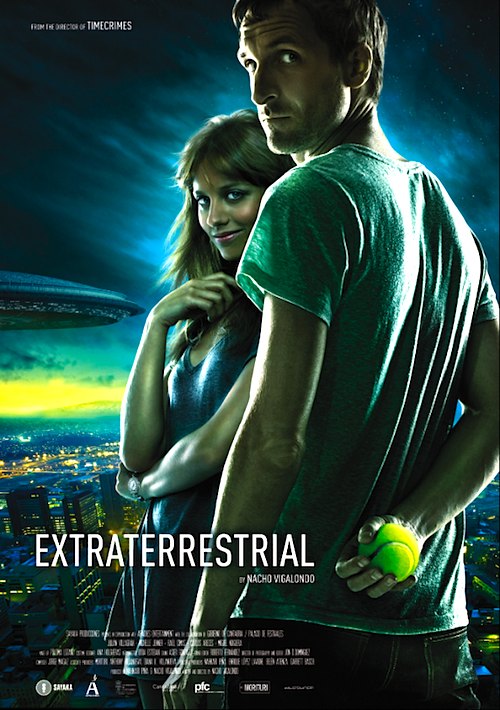
By Joe Bendel. The aliens came and they saw, so now what? That is the question in the back of the minds of the few Madrid residents who did not flee the city. However, they will be mostly preoccupied with their own issues in Extraterrestrial (trailer here), Nacho Vigalondo’s enormously clever take on an alien invasion blockbuster, which opens this year’s Spanish Cinema Now, the Film Society of Lincoln Center’s longest running film series.

Of all the nights Julia could take home a strange man, she picks the eve of the alien invasion. She and Julio are a bit slow rousing themselves in the morning, which is how they miss the military evacuation. Initially she is only worried about her possessive boyfriend, Carlos. However, as soon as she and Julio spy the huge spinning discs in the sky, she lets the smitten Julio stay, settling on a cover story to explain his presence. Before long, they are sharing a wickedly uncomfortable dinner with Carlos, a madman (but not necessarily an abusive one) and Ángel, a creepy torch-bearing neighbor.

The inevitable conflicts of this soiree are obvious, regardless of the alien invasion apparently underway. However, the not-as-dumb-as-he-looks Julio takes advantage of the resulting paranoia. Indeed, what transpires is sheer gleeful lunacy, powered by jealousy, resentment, and all possible shades of love, most certainly including lust.

Granted, Extraterrestrial is not as wildly inventive as Vigalondo’s instant classic Timecrimes (stream it now, thank me later), but it is still toys with and subverts genre conventions in a richly idiosyncratic manner. This is hardly your typical sci-fi programmer. Frankly, Julio, Carlos, and a rogue band of UHF broadcasters do far more damage to the city of Madrid than the armada of aliens. Yet, Vigalondo nurses our V and X-Files honed fear and uncertainty, creating suspense out of whole cloth. The entire film is quite a nifty trick, but not without a heart. Indeed, Extraterrestrial is surprisingly bright and upbeat compared to the seriously noir Timecrimes.

Michelle Jenner in "Extraterrestrial."

Despite the outlandish premise, Michelle Jenner, Julián Villagrán, and Raúl Cimas play their respective sides of the love triangle with absolute conviction. Villagrán is particularly effective, smoothly pulling off each surprise as Julio, the ostensive everyman. Though more broadly comic than his ferocious star turn in The Last Circus, Carlos Areces also still finds some pathos and madness in poor, perennially frustrated Ángel.

As his sophomore feature, Extraterrestrial should firmly establish Vigalondo as an international genre film cult-superstar. It is a truly original way to address some of the oldest themes in recorded storytelling. Highly recommended, it screens this Friday (opening night, 12/9) and the following Thursday (12/15) at the Walter Reade Theater during the 2011 edition of Spanish Cinema Now.

Posted on December 6th, 2011 at 12:03pm.