LFM’s Govindini Murty at The Huffington Post: A Conversation With Werner Herzog, Part I: Into the Abyss

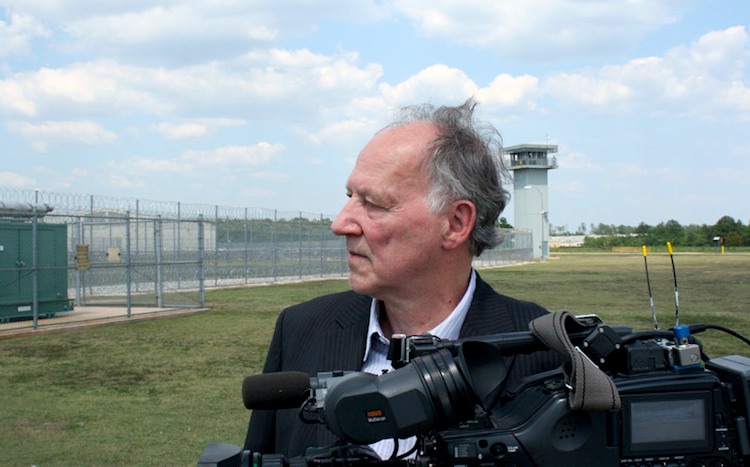
Werner Herzog directs "Into the Abyss."

[Editor’s Note: the post below appears today on the front page of The Huffington Post.]

By Govindini Murty. Few directors are as willing to venture into the abyss as Werner Herzog. His prolific body of work has ranged from intense dramas like Aguirre: The Wrath of God and Woyzeck that plumb the depths of the human soul to documentaries like Encounters at the End of the World and Grizzly Man that examine humanity’s fragile place in the miraculous and terrifying world of nature. The astonishing breadth of Herzog’s filmmaking conveys the humanist’s sense of wonder at the world – what he describes as the “ecstasy of observation.”

Herzog’s latest film, Into the Abyss: A Tale of Death, A Tale of Life (opening this Friday, November 11th) is a compelling look at the contentious issue of the death penalty. Producer Erik Nelson has stated that the film is intended to inform the current Republican presidential debate over the death penalty, in particular with regard to the candidacy of Texas Governor Rick Perry. Herzog himself has issued a Director’s Statement expressing his opposition to capital punishment – though in keeping with his lifelong aversion to political interpretations of his work, he has also asserted that Into the Abyss is not a political film. These apparent contradictions point to the enigma of Werner Herzog himself – on the one hand a sensitive humanist with strong moral convictions, yet on the other hand an artist who resists being defined by political activism or party ideology.

Into the Abyss embodies these contradictions. The film tells the true story of a brutal triple murder committed in Conroe, Texas. Michael Perry and Jason Burkett, intending to steal two cars owned by Sandra Stotler, killed Stotler in her home and then lured her son Adam and his friend Jeremy Richardson into the woods and executed them. Perry and Burkett subsequently went on a joy ride in the cars, before winding up in a bloody shoot-out with the police. Perry and Burkett were convicted of the murders, with Perry receiving the death penalty, and Burkett receiving a life sentence.

Herzog interviewed Michael Perry just eight days before his execution, and also interviewed Jason Burkett in prison. Other interviews include those with Burkett’s wife Melyssa Thompson-Burkett, who contacted Burkett while he was in prison and subsequently married him; Fred Allen, a prison captain who worked in the execution chamber and who assisted in over 125 executions before resigning in moral crisis; and most significantly, the relatives of the victims themselves: Lisa Stotler-Balloun, the daughter of Sandra Stotler and sister of Adam Stotler, and Charles Richardson, the brother of Jeremy Richardson. Stotler-Balloun and Richardson in particular provide the most heartbreaking testimony of the film, as Herzog does not shy away from depicting the shattering effect of the murders on their lives. As a result, Into the Abyss exists in a complex tension between Herzog’s avowed position against capital punishment and his impulse as a storyteller to depict both sides of the story and allow readers to make up their own minds.

I had the opportunity to meet with Werner Herzog in Los Angeles recently and discuss with him Into the Abyss and his extraordinary body of work. Part I of this interview appears below.
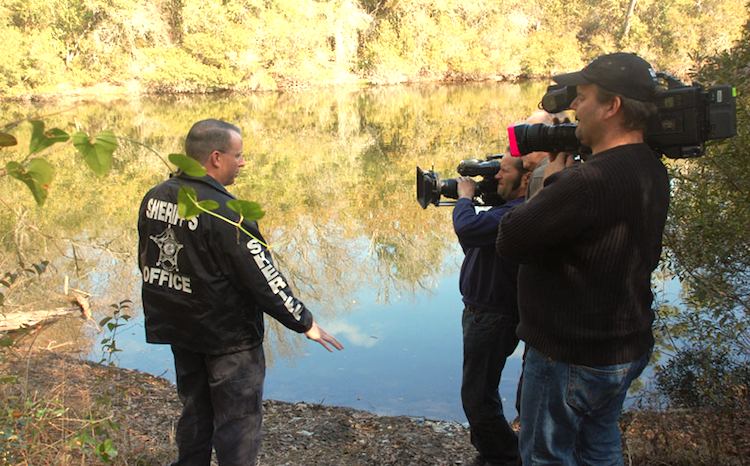
Documenting the crime.

GM: I’d like to ask you about the title of your movie, Into the Abyss, because I’ve seen you refer to the concept of ‘the abyss’ quite a few times in your work. In Woyzeck you have a line “Every man is an abyss, you get dizzy looking in,” and in Nosferatu you have a line “Time is an abyss profound as a thousand nights.” This is a concept you keep referring to – what does ‘the abyss’ mean to you?

WH: It’s a good observation, and when I came up with the title Into the Abyss – it dawned on me that it could have been the title of quite a few other films. Like Woyzeck could have had that title, or The Great Ecstasy of Woodcarver Steiner or even the cave film, Cave of Forgotten Dreams, because I’ve always tried to look deep inside of what we are – deep into the recesses of our existence, of our prehistory – like in Cave of Forgotten Dreams. So it is some sort of a theme that runs through quite a few of my films.

GM: I want to ask you about the relationship between humanity and the universe. There was a wonderful quote at the end of Encounters at the End of the World where Dr. Gorham asks, and I paraphrase, “are we the means through which the universe becomes conscious of itself?” This reminded me of a quote from Blaise Pascal’s Pensées:

“A reed only is man, the frailest in the world, but a reed that thinks. Unnecessary that the universe arm itself to destroy him: a breath of air, a drop of water are enough to kill him. Yet, if the All should crush him, man would still be nobler than that which destroys him: for he knows that he dies, and he knows that the universe is stronger than he; but the universe knows nothing of it.” (Trans. A.J. Krailsheimer)

This seems to apply to Into the Abyss and its depiction of human beings within this world. In the film you go driving down country roads and you show the trailer parks, the run-down stores, the boarded up gas stations, the bars. It looks like a wasteland that God is somehow absent from, and there are these people in the midst of it who are in a terrible state of pain and confusion – in an apparently indifferent universe.

WH: Let me address Pascal first. Yes, I like him very much. I even invented a quote for the film Lessons of Darkness. It starts with a Pascal quote “The collapse of the universe will occur like the creation in grandiose splendor,” and underneath it says Blaise Pascal, but I invented it – and of course Pascal couldn’t have said it better. [Laughs.]

But, it’s interesting. The wasteland, this forlorn landscape, has become fascinating for me – this lost kind of Americana. And one of the death row inmates with whom I spoke – not in this film but in another film I’m already finishing – he said to me how he saw on his very last trip forty-three miles between death row and the death house where they are being executed in Huntsville. And in this cage in the van he sees a little bit of an abandoned gas station, he sees a cow in the field, and all of a sudden for him, everything is magnificent, and he says: “It looked like Israel to me, it all looked like the Holy Land.” And I immediately grabbed my camera and I did this voyage of the forty-three miles and indeed the most forlorn landscapes all of a sudden look like the Holy Land. So I look at these forlorn landscapes all of a sudden with fresh and different eyes. Continue reading LFM’s Govindini Murty at The Huffington Post: A Conversation With Werner Herzog, Part I: Into the Abyss

The Birth of Chinese Indie Cinema: LFM Reviews Beijing Bastards @ MoMA

Chinese rocker Cui Jian.

By Joe Bendel. They are singing about revolution. They are not really doing anything about it, but that was still more than enough for the Communist government. Considered by many the first Chinese indie film, Zhang Yuan’s Beijing Bastards has been censored, banned, and roundly condemned – but thanks to Fortissimo Films, the international independent film production and distribution company – it reached a global audience. Still gritty and subversive after nearly twenty years, Bastards screens this Saturday in New York as part of MoMA’s new retrospective series, In Focus: Fortissimo Films.

Cui Jian is one of China’s most famous underground rockers. In Bastards, he plays himself or a thinly fictionalized version. He has fans but no gigs, because he cannot secure a venue for a prospective concert. He also lost the lease on his rehearsal space for no apparent reason. Though never outright stated, it is clear that the powers that be want to close him down.

Karzi owns a venue, but his rock bar is no great shakes. Neither is he. His pregnant girlfriend Maomao disappeared after he insisted she have an abortion. He doggedly hunts for her, subjecting her friends to outright harassment, but more for reasons of ego than love. Morally ambiguous, Karzi is not the image of Chinese youth the government likes to project, but in 1993, he was the shape of go-go me-me things to come.

A contemporary of Jia Zhangke, Zhang is considered one of the godfathers of the Chinese independent film movement and a forefather of the Digital Generation. In fact, Bastards bears a strong aesthetic affinity to the subsequent dGeneration films. Shot guerilla-style with most of the director’s friends serving as the ensemble cast, the film follows its roundabout narrative from a fly-on-the-wall perspective. This is a street level film, unvarnished and unsentimental. Continue reading The Birth of Chinese Indie Cinema: LFM Reviews Beijing Bastards @ MoMA

SF International Animation Fest: LFM Reviews Tatsumi & Fullmetal Alchemist: The Sacred Star of Milos

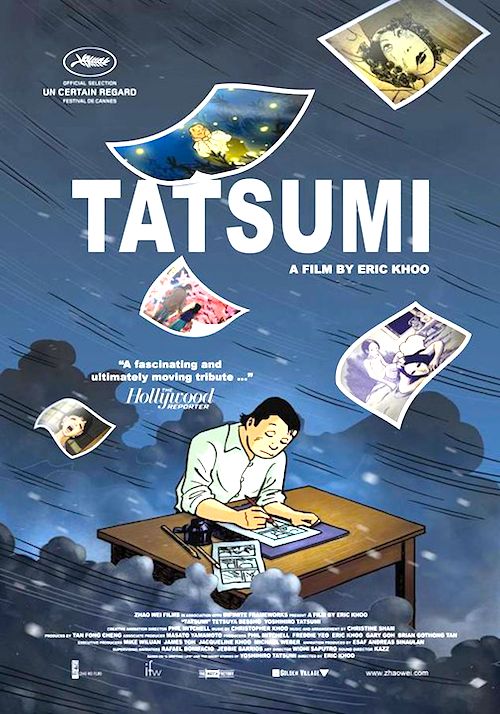
By Joe Bendel. Yoshihiro Tatsumi could be called the Japanese Will Eisner. Tatsumi was the leading exponent of Gekiga, or serious manga that tackled adult story lines. Americans who are very hip or awfully geeky will already know Tatsumi’s work, particularly his Eisner winning graphic novel-autobiography, A Drifting Life. For the rest of us, Singaporean Eric Khoo’s Tatsumi (trailer here) serves as a compelling introduction to his career and stories. Singapore’s official submission for best foreign language Academy Award consideration, Khoo’s animated tribute-biography screens at the San Francisco Film Society’s upcoming 2011 San Francisco International Animation Festival.

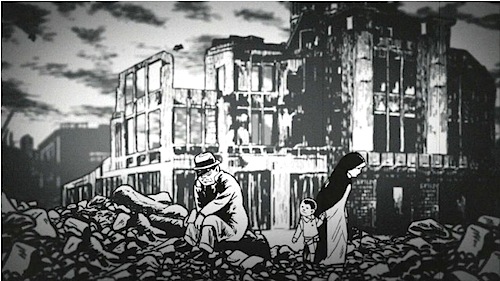
Tatsumi was ten when World War II ended. Somewhat logically, the American occupation and economic revival of Japan would factor prominently in his life and that of his characters. Khoo intersperses five notable Tatsumi stories, mostly in black-and-white, amid his vivid color adaption of the Gekiga pioneer’s memoir. Psychologically complex and deeply flawed, it is clear how Tatsumi’s characters were shaped by their creator’s experiences. In fact, it is easy to conflate them with Tatsumi, particularly the unfortunate artist in Occupied.

Each of the five would stand alone as satisfying self-contained short films. However, the most powerful of the collected stories comes first, by virtue of chronology. Hell forthrightly addresses the horrors of Hiroshima and its aftermath, but it takes viewers to some unexpectedly dark places, undercutting simplistic moral judgments. Throughout all five stories, there is a profound sense of alienation, often prodding the protagonists to commit shockingly anti-social acts out of existential compulsion, but their actions are always understandable, in a sadly human way.

From "Tatsumi."

Though his life was never as lurid as that of his marginalized characters, Tatsumi’s early years were marked by considerable pain and want. Khoo structures the film in a way that really emphasizes how these struggles instilled a humanistic empathy in Tatsumi, embracing those who were downtrodden and even grotesque. Ultimately, it is rather inspiring to see the artist rise from such mean circumstances to become an acknowledged leader of his field. Continue reading SF International Animation Fest: LFM Reviews Tatsumi & Fullmetal Alchemist: The Sacred Star of Milos

Sword & Sandal Report: Immortals, Gods & Kings, Noah, 300: Battle of Artemisia & Pompeii Blow the Lid Off the Ancient World!

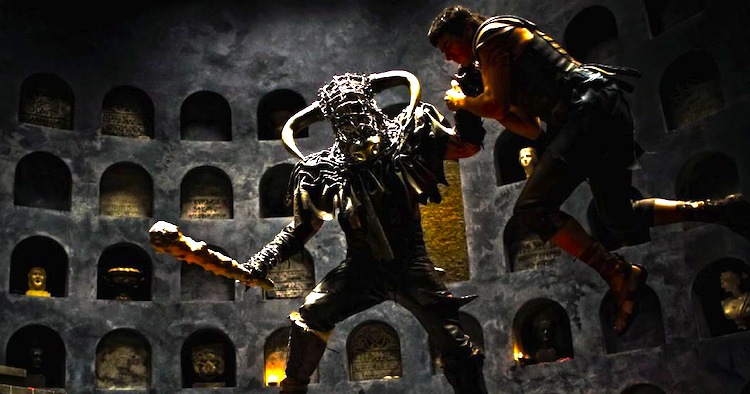
The Minotaur goes to work on Theseus in "Immortals."

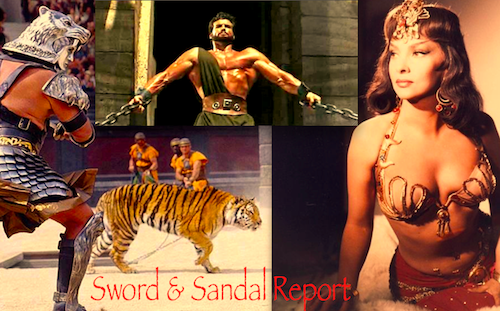
By Jason Apuzzo. Immortals is upon us, opening this Friday in 3D. As LFM readers know, I love the Sword & Sandal genre – it might actually be my favorite type of movie, among the many that we discuss here at Libertas – and so I’m looking forward to seeing the film. I grew up on films like Clash of the Titans and Jason and the Argonauts, the Steve Reeves Hercules films, and Ben-Hur – so it takes absolutely no effort for me to get revved up about a film like this. Especially when there’s a Minotaur involved.

At the same time, based on how Immortals is being marketed, I’m a very long way from believing it’s going to be anything other than a vacuous exercise in style, a kind of Chanel commercial in togas. Having watched/read recent interviews (see here and here) with the film’s director, Tarsem Singh, I have no sense that the film has any kind of personal meaning for him or anybody else involved. Nor do I sense as yet that the film is anything other than a cash-in on the ongoing popularity of 300, from which it obviously draws its inspiration.

Part of this, I confess, has to do with the cast – none of whom is really grabbing my attention. Henry Cavill, who is currently shooting the forthcoming Superman reboot, is someone I haven’t seen before except in 2002’s The Count of Monte Cristo, a film that did nothing for me. He doesn’t look all that interesting, frankly. As for the rest of the cast – Stephen Dorff, Luke Evans, Kellan Lutz – I barely even know who these people are. And as far as the women in the film, Isabel Lucas was appealing enough in Red Dawn, and in the second Transformers movie as a sexually aggressive alien robot … but having her play Athena? The goddess of wisdom? That seems like quite a stretch, like something you’d see in a high school play – along with cardboard swords and paper-mache busts of Caesar. As for Freida Pinto, my sense is that her 15 minutes of fame are rapidly dwindling – prior to her inevitable cash-out three years from now as a Bond girl.

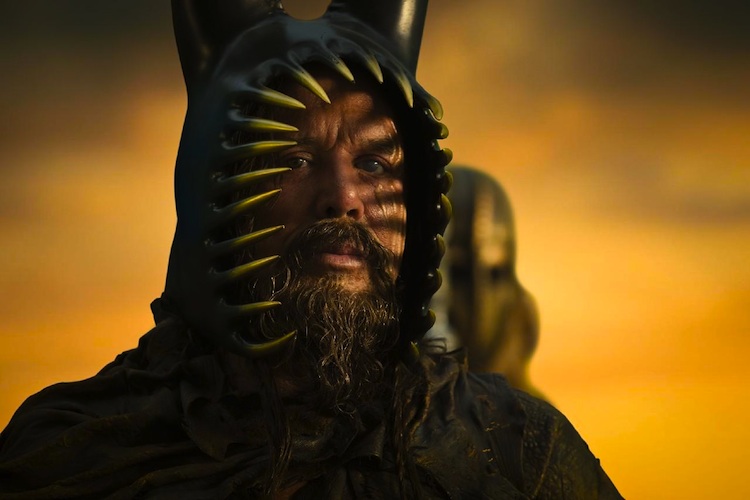
And then there’s Mickey Rourke, wearing what appear to be bronze bunny ears. I’m still trying to figure that one out.

So to say that I’m skeptical is an understatement. Still, the film’s costumes look good, and a great deal of thought seems to have been put into the visual design of the film – so we’ll see. In the meantime, you can read this incredibly inane interview with Tarsem, the cast members are also out talking about the film (Cavill, Rourke, Dorff), you can catch photos of the film and also 8 new clips. Also: the film has new TV spots (here and here), and a graphic novel is apparently on its way; also, the NY Times has a new feature on the film’s stylized violence.

Mickey Rourke in bronze bunny ears as King Hyperion in "Immortals."

• One of the best rumors of late in the Sword & Sandal world – indeed, one of the best movie rumors overall, of late – is that Steven Spielberg may direct Gods and Kings, an epic revolving around the life of Moses. I think this is a fabulous idea, assuming it can be made to happen. Deadline Hollywood reported recently that Spielberg has already read the Gods and Kings script by Michael Green and Stuart Hazeldine, and that the film would be made by Warner Brothers – likely with involvement from DreamWorks.

Where to begin? To have the director of Schindler’s List and Raiders of the Lost Ark take on the life of Moses would seem to make perfect sense. Spielberg would bring an old-fashioned, humanistic warmth and sentimentality to the project that very few directors have anymore, while also bringing a sense of spectacle, adventure and showmanship into the mix, as well. So for what it’s worth, I love the idea of him doing this – although I hope he’d change the title; Gods and Kings sounds a bit too anodyne, for my taste – or maybe just too close to Gods and Generals, I can’t tell. And anyway, aren’t we really talking about ‘Prophets and Pharaohs’ here?

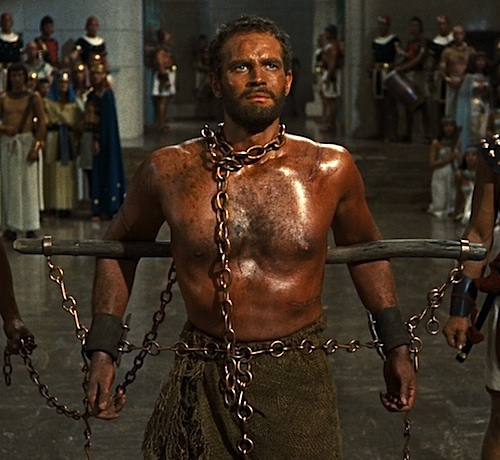
Charlton Heston as a young Moses.

Spielberg is also a major admirer of Cecil B. DeMille’s (watch any documentary on DeMille and you’ll always see Spielberg singing his praises), and I strongly suspect that Spielberg would love to have a DeMille-style religious/family epic of this sort under his belt to cement his legacy – the type of film that could be watched on holidays in perpetuity, much like DeMille’s Ten Commandments. Adjusted for inflation, incidentally, The Ten Commandments is still the #5 movie of all time at the box office, and would’ve made over a billion dollars domestically at today’s ticket prices.

Of course, I don’t know a lot about Gods and Kings; it could be that the screenwriters have opted for a less traditional take on the story than what I’m expecting. Be that as it may, it seems likely that with a project of this kind Spielberg would be swinging for the fences, trying to hit a major home run at the box office and also tell a story that would – in our increasingly fractious times – unite audiences worldwide.

Were I to guess, I’d say that he will likely do some kind of Moses film – although the script will need to match his personal agenda, more than the screenwriter’s. It’s conceivable that this project will remain in development for a while, if he doesn’t like what he sees initially, but I’d bet he’ll give the Moses story a try before too long.

By the way, do I dare mention the possibility of parting the Red Sea … in 3D?

Continue reading Sword & Sandal Report: Immortals, Gods & Kings, Noah, 300: Battle of Artemisia & Pompeii Blow the Lid Off the Ancient World!

Clint Eastwood Talks Politics and J. Edgar in The LA Times

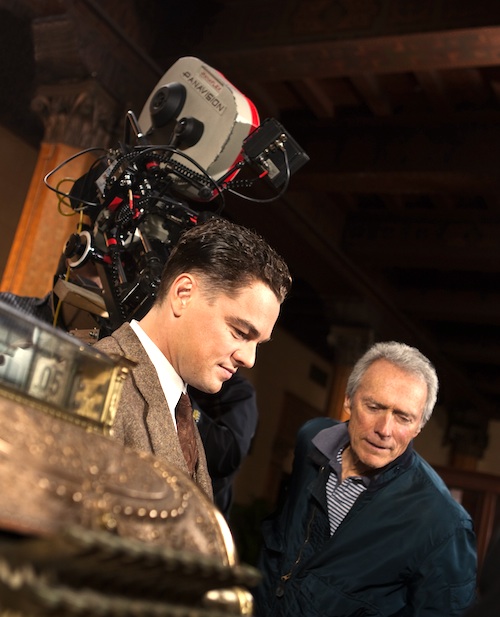
Leonardo DiCaprio & Clint Eastwood film "J. Edgar."

By Jason Apuzzo. I wanted to briefly mention a superb interview conducted by Patrick Goldstein in The LA Times today with Clint Eastwood, director of the new film J. Edgar. Patrick did an excellent job of getting Clint to talk candidly about his political views, and also of teasing out some of the basic ideas that have motivated his career.

In the interview, Clint talks about the various Republican nominees for President (Cain, Romney, Perry), about his attitude toward spending – both the government’s, and his own as a professional filmmaker – and other issues of the moment.

The interview also touches on what I believe to be a basic, rock-bottom issue for Eastwood in his life and career: the need to do tough things in order to survive in an unforgiving world. There is a hard, unsentimental quality to Eastwood’s films that I’ve always liked. Eastwood’s characters are never saints; instead, they’re pragmatists and loners, navigating what is often a morally ambiguous world. (You even feel this in the way Clint’s films are photographed – usually in a shadowy, chiaroscuro style.) Clint is never out to b.s. his audience about human nature, or about what people sometimes need to do to get ahead. As Patrick aptly puts it in his article, “[w]hen you’re in Clint Eastwood country, it’s the strong who survive.”

Eastwood is part of an older, Depression-era generation that lived through a period of time – the economic crash of the 1930s – when the bottom completely fell out of society. It was a period in time when, even though FDR had established a safety net for the destitute, there nonetheless wasn’t the kind of accumulated wealth that we have today after generations of economic growth. Even the poorest people today still have things like electricity, refrigerators, cars, telephones, TVs, etc.; this wasn’t the case during the Great Depression. When people were poor during the Depression, it was in ways that today’s Occupy Wall Street crowd – chattering on their cell phones and Twitter accounts – can’t possibly fathom. The only way we can grasp these things today is by talking to the older generations, or perhaps by reading John Steinbeck or Studs Terkel, or looking at the photography of Dorothea Lange … or watching a film like Clint Eastwood’s Honkytonk Man.

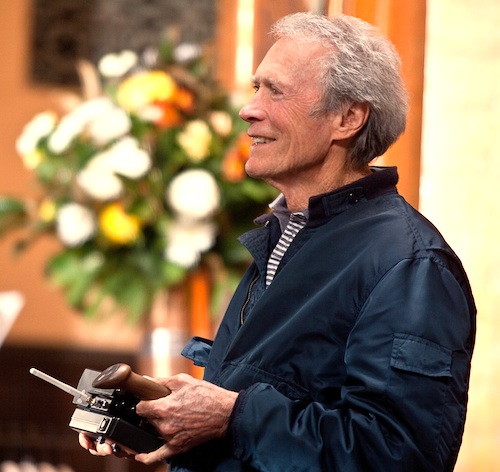
Eastwood on the set of "J. Edgar."

With Eastwood having lived through the hardship of this period as a young person, my sense is that over the years he’s developed two somewhat conflicting qualities: a hardness of spirit, for which his own characters (The Man With No Name, Harry Callahan) are famous, but also a more forgiving, ‘libertarian’ streak in terms of allowing people a wide berth to do what they they think they need to do in order to get by. It’s telling, for example, that of the various Republican candidates Eastwood would be drawn to Herman Cain. “I love Cain’s story,” says Eastwood in Patrick’s article. “He’s a guy who came from nowhere and did well, obviously against heavy odds.” Those same words could easily describe Clint, himself.

I haven’t seen J. Edgar yet, but having read the screenplay it’s easy to see how Hoover’s story fits into Clint’s thinking. Hoover did what he thought he needed to do in order for the country to survive against organized crime, political terrorism, and communist infiltration. This does not mean, however, that Hoover was a saint, or that his legacy should be sentimentalized. It still appalls me, for example, that there was a time when great men and advocates of freedom like Frank Capra and Thomas Mann had FBI files on them. There should be no place for this kind of thing in American life.

At the same time, though, there is always the basic need for the country to survive. That, I strongly believe, was Hoover’s overriding motivation – and it was the right one. As a successful actor-director now working into his 80s, it’s a motivation that Clint Eastwood surely understands.

Posted on November 8th, 2011 at 12:42pm.

Views on Japan: LFM Reviews The Tsunami and the Cherry Blossom and Minka

From "The Tsunami and the Cherry Blossom."

By Joe Bendel. It was only a matter of months after Katrina hit that a bumper crop of outraged documentaries began jostling for art-house attention. Strangely, almost eight months after the devastating Tōhoku earthquake and Tsunami rocked Japan the documentary film industry still maintains nearly complete radio silence. However, filmmaker Lucy Walker recognized the magnitude of the tragic events in Japan, capturing the immediate aftermath and early rebuilding efforts in The Tsunami and the Cherry Blossom (trailer here), which screens as part of the Views on Japan short film program at DOC NYC 2011.

Blossom opens with first-hand video footage that will make viewers forever forswear Roland Emmerich disaster movies. From the relative safety of higher ground, residents watch as the tsunami slowly obliterates their town and all their neighbors left behind. Their audible anguish is truly haunting.

There are many stories from those who lost loved ones. Clearly, the pain remains understandably raw and immediate for them. Yet there is no finger-pointing or ranting in Blossom. The Japanese people are, ironically, both too practical and too philosophical for such indulgences. Instead they seek to remember and rebuild. Whether it is the beautiful young photographer recording the rebirth of the town destroyed in the initial scene, from that very same vantage point, or the relief worker who always stops to salvage family photos and tombstones, their efforts are profoundly moving. Continue reading Views on Japan: LFM Reviews The Tsunami and the Cherry Blossom and Minka