[Editor’s Note: the post below appears today on the front page of The Huffington Post.]
By Govindini Murty. A pair of new films this week offers a critique of capitalism sure to gladden the heart of any Occupy Wall Street protester. This weekend’s Tower Heist depicts a group of employees who plot to rob a Madoff-style financier who cheated them, while the new sci-fi film In Time portrays a dystopian future in which time is literally money.
In Time in particular implies that time and nature are sources of tyranny equivalent to the capitalist system. The film depicts its hero, Justin Timberlake, as a proletarian Prometheus who robs the financial gods in order to redistribute their ill-gotten gains to an oppressed humanity. In In Time‘s near-future dystopia, human beings have been genetically-engineered to stop aging at 25, after which biological ‘clocks’ on their arms determine how long they have to live. Time on these clocks is spent like currency; people pay with hours or days of their lives for everything from a cup of coffee to their monthly rent. The wealthy store up hundreds if not thousands of extra years, while the poor live with only a few extra hours at any time. If they run out of time before they can earn more, the clock runs down to zero and they die.
Will Salas (Justin Timberlake), a young man from the ghetto, teams up with Sylvia Weis (Amanda Seyfried) – the disaffected daughter of wealthy banker Philippe Weis – to rob her father’s time banks and redistribute the time stored there to the poor. They justify this by telling themselves “it isn’t stealing if it is already stolen.” And given the exaggeratedly cruel and unjust world that In Time portrays, who could disagree?
In its desire to equate time with money and denounce capitalism, however, In Time ignores the basic fact that in the real world money is malleable, time is not. Money can be earned, stored up, and passed on to others; by providing a portable form of wealth, it frees people from the barter system and feudal economies of centuries past when human beings were tied to the land like slaves. In short, money offers us a chance at freedom and self-sufficiency, depending on one’s willingness to work and the opportunities one is given.
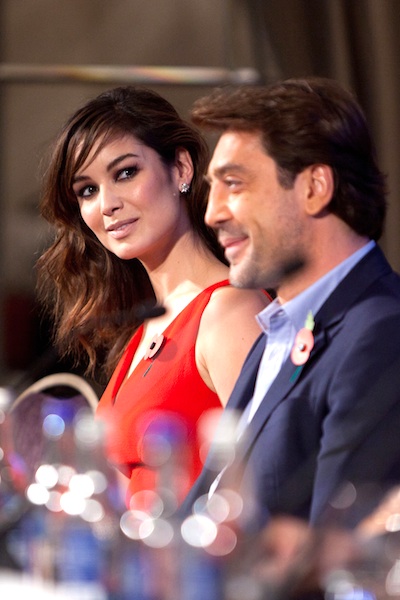
Bérénice Marlohe of the new James Bond film "Skyfall."
By Jason Apuzzo. • The big news from yesterday – the 50th anniversary of Sean Connery’s original casting as James Bond – was that after endless turmoil at MGM the new 007 film Skyfall, the 23rd film in the series, has finally begun shooting. The production team held a press conference (see here and here) to mark the occasion, rolling out new Bond director Sam Mendes along with Daniel Craig and some of Skyfall’s impressive cast, which currently includes: Javier Bardem as the villain, Albert Finney, Judi Dench as M, French actress Bérénice Marlohe as the new Bond girl, Naomi Harris as a ‘field agent’ (not as Moneypenny, as some websites are erroneously reporting) and Ralph Fiennes – who, if rumors prove true, might be making an appearance as Blofeld (a great idea, if it happens).
Not much that wasn’t already rumored about the film was confirmed in the press conference, except that Mendes threw cold water on rumors that he’s somehow taking the emphasis off action in this new Bond film. Frankly, I didn’t believe those rumors in the first place, due to the tight control that the Broccoli family has always kept on the Bond series. There was no way the Broccolis were going to suddenly change their formula just for the sake of Mendes, no matter what kind of august cast he brought with him. Bond producer Michael G. Wilson (stepson to legendary Bond producer Albert Broccoli, and half-brother to Barbara Broccoli) has literally been on the set of the Bond films since Goldfinger, and has seen Bond directors come and (mostly) go, so I never believed that he was all of a sudden going to be endorsing a George Smiley-style version of Bond out of Mendes.
So with all of this talent floating around Skyfall (a good name, by the way) – and there is a lot of talent floating around this production – why am I not feeling more excited? Regular Libertas readers already know the answer to that question: my sense is that the Bond series is, once again, adrift.
As a case in point, as excited as I was about yesterday’s press conference, and about the new film’s impressive cast and great list of locations (Shanghai, Istanbul, Scotland, et al) and about seeing Bérénice Marlohe trotted out in a red dress, etc., I was distinctly bored by the official description of the storyline:
Bérénice Marlohe and Javier Bardem.
In SKYFALL, Bond’s loyalty to M is tested as her past comes back to haunt her. As MI6 comes under attack, 007 must track down and destroy the threat, no matter how personal the cost.
Does any of that sound very interesting? It certainly doesn’t to me – making the usual allowances for the producers trying to keep the description spoiler-free. But the description really should’ve read something like this:
In SKYFALL, an insane billionaire Russian video game designer, who lives in a levitating palace surrounded by genetically designed Thai supermodels, devises a first-person shooter game that mesmerizes the world’s youth into attacking Western bankers. 007 must be hauled away from a secret mission in Cozumel investigating fraud in the international lingerie market to fight this terrifying menace.
That, my friends, would be a Bond film to remember. In the very least, it’s the type of Bond film they would’ve had the good sense to make in the 1960s or 1970s, during the series’ heyday.
Aside from the one-dimensionality of Daniel Craig, part of the problem with the Bond series of late is that it just doesn’t seem very fun or cathartic anymore. The series has lost all of its cracked humor, warped characters and vaguely campy sensibility. It’s become earnest and ‘serious’ when it should be fun.
And when I think of ‘fun,’ the name ‘Sam Mendes’ – alas – isn’t the first name that comes to mind.
At the risk of sounding like a broken record, I’ll repeat here what I’ve been saying for some time: the Bond series should be handed over to Michael Bay and Michael Fassbender, or some combination of talent that can approximate what Bay and Fassbender would bring to the series: i.e., a director who can bring spectacle, sexiness and humor back to the series, and a leading man actually suited to the part, who doesn’t look and act like a baked cauliflower (i.e., Daniel Craig).
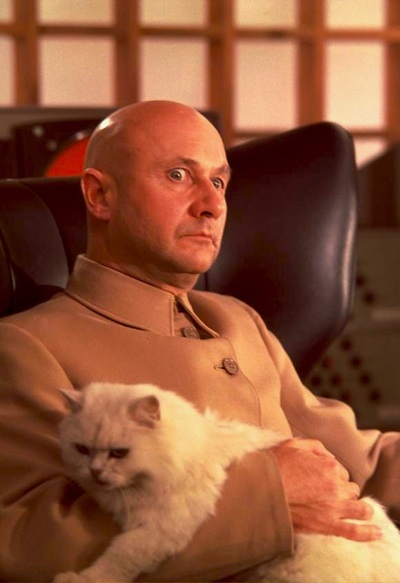
Ernst Stavro Blofeld: Ralph Fiennes' next role?
So is there anything to look forward to with respect to Skyfall? Sure. There are rumors that Ernst Stavro Blofeld may be appearing in the film (likely as the super-villain pulling Javier Bardem’s strings), which would make sense as the role Ralph Fiennes would play. I think this is the one bold stroke that might help the series a great deal, assuming Blofeld became a recurring character again.
Frankly, Blofeld has always been a much better character in the novels than in the films – with only Donald Pleasance in You Only Live Twice bringing the humor and psychotic intensity to the role that it demands. As much as I love Telly Savalas, he was horribly miscast in the role, playing Blofeld like a Long Island mafia don in On Her Majesty’s Secret Service; and Charles Gray was much too smooth and genial for the role in Diamonds are Forever. Fiennes, by contrast, has basically already been playing a variation on Blofeld in Harry Potter for years. Shave his head and put a scar on his face, and I think he’d be perfect. Here’s hoping that’s more or less what they have planned …
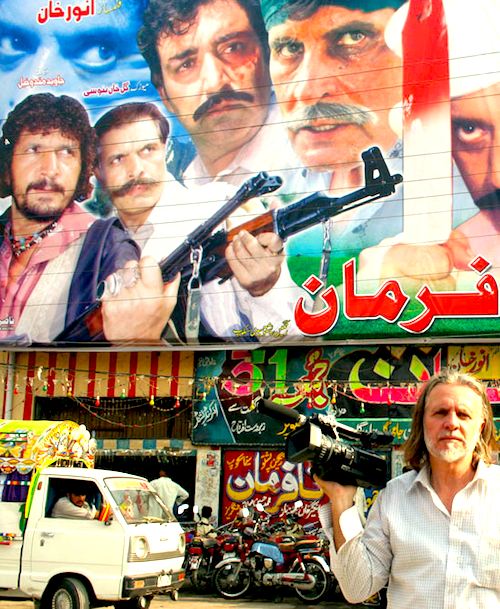
By Joe Bendel. If the Taliban mullahs want to call you something heavy, they will probably label you a “miscreant” (a villainous heretic). Unfortunately, for entertainment-starved Pakistanis, just about everyone involved in artistic endeavors is automatically considered a “miscreant,” most definitely including actors and filmmakers. Ironically though, the cottage Pashto film industry was largely based in the Taliban stronghold of Peshawar, which is where Australian filmmaker-artist George Gittoes took his camera for an up-close and personal look at militant intolerance in The Miscreants of Taliwood (see a 6-minute preview above), which screens during Anthology Film Archives’s upcoming retrospective of Gittoes gonzo-ish filmmaking.
If truth be told, Gittoes was probably fortunate to live through the first thirty seconds of Miscreants. Fortunately, he was only roughed up a bit while filming Islamists building a bonfire of CDs and DVDs in Islamabad, a city that Gittoes reminds viewers contains nuclear weapons. However, as Gittoes pursues his story, he becomes increasingly a part of his own film, at considerably further risk to his own well being.
While it is ordinarily annoying to see filmmakers inject themselves into their own documentaries, Gittoes was hardly motivated by self-aggrandizement. To gain access to the world of Pashto filmmaking, he became an actor himself, forming a fast friendship with his co-star Javed Musazai. When the Taliban terrorized Taliwood into submission, Gittoes financed two films on his own in order to keep the documentary going. Though hardly well-heeled, Gittoes is able to scrape together seven grand, sufficient funds for two Pashto films.
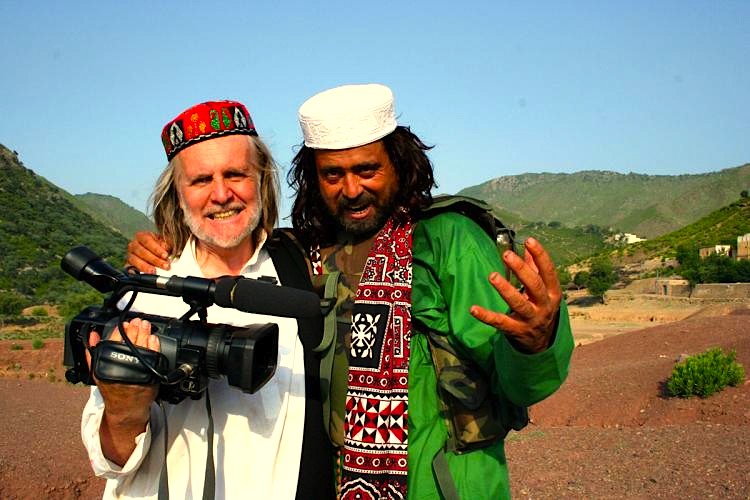
George Gittoes & Javed Musazai in "The Miscreants of Taliwood."
By Joe Bendel. Pashto cinema has an unlikely godfather: an Australian graphic artist and documentary filmmaker, who seems more at home in a war zone than walking the red carpet. To get inside the oppressed Pashto film industry, George Gittoes financed his own Pashto films. The results, as seen in The Miscreants of Taliwood, look rather awful, but they were just a start. Perhaps mindful of previous lost opportunities, Gittoes and an entirely Afghan cast and crew produced an interconnected trilogy of films that directly address issues of gender roles, religious intolerance, and political corruption. They are also love stories. A significant cultural accomplishment (if not necessarily high art), the Love City trilogy has its American premiere this weekend as part of the Anthology Film Archives’ Gittoes retrospective.
If (like myself) you have not seen the first film, also titled Love City, not to worry. Gittoes essentially shotguns the gist of it into the first five minutes of Talk Show. Basically, it is Romeo & Juliet with a happy ending. A young filmmaker falls in love with Jasmin, the daughter of a former mujahedin who happens to own Love City, a Jalalabad wedding hall, but he opposes their love match. Eventually true love wins out, but this is the exception rather than the rule in Afghanistan.
In the second film, Talk Show, the focus shifts to Jasmin’s older sister Asma, who is studying in Peshawar with her Afghan-American friend Ghuty. Unfortunately they are kidnapped by Taliban terrorists while returning home from the wedding. Enlisting the help of Karim, a reputedly mobbed-up restaurateur, her father orchestrates their rescue. Unfortunately Asma falls for Karim in the process, forgetting about cousin Ikram, who has long carried a torch for her. Of course, getting involved with the wrong sort of man is exponentially worse in Afghanistan. However, Asma is not without her own resources. As the host of a groundbreaking issue-oriented talk show, she has a forum to challenge the caddish and corrupt Karim. Continue reading Afghanistan in the Spotlight: LFM Reviews George Gittoes’ Love City Trilogy
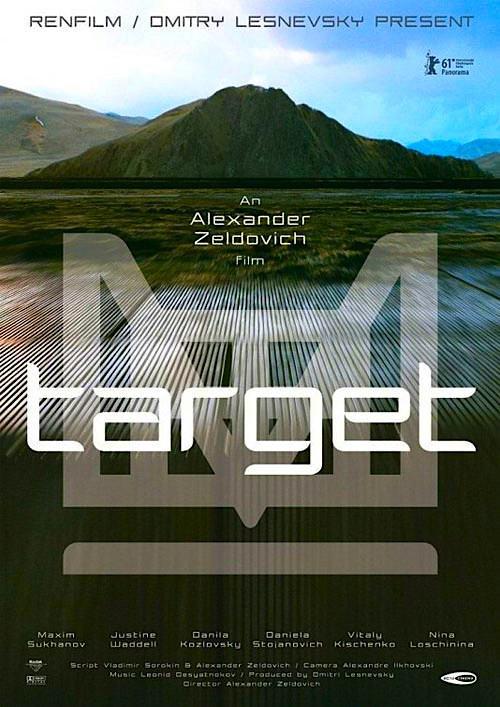
By Joe Bendel. In near future Russia, red signifies good and blue designates evil. Ahem. Russia’s powerful natural resources minister is preoccupied with a device that reveals the good-to-evil ratio of everyone and everything viewed through it. He would like to put this information into practice and he ought to have the time to do so, considering he will more or less live forever. Of course, nothing is quite so simple in Alexander Zeldovich’s science fiction fable The Target (trailer above), which screens during the eleventh annual Russian Film Week in New York.
Somewhere in Nowherestan, there is a colossal abandoned Soviet astrophysics research facility. Built into the ground, it looks like a giant target from the surrounding mountains. The bull’s eye collects not just radiation, but also chi force. Those who spend the night in the focal point will apparently live forever. For a man of privilege like Minister Viktor Chelshchev and his increasingly discontented wife Zoya, it is a trip worth the expense and inconvenience.
With Zoya’s brother Dmitri and his friend Nikolai, a thrill-seeking border enforcement officer, they make the long journey east. They also share their passage with another postmodern pilgrim, who turns out to be the woman of Dmitri’s dreams. Together they spend a fateful night in the Target, which turns out to be everything it was promised to be and then some.
Initially, everyone feels energized, buzzed even. However, it quickly becomes clear the target acts as a karmic steroid shot. Their emotions become rawer and their passions more intense, overriding their empathic affinities. As Zoya and Nikolai launch into an affair, taking the film on a futuristic Anna Karenina detour, Chelshchev boldly announces his intention to screen mines and worksites to avoid evil deposits (for real). How do you think that goes over?
A strange but not implausibly exotic environment, Target initially brings to mind the austere, almost antiseptic near future vibe of classic 1960’s-70’s science fiction films like 2001, World on a Wire, and, dare we say it, Solaris. However, things get rather messy in a hurry. Indeed, Target is a tricky film to get a handle on, because it veers into some trippy territory that has very real narrative consequences. Yet, despite the nature of its themes and motifs, there is nothing New Agey about the film. It is never proscriptive. Rather, it returns to one of the central cautionary principles of speculative fiction: those who would become like gods . . .
As Zoya/Anna, South African born English actress Justine Waddell (who had a smaller supporting role in Bernard Rose’s Anna Karenina) is a brittle, haunting presence, bringing to mind Anouk Aimée and Anna Karina in the films of Fellini and Godard. Likewise, Maxim Sukhanov finds unexpected depths of humanity in Chelshchev, somewhat resembling a Russian Mastroianni. Indeed, Target is better thought of in Nouvelle Vague and surrealist traditions than as genre cinema per se.
From the Russian sci-fi epic "The Target."
Ambitious in scope, cinematographer Alexandre Ilkhovski’s wide vistas of the Target and surrounding mountains are visually arresting. This is definitely big picture filmmaking. Still, in several respects Target is an alarmingly current film, positing a Russia ever more dominated by a resource hungry China. It also depicts the violent cruelty of mobs in no uncertain terms. Even if they are poor, they can still be evil.
In just about every way, Target is an uncompromising film for the ‘top one percent’ rather than a simpleminded rabble. For those who enjoy science fiction at its most challenging, Target is strongly recommended. It screens again tomorrow night (11/1) during Russian Film Week in New York.
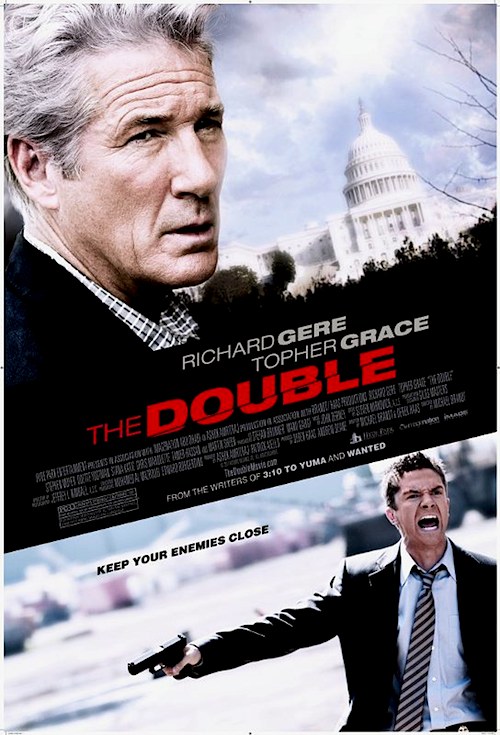
By Joe Bendel. The Cold War is over, technically speaking, but a lot of unfinished business remains. A notorious Soviet assassin is one of those loose ends. Never captured but presumed dead for years, the American intelligence services are slightly concerned when the body of a murdered senator bears the signature techniques of the killer code-named Cassius. Unfortunately, the game is afoot once again for his temporarily retired CIA nemesis in Michael Brandt’s The Double, which opens this Friday in New York.
Paul Shepherdson thought it had all ended with a bang. Cassius’s body was never recovered, but since the killings stopped, closure appeared to be achieved. Years later, the Senate’s leading critic of neo-Soviet Russian aggression is brutally murdered. Pointing to a few variations here and there, Shepherdson insists it is the work of a copycat. However, FBI analyst Ben Geary is certain it is Cassius’s work. He is also something of an expert on the old Soviet bogeyman, having written his master’s thesis on Shepherdson’s investigation. Reluctantly, the CIA veteran agrees to an inter-agency odd-couple pairing with Geary, trying to pour cold water on his enthusiasm every step of the way.
Refreshingly, the Russians and the Soviets before them are the villains in The Double, while the Americans simply scramble to counter their infiltration campaign. (It is a bit of a stretch making the murdered hawkish senator a Democrat and his Russian puppet counterpart a Republican, but if that is the concession that had to be made, so be it.) On the macro political level at least, Double is quite sound and realistic.
Double takes great delight in springing two big twists on the audience, yet inexplicably gives away the first one in the trailer (above). Several more follow, which naturally alter our perceptions of characters a second time. While viewers will be primed for the second switcheroo, Double has some very smart investigative detail that makes the dot-connecting process considerably more engaging than usual.
As Shepherdson, Richard Gere has the right steely, grizzled presence, maintaining a consistent world weary character throughout his character’s revelations. Frankly, Double is his best work in years (maybe since Chicago). Conversely, Topher Grace’s Geary looks like a mere boy among men. Granted, he is a rookie, but he does not even look convincing wearing a suit. His presence is a major albatross weighing down the film. Still, the film has Martin Sheen, suitably commanding as CIA director Tom Highland and True Blood’s Stephen Moyer nicely projects feral cunning as Brutus, the only captured member of Cassius’s team.
In his directorial debut, 3:10 to Yuma co-writer Brandt maintains a decent if not exactly breakneck pace. He has a nice handle on the details, but never delivers a centerpiece action sequence. Still, it is a solid Cold War-reloaded thriller genre fans and Russophobes should enjoy when it opens Friday (10/28) in New York at the AMC Empire and Village 7.