A Russian Freedom Jazz Dance: LFM Reviews Hipsters

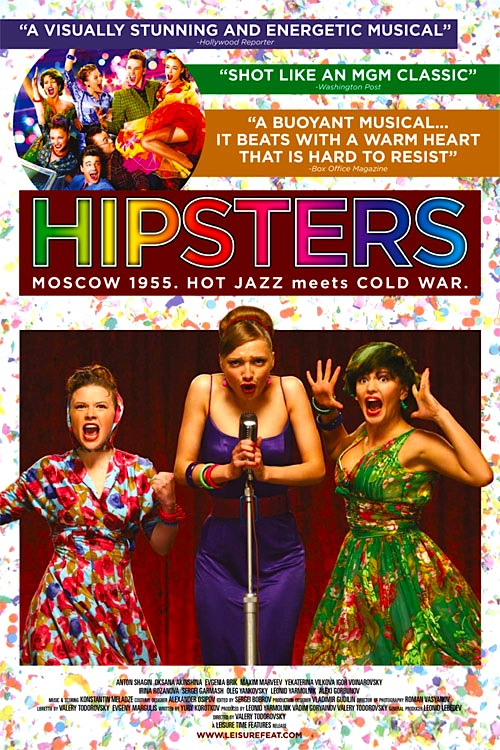
By Joe Bendel. During the Cold War, Willis Conover’s jazz program was the most popular Voice of America show with listeners behind the Iron Curtain, despite the constant barrage of Soviet propaganda crusading against America’s greatest original form of music. With its unmistakable message of freedom, the Communists were right to be concerned. One young soon-to-be-former Communist becomes a convert while pursuing the coolest chick he has ever seen in director-co-librettist Valery Todorovsky’s outstanding period musical Hipsters (trailer here), which opens tomorrow in Los Angeles.

Named after Marx, Engels, Lenin, and Stalin, Mels is a Communist Youth member who looks like a young Conan O’Brien. Polly is a classic Russian beauty, who runs with the jazz-listening extravagantly-dressing hipster crowd. A decided underdog, Mel makes little headway trading in his drab proletarian wardrobe for a candy-colored suit. However, when he takes up the saxophone, he finally turns her head. Of course, their romance will be difficult. As hipsters, they are constantly harassed by Mels’ former comrades. It hardly helps matters that Katya, youth brigade leader, has been carrying a torch for him.

By 1955, most American teenagers were more interested in Elvis Presley than Charlie Parker, but rebellious teens in the USSR had to take what they could get. Hipsters’ music is definitely jazz, but it leans towards jumpier big band arrangements, which are a lot of fun and work well in the film’s context. The film also makes no bones about jazz’s American origins, clearly associating it with notions of freedom. Even one of Conover’s fondly remembered VOA broadcasts is heard briefly.

Sexy and stylish like a hipster, the film dramatically contrasts the color and flair of the rebel jazzers with the drabness of their Soviet environment. Todorovsky created some wonderfully energetic, period appropriate musical numbers, which display a respect and affection for jazz. The hip jitterbuggery choreography is quite entertaining, yet perhaps the musical highlight comes relatively early, when Mels fantasizes playing “Summertime” as a duet with a Parker-esque alto player in New York. It’s a beautiful scene.
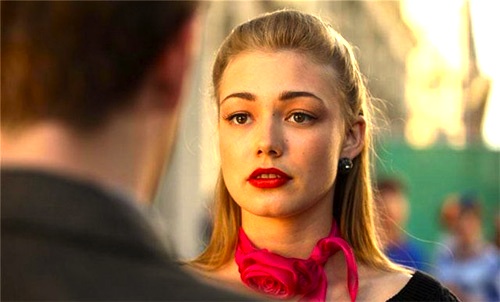
Oksana Akinsha in "Hipsters."

Yet Todorovsky never ignores the ugliness of the Communist era, either. At times, the enforcement of Party discipline at Mels’ school resembles scenes from The Wall. Clearly this was a time of paranoia and petty abuses of power.

As Mels, Anton Shagin passes the likability test, but hews rather closely to a zone of reserved shyness. In contrast, Oksana Akinsha smolders up the screen with old school movie star appeal. In an acutely human supporting turn, Igor Voynarovsky adds further depth and pathos as Boris (or Bob if you’re hip), Mels’ initial tutor in the school of cool. It is also nice to see veteran Russian actor Sergey Garmash as Mels’ gruff but sympathetic father.

Visually dynamic, Hipsters is a refreshingly inventive, jazz-centric take on the movie musical. It is easily the best Cold War era musical since the Czech film Rebelove, which might not mean much to a lot of people, but is high praise indeed. A wonderfully entertaining film with serious substance, Hipsters is one of the year’s best. It opens tomorrow (10/28) in Los Angeles at the Nuart, with a New York engagement currently scheduled for January.

Posted on October 27th, 2011 at 11:39am.
NBC Developing The Infidel as a TV Series

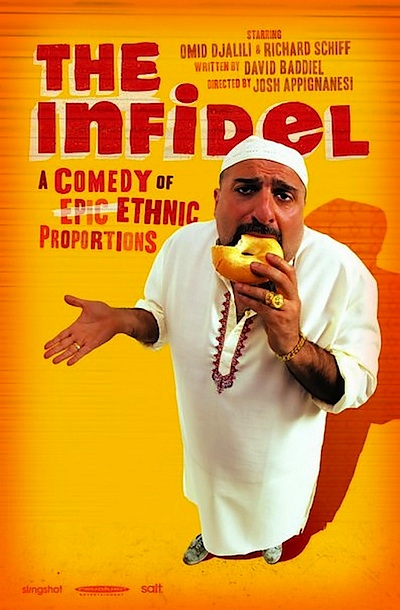
By Govindini Murty. One of the reasons we champion independent film here at Libertas is because of the crucial role it plays in incubating talent. One of the first indie films we talked about when we launched Libertas Film Magazine was The Infidel, a quirky little British comedy that screened at the Tribeca Film Festival in the spring of 2010. The Infidel tells the hilarious story of a middle-aged Muslim man, Mahmud, who finds out that he was actually born Jewish – at the very same time that he also discovers that his son is about to marry into the family of a radical Islamic cleric.

One of the reasons we liked the film so much was because of the lead performance of Omid Djalili, the Iranian-British comic who plays the hapless Mahmud. You can read Jason’s review of The Infidel here, and you can see a number of Djalili’s hilariously un-PC comedy skits on YouTube. One of my favorite Djalili skits is “Arabs at the airport” (Djalili describes getting freaked out when he sees Arabs at the airport), and I also like his satires of immigrant Iranian life – they remind me of the earthy and very funny ethnic humor of Nia Vardalos’ My Big Fat Greek Wedding. Check out Djalili’s “Iranian in UK,” a satire of Sting’s “Englishman in New York.”

Now Deadline Hollywood reports that NBC is developing a TV series to be based on The Infidel. The series would star Djalili, who would also produce the show with his wife. This seems like a timely idea to me. A comic of Iranian descent succeeding in mainstream American TV while satirizing radical Islamist mores would send a great message to the rest of the world – one that advocates for moderation over extremism in the Muslim community. It would also be a rebuke to the repressive Iranian regime, which, as we’ve documented numerous times here, jails and abuses it own leading filmmakers and film artists in one of the most anti-art dictatorships on earth.

Finally, a TV series based on The Infidel is a good idea because it would also just be funny. I don’t find a lot of today’s comics very amusing, but Djalili is one of the few who seems to have a natural ability to make people laugh based on character and timing – not just gross-out jokes. This is a great thing, whether or not it leads to world peace and understanding. I hope the NBC series stays true to the courageous, un-PC spirit of the original film. I find the Brits are a lot braver in their satire than Americans, and I truly hope that NBC doesn’t water down the comedy of the original Infidel or reverse its message. Check out the trailer for The Infidel above and I think you’ll see why we welcome this becoming a TV series.

Posted on October 26th, 2011 at 7:51pm.

India Cranks the CGI: LFM Reviews RA.ONE

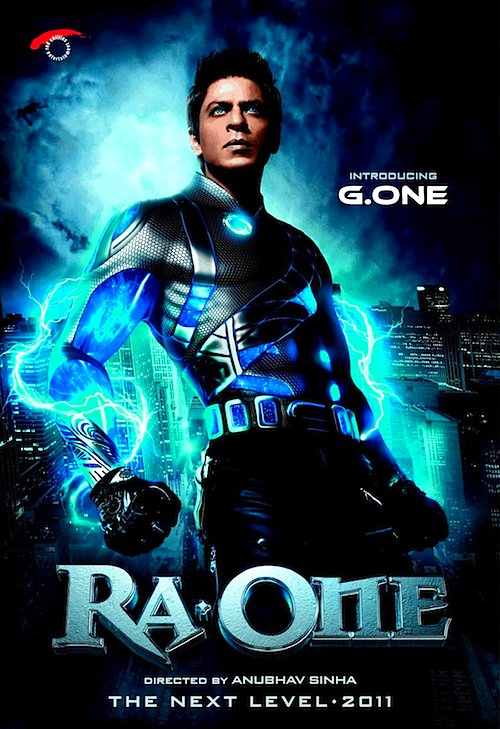
By Joe Bendel. Two video game characters will continue their epic struggle of good versus evil in the real world. At least one of them also sings and dances. It’s not the super-villain. Combining Bollywood style musical numbers with Terminator and Tron inspired science fiction motifs, Anubhav Sinha’s RA.ONE (trailer here) opens today in New York after already setting box-office presales records in India (a feat that should stand for at least another month, possibly six weeks).

Shekhar Subramanium is a game designer with a bratty son who prefers villains to heroes. For his birthday, Subramanium obliges him with RA.ONE, the monstrous bad guy more powerful than G.ONE, the good guy in his latest cyber-VR game, modeled on its creator. Lucifer, as the kid dubbed himself in gaming circles, is delighted, kicking RA.ONE’s tail in the game’s first round. However, when Lucifer is pulled away before RA.ONE has a chance for payback in the virtual world, the dark lord decides to go get him some in the real world.

While the film pretends to present a scientifically plausible explanation for RA.ONE and then G.ONE making the big Matrix leap to reality, it is really all just hocus pocus. Yes, there are ample science fiction elements, but the film also diligently hits all the traditional Bollywood and Tamil bases. A father dying before his son can tell him he loves him? Check. Flashbacks in the rain? Check. Redemption arriving by way of a surrogate father figure? Maybe, just maybe.

Though at first just a shortening of “Random Access One,” RA.ONE became a digital reboot of Ravana, the Hindu demon king, during Subramanium’s game development process. Similarly, G.ONE became a derivation of the Hindi word for life. That’s about as Joseph Campbell as the film gets, but there are some cool musical numbers. Continue reading India Cranks the CGI: LFM Reviews RA.ONE

LFM Review: My Tehran for Sale

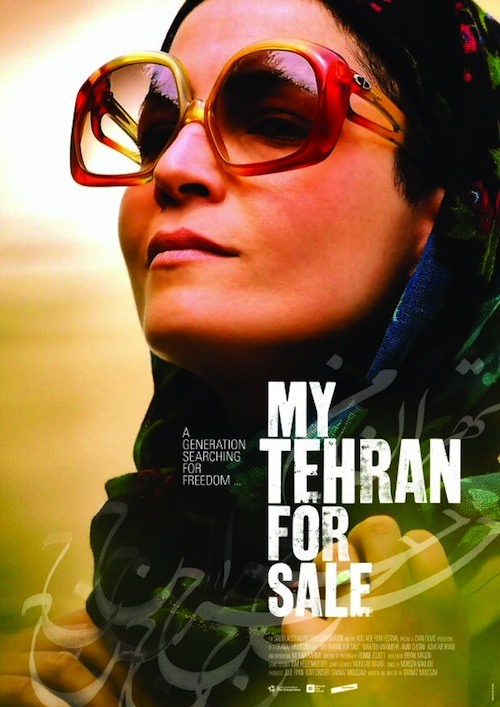
By Joe Bendel. Recently, in response to the categorical rejection of Iranian filmmaker Jafar Panahi’s appeal and the truly barbaric sentence of one year in prison and ninety lashes handed down to actress Marzieh Vafamehr, many prominent Iranian artists (including the great Shohreh Aghdashloo) have called on the world to “boycott official Iranian film and television organizations and sanction its members.” While their outrage is appropriate, the work that caused Vafamehr’s plight should not be thrown out with the bathwater. An important film even before the arrest of its lead actress, the Iranian born Australian-based filmmaker Granaz Moussavi’s My Tehran for Sale (trailer here) recently screened during the inaugural Dialogue of Cultures Film Festival in New York.

In what will become an ever more self-referential turn, Vafamehr plays Marzieh, an avant-garde actress seeking to expatriate because her plays have been banned by the censors. She is well educated, middle class, and ideologically moderate, none of which are much of an advantage in contemporary Iranian society. Navigating the Kafkaesque immigration process for years, Marzieh is hoping to soon liquidate all her possessions to finance her move. Of course, complications arise.

Initially, Marzieh has a bit of good fortune. Attending an underground rave in the countryside with her friend Sadaf, Marzieh happened to be in the stables with Saman, the recently repatriated son of immigrants looking to make his fortune in Tehran. Given the unambiguous nature of their encounter, this scene probably did not help Marzieh’s case. However, the real scandal is the conduct of the morality police, terrorizing women like Sadaf for their unadorned heads.

Quickly Marzieh and Saman become something of an item. Despite his myriad of faults, Marzieh enjoys a somewhat pleasant interlude. Still, grim realities are ever-present in the margins of Sale, represented by a woman committing suicide rather face the disgrace of pregnancy out of wedlock, the whispered news of yet another colleague’s arrest, or simply the general sense of unease surrounding her life. Continue reading LFM Review: My Tehran for Sale

ANNOUNCEMENT: LFM’s Govindini Murty to Blog at The Huffington Post

By Govindini Murty. I’m pleased to announce to Libertas readers that I’ve been invited to blog at The Huffington Post.  I will continue to edit and write for Libertas, of course, but this is a great opportunity to reach a new readership as well.  My first post at The Huffington Post just went up this afternoon, and was featured both on the front page and on the Entertainment page. There’s already a lively debate underway in the comments section, and I hope that Libertas readers will join in.

I’ll be cross-posting select posts so you can read my posts here or at The Huffington Post.

Here’s today’s post:

Sony Makes the Right Decision in Postponing Bin Laden Movie

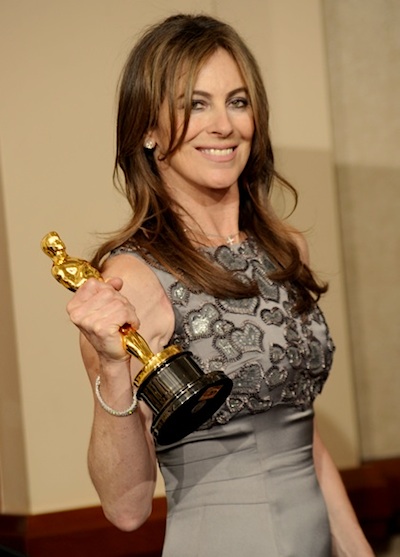
After months of controversy over Kathryn Bigelow’s planned bin Laden movie, Variety has reported that Sony is postponing the release of the film until likely after the 2012 election. This is a wise decision on the part of the studio.

Director Kathryn Bigelow.

Sony’s bin Laden movie had come under a firestorm of criticism earlier this summer when Maureen Dowd wrote in the New York Times that director Kathryn Bigelow and screenwriter Mark Boal had been given special access to information on the bin Laden raid by the Obama White House, and that the film’s planned release in October 2012 was “perfectly timed” to help President Obama with the election. Not surprisingly, Republicans reacted to this news with outrage. Rep. Peter King of New York called for an investigation into the film, and Rep. Lynn Jenkins of Kansas announced plans for legislation titled the “Stop Subsidizing Hollywood Act” to prevent the filmmakers from accessing government information on the bin Laden raid. A movie that should have been a nonpartisan account of a great American victory — the Navy SEAL mission that killed the world’s most infamous terrorist — was in danger of being overshadowed by a cloud of partisan controversy.

The dispute over the bin Laden film didn’t just threaten to undermine the film itself — it also potentially diminished support for a number of other film and TV projects in the works that aim to portray the American military positively in the War on Terror. These projects range from Jerry Bruckheimer’s Navy SEALs TV series for ABC and Relativity’s Navy SEALs movie Act of Valor to movies like Peter Berg’s Lone Survivor and Christopher McQuarrie’s Rubicon that depict Navy SEALs fighting the Taliban in Afghanistan. While liberals in the industry are supportive of these films after the success of the bin Laden raid, conservatives paradoxically have become convinced by the dust-up over Sony’s bin Laden movie that all these other projects must be thinly disguised pro-Obama propaganda as well. (See the comments section of my recent article in The Atlantic, where conservatives responded with skepticism to news of these War on Terror projects.)

As a result, a movie that should have been a unifying depiction of an American victory in the War on Terror has become a political hot potato. Kathryn Bigelow and Mark Boal released a statement in August saying that their film would depict the killing of bin Laden as “an American triumph, both heroic, and non-partisan.” Nonetheless, Sony needed to change the release date to truly show that their bin Laden movie was not intended to influence the election. Continue reading ANNOUNCEMENT: LFM’s Govindini Murty to Blog at The Huffington Post

Dialogue of Cultures International Film Festival: LFM Reviews Transit Cities

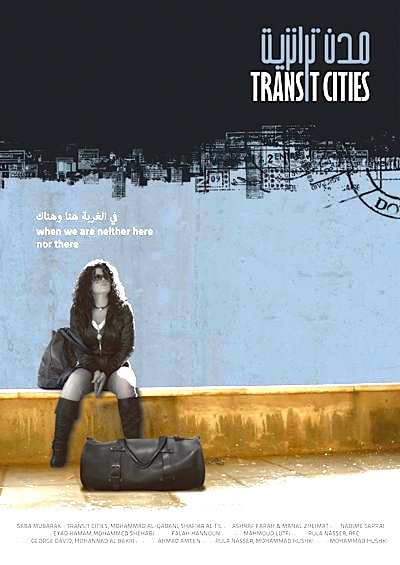
By Joe Bendel. How can a major metropolis simultaneously become larger but less cosmopolitan? Such appears to be the case when Laila Kamel returns to her family home in Amman, Jordan after a long stay in America. Things have changed for the worse in Mohammad Al Hushki’s Transit Cities (trailer here), which has a special one week New York theatrical run in conjunction with the Dialogue of Cultures International Film Festival, beginning today (10/21).

After fourteen years, Kamel returns to Amman a divorced woman. It is a personal failure she is not eager to admit to her family. However, her father is not exactly grilling her for information. Broken by his own disappointments and openly contemptuous of her lifestyle choices, he barely speaks to her. Of course, he hardly speaks to anyone, so acute is his depression.

Much too her surprise, Kamel’s mother and sister now wear the hijab in public. Granted, Amman is not Saudi, but the prodigal daughter is shocked by the radical shift in gender role expectations. Not surprisingly, she has a difficult time acclimating to the “new” Jordan. Nor does she win many new friends disdaining religious hypocrisies, like the practice of charging Murabaha or Islamic interest.

It is more than a bit surprising the state chartered Royal Film Commission Jordan would partner in Transit’s production, yet here it is. Indeed, the film portrays Jordan as a society in regression with a distinctly inflationary economy. In this non-usurious environment, coffee for two in a comfortable café will run you sixty dollars (it must be shade-grown fair-trade). However, if Kamel invites over a man for a long night of wine and reminiscing, it is a scandal.

Saba Mubarak and Ashraf Farah in "Transit Cities."

Saba Mubarak makes a strong impression as Kamel, vividly expressing all her mounting frustrations, resentments, and self-doubts. She is a complex character, who sometimes makes matters worse for a host of contradicting motivations, but is never unreasonably unreasonable. Likewise, Ashraf Farah brings assured nuance to the jaded Rabea, her father’s former young colleague, with whom she shares considerable history the film merely hints at. Together, they develop very intriguing if not exactly romantic chemistry together.

Only Jordan’s second “indie” production, Transit is quite stylishly put together. Though Al Hushki intimately focuses on Kamel, cinematographer Mahmoud Lofty evocatively captures the mood of dislocated alienation, like a Lost in Translation with a point to it all. Traditional in its instrumentation but often sounding relatively modern in its melodic and harmonic approach, Nadim Sarraj’s score also perfectly suits the film’s between-two-worlds themes.

While clocking-in just over the seventy minute mark, Transit is a wholly engaging and satisfying film (though alas, not necessarily an optimistic one). A shrewd choice to serve as the DCIFF’s showcase selection, it screens for a full week in New York at the Quad Cinema starting today (10/21)—and tickets are only $5.00.

Posted on October 21st, 2011 at 2:22pm.