By Joe Bendel. Before Kim Il-sung, mass-murdering megalomania had never been so kitschy. The Kim dynasty’s tyrannous misrule has been marked by imposingly ugly architecture, stilted cinema, and truly bizarre mass “arirang” stadium performances, all of which promoted the so-called Juche Idea, his crypto-Confucian brand of self-isolating socialism. An expatriate leftist South Korean filmmaker takes on the challenge of making Juche propaganda art films for an international audience, when not weeding the vegetable patch of a North Korean arts collective in The Juche Idea (trailer above), Jim Finn’s experimental mockumentary mash-up, now available on DVD.
Before he bravely led the proletariat into the future, the crown prince Kim Jong-il wrote North Korea’s definitive book on film studies. Not surprisingly, he concluded any honest, class conscious film should scrupulously adhere to his father’s Juche Idea concepts. DPRK films tended to be a wee bit formulaic as a result, typically culminating with a tearful self-criticism session and a vow to rededicate one’s self to Communist Party, as Finn illustrates with several clips crying out for the Crow and Tom Servo treatment.
As Yoon Yung Lee, the filmmaker-in-residence, splices together her strange Chuck Workman-like Juche films, the insular nature of the North’s ideology-driven culture becomes inescapably obvious. As soon as any distance is applied to the cheesy visuals and overblown synchronized dance numbers, irony rushes in like air into a vacuum. There is also an unexpected abundance of accordion music to heighten the surreal vibe of it all.
Finn never directly addresses the brutal reality of DPRK concentration camps, intrusive secret police, and widespread famine. As a result, Juche Idea really ought to be seen in conjunction with other North Korean documentaries, like Mads Brügger’s fearlessly subversive Red Chapel, which Lorber Films has also just released on DVD. Unlike the play-it-safe “Yes Men,” Brügger and his colleagues punk a target that wields absolute, unchecked power, on its own turf. You have yet to truly live until you have witnessed a pair of Danish-Korean comedians perform a slapstick rendition of “Wonderwall” for an audience of stone-faced DPRK apparatchik-minders in this mad expose-performance art hybrid.
In contrast, Juche Idea is all about the outrageous over-the-top propaganda serving the Great and Dear Leaders’ personality cults, without any reality-based context. Though it seems hard to miss the joke when a Russian tourist’s loose bowels lead to a lecture on the merits of North Korea’s socialized medicine, some of those protesting downtown might just swallow it whole.
Clearly, Finn is not exactly an underground conservative filmmaker, having also produced the short film Dick Cheney in a Cold, Dark Cell, which should have certainly maintained his standing in the experimental film community. Still, after watching Juche it is clear North Korea is a profoundly scary place, at least by any rational aesthetic standard.
Viewers who missed Brügger’s Chapel in theaters should definitely catch up with it first and then supplement it with Juche’s head-spinning images and sly satire. Though only sixty-two minutes, there are some nice supplements on the DVD, including some deleted scenes, such as a whacked-out Juche comic book given the motion-comic treatment, as well as Finn’s short film Great Man and Cinema, which essentially boils down the essence of Juche Idea to three minutes and forty-nine seconds. Recommended for the ironically-inclined and the propaganda-savvy, Juche Idea and Chapel are easily two of last week’s most notable DVD releases.
On balance I like the look of the film, and the scale of it seems impressive for an indie production. Obviously the cooperation of the military was critical here. My understanding is that Act of Valor began as a documentary-style production about SEAL operations and then gradually morphed into a more conventional narrative – and the trailer certainly has a hybrid, docudrama feel to it. In any case, it looks like something that will be worth seeing in IMAX when it’s released in that format come February of next year.
By Govindini Murty. As our regular Libertas readers know, Jason and I have worked for over seven years to promote a greater diversity of voices in Hollywood. We’ve promoted hundreds of pro-freedom, pro-American, and conservative-friendly films, both through the Liberty Film Festival and the original Libertas blog, as well as the new Libertas Film Magazine. As I’ve said numerous times, we don’t do this because we want Hollywood dominated by conservative political propaganda any more than we want Hollywood dominated by liberal political propaganda. We do this because we care deeply about film and the arts and we feel that having a diversity of voices in our culture is crucial to maintaining the democratic values that make America great.
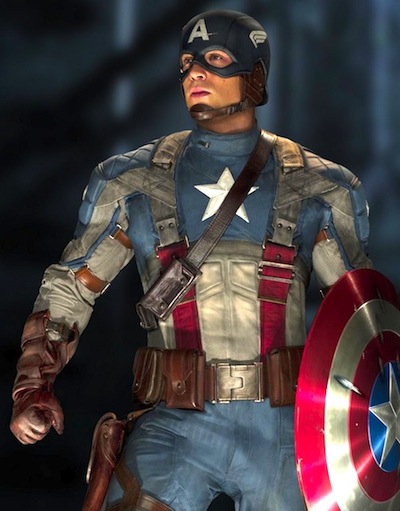
Chris Evans as Captain America.
However, Jason and I have been very concerned over the years by the conservative establishment’s refusal to seriously engage in film and the arts. By “engagement” I don’t mean reviewing a film here or there or supporting the odd conservative political documentary. I mean genuinely and passionately engaging in film and the arts: funding and supporting filmmakers, artists, and creative people, devoting a significant portion of their media platforms to supporting the arts (even when they don’t directly tie into the conservative political agenda), taking real pleasure in creating beautiful, profound, and arresting artworks that imaginatively inspire people. Conservatives have enormous resources at their disposal to have a greater voice in the culture if they want to. That they fail to seriously engage in the culture year after year is deeply troubling. It undermines both the growth of the conservative movement, as well as the vibrancy of our culture, which needs both sides engaged in order to create art and entertainment that represents all Americans.
So, I’ve written a piece in The Atlantic today (see below) that examines the issue of why conservatives are so reluctant to support conservative-friendly films. As our readers know, when Jason and I relaunched Libertas, we were determined to positively promote films and creative artists. We were tired of just complaining about Hollywood. Conservatives have complained about Hollywood for years, and it never seems to accomplish anything. We decided that rather than give the site over to partisan politics and to obsessing over every left-wing Hollywood affront, we wanted to dedicate our time to promoting films and artworks that broadly affirm freedom and individualism. We were inspired by the genuine change we had seen in the film industry in the last two to three years, in which a greater number of pro-freedom films are suddenly being made. There’s plenty of room for hope and excitement, and yet I don’t see this hope and excitement translating into the rest of the conservative world. Conservatives in the media certainly know about these films because they do cover them (often with snarky and dismissive reviews) – they just refuse to take them as a positive sign of change that should be embraced.
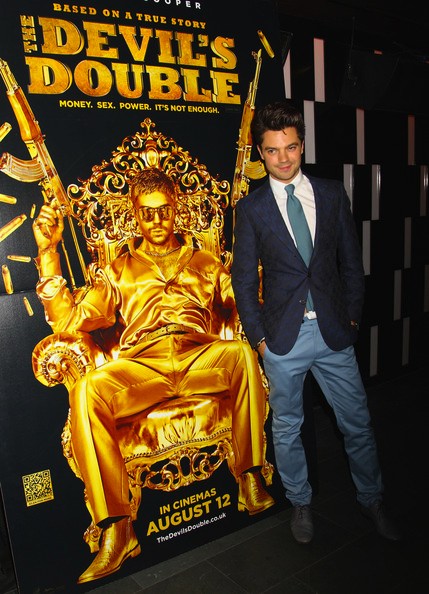
Dominic Cooper promoting "The Devil's Double."
I hope my Atlantic piece (see below) will inspire some honest debate amongst conservatives. I didn’t write a partisan piece – I wrote a piece that objectively deals with the issues as they appear. I truly appreciate all of our conservative, libertarian, independent, and liberal readers here at Libertas who have shown their commitment to supporting the idea of freedom in film. You’re the good ones – you get it. I hope the message spreads to the rest of the public as well, because the culture is too important to be treated as a partisan whipping post. It deserves to be treated honestly, objectively – and always with respect for the artists who create the works that give our culture meaning.
The recent news that MGM’s remake of Red Dawn may finally reach theaters should be reason for conservatives to celebrate. The Los Angeles Timesreports that MGM is in talks to sell Red Dawn to Film District (the company behind Ryan Gosling’s Drive), who will likely release the film in 2012. The original Red Dawn is one of the iconic films of the cultural right. Written and directed by John Milius, the 1984 film depicted a group of plucky teens who fight off a Soviet invasion of the U.S. This new Red Dawn, of which I’ve seen an early cut, features a similarly patriotic storyline—and stars one of Hollywood’s hottest young leading men, Chris Hemsworth (Thor). And even factoring in some controversial re-edits that change the villains from the communist Chinese to the North Koreans, the new Red Dawn seems like exactly the kind of pro-American action fare that should please cultural conservatives.
But will conservatives actually support Red Dawn when it comes out?
After years of feeling burned by Hollywood, today’s conservatives seem reluctant to go to the movies, even to see films promoting their own values. A number of right-of-center-friendly movies have been made in recent years—ranging from big-budget studio fare like the Transformers movies or art-house films like The Devil’s Double, to overtly political documentaries like The Undefeated—yet conservatives have responded with little enthusiasm to such films. Indeed, at times conservatives seem more interested in debating left-leaning works like Avatar or Fahrenheit 9/11 than in supporting movies friendly to their own cause.
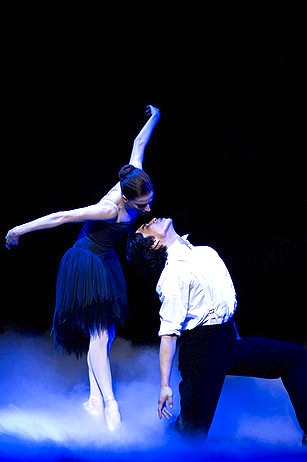
From "Mao's Last Dancer."
Witness the conservative public’s tepid response to two recent films on “conservative” subjects: the movie adaptation of Ayn Rand’s novel Atlas Shrugged, and the Sarah Palin documentary The Undefeated. Both films received extensive media coverage earlier this year. Fox News and the Fox Business Network ran numerous segments on each film (with John Stossel devoting an entire show on Fox Business to Atlas Shrugged), and both films were widely discussed on talk radio and in the print media. Yet when the films were released, they fared poorly at the box office. Atlas Shrugged made only $4.6 million on a reported budget of $20 million, and The Undefeated made only $116,000 on a reported budget of $1 million. Granted, both films received mixed reviews, at best. Nonetheless, as conservative film critic Christian Toto pointed out in a recent Daily Caller article titled “Why don’t conservatives support conservative films?,” the popularity of Rand’s original Atlas Shrugged novel and of Sarah Palin as subject matter should presumably have led to greater enthusiasm among conservatives for these projects. Yet they didn’t.
Stranger still, even when offered more popular or critically acclaimed films, many conservatives still seem reluctant to support them.
For example, a well-reviewed film recently appeared in theaters that offers an implied justification for the toppling of Saddam Hussein’s regime. The Devil’s Double tells the true story of Uday Hussein, Saddam Hussein’s gangster-like son, and his reluctant body double, Latif Yahia. Both roles in the film are played by rising star Dominic Cooper (Captain America), whose electric performance has made him one of Hollywood’s most sought-after leading men. The Devil’s Double depicts the Hussein regime pillaging and demoralizing Iraq’s people—and even includes flattering footage of George H.W. Bush and Dick Cheney. And despite its seemingly right-of-center politics, the film was screened to rave reviews at Sundance, with Roger Ebert even calling it a “terrific show” and praising Dominic Cooper’s “astonishing dual performance.”
>>>Read the rest of the article at The Atlantic here.
Posted on October 12th, 2011 at 5:32pm.
[Editor’s update: Many thanks to Kevin Roderick for mentioning Govindini’s Atlantic piece in his article “Left coast writers splash in the Atlantic” on LA Observed. Kevin runs one of the great LA sites and I urge you all to check it out.]
[Many thanks as well to Michelle Malkin’s Hot Air for linking to Govindini’s Atlantic article. Hot Air is always on top of the most interesting news and analysis, so be sure to check them out.]
[And of course, a big thank you as well to our friend Lars Larson. Lars is one of the best-informed and most articulate talk radio hosts out there (and rapidly rising, with his radio show carried in over 200 markets). Lars posted Govindini’s article on his site and he has always been supportive of Libertas Film Magazine and the cause of freedom in film.]
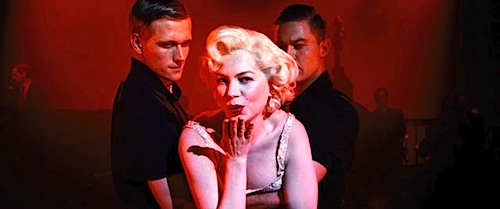
By Joe Bendel. Sir Laurence Olivier and Marilyn Monroe were about to achieve career highpoints in John Osborne’s The Entertainer and Billy Wilder’s Some Like it Hot, respectively. However, the chemistry was somewhat lacking in their one and only film together, The Prince and the Showgirl, tepidly received by critics and audiences alike in 1957. The behind-the-scenes story of their rocky shoot is told from the perspective of a smitten production assistant in Simon Curtis’s My Week with Marilyn (trailer here), the centerpiece selection of the 49th New York Film Festival.
Though to-the-manor-born, young Colin Clark wants to make his own way in the world working in motion pictures. Refusing to take no for an answer, Clark parlays a dubious introduction into a gofer job with Olivier’s production company. Recently knighted, the great actor is planning to direct the American bombshell in a light comedic role his wife, Vivien Leigh, originated on-stage. Unfortunately, when Monroe shows up with full entourage in tow, it is quickly apparent that she’s deeply enthralled by the method school of acting, dubious claptrap Sir Laurence has little patience for.
Despite beginning a healthy romance with Lucy, a wardrobe assistant arguably as attractive as the childlike and frequently doped-up Monroe, Clark falls hard for the famous sex symbol. While not exactly mutual, Monroe starts to rely on the solicitous young man’s emotional support. It all leads to much gossip and quite a bit of ill will on the set.
Bringing an icon back to life.
If Marilyn Monroe truly was a ragingly insecure woman who lived in a pronounced state of arrested development, then Michelle Williams plays her quite well indeed. Though she is already being positioned as an Oscar contender, her Monroe seems to be a blank slate on which the other characters project their desires. Was that all there really was to her? If so, how very sad.
In welcomed contrast, the British ensemble cast, including the likes of Dame Judi Dench, Michael “Foyle” Kitchen, and Julia Ormand (as Leigh, no small part to step into either), plays it to the hilt, bandying about witticisms as if they are in The Bad and the Beautiful, as rewritten by Noel Coward.
Yet, the casting of Kenneth Branagh as Olivier is particularly inspired. Not only does Branagh have the right “classically trained” presence and flair for razor-sharp dialogue, one can see parallels of his own career in that of Sir Laurence. Earning acclaim and the not infrequent comparison to Olivier with his early Shakespearean films, Branagh’s recent career had been somewhat checkered (including a critically drubbed remake of the Olivier vehicle, Sleuth), until scoring an unlikely comeback with Thor. Regardless, he plays the iconic thespian with genuine depth and charisma.
Granted, Week is based on his memoir, but the amount of screen time devoted to Eddie Redmayne’s Clark seems wildly misappropriated, considering the far more interesting actors and great larger than life figures of cinema history that are also assembled in the film. Frankly, his sad eyed, love-struck act quickly gets rather dull. Fortunately, the seasoned veterans like Branagh, Dench, and Sir Derek Jacobi can be relied upon to supply Week with periodic jolts of energy.
Curtis certainly keeps the filmbreezing along nicely, capturing a nice sense of the era along the way. Always pleasant viewing, Week features some wonderfully tasty supporting performances. It just seems to consistently focus on the two dullest people at a banquet of greatness. A case of a film whose sum of its parts is probably greater than its whole, Week screens again tonight (11/12) at the Walter Reade Theater as the Centerpiece of the 2011 NYFF. However, only standby tickets are available, so good luck.
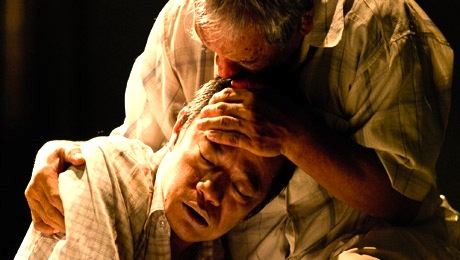
By Joe Bendel. After twenty-five years of incarceration, the recently released ex-con Lin Wen-sheng understands how to take a beating. It is a skill he tries to teach to a gangster’s abused pre-teen in Chienn Hsiang’s Ranger, the powerful concluding film of the San Francisco Film Society’s 2011 Taiwan Film Days.
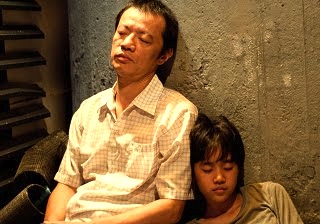
In contradiction of established film noir conventions, Lin did not leave prison looking for revenge or redemption. Having enduring the assaults of rival gangs for a quarter century, he is essentially dead inside. Though the aging crime boss Dragon intends to look after him, Lin is left forgotten in a corner, next to the beaten and battered kid the mobster never wanted.
After a particularly rough beating, Lin takes the child to the hospital. Of course, this necessitates a police report, setting in motion a chain of events Lin will be largely oblivious to. Reluctantly though, he starts to care for the vulnerable youngster, perhaps seeking to make amends for his crimes or to compensate for his estranged relationship with his own father.
Ranger is about as grimly deterministic as a film can get. Yet its view of humanity is not unremittingly pessimistic, showing many small but touching acts of kindness, as Lin marches towards his destiny. Indeed, it blends naturalism and humanism into a strange cocktail that ultimately represents Taiwan and Taiwanese cinema quite well.
From "Ranger."
The winner of the Taipei International Film Festival’s best actor award for Ranger, Wu Pong-fong’s Lin is viscerally intense but scrupulously understated. His work with the film’sadolescent costar is also rather honest and poignant. In fact, Ranger might herald the arrival of a considerable young star in the making, yet the nature of the performance is such that it is difficult to discuss without spoiling a major development.
While periodic flashbacks establish the crushing weight of the past, former cinematographer Chienn Hsiang sensitively helms Ranger, allowing its quiet moments to blossom organically. It is a film that a distributor like Magnolia ought to take a serious look at, since they could position it either for the serious art-house market or as a gritty genre gangster movie. Regardless, it is a very accomplished film. The highlight and fittingly the closing selection of the SFFS’s Taiwan Film Days, Ranger is quite highly recommended when it screens this coming Sunday night (10/16) at the New People Cinema.
By Joe Bendel. Toro’s business is one of the few not feeling the pinch of the financial crisis. He runs a boiler room for telephone and internet fraud. He does it well. It is a much different story for the amateur kidnappers he targets in Wang Chi-tsai’s zeitgeisty dramedy Formosa Mambo (trailer here), the opening night film of the San Francisco Film Society’s 2011 Taiwan Film Days.
A well educated loser, A-kang was amongst the first wave of layoffs at his former company. A terrible interviewee, he cannot even make of go of it as a street vendor, much to his wife’s frustration. However, he gets something of a dubious break when his childhood friend Toro, a.k.a. “Mosquito,” stops at his food cart. He needs a new employee for his scam operations, and has a big deal brewing. He is scheming to intercept the ransom payment demanded by a trio of unemployed migrant workers, who have kidnapped the son of Huang Shu-li, a friend of A-kang’s wife.
Initially, Mambo appears to be one of those slice-of-urban-life films with braided storylines and characters who keep crossing paths but never significantly interacting. Refreshingly though, Wang and co-writer Cai Deng-ciao draw their motley crew together rather quickly and tightly. In fact, after the first act set-up, they no longer rely on coincidence, but karma is definitely knocking on the door.
From "Formosa Mambo."
Mambo is a surprisingly slippery film to get a handle on. At times, it seems to be going for a breezy cynicism, while borrowing elements from disparate films, like Jimmy the Kid and High and Low. Never abandoning the black comedy, it eventually takes a detour through class-conscious naturalism on its way to an ironic punchline. Yet, the way Wang keeps viewers off balance while maintaining the brisk pace is strangely effective.
Chen Yi-wen (a well established filmmaker, not to be confused with the lovely Miss Chinese Taipei), is masterfully roguish as Toro, appropriately delighting in skullduggery, even as he hints at the stirring remnants of a conscience. By contrast, as A-kang, Chu Chung-heng’s guilt-ridden angst routine gets a bit old after a while. Still, he has some nice quiet moments with Jin Siao-man’s Sha-sha, the gang’s staff seductress and computer hacker.
In a way, Mambo is a morality play that forgets to end with a neat and tidy morale. Frankly, it breaks a lot of rules of canned screenwriting, but that is a good thing. Quite clever in an admittedly idiosyncratic way, Mambo is definitely an interesting choice to kick-off this year’s Taiwan Film Days, which has quickly become the top showcase for contemporary Chinese cinema in America (including New York). It screens twice this Friday (10/14) at the New Peoples Cinema, the new home for SFFS programming.
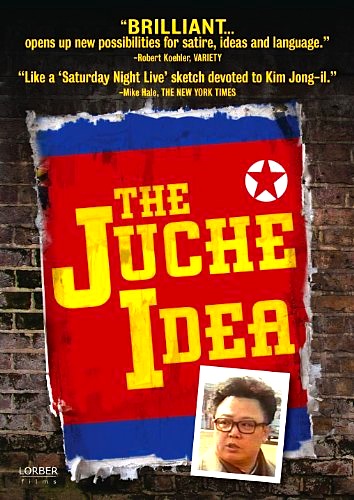 Before he bravely led the proletariat into the future, the crown prince Kim Jong-il wrote North Korea’s definitive book on film studies. Not surprisingly, he concluded any honest, class conscious film should scrupulously adhere to his father’s Juche Idea concepts. DPRK films tended to be a wee bit formulaic as a result, typically culminating with a tearful self-criticism session and a vow to rededicate one’s self to Communist Party, as Finn illustrates with several clips crying out for the Crow and Tom Servo treatment.
 Clearly, Finn is not exactly an underground conservative filmmaker, having also produced the short film Dick Cheney in a Cold, Dark Cell, which should have certainly maintained his standing in the experimental film community. Still, after watching Juche it is clear North Korea is a profoundly scary place, at least by any rational aesthetic standard.