LFM Reviews A Sinner in Mecca @ The 2015 Hot Docs

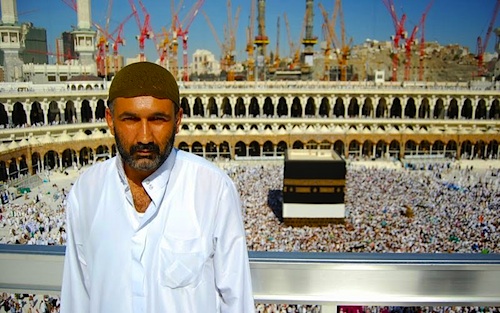
By Joe Bendel. The extra security provided openly gay Muslim filmmaker Parvez Sharma at this year’s Hot Docs is an ominous development, but in a perverse way, the death threats prompted by his latest film constitute a ringing endorsement. Nonfiction-filmmaking does not get much gutsier than Sharma video-documenting his hajj. Frankly, it is a bit surprising the ever-so open Saudi government granted his hajj visa. They probably already regret it, but not for reasons you suspect. Ignore the overheated internet trolling and honestly engage with the issues raised by Sharma’s A Sinner in Mecca when it screens again at the 2015 Hot Docs in Toronto.

Sharma had already been on the receiving end of a minor fatwa, because of his prior documentary on the Muslim LGBT experience, A Jihad for Love. After marrying his partner, Sharma decided to take his hajj, hoping to reconcile his faith with his sexuality. Of course he will secretly document the process. He is a filmmaker. That is what he does. Frankly, nobody is more aware of the potential danger for an internationally recognized LGBT activist in Wahhabist Saudi Arabia than Sharma. He was consciously risking his life to make the film, but he was completely unprepared for the rampant exploitation and abuse all pilgrims must endure.

Critics of Sharma will latch onto his sexuality because they are homophobic (and misogynistic and anti-Semitic), but the real arsenic in the film are the many scenes exposing the Saudi government’s neglect and overt commercialization of Islam’s holiest site, bar none. Tellingly, one fellow pilgrim tells Sharma: “I’m glad they don’t allow non-Muslims, so the Western world cannot see this.”

As Sharma struggles to complete the pilgrimage rituals, he must navigate filthy streets teeming with rubbish, amid what is supposedly a holy and protected city. Unquestionably though, the most disturbing incident comes when Sharma relates a conversation he had with a man whose wife was sexually molested while circling the Kaaba, which Muslims consider to be the first house of worship, constructed by Abraham. Apparently, this is not an uncommon experience.
From "A Sinner in Mecca."

Much of Sinner would be legitimately horrifying, even if Sharma was not constantly worried his true identity might be revealed. That is why the coda in which he declares his faith is renewed feels completely out of place and inconsistent with everything that preceded it. One suspects that Sharma is trying to convince himself for his own personal reasons. We have to respect that, but the footage he covertly shot (on mini-handhelds and his iPhone) speak thunderously.

First and foremost, Sinner thoroughly indicts the Saudi custodianship of Mecca. If you really wanted to be provocative you could argue the global Muslim community would be much better served if Mecca were in Israel, because the Israeli government understands how to respect and preserve artifacts and landmarks associated with other religions (exhibit A: the Dead Sea Scrolls). Regardless, Sharma’s hajj is a very personal act, but his documentation has much greater implications. Bold and stingingly truthful, A Sinner in Mecca is very highly recommended when it screens again tonight (4/30) and Saturday (5/2), as part of this year’s Hot Docs.

LFM GRADE: A-

Posted on April 30th, 2015 at 4:48pm.
LFM Reviews Hyena @ Tribeca 2015

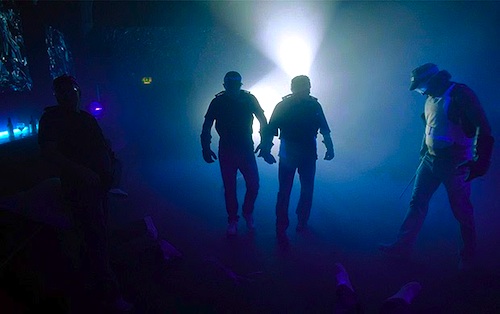
By Joe Bendel. If they hadn’t become corrupt cops, Michael Logan and his team probably would have been football hooligans. Unfortunately, there probably isn’t enough time for the husky louts to go less crooked. Karma will be harsh to some in Gerard Johnson’s Hyena, which opens this Friday in New York, following its U.S. premiere at the 2015 Tribeca Film Festival.

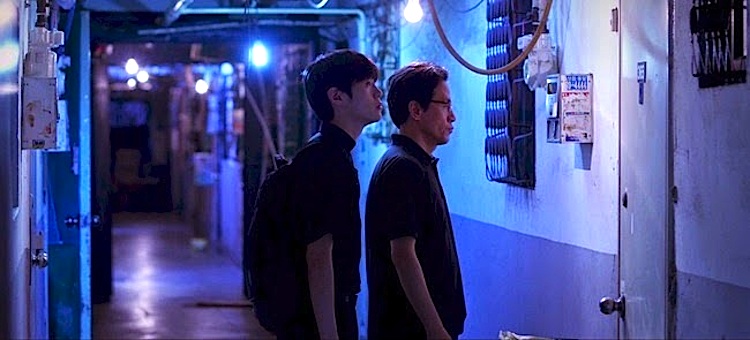
After plundering a large quantity of cocaine in a night club shake down, Logan’s team is in the mood to party. That is often the case, but this time Logan has bigger fish to fry. He has a meeting with his partner in a new Turkish drug trafficking scheme. This is not an undercover operation. It’s an investment. Inconveniently, Logan secretly witnesses the psychotic Albanian Kabashi Brothers murdering his contact. At least Logan manages to secure their first shipment. The Kabashis will be looking for that.

Things will steadily go from bad to worse for Logan. Initially, he tries to forge a temporary working arrangement with the Kabashi Brothers, but nobody believes that will last. He also must contend with an Internal Affairs investigation, while his mates become increasingly erratic and drug-addled. Seriously, how hard could it be to bust these knuckleheads?

From "Hyena."

Yes, we have seen this all before—and we’ve seen it better. The opening sequence is a stylistic tour-de-force, but from there on Gerard is indecisively torn between old school exploitation movies and affected art cinema. To a large extent, you can determine a film’s pretentiousness by comparing the amount of screen time devoted to the back of the protagonist’s head as they grimly trudge onward versus more conventional (and engaging) frontal and profile shots. In Hyena, the ratio is nearly one-to-one, which means tough sledding.

When we can actually see his face, Peter Ferdinando is pretty good as Logan. Likewise, Ben Wheatley regular Neil Maskell is obviously on comfortable ground as Logan’s sleazebag subordinate, Martin. His Kill List co-star MyAnna Buring also brings some verve to the film as Logan’s exasperated girlfriend, Lisa. Inexplicably, cult favorite Mem Ferda is almost completely wasted in what is effectively a cameo as Turkish crime lord Akif Dikman. Like Buddy Sorrell on the old Dick Van Dyke Show, he spends most of his screen time lying on a couch. Yet, he is still cool.

Speaking of Ferda, Hyena obviously follows in the tradition of Luis Prieto’s Pusher remake, but it cannot match the frenetic energy. Johnson tries to compensate with 1970s era pessimism and nihilism, but that gets old after the first act. However, fans of The The will get an nostalgic charge out of their original soundtrack. Not recommended, Hyena opens this Friday (5/1) in New York at the Cinema Village, after screening as a midnight selection at this year’s Tribeca Film Festival.

LFM GRADE: D

Posted on April 29th, 2015 at 11:57am.

LFM Reviews Wonderful World End @ The 2015 San Francisco International Film Festival

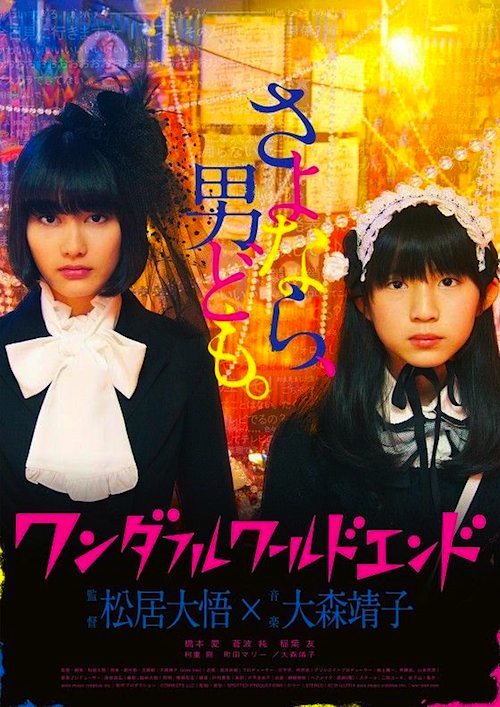
By Joe Bendel. Evidently, you can make a career out of being cute and popular in Japan, but it isn’t easy. Would-be model-actress Shiori Hayano does not have that many followers for her social networking outreach, but she has one undeniable super-fan. Their relationship will be hard to classify, but all kinds of intense (as befits its internet origins) in Daigo Matsui’s Wonderful World End, which screens during the 2015 San Francisco International Film Festival.

Hundreds of people watch Hayano put on make-up and discuss her Gothic Lolita wardrobe, but that mostly just earns her demoralizing work handing out fliers and the odd appearance on dodgy late night talk shows. However, thirteen year old Ayumi Kinoshita thinks she is the living end. Eventually, the shy girl runs away from home, hoping to be near her idol. Hayano’s hipster boyfriend Kohei Kawajima obliges, letting Kinoshita crash at their pad. Initially, Hayano is put off by his presumption, but she soon enjoys the constant adulation. As she tires of Kawajima’s pretensions, Hayano starts to develop a yuri-ish attraction to her younger fan, but it will be rudely interrupted when Kinoshita’s mother tracks her down.

At various junctures Wonderful threatens to turn dark and heavy, but for a film about runaways, it maintains an unusually upbeat mood. In fact, crazy surreal third act developments turn it into a legitimate genre picture, but what genre is anyone’s guess. Somehow, Ai Hashimoto manages to anchor the hyper-real proceedings, neatly balancing Hayano’s pronounced vanity with affecting sensitivity. She is relentlessly endearing, especially as she starts to develop offline human connections. Jun Aonami also looks frighteningly young and vulnerable as Kawajima, while Marie Machida has some strange but compelling moments as her mother.

From "Wonderful World End."

Essentially, Wonderful is a two-hander with Hashimoto assuming the senior partner role. However, veteran thesp Go Riju steals a few scenes as Hayano’s sleazy agent. He almost makes exploitation look quirky and charming—almost. Since her label helped underwrite the production, Japanese alt-rocker Seiko Oomori also gets her feature spots in performances that were also produced as music videos. She is a charismatic live performer who nicely fits the film’s milieu, so her musical interludes do not feel so very out of place.

The vibe of Wonderful veers all over the place, but its energy is consistently impressive. In many ways, it suits the nature of contemporary uber-connected youth culture. Odd but indisputably grabby, Wonderful World End is recommended for fans of jpop and yuri manga when it screens tomorrow (4/30), Friday (5/1), and Saturday (5/2), as part of the 58th San Francisco International Film Festival.

LFM GRADE: B

Posted on April 29th, 2015 at 11:57am.

LFM Reviews 12th Assistant Deacon @ The 2015 Stanley Film Festival

By Joe Bendel. Demonic horror can be profoundly unsettling, but it largely validates a Christian (particularly Catholic) framework of good and evil. After all, William Peter Blatty is admirably serious about his Catholic faith. While it definitely follows in the thematic tradition of The Exorcist, Jang Jae-hyun gives the possession horror story a distinctly Korean identity in 12th Assistant Deacon, which screens during the 2015 Stanley Film Festival.

Father Kim is determined to exorcise the demon possessing comatose teenager Young-shin. If he can liberate her spirit, her body might start responding, as well. Tragically, the demon is particularly cruel and belligerent. Despite his repeated efforts, many of his appointed assistants have been scared off by its mocking torments. Yes, it is safe to say Deacon Choi has more than ten predecessors. To his credit, he has deep faith and can pray in multiple languages, but he too has painful memories the evil one will exploit.

On the surface level, 12th Assistant resembles any number of possession films, but its atmosphere and execution are considerably superior. It gets decidedly tense, but what really sets the film apart is its unequivocal embrace of faith and spiritual resiliency. Father Kim explicitly argues that the darkness they witness necessarily implies the existence of the light. He is quite convincing, in the context of the film.

Park Ji-il is absolutely terrific as the battle-hardened Father Kim. He handles the surprisingly impressive special effects scenes quite well and completely nails his big speech. Likewise, Lee Hak-joo hits all the right notes as the earnest but unprepared deacon.

This is one of the rare films Catholics, Evangelicals, and cult film connoisseurs can enjoy in equal measure. Its depiction of demon-exorcising Catholic clergy is particularly interesting, considering it was produced in South Korea, where Christianity is the largest organized religion. Yet nearly half the country is agnostic and many regard Christianity with suspicion or worse. That thorny dynamic is directly reflected in Father Kim’s complex interactions with Young-shin’s very different parents. It is a serious film, but also seriously scary. Highly recommended for horror fans, 12th Assistant Deacon screens this Friday (5/1) as part of Short Program II, at this year’s Stanley Film Festival.

LFM GRADE: A

Posted on April 29th, 2015 at 11:56am.

LFM Reviews Monty Python—The Meaning of Live @ Tribeca 2015

By Joe Bendel. The surviving members of Monty Python have little use for solicitors and lawyers, no matter how silly their walks might be. They have good reason, measurable in pounds. After fighting a nuisance suit for years, the Pythons found themselves holding a mountain of legal debt. Not getting any younger, they wanted to pay it all off as quickly and cleanly as possible. For Monty Python that meant returning to live performance. Roger Graef OBE & James Rogan document the preparation and behind-the-scenes camaraderie of their resulting sold-out stadium shows in Monty Python—the Meaning of Live, which screened as part of a Python celebration at the 2015 Tribeca Film Festival.

Meaning of Live should not be confused with The Meaning of Life or The Life of Brian (which also screened at Tribeca) and it certainly should not get mixed up with Douglas Adams’ The Meaning of Liff. This is strictly a fan’s eye view of the Pythons at work and in-performance. Fortunately, they are all still pretty funny, so you never know when they are going to unleash some of the old magic.

Yes, this is all about paying tribute and singing along to “Always Look on the Brighter Side of Life.” However, there are some interesting tidbits to be gleaned on the economics of a Monty Python farewell concert. Evidently, it is so costly to rent London’s massive O2 Arena, you really need to play for about a week to get into the black and you will not have the luxury of much tech rehearsing in the actual space. Hence, the Pythons signed on for ten shows. Frankly, they should have just added three or four shows in order to finally finance Terry Gilliam’s Don Quixote.

From "Monty Python—The Meaning of Live."

Yes, even though Gilliam was never much of an on-camera guy, he does his part in classic skits as a full-fledged member. One-for-all, after all. Part of the fun of Live is watching the fun the Pythons are having being together again. That is more than a little fannish, but they’ve earned it. However, there are also a few notable cameos, ranging from the heart-warming (Carol Cleveland once again performing with the randy lads) detouring through the lameness (Mike Meyers taking a pointless walk-on) to the truly surreal (Stephen Hawking singing the “Universe Song” through his computer voice-box).

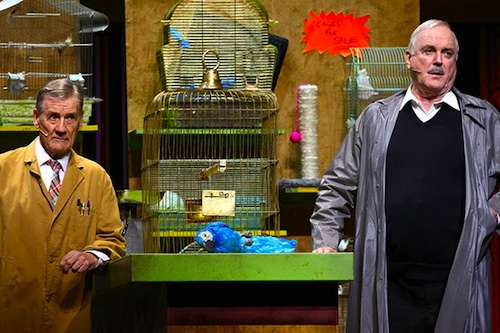
Of course, we also get plenty of bite-sized servings of classic call-backs. The parrot is still dead as a doornail and the lumberjack still likes to dress up in women’s clothing and hang around in bars—and it is all still good stuff. However, perhaps we had better enjoy it while we can. How long will it be before the professional comedy scolds tell us it is inappropriate to laugh at the lumberjack sketch or any of the dozens of other politically incorrect gags in the Python repertoire?

You sort of have to be a fan to appreciate Meaning of Live, but there are plenty out there. More consistent than A Liar’s Autobiography but not nearly as comprehensive and authoritative as Almost the Truth—the Lawyer’s Cut, Live is basically a breezy curtain call, but it will definitely tide fans over until their next absolutely final farewell project. Recommended accordingly, Monty Python—the Meaning of Live screens today (4/28), Saturday (5/2) and Sunday (4/3) at Hot Docs up north, following its international premiere at this year’s Tribeca Film Festival.

LFM GRADE: B

Posted on April 28th, 2015 at 8:37pm.

LFM Reviews (Sex) Appeal @ The 2015 Los Angeles Asian Pacific Film Festival

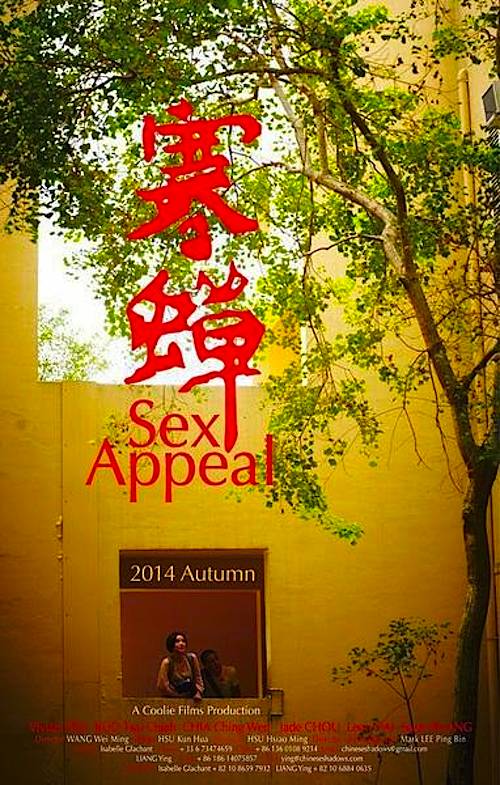
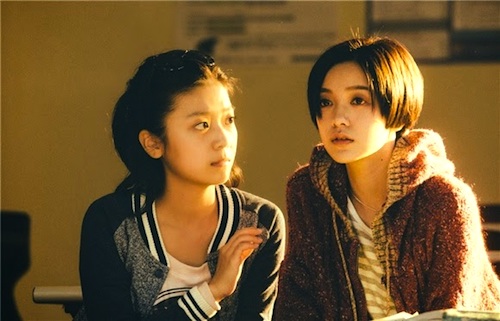
By Joe Bendel. This Taiwanese film fully capitalizes on Taitung’s scenic backdrops and its protagonist is often seen listening to headphones. Superficially, it might look a lot like the popular and critical hit The Most Distant Course, but this is a radically different film. For one thing, the young woman in question is not trying to hear a human connection in mysteriously provided audio recordings. Rather, she is trying to blot out the outside world after suing the popular professor who raped her in Wang Wei-ming’s (Sex) Appeal, which screens tonight during the 2015 Los Angeles Asian Pacific Film Festival.

Even though Pai Hui-hua is from Taipei, she is one of the most innocent new arrivals at her Taitung liberal arts college. On the train, she meets cute with Wang Mu-hung, but she is not convinced he is serious enough for her. Like many freshmen, she is in awe of orchestra director Li Jen-fang, so she understandably accepts his potentially problematic lunch invitations. Unfortunately, Li soon forces himself on her in his office. Confused about her feelings for the married professor and ill-equipped to deal with his behavior, Pai lets the situation continue until she finally attempts suicide.

In a massive conflict of interest, the campus victims’ advocate happens to be Li’s wife, criminal law professor Lin An-ni. Instead of representing Pai, she will essentially prosecute the damaged student when she finally presses charges. Frankly, her attorney is also somewhat problematic. Fang An-yu is something like a Taiwanese Gloria Allred, who has been opposing the university in a murky land use litigation that is never coherently established. She only took the case at the insistence of Pai’s counselor, Wang Wen-hui, a former friend with whom she had a falling out years ago.

Aside from Fang and Wang’s overly melodramatic spats, (Sex) is an unusually mature and challenging drama. Granted, there is never any question Li is guilty, but it vividly demonstrates how ordinary human weaknesses can be exploited after the fact. Pai becomes a victim several times over, pushing away Wang Mu-hung (whom viewers become rather attached to), because that is the sort of thing that happens in such situations.

From "(Sex) Appeal."

Those who primarily know Amber Kuo from the Tiny Times franchise will be floored by the power and vulnerability of her performance as Pai. She has some tough scenes with no place to hide, but she forces the audience to watch and feel her torment. Likewise, Vivian Hsu is terrific as Fang, at least when she is not clawing with counselor Wang. Yet, it is TV star Yuan Huang’s Wang Mu-hung who serves as the conscience of the film. His sensitive portrayal makes it impossible to dismiss (Sex) as some sort of anti-male polemic. Indeed, it is about a host of unequal power relationships, starting with teachers and students, but also incorporating the popular versus the unpopular and the well-connected versus the socially marginalized.

(Sex) features some very big names (Kuo and Hsu) working at the top of their games. It is hard to watch at times, but it deftly reflects the manner in which insanity is apt to run unchecked through university campuses. Highly recommended, (Sex) Appeal screens tonight (4/28), as part of this year’s LAAPFF.

LFM GRADE: A-

Posted on April 28th, 2015 at 8:37pm.