LFM Reviews Greatest Catch Ever @ Tribeca 2015

From "Greatest Catch Ever."

By Joe Bendel. The sports media loves to depict New England Coach Bill Belichick as a football genius and the New York Football Giants’ Tom Coughlin as an anachronistic disciplinarian. However, Belichick has an O and 2 record against Coughlin in the Super Bowl, so the New York coach must be an even smarter genius. Of course, Coughlin had help from some spectacular play-making. None stands out more than David Tyree’s one-handed leaping grab to keep the Giants’ fourth quarter go-ahead scoring drive alive. That 2008 Super Bowl catch is chronicled, analyzed, and celebrated in Spike Lee’s documentary short, Greatest Catch Ever, which screened Sunday as part of a special ESPN Sports Film Talk at the 2015 Tribeca Film Festival.

Spike Lee was watching Sports Center one night when he heard Tom Brady describe a teammate’s snag as the best he’d ever seen. That stuck in Lee’s craw and ultimately resulted in this short documentary. The format is simple. Lee interviewed the principle Giants players, in their practice facility, with their Super Bowl XLII and XLVI championship banners ever so conspicuous. Tyree, Coughlin, Plaxico Burress, Eli Manning, and linesman Chris Snee leave the trash-talking to Lee, but he is happy to fill that void.

However, Lee finds ways to open up the film a little, including traveling to the home of former New England safety Rodney Harrison, who is the Bill Buckner of the famous catch. He also compares and contrasts Tyree’s grab with subsequent Giants highlight catches superhumanly pulled in by Mario Manningham and Odell Beckham, Jr.

From "Greatest Catch Ever."

It is amazing how right Lee is on sports and how wrong he gets nearly everything else. Like Alex Gibney, he should pretty much stick to sports docs (or Scientology exposes, if he wants a real challenge). He was amusing ripping on Belichick both in the film and during the post-screening panel discussion. Yet, to Lee’s credit, he generously gave credit in turn to Harrison, for agreeing to face his ghosts on camera. Tyree, Burress, and Snee were also present, looking fit, and clearly enjoying the opportunity to reminisce and needle each other.

Even Giants fans will be surprised how many stories were intertwined with the big catch (depicted via stills, due to NFL Films’ difficulty playing nice with others). Christians in the audience were especially moved by the role Tyree’s faith played in the famous play. At about half an hour, Greatest Catch Ever always feels brisk and muscular—and never padded. In fact, one suspects Lee could have easily expanded it to forty-five minutes without repeating himself. Altogether, Tribeca’s presentation was a highly enjoyable trip down memory lane. New York Football Giants fans will love it when it eventually airs on ESPN, but the network’s Belichick apologists probably not so much.

LFM GRADE: B+

Posted on April 21st, 2015 at 2:26pm.
LFM Reviews Palio @ Tribeca 2015

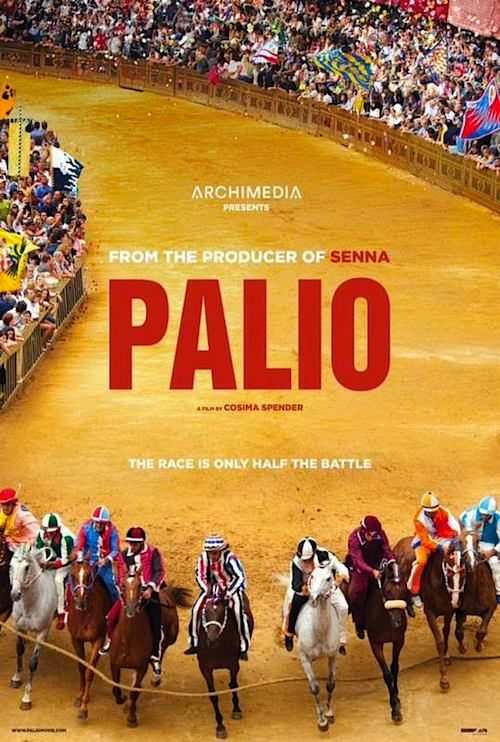
By Joe Bendel. The world’s oldest continuous horse race is a full contact, bareback spectacle. The rules seem perversely designed to maximize acrimony and anarchy—and the good citizens of Siena’s seventeen districts would not have it any other way. Viewers experience all the longstanding personal rivalries and district grudges fueling the summer tradition in Cosima Spender’s amazing documentary Palio, which screens during the 2015 Tribeca Film Festival.

If you live in Siena, you identify with your district, rather than the city as a whole. Since at least the Fourteenth Century, they have held some form of the Palio di Siena. Every July 2nd and August 16th, the districts compete in a horse race staged in the ancient Piazzo del Campo. There are no saddles and essentially no rules. Jockeys are free to bash each other and their horses black and blue. However, unlike every other horse race in the world, if a jockey is knocked off his steed, the riderless horse can still win. Current dominant Palio champion Gigi Bruschelli notched a victory that way, which his many critics are quick to belittle.

Bruschelli has amassed thirteen Palios in sixteen years. He has his sights set on Andrea “Aceto” de Gortes’ record of fourteen Palios. However, the Palio legend has formed an unlikely alliance with his former nemesis, Silvano “Bastiano” Vigni, who is training Bruschelli’s one-time protégé Giovanni “Tittia” Atzeni to unseat his old stable-master.

You might think you know horseracing from going to the Aqueduct, but the Palio is a completely different kettle of fish. Spender and cinematographer Stuart Bentley caught some absolutely jaw-dropping, up-close footage of horses crashing into the barrier wall and then careening back into the race. You can see the horses sweat and the men snarl. If you were to witness a Palio-style pile-up at an American track, you would expect to see the vet walk out with a shotgun. Yet, in Siena, everyone just shakes it off.

Yes, cornering is a bit of a challenge at the Palio, but perhaps even more mind-blowing, pay-offs and log-rolling are generally accepted parts of the game. It is common knowledge the other riders from Bruschelli’s stable are looking to cover his back, unless another district makes them a better offer. As a result, the behind-the-scenes intrigue is even more important than the action on the track.

Not so surprisingly, there is probably more trash-talking in Palio than any other sports doc one can think of. Like betrayal, it is a big part of the game. The old salty dogs Aceto and Bastiano are particularly good at it. Listening to them excoriate Bruschelli and needle each other is wickedly amusing. Yet, if you think they are harsh, wait till you hear some of the districts’ chants.

In many ways, the Palio is like stepping into the late Middle Ages. Visually, Spender’s Palio is a rich feast of chaos and color, vividly capturing all the traditional pomp as well as the bedlam on the track. There are real stakes to the narrative she chronicles and genuine roguish charm to her cast of characters. A documentary on Italian horseracing might sound like a decidedly specialized subject, but Palio is readily accessible and endlessly intriguing, in a stranger than fiction kind of way. In fact, it is so entertaining, it is even worth the time and hassle it takes to get to the Regal Battery Park. Highly recommended, Palio screens again Wednesday (4/22) and Saturday (4/25), as part of this year’s Tribeca Film Festival.

LFM GRADE: A

Posted on April 20th, 2015 at 4:41pm.

LFM Reviews 24 Days

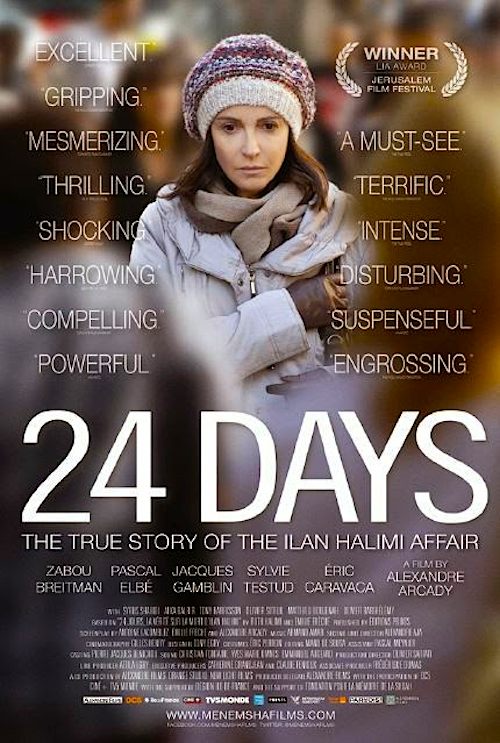
By Joe Bendel. The savage Charlie Hebdo shootings only just happened on January 7th of this year, but one can already feel complacency re-settling back in, predictably like the turning of the seasons. After all, it was not without recent precedent. The kidnapping and torture of Ilan Halimi was a hate crime that shocked France, but only too briefly. Taking the subsequent book written by Halimi’s mother Ruth as his source material, Alexandre Arcady chronicles the tragic events step-by-chilling-step in 24 Days, which opens this Friday in New York.

Ilan Halimi was a likable young man, who was always close to his mother and sister, but was also rebuilding his somewhat strained relationship with his divorced father in the months leading up to his abduction. Although he simply worked at a cell phone store, a Muslim gang operating in both Paris and Ivory Coast deliberately targeted him because he was Jewish. In their hatred, they assumed all Jews had money. Alas, the Halimis were rather lower middle class with little ready cash on hand. Therefore, they had little choice but to alert the police.

The police’s secret involvement will be both a curse and a blessing. Initially, the negotiator advising Ilan’s father Didier as the family’s chosen representative is somewhat helpful reducing the unrealistic 450,000 Euro ransom. Tragically though, the police’s refusal to acknowledge the anti-Semitic nature of the crime leads to a fundamental misunderstanding of the “Gang of Barbarians,” as the abductors called themselves.

Considering how easy it is to google Ilan Halimi, it is not much of a spoiler to say the case ends quite dreadfully. However, Arcady maintains a great deal of suspense, as the horror and outrage steadily mount. Yet, this is not a propagandistic passion play. Arcady and co-writers Antoine Lacomblez and Emilie Frèche prefer to focus on resulting emotional toll the ordeal takes on the Halimi family. It is not just limited to his nuclear family either. With the police tightly controlling Didier Halimi’s contact with the kidnappers, the Gang of Barbarians expand their game of psychological terrorism, sending unspeakably graphic photos of Ilan to his cousin and rabbi.

Zabou Breitman viscerally expresses the anguish and sorrow of Ruth Halimi, but it is the quieter, more understated work of Pascal Elbé that will truly haunt viewers over time. Likewise, Jacques Gamblin dials it way down as Commandant Delcour, a sort of problematically politically correct version of Harry Baur’s soul-deadened Maigret. Within the large and diverse supporting ensemble, Audrey Giacomini stands out as Halimi’s terrified pseudo-girlfriend (understandably so, since by grabbing Ilan, the kidnappers also had her flat keys).

24 Days will turn your stomach into ice-water. It is a tense, often brutal white-knuckle ride from start to finish. However, it is important to understand, Arcady and his co-writers somewhat water-down the torments inflicted on Halimi, probably because it would be impossible to release anything remotely accurate in mainstream French theaters. Nevertheless, what we do see is profoundly disturbing.

Frankly, this film speaks for itself, if audiences are willing to listen. Unfortunately, French politicians prefer to pander for “multi-cultural” votes rather than really facing the root causes of the precipitous rise of anti-Semitic violence. Sadly, it is probably only a matter of time before another Charlie Hebdo-Ilan Halimi style attack. Very highly recommended as a masterful work of cinema and an impassioned warning for those who value tolerance and the rule of law, 24 Days opens this Friday (4/24) at the Quad Cinema in Manhattan and the Kew Gardens Cinemas in Brooklyn.

LFM GRADE: A

Posted on April 20th, 2015 at 4:41pm.

LFM Reviews Gored @ Tribeca 2015

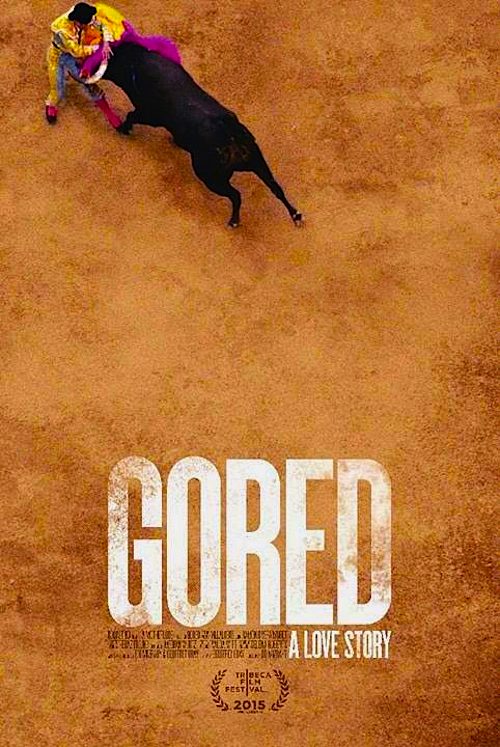
By Joe Bendel. If you have read your Hemingway nonfiction, you know aficionados identify with two types of matadors. There are the naturals who just exude elegance in the bullring and there are the pluggers who lack that innate grace, so they display exceptional courage to win over the crowd. Having been on the receiving end of the bulls’ horns twenty-three times, there is little question what kind of bullfighter Antonio Barrera happens to be. For the sake of his wife and family, the gutsy Barrera is finally retiring, but he will first face one last bull in Ido Mizrahy’s Gored, which screens during the 2015 Tribeca Film Festival.

Any time a bullfighter steps into the ring, the stakes are high, regardless of the circumstances. Arguably in this case, Barrera has already pushed his luck, about twenty-two times. As a family man, he has a lot to lose. Yet, like any athlete, he wants to go out on his terms. However, anyone expecting the ginned up suspense and bombast of NFL Films productions (“but for Barrera, there would be another day”) will be thrown by Mizrahy’s change-up.

Gored is a surprisingly quiet and contemplative film. At its finest, Gored vividly coveys the importance of tradition, pageantry, and honor for the increasingly beleaguered sport. However, for those who do not follow bullfighting with the ardor of an aficionado, a little less direct cinema observation and a little more context would have strengthened the overall viewing experience. Apparently, a great deal of the work for Spanish bullfighters like Barrera is now found in Mexico. Although still legal in most of Spain, the Catalonian ban is an ominous portent for the sport’s future. It would be enlightening to hear Barrera’s thoughts on the matter, but Mizrahy maintains a scrupulously intimate focus throughout.

Regardless, it is impossible to get bored, or take anything for granted once Barrera steps into the ring. He comes across as an earnest and surprisingly responsible individual, despite all those gorings. He allows Mizrahy in during some remarkably unguarded moments, letting the audience to see all many of his scars and even more of his vulnerabilities.

Without question, Gored gets the nod for best title at Tribeca. While nowhere remotely as sensationalistic as it sounds without context, it still delivers some tense moments. Thanks to Hemingway and Bizet the very notion of bullfighting summons all sort of romantic images, so it is nice to have some of the behind-the-scenes realities and very personal backstories recorded for posterity. Recommended for aficionados, Gored screens again Tuesday (4/21) and next Saturday (4/25), as part of this year’s Tribeca.

LFM GRADE: B-

Posted on April 20th, 2015 at 4:41pm.

LFM Reviews A Faster Horse @ Tribeca 2015

By Joe Bendel. It is a scrappy underdog story, whose hero is the world’s oldest automotive company. Granted, old Henry Ford was a hard cuss to love, but at a time when we lucky taxpayers were underwriting all of its competitors’ bad decisions – and Detroit, the seat of the nation’s auto industry, was declaring bankruptcy – it was hard to root against the Ford Motor Company. Not only did they refuse government bailout money, they announced an ambitious redesign of their signature vehicle, the Mustang, to be released in time for its fiftieth anniversary. It will be Chief Program Engineer Dave Pericak’s task to ensure the new Mustang is both innovative but also true to the beloved car’s tradition. David Gelb follows the process from drawing board to dealer lot in A Faster Horse, which screens during the 2015 Tribeca Film Festival.

Yes, Steve McQueen drove a Mustang in the eternally cool Bullitt chase scene. Yet, the Mustang was conceived as a high performance car that was affordable for middle class consumers—a classically American concept if ever there was one. However, it was not so easy convincing Henry Ford II, who was still smarting from the Edsel. Horse gives full credit to then Ford exec Lee Iacocca for his role in championing the Mustang. Gelb also nicely captures the love and esteem many Mustang enthusiasts and motor clubs have for their car of choice.

Nonetheless, most of film follows the design, testing, and manufacturing process. Frankly, it is refreshing to see a film that values commerce and industry. Gelb is also fortunate that most of the Ford team are enthusiastic and rather eloquent. After all, they are all delighted to be working on the pride of the company’s fleet. Whether you are in engineering or marketing, everyone at Ford wants to work on the Mustang—and if you work at General Motors, you want to be at Ford.

From "A Faster Horse."

Clearly, there are real stakes at play in Horse. However, Gelb does not merely bury his lede, he covers it in cement and drops it in the East River. The GM and Fiat Chrysler bailouts and Detroit’s economic woes are briefly mentioned at the start of the doc, only to be neatly swept under the rug. Given the situation, the guts and vision of the Mustang redevelopment project were rather remarkable.

Not to be spoilery, but Horse ends on a wholly satisfying note. Let’s be honest, there is a reason Gelb’s film is about the Mustang instead of the Camaro. It is more-or-less the same reason Ford has outperformed its subsidized rivals. Fifty years from now, you will probably still be able to get your Mustangs serviced. Had it been less timid in exploring the full economic and political context of the fiftieth anniversary redesign, Horse could have been a truly great documentary. As it stands, it is highly watchable and a nice change of from the typical demonization of the auto industry. Recommended for car fans and viewers fascinated by processes, A Faster Horse screens again tonight (4/20), Thursday (4/23), and Saturday (4/25), as part of this year’s Tribeca Film Festival.

LFM GRADE: B

Posted on April 20th, 2015 at 4:40pm.

LFM Reviews Listen @ Tribeca 2015

By Joe Bendel. If you think the burqa is empowering, try wearing one for a week in August. Then try reporting your violent and sexually abusive husband to the local police, despite not speaking the local language. A translator ought to help, especially a woman, but reality will be tragically different for the battered wife in Hamy Ramezan & Rungano Nyoni’s short film Listen, which screens as part of the Interferences programming block during the 2015 Tribeca Film Festival.

She cannot speak Danish and she cannot remove her burqa. She has fled her home, taking only her young son with her, hoping and expecting the Danish police will provide shelter. However, she never anticipated the interpreter would deliberately mistranslate her pleas. The translator is also a woman, but clearly she considers herself an Islamist first and foremost. She duplicitously tells the police the woman is seeking divorce advice, whereas she tries to convince the increasingly desperate woman to trust her imam to resolve her marital troubles.

It takes about five seconds to understand just how isolating and alienating the burqa truly is. Had her face been visible, her expressions and her bruises would have told the cops what the interpreter deliberately mistranslated. Listen is a relatively short thirteen minutes, but Ramezan & Nyoni still patiently take their time, showing the initial police interview from each party’s perspective, to fully establish the tragic significance of the situation.

From "Listen."

Although we never see her, Zeinab Rahal’s body language still constitutes a harrowing performance. Just think how good she could be unshackled from the burqa. Likewise, Amira Helene Larsen discomfortingly projects the assurance of a blind believer. Nanna Bottcher also nicely hints at the police woman’s nagging suspicions, but Alexandre Willaume’s knuckle-dragging police man is film’s only real caricature.

As a strong follow-up to Ramezan’s previous solo short film, Keys of Heaven, Listen forcefully announces it is time for the Finnish-Iranian filmmaker to graduate to full features. Its treatment of issues facing Muslim women is both stinging and sensitive. Highly recommended as an eye-opener with serious dramatic chops, Listen screens again as part of Tribeca’s Interferences short film program today (4/20), Friday (4/24), and Saturday (4/25).

LFM GRADE: A

Posted on April 20th, 2015 at 4:39pm.