LFM Reviews The Fool @ The 2015 New Directors/New Films

By Joe Bendel. The assassination of Boris Nemtsov is yet another example of how tragedy continues to mysteriously befall critics of the Putin regime. Although Putin’s name is never mentioned in Yuriy Bykov’s latest film, his friends should keep a close eye on him. Bykov unambiguously indicts the corruption and lawlessness of Putin’s Russia, but he goes even further than Andrey Zvyagintev’s Leviathan, condemning the complacency and complicity of the average citizenry that allows such abuses to continue unchecked. Viewers will find Bykov’s The Fool is a bitter cocktail with a powerful kick when it screens during the 2015 edition of New Directors/New Films.

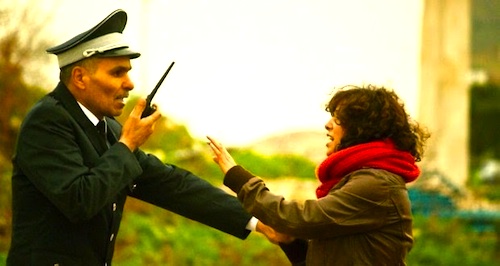
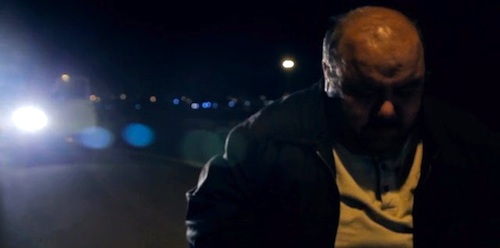
Dima Nikitin is a plumber, but he is studying structural engineering in hopes of securing a promotion in the municipal works department. His wife finds his efforts ridiculously naïve, because everyone knows such matters are arranged through pay-offs. Yet, he continues nonetheless. Called to cover for a drunken worker in a dilapidated housing project just outside his district, Nikitin has the training to recognize the tenement is on the verge of collapse. There is a huge fissure running up on side of the listing building on down the other. The foundation is literally crumbling and the ground has shifted beneath it. Concerned for the fate of the 820 residents (and what unsavory tenants they are), Nikitin takes the matter directly to the civic council, which has conveniently assembled to celebrate the birthday of corrupt Mayor Nina Galaganova.

Of course, nobody wants to hear what Nikitin has to say. Where did all the money earmarked for the complex’s maintenance go? After the mayor got her cut, it paid for a lovely house for the daughter of public housing manager Fedotov, as well as an apartment in Moscow for his thuggish son. Nevertheless, when Nikitin takes Fedotov and the fire chief out to the building, they are forced to acknowledge the urgency of the situation. The politically inexperienced Nikitin takes Galaganova at her word when she agrees to evacuate the building, but her shady advisors have different ideas.

Despite its explicit commentary on Putin’s Russia, The Fool works as a ticking clock thriller on two levels. We experience the suspense of whether Nikitin and his reluctant allies be able to start the evacuation before it is too late, while simultaneously worrying he will go the way of Nemtsov and Anna Politkovskaya for his efforts. This being Russia, it is hardly spoilerish to say the answer will be blackly ironic.
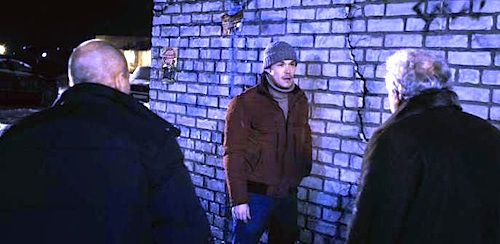
From "The Fool."

Due to its dourly naturalistic vibe, the grit and depth of the performances in The Fool sort of sneak up on the audience, but their resonance lingers. Artyom Bystrov elevates Nikitin far beyond a workaday everyman or symbolic victim. He is an anguished and self-aware Quixotic figure. Likewise, Boris Nevzorov and Kirill Polukhin are absolutely riveting as the knowingly compromised Fedotov and the fire chief. Alexander Korshunov adds tragic heft as Nikitin’s futilely principled father, the block from which he was chipped, but Olga Samoshina and Darya Moroz are rather one-dimensional as his relentlessly shrewish mother and under-developed wife.

Perhaps Bykov gives us a tad too much of Nikitin’s family drama, but his long dark night of soul is completely engrossing and profoundly alarming. Bykov lets nobody off the hook, least of all the mean, petty, loutish, and entitled tenants Nikitin is trying to save. Clearly, they are almost as much of the problem as Galaganova, but that is hardly the sort of message the state-controlled Russian media is likely to trumpet. Very highly recommended, The Fool screens this Thursday (3/19) at MoMA and Saturday (3/21) at the Walter Reade, as part of this year’s ND/NF.

LFM GRADE: A

March 17th, 2015 at 9:36pm.
LFM Reviews The Challat of Tunis @ The 2015 Socially Relevant Film Festival

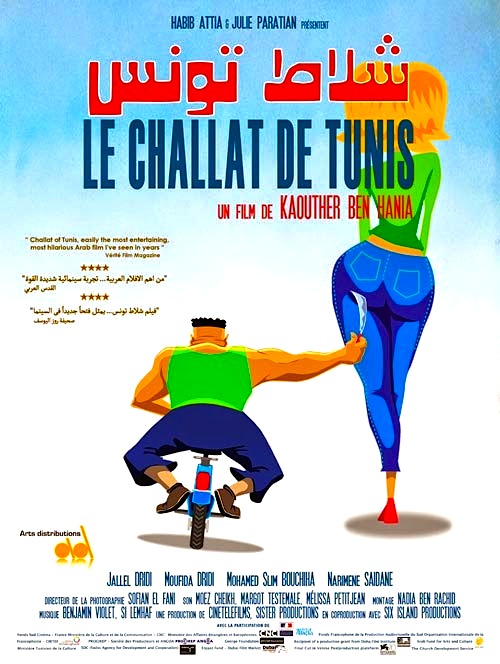
By Joe Bendel. There is plenty of mock in Kaouther Ben Hania’s hybrid-doc, but the attitudes it depicts are embarrassingly real. In 2003, an unknown assailant drove through the streets of Tunis, slashing the buttocks of women who were not sufficiently “modest” in their dress. One Arab Spring revolution later, the so-called Challat is still regarded as a cult hero by a significant number of Tunisians—all male and Muslim, of course. Ben Hania set out to find the slasher in a traditional documentary, but official road blocks forced her instead to make a true-in-spirit examination of the Tunisian national character in The Challat of Tunis, which screens during the 2015 Socially Relevant Film Festival.

At least eleven women were attacked by the Challat. The “at least” caveat is important, because the Tunis police do not exactly encourage reports of sexual violence. If you suspect they might blame the victim, you don’t know the half of it, but Ben Hania saves their real life testimony for the final act. Most of the narrative is devoted to her semi-fictional pseudo-Michael Moore style search for the unpunished perpetrator. Circumstantial evidence points to an unemployed misogynist named Jalel Dridi, who adamantly takes credit for the slashings. Initially, he is quite convincing, but Ben Halia eventually starts to doubt some of the details of his story.

Let’s not sugarcoat it. There is something deeply pathological about a society in which people want to be known as violent criminals who prey on women. Dridi might be a fraud or an actor in a put-up job, but there are plenty of men-in-the-street responses to him that speak volumes about Arab Muslim attitudes towards women. For instance, one imam endorses his Challat video game, because it grants points for slashing disrespectfully dressed women, while deducting from players’ scores if the assault women in suitably oppressive garb.

From "The Challat of Tunis."

Some of the comic bits are better developed than others, but they all reflect highly problematic social iniquities and double standards. Ben Halia even shows an aptitude for broad Apatow style comedy when Dridi buys a “Virgin-o-meter” to test his unlikely new girlfriend. However, the film really knocks the wind out of the audience when Ben Halia dispenses with her hyper-real narrative to interview two of the Challat’s extraordinarily brave victims on camera. Their stories of lingering physical and emotional pain, as well as the humiliation they experienced at the hands of the police, make the blood run cold.

There are a wealth of telling moments to be found in Ben Halia’s street interviews, such the unusually candid coffee house patron who initially argues Muslim prejudices for the attacks, but walks it back as an “Arab” thing when his cronies object. Clearly, nobody (no man) in Tunisia wants to forthrightly deal with Challat attacks and the lasting cultural effects, which is why Ben Halia’s film is such a bold poke in the eye. It has some odd moments, but there is always method to her madness. Strongly recommended, The Challat of Tunis is by far the feature highlight of this year’s SRFF when it screens this Thursday (3/19) at the Tribeca Cinemas.

LFM GRADE: B

Posted on March 17th, 2015 at 9:35pm.

LFM Reviews The Unclean @ The 2015 Socially Relevant Film Festival

From "The Unclean."

By Joe Bendel. Incidents of Muslim cab drivers refusing service to blind passengers with guide dogs made headlines in Minneapolis and Saskatchewan, but the resulting hand-wringing would have baffled Iran’s theocrats. Dog ownership is forbidden in Iran (under pain of 74 lashes), because canines are considered “unclean” accordingly to Islamist teachings. However, it is not as if dogs no longer exist in Iran. Sadly, when a decent henpecked Iranian husband accidentally hits a stray with his car, it causes a moral dilemma he is powerless to resolve in Bahram & Bahman Ark’s short film, The Unclean, which screens during the 2015 Socially Relevant Film Festival.

Naser probably never had a hope of seeing the poor dog as he was driving home through Tehran’s poorly illuminated streets, but he sure felt the sickening bump. Not the type to hit-and-run, Naser bundles up the bloodied animal and somehow manages to get him to a veterinary clinic. Unfortunately, it has no in-patient facilities, leaving Nasr two choices. He can either have the dog put down or he can have him treated, but he would have to find a safe place for him to recuperate. Obviously, his gossip-sensitive wife will never allow an unclean animal in the house. Nor will his anyone else in his limited circle of acquaintances.

As his namesake, Naser Hashemi’s performance is absolutely devastating, in a quiet, unassuming sort of way. He straightforwardly and viscerally conveys the anguish of an everyman who tries to act humanely, but is undermined by ideology and circumstance, yet will carry the resulting sense of guilt nonetheless. Frankly, this film is a tragedy for both man and dog.

Unclean might sound relatively small in scope, but it makes a powerful statement. The film’s low-fi nocturnal look also rather appropriately fits Naser’s long dark night of the soul, giving viewers a sense of how menacing the streets of Tehran can feel during the late night hours. It is the sort of film that hits you on a gut level, but it might be too much for sensitive dog people to take.

There is also quite of bit of harrowing imagery in the festival’s other Iranian short, but Yahya Gobadi’s animated Tears largely decontextualizes the time and place, making it more of a timeless fable. Nevertheless, it depicts the traumas of war quite vividly through the eyes of a child (who gets little help from the surviving adults around her after her parents are killed in a bombing raid).

Stylistically, the animation of Tears is somewhat akin to the more grounded passages of The Wall. Visually, it is distinctive, but Unclean is a far more personal and directly immediate film. Highly recommended, Unclean screens Sunday afternoon (3/22) at the Quad Cinema and the well-meaning Tears screens this Friday (3/20) at the Tribeca Cinemas, as part of short film programs at the Socially Relevant Film Festival.

LFM GRADE: A

Posted on March 17th, 2015 at 9:35pm.

LFM Reviews Plundering Tibet @ 2015 Socially Relevant Film Festival in New York

By Joe Bendel. This film was made possible by Google Earth and made necessary by the Chinese Communist Government. Most people of good conscience understand that the occupying Chinese powers have sharply curtailed Tibet’s political and religious freedoms. However, the extent to which state-backed enterprises are currently despoiling the Tibetan environment remains a largely under-reported story. Canadian filmmaker Michael Buckley concisely and cogently exposes this systematic abuse in the short documentary Plundering Tibet, a selection of the upcoming 2015 Socially Relevant Film Festival in New York.

Obviously, it is difficult to gain access to Tibet, especially if you have a history of speaking out against the Communist occupation (and if you don’t, perhaps you should ask yourself why not?). Even for those already within the country, many of the pertinent sites are forbiddingly remote. That had provided them a measure of protection, but with advances in technology, Chinese consortiums are now better able to access and extract remote mineral reserves. In many cases, like the recently discovered lithium deposits, the rapidly escalating value of Tibet’s natural resources now more than covers the cost and effort involved in their appropriation.

From "Plundering Tibet."

Needless to say, Tibetans receive no compensation from such plundering. That would be bad enough, in a conventionally venal way. However, Tibetan Buddhism celebrates the divine in the natural world and specifically recognizes many of these sites as sacred holy places. This is not simply exploitation. It also constitutes desecration.

Buckley lucidly but forcefully establishes the full significance of China’s policies of plunder, highlighting several especially egregious cases. Given his reliance on Google Earth, the look and the feel of the film is sometimes comparatively less cinematic than the standard issue-oriented documentary, but what choice did he have? At least he is able to illustrate his indictment with visual evidence. As a result, the film is quite convincing.

What is happening in Tibet is a crime. Even those who do not consider themselves environmentalists should be alarmed by this state-sponsored defilement, out of respect for Tibetan cultural and religious traditions. One of the clear highlights of the Socially Relevant Film Festival (and one of the few selections mercifully not trying to gin up false pity and outrage), Plundering Tibet screens this Tuesday (3/17) at the Maysles Cinema.

LFM GRADE: B

Posted on March 17th, 2015 at 9:34pm.

LFM Reviews Cymbeline

By Joe Bendel. Not exactly comedy or tragedy, Cymbeline is considered by many critics Shakespeare’s sly attempt at self-parody. Its only highly quotable line is: “the game is up,” so it is not surprising that it is one of the Bard’s least performed plays. Yet, that makes it considerably easier for Michael Almereyda to stage a liberty-taking modernized production. The battle fought by the Celtic British and the forces of Rome becomes a conflict between the British biker gang and the Rome Police Department in Almereyda’s Cymbeline, which opens this weekend in New York.

In many ways, Cymbeline really is a mash-up of Shakespeare’s greatest hits, starting with the star-crossed romance of Imogen and Posthumus Leonatus. Having secretly married, they have already gotten further than most Shakespearean lovers. However, Imogen’s father, Cymbeline the biker king, is less than thrilled when their union is revealed. Since he essentially promised Imogen to step-son Cloten, the loutish offspring of his Lady Macbethish second wife, it is a rather awkward turn of events for him. Fleeing Cymbeline’s wrath, Leonatus takes refuge in Italy (or somewhere more prosaic), where he encounters the Iago-like Iachimo. After listening to Leonatus boast of his wife’s fidelity, Iachimo wagers he can seduce the woman. It is a bet Iachimo will collect through deceit and subterfuge.

There is no avoiding the antiquated vibe of the Iachimo storyline, but Almereyda plays it up big anyway, because the old scoundrel is portrayed by Ethan Hawke. Much more successful is the geopolitical intrigue reconceived as the biker gang’s fraught dealings with the corrupt civic constabulary. Some things are timeless, whereas as other are very much a product of their time and place.

Of course, Ed Harris as a leather jacket wearing biker monarch blasting away with an assault rifle gives Almereyda a solid base to work from. He has the stately presence of a Shakespearean king, while calling back to his early roots in George Romero’s Knightriders. Believe it or not, Milla Jovovich pulls off the Queen’s Machiavellian iciness quite well. Bill Pullman has limited screen time, but he makes a great entrance as the ghost of Leonatus’s father, while John Leguizamo is well cast as Pisanio, the wily servant. Nevertheless, it is Delroy Lindo who steals scene after scene as Cymbeline’s banished former ally.

From "Cymbeline."

On the other hand, the younger romantic leads and rivals largely underwhelm. Dakota Johnson is just sort of eh as Imogen. Penn Bagley is a double-eh as Leonatus and Anton Yelchin is a triple-eh as Cloten. Generally speaking, the older and more seasoned the cast member, the better they come across in Almereyda’s Cymbeline.

Once known as Anarchy, the updated Cymbeline openly invites comparison to Sons of Anarchy. It is a strange choice for such a treatment (perhaps Julius Caesar, the grandpappy of all power struggles would have made a better fit), but the greasy roadside settings are considerably more effective than one might expect, giving it a distinctly austere but slightly unreal aesthetic. It is clear why Cymbeline is considered a minor work in the Shakespearean canon, but perhaps the best way to handle it is by thoroughly recontextualizing as Almereyda does. It is an odd little film with a big cast that is rather entertaining, in an idiosyncratic way, despite its ragged edges. Recommended for fans of non-traditional Shakespeare, Cymbeline opens this weekend in New York at the Quad Cinema.

LFM GRADE: B

Posted on March 14th, 2015 at 4:35pm.

LFM Reviews Jellyfish Eyes @ The 2015 New York International Children’s Film Festival

By Joe Bendel. Considering Japanese pop artist and commercial phenom Takashi Murakami frequently features his manga alter-ego, Mr. DOB in his work, it is not surprising his debut feature film is heavy on the creatures. Eventually, a kaiju attacks, but that also makes sense, given Ultraman’s formative influence on his artistic development. It is all kid friendly, but in a slightly trippy sort of way, like Sid & Marty Krofft rebooted for Japan. As a result, one sensitive young lad is in for the weirdest coming-of-age story in Murakami’s Jellyfish Eyes, which screens during the 2015 New York International Children’s Film Festival.

Tsunami survivor Masashi Kusakabe is relieved to be moving out of the shelter, even though he and his mother are still deeply grieving his father. However, he quickly suspects there is some sort of strange presence in their new exurban apartment. That would be the critter he eventually names Kurage-bo or Jellyfish Boy. It turns out all the kids at his new school have what they call F.R.I.E.N.D.S., except they can control theirs with special handheld devices given to them by the local lab, from where Kurage-bo escaped.

Kusakabe quickly bonds with Kurage-bo, whose resourcefulness stymies the attempted bullying of the bad boy clique and their creepy F.R.I.E.N.D.S. It seems there is a sort of underground F.R.I.E.N.D. fighting circuit operating afterschool. Fortunately, Luxor, the biggest, hairiest F.R.I.E.N.D. was entrusted to Saki Amamiya, who vehemently dislikes all forms of fighting. She is not too fond of her mother’s doomsday cult either, but she might be okay with Kusakabe. Unfortunately, the aspiring bullies will escalate their aggressive behavior, with the secret encouragement of a shadowy cabal operating in the research institute. Somehow the negative energy generated by the children and their F.R.I.E.N.D.S. perfectly suits the needs of the so-called “Black-Cloaked Four.”

From "Jellyfish Eyes."

Based on post-screening reactions, it is safe to say Luxor is a smash hit with kids. You have to admit, he is pretty cool and pairing him up Himeka Asami’s Amamiya just cranks up the cuteness to Spinal Tap levels. In contrast, Kurage-bo is sort of weird looking, but he grows on you. However, the earnestness of young Takuto Sueoka and Asami really sell the madness, while directly expressing extraordinary angst no kid should have to deal with. Likewise, Mayu Tsuruta is quite touching as Kusakabe’s bereaved but steadfast mother Yasuko.

The shadow of the 2011 disaster is constantly present in Jellyfish Eyes, but Murakami largely keeps it in background, rather than belaboring the point. He clearly has a nice touch with kids, but there is a lot of manipulation and thematic recycling going on his the boy-and-his- F.R.I.E.N.D. narrative. Nevertheless, the bizarre details (how many kids’ films have both an apocalyptic cult and an apocalyptic secret society?) as well as the sincerity of the primary cast really distinguishes the film from the field. Imagine if he got together with Takashi Miike? The mind reels. Warmly recommended for older elementary school kids who have discovered anime or kaiju movies (and big kids who enjoy either), Jellyfish Eyes screens again at the SVA Theatre this coming Sunday (3/15), as part of this year’s NYICFF.

LFM GRADE: B+

Posted on March 14th, 2015 at 4:35pm.