LFM Reviews Road Hard

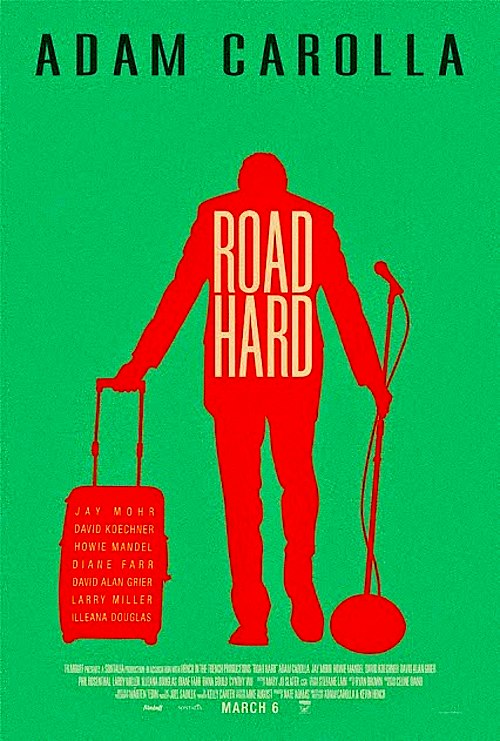
By Joe Bendel. Comedian Bruce Madsen is sick of going out on the road. The only consolation is that he lives in Los Angeles. He is pretty sick of it too, but he stays because that is where his daughter and the business are. He grinds away hoping his agent will find a way to get him back on television, enduring the pettiest annoyances the club circuit has to offer in Adam Carolla & Kevin Hench’s Road Hard, which opens this Friday in New York.

Madsen was once the co-host of the crude but popular Bro Show. His former partner is now the star of his own late night network talk show. Yes, there do seem to be some parallels between Carolla’s life and his on-screen character. Madsen is also divorced, living in the converted garage of his former McMansion, so he can be close to his adopted daughter, Tina—that is when he happens to be in town. Since Madsen was once on television, he can still draw relatively well at middling comedy clubs, but it is getting to be a drag.

Madsen perks up a little when he meets Sarah at a typically de-moralizing gig. Of course, she happened to be there through a strange set of circumstances. She certainly isn’t a fan, but they will somehow meet again. Will Madsen finally get off the show business treadmill or will his persistence finally be rewarded? Road Hard will answer those questions satisfyingly, but first Madsen’s ego will have to take a few beatings.

Road Hard is sort of like Scared Straight for anyone considering a career as a comedian, but it is consistently humorous, nonetheless. Clearly, Carolla can still do old school stand-up, because his bits are peppered throughout the film. He is also quite funny kvetching with his cronies Phil Rosenthal (essentially playing himself) and David Alan Grier (as Michael Gerard, a comic on an unlikely upswing). Yes, you read that here first—the words “David Alan Grier” and “funny” used in the same sentence. Howie Mandel also turns up for an unusually edgy and self-deprecating cameo, again as himself, but Larry Miller disappointingly resorts to a lot of shtick as Madsen’s sleazy agent (is there any other kind?), “Baby Doll” Weissman.
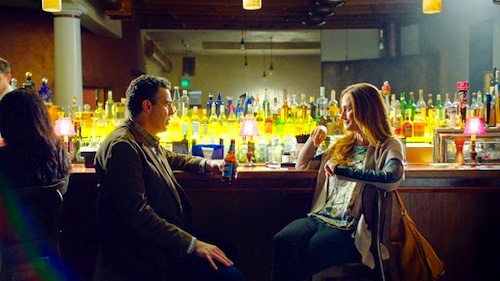
From "Road Hard."

Yet, one of the nicest surprises is the easy-going chemistry between Carolla and Cynthy Wu and his former Loveline colleague, Diane Farr, as Tina and Sarah, respectively. These feel like believably imperfect but workable relationships. In fact, there are some moments down the stretch that are quite sweet, despite all the preceding masturbation jokes.

Yes, Road Hard works blue from time to time, but it has both an edge and a heart. Its show business insider stuff rings true and it delivers laughs at a more regular pace than the standard issue studio comedy. Recommended rather enthusiastically for stand-up fans and those of us who always wondered what went on behind-the-scenes at Loveline tapings, Road Hard opens this Friday (3/6) in New York at the AMC Loews Village 7 and also launches on iTunes day-and-date.

LFM GRADE: B+

Posted on March 6th, 2015 at 1:24pm.

LFM Reviews Detective K: Secret of the Lost Island

By Joe Bendel. Considering what debased currency did to the Roman Empire, the Joseon king is right to be concerned about an upsurge in counterfeit silver in circulation. However, it is highly debatable whether Kim Min, a.k.a. Detective K, and his shticky sidekick are the right people to investigate. They dive head-first into the case nonetheless in Kim Sok-yun’s Detective K: Secret of the Lost Island, which opens today in Queens.

Even in the Joseon era, no good deed goes unpunished. As a reward for his brilliant service, Detective K has been banished to the provincial coast. He understands it is just a temporary political thing, but it provides a handy excuse to rebuff young Da-hae. Desperate to find her missing sister Do-hae, she swims the channel every morning to cook and clean for the so-called detective, hoping he will take on the case. Eventually, she sets out to find Do-hae herself. Unfortunately, by the time Det. K grows alarmed by her prolonged absence, he is so deeply embedded on our hate-list, he will probably never redeem himself.

From "Detective K: Secret of the Lost Island."

Of course, it is the counterfeit silver that really motivates Kim Min to sneak away from his exile. Naturally, this leads to trouble with the authorities, but at least one high-ranking official will cover for him. His investigation soon brings him to the wild and woolly Japanese port colony that processes most of Joseon’s silver imports. There Detective K encounters Hisako, the femme fatale courtesan, who is either a lethal villain or an alluring ally. Only time will tell. However, the pressure and guilt will quickly mount for Detective K when he realizes the disappearances of Da-hae, Do-hae, and hundreds of other young nobi slave girls are somehow related to the silver counterfeiting ring.

There is something a little off about Lee Nam-gyu and Kim Soo-jin’s screenplay when it makes us despise the franchise character. It is really not Kim Myung-min’s fault, but he never conveys any spark of life as Detective K. For his part, the rubber faced character actor Oh Dal-su continues to be Michael Caine-level busy. Despite a little mugging, he is likable enough as the put-upon sidekick, Seo Pil. On the other hand, Lee Chae-eun and Hwang Chae-won are unusually charismatic and painfully heartrending as Da-hae and Do-hae, respectively. At least for pure entertainment, Lee Yeon-hee scorches up the screen as Hisako.

Nobody respects Korean cinema more than we do here, but the not infrequent habit of putting tiny little girls in positions of horrifying peril has become a too familiar custom better honored in the breach than the observance. It makes it difficult to enjoy the action and mayhem. Nevertheless, Detective K has some impressively mounted set piece sequences and several highly effective supporting turns. Recommended for those who enjoy broad comedy mixed with intrigue, Detective K: Secret of the Lost Island opens today (3/6) at the AMC Bay Terrace in Bayside, Queens.

LFM GRADE: C+

Posted on March 6th, 2015 at 1:23pm.

Get a Load of that Pastrami: LFM Reviews Deli Man

By Joe Bendel. By now, many people do not realize that at the time of the Civil War, Jews were largely more accepted by the South than the North. However, there was one Unionist who stood tall against anti-Semitism (Lincoln, of course). Maybe it should therefore not be so surprising one of the one hundred fifty-some surviving real deal kosher delis happens to be in Houston, Texas. Proprietor Ziggy Gruber (formerly of New York) will be our primary guide through the savory traditions of delicatessen cuisine in Erik Greenberg Anjou’s Deli Man, which opens this Friday in New York.

Gruber was born into the delicatessen establishment, as the grandson of the owner of Broadway’s famed Rialto deli. He started working part-time for his beloved grandfather at an early age and absorbed all his traditional recipes and practices like a sponge. He now co-owns and operates Kenny & Ziggy’s New York Delicatessen in Houston, one of an estimated 150 legit kosher delis in America. To put things in perspective, there were over 1,500 certified kosher delis in New York City during the 1930s.

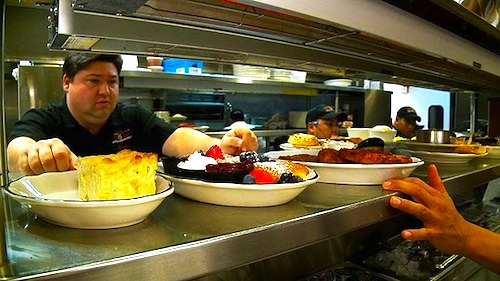
Anjou supplies some historical context (pastrami originally came from Romania) and offers some analysis of deli fare as a poignant cultural remnant of a shtetl world that no longer exists, but when you really get down to it, Deli Man is all about the food. The mountainous pastrami sandwiches are as mouth-watering as you would expect, but everything coming out of Gruber’s kitchen looks appetizing. In fact, he whips up some sort of roast shank that could probably justify a trip to Houston by itself.

From "Deli Man."

Anjou could not have cast a more fitting central figure than the effusive Gruber. The man knows deli traditions through and through, yet he treats his staff and customers like family, regardless of their backgrounds. We also meet a representative sampling of other deli men and women, including Jay Parker of Ben’s Best in Rego Park, Queens, which is about as authentic as it gets. However, Anjou only peaks into the personal life of Gruber, who may have finally found someone willing share so much of his time with the corned beef. It is nice to see things working out for him, considering what he has done to keep his family and culinary traditions alive.

Anjou duly observe the irony that it was Jewish Americans’ successful acceptance and assimilation into suburbia that largely drove scores of neighborhood kosher delis like Ben’s Best out of business, without belaboring the point. Indeed, there is some serious substance to the film, but there is no getting around its food porn indulgence—and who would want to? Recommended for those who appreciate culinary cultural history on rye, Deli Man opens this Friday (3/6) in New York at the Lincoln Plaza uptown and the Landmark Sunshine, not so far from Katz’s on Houston Street.

LFM GRADE: B

Posted on March 4th, 2015 at 10:13pm.

LFM Reviews When Marnie Was There @ The 2015 New York International Children’s Film Festival

By Joe Bendel. For young Anna Sasaki, coming of age is a particularly dramatic process, in a dark psychological kind of way. She is like a character out of Daphne du Maurier or Mary Roberts Rinehart novels, who has been sent to spend the summer in a bucolic marshland that could have been painted by the Impressionists. Nobody would be better suited to realize her new environment than the Studio Ghibli team, but alas, this will be their final release for the foreseeable future. While it lacks the tragic sweep of its immediate predecessors (Princess Kaguya and The Wind Rises), Hiromasa Yonebayashi’s When Marnie Was There is an appropriately intimate goodbye that packed the house for the opening night of the 2015 New York International Children’s Film Festival.

Sasaki is far too sensitive to make friends easily with her classmates. Her stress-aggravated asthma does not help, either. After a particularly severe attack, Sasaki’s mother Yoriko sends her to stay with her extended relatives, kindly old Kiyomasa and Setsu Oiwa. However, as a foster child, Sasaki has difficulty accepting any of them as family, including Yoriko, despite their genuine concern.

To humor Setsu, she makes a few half-hearted efforts to befriend some of the village girls her age, but Sasaki prefers to make sketches on her own. One of her favorite subjects is Marsh House, an abandoned mansion only intermittently accessible during low tides. Strangely though, a young girl named Marnie seems to live there with her ominously gothic servants. Sasaki and Marnie are drawn to each other like lonely kindred spirits. At last, each feels they have finally found a true friend. Yet, Marnie’s penchant for vanishing without a trace confuses and sometimes hurts Sasaki.

From "When Marnie Was There."

It does not take much deduction or intuition to figure WMWT is some sort of supernatural story, but it still holds some profoundly resonant secrets. It certainly looks like a Studio Ghibli film, which means it is lushly gorgeous. As with The Secret World of Arrietty, his previous film as a director (also based on a British YA novel), Yonebayashi fully captures the beauty and malevolent power of the natural world. Frankly, it is rather impressive how quickly and yet how smoothly he can change the vibe from sunny pastoral to psychological suspense. There is even a scene in a supposedly haunted grain silo that evokes the mission tower staircase in Vertigo, fittingly enough in a film featuring a titular character named Marnie.

WMWT is a deeply humanist film, brimming with forgiveness and empathy. Through her POV, we will acutely understand how coming to terms with the past will allow Sasaki to carry on and embrace life. As a potential sign-off from Studio Ghibli, that’s not bad. Amongst their storied output, it probably ranks somewhere in the middle, but had it come from just about any other animation house, it would represent their crowning achievement. Granted, the opening act is a little slow getting it in gear, but overall, it is remarkably astute emotionally and refreshingly life-affirming. Highly recommended, When Marnie Was There screens again next Saturday (3/7) at the SVA Theatre, as part of this year’s NYICFF.

LFM GRADE: A-

Posted on March 4th, 2015 at 10:12pm.

LFM Reviews The World of Kanako @ The 2015 Film Comment Selects

By Joe Bendel. Showa Fujishima has made just about every parenting mistake a father can make and invented some that are uniquely his own. Not surprisingly, he really hasn’t been around much to see the results. At least that allows him to cling to a few willful misconceptions regarding Kanako. However, when his estranged ex-wife begrudgingly requests the ex-cop’s help finding their missing daughter, he learns far more than he bargained for in Tetsuya Nakashima’s The World of Kanako, which screens during the 2015 edition of Film Comment Selects.

Prepare to have your head messed with. Nakashima will fracture his timeline nearly beyond recognition and do his best to represent Fujishima’s warped perspective. The former copper now working as a rent-a-cop always had anger management issues, which directly led to his personal and professional disgrace. He is supposed to take drugs for his temper and mood swings, but they do not seem to be working, even though they might somewhat skew his perception of reality.

Kanako has already been missing for five days before Fujishima’s ex finally asks for his help. Intuitively, he assumes her disappearance is linked to the punky gang kids she has been hanging with, which is largely correct, but his presupposition that Kanako is an innocent victim will be rudely disabused. He soon learns she is up to her neck in drugs and pimping out classmates to well-heeled pedophiles. She was also apparently somehow mixed up in the suicide of her classmate Ogata. We will learn just exactly how so in flashbacks seen through the eyes of Boku, a secondary POV character, whose experiences with Kanako will parallel those of poor Ogata.

Meanwhile, Fujishima’s hostile former colleagues are more than happy to treat him as a suspect in a gangland-style killing perpetrated at the minimart he was ostensibly guarding. It turns out Kanako’s world is a small world when links turn up suggesting a connection between the convenience store massacre and her disappearance. Fujishima is in for a lot of pain and humiliation, but he will deal out plenty more to anyone he considers a potential suspect or accomplice.

Man, Kanako is dark, even by the standard Nakashima set in his previous films, Confessions and Memories of Matsuko. However, unlike the seamlessly constructed escalation of Confessions, WoK is a bit of a rat’s nest, compulsively flashing forward and backwards and liberally tossing unreliable perceptions or downright hallucinations to the point where many viewers will just drop the narrative thread and stop caring altogether, despite the occasional tongue-in-cheek hat-tips to 1970s exploitation cinema. The form of the film is enough to give you a headache, separate and apart from the rampant cruelty it depicts. Based on Akio Fukamachi’s novel, WoK is a nihilistic indictment of just about everything—that’s nihilism spelled with a capital “F” and a capital “U.”

To his credit, Kôji Yakusho doubles down over and over again as the violently erratic Fujishima. It is a messy, let-it-all-hang-out performance, but Yakusho takes it to such dark places, it is ultimately rather soul-scarring. Nana Komatsu is ethereally evil as the deceptively innocent looking Kanako, while Satoshi Tsumabuki chews the scenery with swaggering glee as Det. Asai, the sucker-sucking cop who apparently thinks he’s Kojack. Ai Hashimoto manages to add a thimble full of humanity to the film as Kanako’s estranged and disgusted middle school friend Morishita, but such figures of decency are few and far between in Kanako’s world. Frankly, it is hard to fully judge Kanako’s former homeroom teacher, Rie Higashi, but (Matsuko star) Miki Nakatani’s performance is truly riveting and maybe even redemptive.

From "The World of Kanako."

If this is what life is really like for Japanese middle and high school students, I would immigrate if I were a parent. It is hard to imagine a more exhausting film than WoK, for reasons of both style and content. It is clearly the work of a genuine auteur, who does not get his just international due, but Nakashima really demands a great deal of indulgence this time around. Lacking the tightness of Confessions and the pure gut-wrenching emotional payoff of Matsuko, it just starts to feel like it is piling it on after a while. For those who enjoyed cult hits like Confessions, Lady Snowblood, Audition, and the real Oldboy, but found them too artificially optimistic, WoK will give you the straight shot of bile you crave. Recommended accordingly for ardent Nakashima admirers, The World of Kanako screens this Thursday (3/5), at the Walter Reade Theater, concluding this year’s Film Comment Selects.

LFM GRADE: C+

Posted on March 4th, 2015 at 10:11pm.

LFM Reviews Faults

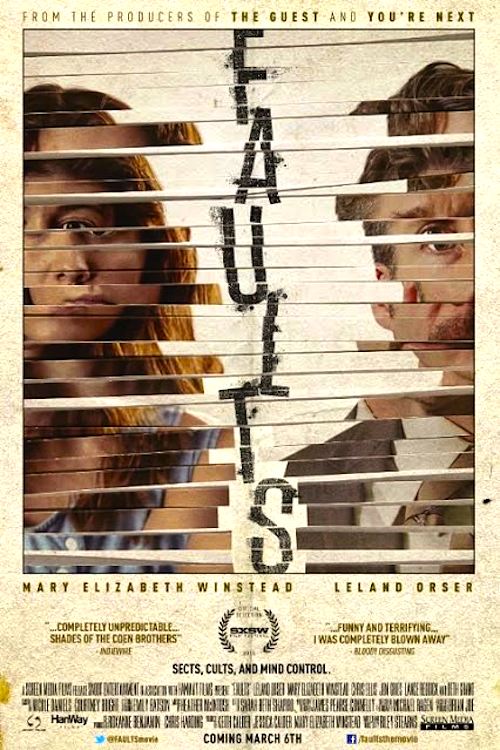
By Joe Bendel. They do not use an initial article. Claire’s cult merely refers to itself as “Faults.” “From a fault comes a change” they like to say—and they seem to think a big apocalyptic one is coming. That is why they do not have time for children, or “parasites” as they call them. Okay, that sounds a little creepy, but it still isn’t as nuts as Xenu and the thetan madness. Her parents will hire a disgraced cult expert to deprogram her, but nothing will go according to his plan in Riley Stearns’ Faults, which opens this Friday in New York.

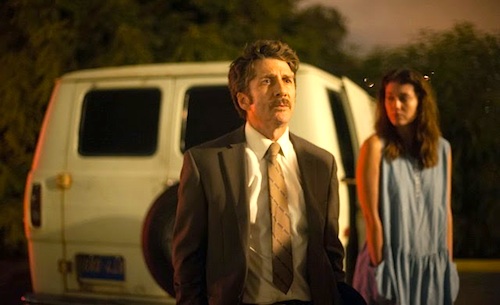
Ansel Roth was once a bestselling cult investigator with his own television show, but a case that went sour cost him just about everything. He now lives a hand-to-mouth existence giving seminars in third-rate hotels, where he transparently hawks his self-published follow-up book, to pay back Terry, his loan shark-ish manager, who fronted the printing costs. Who would attend his speaking engagements? The truly desperate, like Claire’s parents, Paul and Evelyn.

Although Roth had essentially quit the de-programming business, he agrees to help the couple, largely due to the motivation supplied by his manager’s enforcer. Yet, as soon as he abducts the young woman and commences the process, strange complications start to arise. Claire is unusually calm and pre-possessed, answering his questions without a lot of rhetorical contortions. On the other hand, her parents start to acting in suspicious ways that might suggest a history of emotional and perhaps even sexual abuse. Nevertheless, Roth is under pressure to get this deal done, so he can pay off his overdue debt.

Given the potentially lurid nature of its subject matter, it is rather impressive how low-key and subtle Stearns’ treatment is. He takes his time establishing Roth’s bitter and nebbish character through some wickedly droll black comedy. The stakes are considerable throughout the chess game he plays with Claire (played by Stearns’ real life wife, Mary Elizabeth Winstead), but when things take a macabre turn, it is more amusing than alarming. Granted, we have seen many variations on the film’s big twist before, but the smaller helper-twists are quite clever.

From "Faults."

It is a shame award season never seriously considers genre films, because Leland Orser’s lead performance merits that sort of attention, just like the dynamite Nick Damici in Late Phases. He masterfully alternates between comedy and tragedy, without breaking stride. He and Winstead crackle together in their sparring sessions. Lance Reddick (the hotel manager in John Wick) is also all kinds of hardnosed as Terry’s muscle, Mick, while John Gries chews plenty of scenery as his weird boss.

There are several spots in the third act Stearns could have played up much bigger, but that matter-of-factness makes the film quickly appreciate in viewers’ consciousness, in retrospect. Look, sometimes less really is more. In fact, Faults is a cool example of how a highly effective genre hybrid can be whipped up on a limited budget. Aside from maybe one sequence, the whole thing could have been shot in a low-rent motor lodge. The finished product is a great showcase for Stearns and his consistently strong ensemble of character actors. Highly recommended, Faults opens this Friday (3/6) in New York, at the Cinema Village.

LFM GRADE: B+

Posted on March 4th, 2015 at 10:11pm.