By Jason Apuzzo. According to The Hollywood Reporter, Joel Surnow’s The Kennedys miniseries has finally found a home – at the ReelzChannel, where the show will premiere April 3rd.
This is good news, I suppose, but quite a come-down from what the initial ambitions for this series were. In the status-conscious world of Hollywood, this amounts to a body-slamming of everyone involved in the project – sort of like the LA Dodgers moving back to Brooklyn.
In any case, I suppose I will now have to actually find the ReelzChannel.
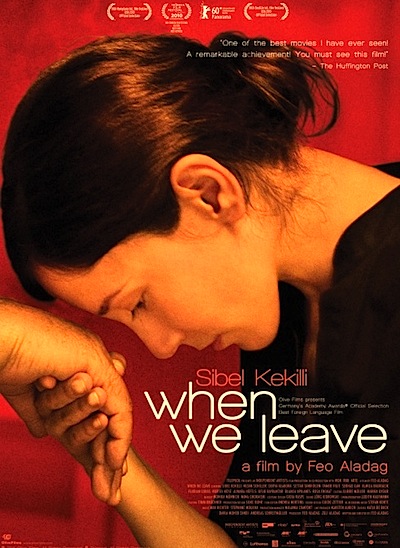
By Joe Bendel. Like many Turkish immigrants, Umay came to Germany in search of a better life for herself and her young son Cem. In their case, that meant getting away from her abusive husband Kemal. Unfortunately, she finds the traditional baggage from her home country is hard to shake in Feo Aladag’s When We Leave(trailer above), Germany’s unfairly overlooked official submission for best foreign language Oscar consideration, which opened Friday in New York and elsewhere.
Due to Leave’s framing device, we start the film under the assumption that things will not work out for Umay. Actually, we have no idea. A strikingly beautiful woman, Umay’s husband uses her as a domestic slave. However, when he begins terrorizing their son as well, Umay decides to flee. At first, her family in Germany is delighted to see her, but they keep asking about Kemal. When her father Kader and older brother Mehmet learn the truth, they have only one word for Umay: “whore.”
Despite Umay’s protests, Kader makes it unequivocally clear Umay must return to her rightful owner, or consider herself banished from the family. While Umay must protect herself and her son, she cannot turn her back on the only family she has ever loved. Unfortunately, the warning of her friend proves tragically correct—her family will always choose their community over a mere daughter.
Leave is a truly intense film that frankly depicts all manner of crimes committed in the name of so-called ‘honor.’ We witness spousal abuse, abduction attempts, stalking, and worse. Yet, for Umay, the emotional isolation for her family is the hardest to bear.
The strikingly beautiful Sibel Kekilli deservedly won best actress honors at last year’s Tribeca Film Festival for her heartrending portrayal of Umay. An active supporter of Terre de Femmes, a German-based non-profit dedicated to Muslim women targeted with physical violence, Kekilli clearly drew from real life in her riveting performance. It is hard to watch at times as her Umay is spat upon (literally and figuratively) by her formerly loving family.
The unblinking intimacy of Aladag’s approach viscerally captures a wealth of unspoken nuances passing between characters. She also elicits some quite accomplished work from her supporting cast. As Umay’s German boyfriend Stipe, Florian Lukas adds a bit of depth to a part that could easily be dismissed as the schmucky nice guy. Yet perhaps the most surprising turn comes from Settar Tanriögen as Umay’s pained father, evoking a sense of high tragedy through Kader’s cowardice and conformity.
Frankly, it is something of a scandal Leave did not even make the nine film shortlist for the best foreign language Oscar. It is a powerful film, featuring a truly brave lead performance from Kekilli. Far superior to the five nominees announced last Tuesday, the remarkable Leave opened Friday (1/28) in New York at the Angelika Film Center.
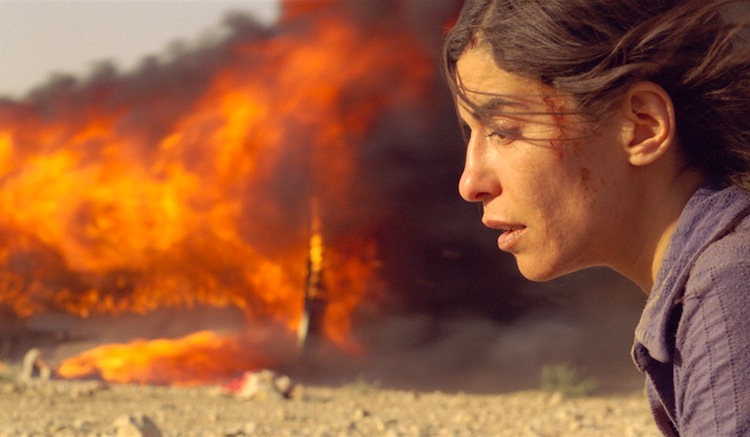
By Joe Bendel. Religious extremism is a handy prism through which to view Mid East conflicts. However, it ignores one critical contributing cause of ever-escalating violence, at least according to the recent screen adaptation of Lebanese-Canadian Wajdi Mouawad’s stage play. While religious resentments are often a primary motivation, nothing trumps human nature and the downright Biblical desire for revenge. It’s that eye-for-an-eye cycle a Middle Eastern immigrant hopes to break with her last will and testament in Denis Villeneuve’s Academy Award nominated Incendies, which screened during the recently wrapped 2011 Sundance Film Festival.
Nawal Marwan, beloved employee of attorney and notary-public Jean Lebel, had secrets her grown son and daughter never suspected. An immigrant from an unnamed Middle Eastern country bearing a strong resemblance to Lebanon (particularly given its open warfare between Christian and Muslim militias), Jeanne and Simon assumed their father died during the civil war. Much to their surprise, at the reading of Marwan’s will, Lebel produces two letters handwritten by their late mother. One they are to deliver to their father, the other to their heretofore unknown brother.
At first, Simon refuses to play his mother’s game, leaving Jeanne to wrestle with their family intrigue alone. However, as she learns the extent of her mother’s past, including involvement with a shadowy Muslim warlord and a long stint in a notorious Christian militia prison, Simon reluctantly joins her, with the faithful Lebel in tow.
From Denis Villeneuve’s "Incendies."
Perhaps the most fascinating aspect of Incendies is the slipperiness of various characters’ loyalties. Though raised a Christian, Nawal Marwan throws her lot in with the Muslim militia after witnessing a Christian atrocity. Likewise, a critical mystery man changes sides at least twice, seemingly just to facilitate various plot turns.
Indeed, Incendies has a monster of a twist that viewers probably will not recognize until Villeneuve commences the film’s big reveal. It depends on a very tight timeline though, which just barely holds up to post-screening scrutiny. Frankly, given the importance of dates, Mélissa Désormeaux Poulin and Maxim Gaudette, though otherwise convincing in the roles, look at five or ten years too old as the grown Marwan children. Yet Villeneuve pulls it off through sheer cinematic power.
While Incendies might sound like typically didactic Mid East agitprop, it really is more about the personal than the political. In fact, neither Israel nor America are ever mentioned at all. Instead, it is about the grubby, up-close-and-personal hatreds and resentments that define such skirmishes. At one point, the Marwans are advised to seek out a former militia leader for information, because warlords have long memories. Point taken.
If not exactly subtle filmmaking, Incendies delivers visceral drama. Oddly, it also serves as a tribute to the noble calling of notaries through Rémy Girard’s richly realized supporting turn as Lebel. A suitably sweeping package, cinematographer André Turpin adeptly captures the rough beauty of the landscape, while the euro-pop influenced sound track sounds somewhat out-of-place, but is evocative nonetheless. A bold, messy, and totally engrossing film, Canada’s Incendies is one of the better nominees for the best foreign language Oscar and a worthy selection of this year’s Sundance Film Festival.