It’s Tough to Be a Girl in the Kingdom: LFM Reviews Wadjda

By Joe Bendel. In a country where women are forbidden to drive cars and movie theaters are prohibited, this is obviously a significant two-fer. Not only is it considered the first feature film produced entirely in Saudi Arabia, it was also directed by a woman. (It should be noted that the film was partly backed one of the prince’s companies, lest you suspect that the Zionist conspiracy was working overtime.) It might not drag Saudi Arabia into the modern world, but at least Haifaa Al Mansour’s Wadjda is a good film well worth seeing when it opens this Friday in New York.

Ten year old Wadjda’s attends a hardline Islamist girls’ school that has little to teach beyond the Koran. Bless her heart, she is a terrible student, but obviously much more interesting than her docile classmates. Everyone is rather surprised when she enrolls in the school’s Koran reciting competition, but she has plans for the prize money. She is determined to buy the sparkling new green bicycle that caught her eye.
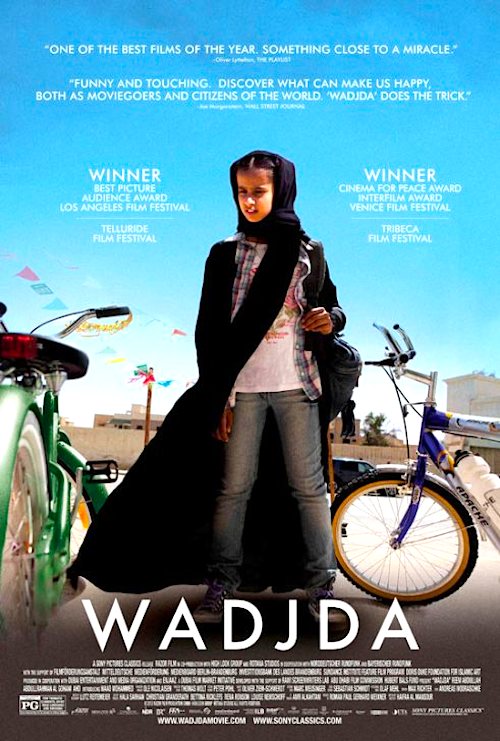
Of course, biking is strictly not allowed for girls. After all, those narrow seats might rob them of their virtue. Seriously, that is the justification. Nevertheless, Wadjda convinced her neighborhood friend Abdullah to secretly teach her how to ride his bike. Thanks to the circumstances of her family life, she will have plenty of time to spend with him. Her loving mother works on the other side of town, forced to rely on her surly driver to shuttle her back and forth. In contrast, Wadjda’s father is an infrequent presence in her life. He lives with his mother, who seems to be plotting a second marriage for her son. Wadjda’s mother lives in fear of this nuclear option.

Wadjda is a gentle coming of age story, but it is bursting with telling moments. Perhaps the greatest eye-opener is the extent to which women, such as Wadjda’s shrewish head mistress Ms. Hussa, enable and promote their society’s institutionalized misogyny. Time and again, Wadjda’s mother faces major dramas over what would be mere day-to-day chores for women in the west, because of her gender restrictions. It is also hard to see what use Wadjda’s Islamist education will ever be, but that is obviously the whole point.

Nonetheless, both Wadjda and Abdullah (played by Waad Mohammed and Abdullrahmin Algohani, respectively) represent the promise of youth. Given her extensive screen time, Mohammed is particularly impressive, largely carrying the film with aplomb, but they are both immensely likable, blessed with natural screen charisma. Watching their chemistry develop gives viewers hope, but they are only two kids.

While Wadjda the film is understandably small in scope, there are considerable stakes involved for mother and daughter alike. Monsour tells a timely and compelling story with a sure directorial hand and a sensitive touch.Indeed, the indomitable Wadjda is a remarkably engaging character who ought to win over art house audiences. Highly recommended, particularly for those interested in global women’s rights issues, Wadjda opens this Friday (9/13) in New York at the Lincoln Plaza Cinema.

LFM GRADE: A-

Posted on September 9th, 2013 at 3:44pm.

A Tale of Russian Orphans: LFM Reviews The Dark Matter of Love @ The 2013 Toronto International Film Festival

By Joe Bendel. Over 300 so-called “Pipeline Babies” have become the new face of Putin’s Russia. Often special needs children, they had already met and begun forming relationships with their presumptive American parents. However, as they waited for the paperwork to be finalized, the Putin regime banned American adoption as the latest salvo in his neo-Cold War. With no realistic prospects of Russian adoption, it is the children who will suffer the most as a result, but looking after the weak and the vulnerable was never the Russian strong man’s priority.

Admirably, the filmmakers behind a new film documenting the complicated adjustment process for three of the final (as of now) Russian orphans adopted by an American family are using the Toronto premiere of their film to shine a spotlight on the Pipeline Baby issue. Masha, Marcel, and Vadim are not Pipeline children, but the Diazes might sometimes wish they were during the rocky course of The Dark Matter of Love, which screens during the 2013 Toronto International Film Festival.

Adopting one child is a considerable undertaking. Taking on three at once is rather daunting. Recognizing the potential challenges (at least on an intellectual level), the Diaz family enlisted scientific help. Dr. Robert Marvin and his associate Nicole Millirin will monitor and counsel the family, reviewing video footage that would become part of this film. Masha is a classic case of the emotionally guarded orphan who erects nearly impenetrable protective walls around herself. In contrast, the younger twins, Marcel and Vadim, indulge in the sort of histrionic acting out also commonly observed in recently adopted children. Altogether, they are quite a handful, leaving the Diaz parents little time for their biological teenage daughter, Cami.

Throughout much of the second act, viewers will be reminded of what they say about good intentions. Nonetheless, Marvin and Millirin offer the family some very constructive feedback. The authoritative Marvin also provides the audience a lucid thumbnail sketch of the evolution of developmental psychology over the last fifty-some years. Looking a bit like Max von Sydow’s sensitive younger brother, Marvin is a reassuring presence who adds quite a bit to the film.

Frankly, the documentary might have benefited from a bit more of Marvin and Millirin. While the Diazes are clearly good people with strong values, ninety-three screening minutes is a long time to spend with them. Indeed, Dark Matter could easily be whittled down to an hour for a later PBS broadcast.

Despite some painful moments, Dark Matter will leave viewers largely optimistic regarding the Diaz children’s future. It certainly never offers any inadvertent justification for Putin’s iron-fisted American adoption ban. Considering Masha and the twins were adopted just before the decree was passed, it is perfectly logical and appropriate for McCarthy and her colleagues to take up the Pipeline Baby cause as part of their awareness campaign. Millirin has even sacrificed some privacy by announcing she happens to be a lesbian adoptive mother, in protest of both the Russian government’s adoption ban and their harsh new anti-gay laws. It is rather incredible how much there is to be alarmed by in Putin’s Russia, such as the continuing persecution of dissenting activists, like Pussy Riot. What a perfect spot to hold the Olympics.

Recommended for those interested in its family development issues, The Dark Matter of Love screens again today (9/9) and Friday (9/13) as part o this year’s TIFF. Concerned viewers can also sign an online petition on behalf of the over 300 affected children here.

LFM GRADE: B-

Posted on September 9th, 2013 at 3:38pm.

Life in a North Korean Sleeper Cell: LFM Reviews Secretly Greatly

By Joe Bendel. In North Korea, loyalty is only for the little people. In contrast, the state owes them nothing for their faithful service and sacrifice. A trio of DPRK sleeper spies learns this lesson the hardest way possible in Jang Cheol-soo’s Secretly Greatly, which the Korean Cultural Service will screen for free this Tuesday in New York.

Won Ryu-hwan is one of the most lethal commandos ever forged by the North Korean military. Folks in a sleepy South Korean town know him as Bang Dong-gu, the village idiot. To maintain his deep cover, Won follows a strict regimen, such as regularly being seen in public doing both number one and number two. It is a real bummer for Won when the lovely Yu Yu-ran sees him doing his duty (if you will), but at least he will have some comrades to commiserate with when two new sleepers arrive in town.

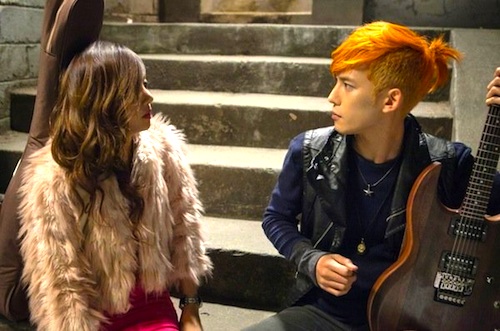
Lee Hae-rang is supposed to be a hipster-rocker, but he cannot play the simplest of chords. However, he is well connected as the illegitimate son of a high ranking general. On the other hand, Ri Hae-jin makes a convincing high school student, because he is still a teenager. Of the three, only Ri has seen any action, carrying out the assassinations of several defectors.

With the change at the top of the regime, the sleeper agents suddenly look like a potential liability, resulting in a general self-termination order. Of course, Won will do anything his government demands, but first he has the gall to ask for some assurance the Party will take care of the beloved mother he has not seen for years. Right, do you want the bad news first or the really bad news. Regardless, his old commander Kim Tae-won has been dispatched to personally handle the three newly dubbed “traitors.”

Based on a web-comic, Secretly is unusually forthright about the nature of the Communist North. Characters often refer to work camps as a punishing fact of life. Yet, it also portrays the soul crushing impact of the lifetime of propaganda Won has absorbed and still desperately clings to. Nevertheless, the first half of the film mostly hits comedic notes, often approaching outright slapstick.

From "Secretly Greatly."

Of course, when the DPRK turns on its former heroes, the film pivots into much darker territory. When it is finally go time, action coordinator Park Jeong-ryul delivers some spectacularly cinematic but seriously down-and-dirty fight scenes. Bear in mind, Secretly was a blowout hit at the Korean box office, so you can also expect some tragedy down the stretch, but that is also rather realistic. Pyongyang does not do happily-ever-afters.

Kim Soo-hyun fully commits himself to Dong-gu’s cringy humiliations, perhaps even overdoing it a tad. Still, he is a credible action figure when Won gets down to business. Park Ki-woong is a bit more restrained as would be rocker Lee, while Son Hyun-joo is all kinds of badness as the conspicuously scarred military heavy. Although is a small supporting role, Lee Chae-young also has some fine moments as the town tramp, nicely bringing out Dong-gu’s inner tensions.

Secretly has no illusions about the dehumanizing nature of the DPRK, but it is not so crazy about the ROK government, either. Arguably, the most sympathetic figure of officialdom is Kim Soo-hyuk, the unreconstructed but fundamentally decent cold warrior charged with capturing the sleeper spies. Altogether it is a strange mix of broad comedy, gritty action, and cynical intrigue that works far better than it might sound. Recommended for fans of spy vs. spy beatdowns, Secretly Greatly screens tomorrow (9/10) at the Tribeca Cinemas, free of charge, courtesy of the Korean Cultural Service in New York.

LFM GRADE: B+

Posted on September 9th, 2013 at 3:35pm.