LFM Reviews Coming Home

By Joe Bendel. Most ballets tell tragic stories, but the Maoist-era Red Detachment of Women caused them. It certainly contributed to the woes of Lu Yanshi’s family during the Cultural Revolution. Their wounds will never fully heal, even when he is finally “rehabilitated” and released from his prison camp in Zhang Yimou’s straight-up masterpiece Coming Home, which opens this Wednesday in New York.

Lu Yanshi was a college professor—and therefore a class enemy during the Gang of Four’s reign of terror. Further compounding his guilt, Lu escaped from his labor camp, finding the half-starved life of a fugitive more bearable. Naturally, the Communist Party responded by pressuring his family. Lu’s wife Feng Wanyu will bear any risk to protect him, but their daughter, Dan Dan, has absorbed too much of the omnipresent propaganda. She is a gifted ballet dancer, but she could very well lose the lead role in Red Detachment of Women she has worked so hard to win. Convinced to inform on her father, she learns the hard way what sort of opportunities are available to the children of traitors.

Gaining nothing, Dan Dan’s relationship with her mother is nearly irreparably poisoned. Unfortunately, the years Feng spends separated from Lu are not kind to her. By the time he is released, Feng is already suffering from mild dementia. Due to some cruel form of amnesia, she is unable to recognize Lu. Worse still, she sometimes mistakes her distraught husband for the predatory Officer Fang, who used Lu’s safety to extort sexual favors from Feng, like any good Communist would. However, Lu quickly reconciles with his deeply remorseful daughter.
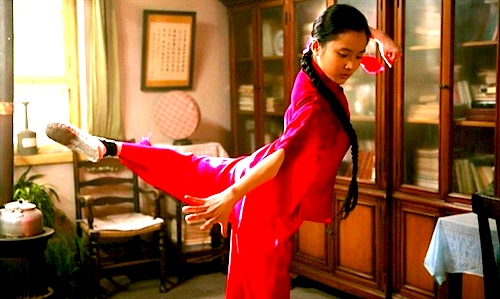
From "Coming Home."

If you think there is a better performance to be seen in a film this year than Gong Li’s turn-for-the-ages as Feng, you either have profoundly faulty aesthetic judgement or were simply even more struck by the achingly poignant dignity of Chen Daoming’s Lu. Watching Lu as Feng unknowingly tells him about himself is more devastating than a thousand Old Yellers getting shot. What they are doing is actually very complicated. They are playing scenes with each other in the moment, but also with each characters’ ghosts from the past. Yet they pull it off brilliantly. It is their work that leaves a lump in your throat, but Zhang Huiwen is still quite touching as the disillusioned Dan Dan—and also convincingly graceful in her dance scenes.

Frankly, Coming Home is not trying to be a political film, because the terrible implications of the Cultural Revolution need no belaboring. They are ever-present and inescapable. Instead, it is an exquisite tragedy, rendered with incredible sensitivity and humanism. Zhang has gone big with epics like House of Flying Daggers and made Fifth Generation-defining classics with Gong Li, like Red Sorgum and The Story of Qiu Ju, but with the perfectly balanced Coming Home he expresses the pain and confusion of hundreds of thousands of families on a painfully intimate canvas. If you only see one film this year, you want it to be Coming Home. Very highly recommended, it opens this Wednesday (9/9) in New York, at the Angelica Film Center downtown and the Lincoln Plaza uptown.

LFM GRADE: A+

Posted on September 9th, 2015 at 5:29pm.
LFM Reviews Wolf Totem

By Joe Bendel. The land will be befouled and God’s creatures will be senselessly slaughtered. This is China in the full throes of the Cultural Revolution. As they witness the consequences first-hand, two formerly eager volunteers will be deeply disillusioned by the Party’s ruinous policies in Jean-Jacques Annaud’s Wolf Totem, which opens this Friday in New York.

When they first arrive, cadres Chen Zhen and Yang Ke really believe they will be making a difference for the hardscrabble herders of Inner Mongolia. However, they quickly learn to respect the power of nature, especially the danger and beauty of the regions’ wolves. They also cannot miss the bad vibes radiating off the local party boss, Bao Shunghi. However, they manage to settle in with their ethnic Mongolian hosts rather nicely, especially considering the condescending nature of their assignment.

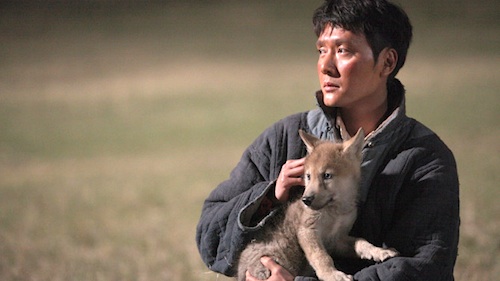
Frankly, they learn more from the herders than vice versa. After a too-close-for-comfort encounter with a wolf pack, Chen Zhen becomes increasingly fascinated with the Eurasian wolves. He cannot shake the idea that they deliberately spared him. Therefore, he is increasingly appalled by Bao’s cruel bounties on wolves, to pave the way for the locust-like settlers. He is also threatening the nomadic herders’ traditional way of life by despoiling their grassland for his developments. Seeing the wolves’ numbers dwindling, Chen Zhen does something rash. He secretly adopts an orphaned wolf cub. Yet, it is immediately clear the young wolf will always be too wild to live among people, but might become too domesticated to survive in nature.

Do not take this as a joke: it is frankly amazing what expressive performers these wolves are on the big screen. Lead training Andrew Simpson raised 35 region-appropriate wolves especially for the film—and the camera absolutely loves them. Even with extensive safety measures in place, Feng Shaofeng did not escape injury working closely with the wolves, but it was probably worth it. The co-star of White Vengeance and The Golden Era gives probably his career best performance as Chen Zhen. Once again, Shawn Dou is stuck playing second banana, but he keenly expresses the bitter nature of their hard lessons learned. Yin Zhusheng also makes a perfectly odious yet charismatic villain as Bao. Regardless, nobody will ever upstage those wolves.

From "Wolf Totem."

It is a not-so minor miracle this adaptation of Lu Liamin’s autobiographical novel (written as Jiang Rong) was ever made, especially considering Annaud was banned from China for years following Seven Years in Tibet. The explicit environmental themes and only slightly more muted critiques of the Cultural Revolution are also third-rail kind of subjects for the state film authorities. Nevertheless, they not only lifted Annaud’s ban and helped underwrite the production, they also chose Totem as China’s official foreign language Academy Award submission. Clearly, they are playing to win rather than score PR points with a non-existent international audience, as they often have in the past. Big and sprawling, with a green conscience, Totem is an Academy-friendly film, in nearly every way.

It also happens to be a very good film, which is a nice bonus for the rest of us. Totem offers more striking proof of why Annaud is considered the best contemporary narrative filmmaker working with animal and natural subjects. Cinematographer Jean-Marie Dreujou captures all the wolves’ twitchy power as well as the stunning beauty of the surrounding vistas. The late great James Horner’s reputation will also be further burnished by what is sadly one of his final scores. Few composers could produce such sweeping themes that are still so distinctive and evocative of a film’s time and place. It is an aesthetic marvel and one of the best environmental films in decades, precisely because it makes deeply compelling spiritual and cultural connections to the threatened Mongolian ecosystem. Very highly recommended, Wolf Totem opens this Friday (9/11) in New York, at the AMC Empire.

LFM GRADE: A

Posted on September 9th, 2015 at 5:29pm.

LFM Reviews The Beauty Inside

By Joe Bendel. Kim Woo-jin is a furniture designer, a sensitive hipster job if ever there was one. However, viewers will not envy his cool sounding gig. It is, after all, lonely work and Kim has some peculiarly unique issues that makes it feel ever more so. Shape-shifting romance gets a fresh spin in BAIK’s The Beauty Inside, which opens this Friday in New York.

Ever since he was eighteen, Kim wakes up from each slumber in a different body. He has the same consciousness, but he could be man or woman, young or old, Korean or a foreigner. Naturally he dropped out of school and has never had a relationship past a one-night stand. Refusing to forget his high school friend, Sang-baek discovered Kim’s secret and now manages his exclusive custom-made furniture business. His otherwise lonely world is about to be rocked by Hong E-soo, the beautiful and knowledgeable sales associate at his favorite limited edition furniture store.

Falling hard, Kim will wait until he finally has another handsome face to ask her out. When she says yes, he presses his advantage as best he can, resisting sleep for several days, he manages to make quite an impression, but a crash is inevitable. Despite his disappearing act, Kim cannot make a clean break of it. Eventually he will try to explain himself when he is hired as a sales trainee while outwardly appearing to be a fragile young woman.

Up to a point, BAIK and co-screenwriters Kim Sun-jung and Park Jung-ye adapt Drake Doremus’s corporate-sponsored social-media produced film that you probably haven’t seen in the first place. However, they take the story far deeper, exploring the day-to-day issues that plague Kim’s relationship with the understanding Hong. Some challenges are obvious and comparatively pedestrian, but the overall stress on Hong is more serious than the cloistered Kim initially understands.

Beauty Inside sort of compares to the honestly not so bad Adam Sandler vehicle 50 First Dates, but it is more fantastical and more serious in the treatment of its premise. Some real thought went into the implications of Kim’s condition. BAIK also stays faithful to the conceit, by never using a consistent Kim Prime for voiceovers or scenes reflecting how he sees himself. Instead, we have to adapt to a new Kim right along with Hong.

From "The Beauty Inside."

As a result, Beauty Inside is like the Korean It’s a Mad, Mad, Mad, Mad World of intimate romantic fantasies. Not only do some of South Korea’s top stars play Kims, their agents were also press-ganged into service, along with most of the crew. Somehow, everyone seems to connect with the pathos of Kim’s unusual state. Even those appearing briefly manage to express deep angst and loneliness. Yet, none of the leading men Kims can hold a candle to Chun Woo-hee’s delicate vulnerability as the sales trainee Kim. It is also pretty impressive watching Han Hyo-joo’s smart and sophisticated Hong play off dozens of radically different Kims.

Beauty Inside would be one of the best rom-coms of the year, but it is much more rom than com. There are some slightly absurd situations, but what humor there is can never be described as low or broad. For what its worth, the film also seems to be genuinely interested in fine furniture, which is kind of nice. Highly recommended for those who enjoy romantic fantasies that come with surprising substance, The Beauty Inside opens this Friday (9/11) in New York, at the AMC Empire.

LFM GRADE: A

Posted on September 9th, 2015 at 5:28pm.