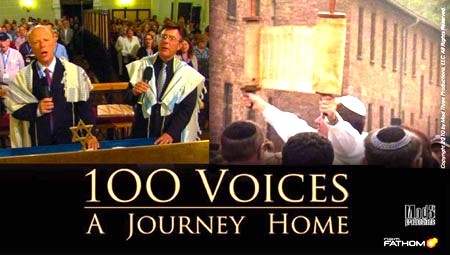
By Joe Bendel. There were more righteous gentiles from Poland than any other country. No strangers to suffering, three million Poles also died under National Socialism, while the Polish resistance forces were the only organized underground with a division specifically dedicated to saving Jewish lives. Yet, the Nazis were grimly successful cleaving apart Polish and Jewish culture, though they had been closely intertwined for centuries. In an effort to mend that breach, a group of 72 cantors made an emotional tour of Poland last June, fortuitously captured in Danny Gold and Matthew Asner’s documentary 100 Voices: A Journey Home, which began a limited engagement in New York and Los Angeles last Wednesday, following a special nationwide one-night event-screening this past Tuesday.
Tuesday’s special screening was presented under the auspices of NCM Fathom, the in-theater event specialists, which is particularly apt considering their specialty simulcasting opera. Indeed, there is a strong affinity between opera and the cantorial music of Voices. In fact, the father of two tour participants probably saved his life during the Holocaust by convincing the Nazis he was an opera singer rather than a cantor. While their music is liturgical, most cantors’ delivery is expressive and dramatic, bearing a strong stylistic resemblance to full-voiced opera singing.
After providing viewers an essential grounding in cantorial music and great cantors past (including the jazz-influenced Moishe Oysher), Voices follows the cantors on their eventful tour, organized by the forceful Cantor Nathan Lam of the Stephen S. Wise Temple in Los Angeles. Adding additional tragic significance, Polish President Lech Kaczyński was in attendance for their tour-opening command performance at Warsaw’s National Opera House mere weeks before his fatal plane-crash. It was a heavy program featuring an original composition penned by Charles Fox (probably best known for “Killing Me Softly”) inspired by Pope John Paul II’s simple prayer left at the Western Wall.
Yet, the next performances were probably even more personally moving for the cantors, including memorial performances at Warsaw’s only surviving synagogue and at the gates of the Auschwitz concentration camp. However, the tour ended on a hopefully note, culminating with an open-air concert at the Krakow Jewish Cultural Festival, organized by the Catholic Janusz Makuch. Embracing the term “Shabbos goy” Makuch has worked to foster an appreciation of Poland’s Jewish heritage since 1988 (an effort greatly aided by the fall of Communism in 1989).
While the music of Voices may not be to all tastes, precisely for its operatic quality, there is no denying its power. Beautifully recorded and presented by directors Gold and Asner with cinematographers Jeff Alred and Anthony Melfi, it should lead to a deeper and wider appreciative of cantorial music, certainly outside Judaism and perhaps within the faith as well.
Indeed, Cantor Lam’s project was notable not just for the size of the tour, but the noble intent. Recently, many religious leaders have acted provocatively, even insensitively, while claiming the mantle of intolerance (yes, I definitely mean the organizers of the World Trade Center mosque here). However, the Voices tour really was undertaken in the spirit of tolerance, seeking to strengthen ties and understanding between faiths and people. A well intentioned film executed with grace and dignity, Voices deserves an audience well past Oscar season. It plays in select theaters in New York and Los Angeles through September 28th.
Albert Speer's proposed "Volkshalle" for the Nazi capitol.
By David Ross. Nazism was history’s most despicable moral perversion and criminal conspiracy, but too often the examination of Nazism goes no farther than moral condemnation. This posture is perfectly understandable, but it does nothing to further the understanding of Nazism as a philosophy and historical development. The difficult thing is temporarily to relax the impulse to condemn and to bring a degree of detachment to the analysis of Nazism as a system of thought. As one who frequently teaches literary modernism – Yeats, Eliot, Pound, Lawrence, Wyndham Lewis – I must constantly address a certain kind of romantic conservatism, and this naturally raises questions about fascism and Nazism. I tell my students something like this: “Its not enough to call Nazism evil, though certainly it is evil. You have to consider the nature and logic of its evil. You have to engage its ideas.” At this point, I usually insert that I am myself Jewish, which lowers eyebrows somewhat. Two deeply thoughtful documentaries, one German, one American, attempt just this kind of work and make for important lessons in the history ideas.
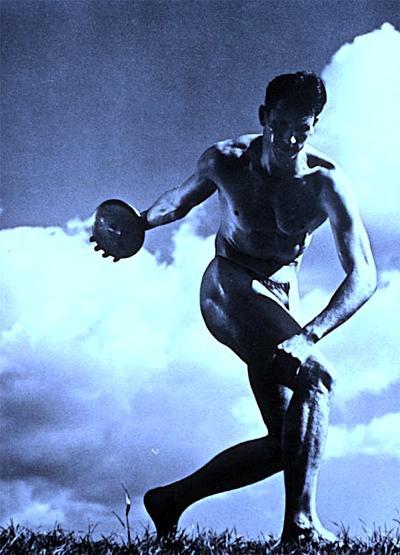
Peter Cohen’s The Architecture of Doom (1991) examines Nazi aesthetic theory and the Nazi obsession with art generally. Nazi artistic taste (a mélange of alpine-oriented romanticism and grandiose neo-classicism) was often kitschy and crass, but the Nazi cult of beauty was remarkably passionate and central. Hitler began as an artist, as everybody knows, but it’s less well known that he remained the most extraordinarily obsessed aesthete, buying and stealing works of art by the thousands and involving himself at every level with what may have been his greatest dream: the architectural recreation of Germany on a scale of classical magnificence to rival ancient Rome. The film’s crucial recognition is that Nazism’s aesthetic program partially or even largely drove its political and military program. Nazism did not conceive its program of conquest as an end in itself, but as a means of implementing the cultural and aesthetic renaissance that was Hitler’s chief fantasy. Likewise, the film clarifies the connection between Nazism’s aesthetic program and its campaign of hygiene, eugenics, euthanasia and genocide. Adulating the classical ideal suggested by the sculpture of antiquity, the Nazis conceived their murderous activities as a program of ‘beautification’ in the literal sense. The goal, according to Cohen’s film, was less to create a pure race than a physically beautiful race. The Nazis considered racial purity an indispensible basis of this beauty, but they did not necessarily consider this purity an end in itself.
From Leni Riefenstahl's "Olympia" (1936).
This aestheticism does not in the least mitigate the Nazis’ vast crimes, but it does force us to move beyond the reassuring notion that Hitler was merely a maniacal sadist, a kind of Jeffrey Dahmer with a propaganda machine and vast army at his disposal. The scarier proposition is that aesthetic ideals we ourselves may share, or at least not entirely deplore, were mixed up in the vile stew of Nazism, and that ‘beauty’ itself may become a dangerous absolutism. Is our own culture implicated in this dynamic? Obviously we are not about to launch a racial genocide, but our popular culture may want to rethink its own extraordinary emphasis on physical perfection. Though this emphasis is not likely to lead to a renewal of the gas chambers, it may someday lead to a program of genetic selection and manipulation of the kind envisioned by a film like Gattaca. Mass-murdering the living is far worse than manipulating the unborn, but both programs share the dangerous premise that human beings are fundamentally stone to be carved, clay to be shaped. In this respect, The Architecture of Doom should give us pause.
Stephen Hicks’ Nietzsche and the Nazis (2006) delivers a whopping 166 minutes of philosophical disquisition in the attempt to explain the nature and impetus of Nazism. Unlike the graceful cinematic art of The Architecture of Doom, Nietzsche and the Nazis has the feel of a college lecture filmed on the cheap. It cuts between still photographs and Hicks himself speaking against a variety of nondescript backdrops, while the text itself is at best workmanlike. And yet Hicks, a philosopher at Rockford College in Illinois and author of a book likewise titled Nietzsche and the Nazis (2006), makes a lucid and thoroughly intelligent case that Nazism was not a function of economic conditions or social psychology or personal pathology – the usual notions – but of certain strands in the history of philosophy, and that it enacted ideas that were deeply embedded in the German culture and the German philosophic tradition. Hicks mentions Hegel, Fichte, and Marx, but gives primacy to Nietzsche, whom Hitler revered. Continue reading Lessons in Darkness
By Jason Apuzzo. Let me begin by saying that this review is written for people who have not already been irretrievably burned by Oliver Stone. To those of you out there who have been irretrievably burned by Stone, you have my sympathies and my understanding – and if you feel sufficiently put off by Stone’s behavior over the years never to watch another one of his films, I will not argue the point. Stone is to blame for that, not you. So if you wish to proceed to another post here at Libertas, you have my blessings.
You would, however, be missing out on what is actually quite an enjoyable film in Wall Street 2 – a film that, much like the original Wall Street, is weirdly at odds with its creator in creating such a compelling and seductive portrait of a system the filmmaker supposedly despises. In this, Wall Street 2 becomes the latest example of a film that actually appears savvier and more insightful – not to mention warmer and more sentimental – than the man who made it.
I must confess that I was not expecting Stone’s film to be enjoyable, for at least three reasons. One, Stone’s skills as a filmmaker have atrophied significantly over the years. What originally put Oliver Stone on the map, culturally speaking, were well-constructed (if obnoxious) entertainments like Platoon and JFK. Stone’s Alexander, however, was easily one of the worst films I’ve seen over the past decade – a mess on so many levels that I can’t even imagine how the film ever got made, let alone released. And Stone’s World Trade Center seemed to miss its moment; if you think no one remembers 9/11 any more, absolutely nobody remembers Oliver Stone’s film about it. World Trade Center was an anodyne, strangely uninteresting exercise for such a voluble director as Stone – a lugubrious, by-the-numbers drama that could easily have been a made-for-TV movie, and that disgracefully avoided the subject of terrorism altogether. That Stone would avoid the subject of terrorism was not only dishonest and ideologically loaded on his part, but at odds with the drama of the moment – like making a movie about Pearl Harbor without mentioning Imperial Japan.
The third reason, of course, has to do with Stone’s compulsive politicizing of everything he does – and the Wall Street meltdown of 2008 seemed altogether too ripe an opportunity for someone with his blunderbuss sensibility – a kind of smorgasbord of possibilities to take potshots at the capitalistic system that has, of course, made his own career possible.
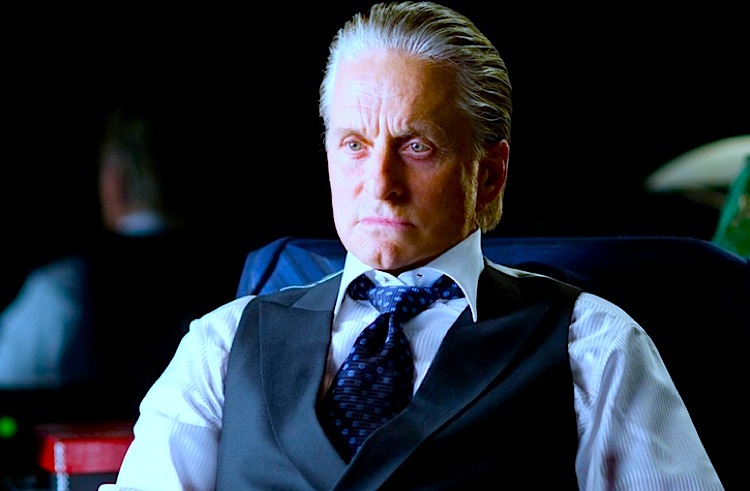
Gekko.
What I will confess to have forgotten, however, was what a seductive portrait of Wall Street Stone’s original Wall Street film was. Stories of the guys who were lured into lives as stock traders by Stone’s film – and by the magnetism of Michael Douglas’ Gordon Gekko character – are legendary, and form part of the strange and contradictory afterlife of that film as a high-end cult phenomenon. Wall Street did for The Street in the 80s what Top Gun did for the military. What Stone’s original film captured was the drama, the adrenaline rush, the heat and speed of the Wall Street lifestyle as it’s lived on a daily basis. Personal note here: I was close to two guys at Yale who were obsessed with Gekko (and American Psycho), and who got swept right into that world in the early 90s – and I mean all of that world, with its giddy, steroidal highs and humiliating lows. A world of glitzy New York penthouses, weekends in the Caribbean, coke, endless women, media scandal … and ego. Greed? Yes, there was that as well – but I never really bought the idea that what drives the guys on The Street is greed, per se. It always seemed more like ego, the desire to win – or at least, survive. More on that subject below.
And so the perverse truth of the matter is that Stone himself is as much to blame for today’s Wall Street as anybody else – which may be why he pops up occasionally in Wall Street 2, playing a cameo role an investor. [Which, incidentally, his own father was – his father having been a stock broker and a Republican who was broken by The Street and eventually went bankrupt.]
Wall Street 2: Money Never Sleeps brings this adrenaline-fueled world of Gordon Gekko back – with all its stratospheric highs and punishing lows – and updates it to the world of today, the world of the financial markets post-crash. And it attempts to incorporate what Stone has learned (if not necessarily what the rest of us have learned) from that calamity. Not surprisingly, what Stone has learned from the Meltdown is that greed was its driving force – not just the greed of the Wall Street guys (and they are depicted almost uniformly as guys in this film – there’s hardly a female in sight), but all of our greed. Greed here is defined as our current tendency to overreach, to live off little more than borrowed money and a prayer. For example: greed in the way we re-finance homes, based on … what? A desire to free up some cash without really doing anything. Or the way we leverage our other assets based on … what? Too often just a hope.
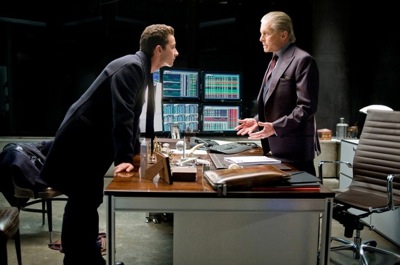
In the heat of the game.
There’s truth in Stone’s critique, of course – not nearly the whole truth about what brought down the market, but certainly enough truth to serve as a kind of moralistic backdrop to Stone’s real business, which is actually not political at all. Wall Street 2 is really about about something else altogether, which is: how to maintain one’s integrity not only in the high-pressure environment of finance, but in the ultimate high-pressure environment of one’s own family. In essence, how do you preserve your own ego – when even people you love may be putting your well being in jeopardy?
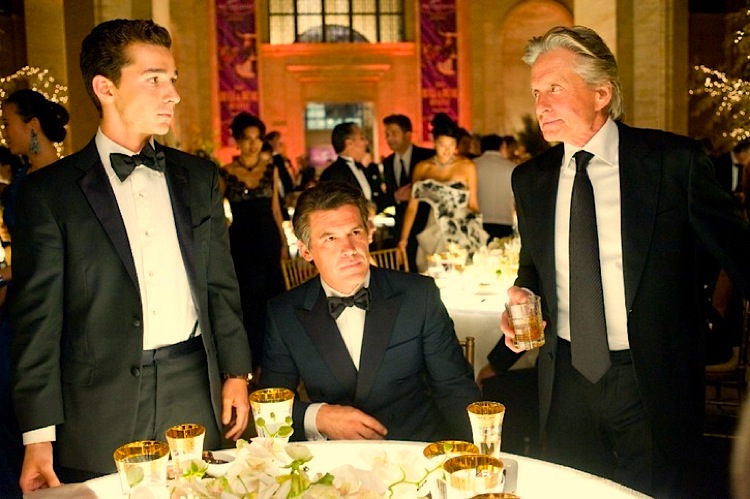
Wall Street 2 is essentially a kind of 2-hour, five-Act Shakespearean family drama that begins with Gordon Gekko leaving jail in 2001, being given back his few remaining momentos from the 80s. [This is the great scene from the trailer, when he poignantly gets his empty gold money clip back – and his gigantic, 80s-era mobile phone.] Gekko leaves the jail, walks outside into the sunlight to find … no one waiting for him. He’s become the quintessential forgotten man. Flash forward to 2008, and the central character of the film: Shia LaBeouf’s ‘Jake Moore’ character. LaBeouf is a young guy on The Street, making his way up, who has two things that define him: he’s got smarts and is street-savvy (more so than Charlie Sheen from the original film), yet he also has an ‘idealistic’ side to him that’s kept fully charged by his web-activist girlfriend (Carey Mulligan), who just happens to be Gordon Gekko’s estranged daughter, Winnie. Winnie is extremely wary of her father, blaming him for the (off-screen) drug-related death of her brother. Gekko himself by this point in 2008 has now become a ‘reformed’ man, a best-selling book author whose media jeremiads are designed to warn others off of his earlier ‘bad’ example.
WARNING: SPOILERS AHEAD
Jake and the rest of Wall Street then undergo the 2008 meltdown, in which Jake’s financial house goes down – and Jake’s soft, humanistic mentor (Frank Langella) commits suicide. There’s something extremely dramatic about these early sequences of the film, because we get the sense of real history playing out – and Stone’s handling of these moments when the Feds are trying to decide who to bail out (or not) are handled nicely. One gets the sense of the arbitrariness, the messiness and – crucially – the egos involved in deciding who was to be saved, and who would walk the plank. We all like to feel that these were clean, impartial decisions – yet we know by now that they weren’t. [Why was Lehman allowed to go down, for example, but not AIG?] These decisions were as much a result of the personalities involved as the economics, or the politics for that matter.
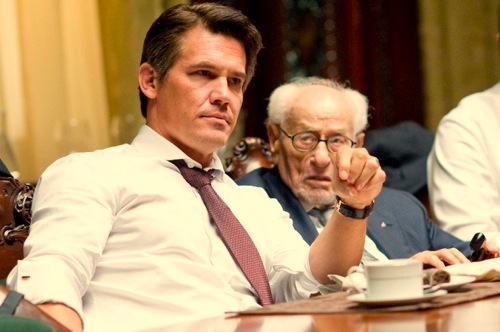
Josh Brolin as an engaging villain, Bretton James.
Although Wall Street 2 is chock-full of politics – it’s an Oliver Stone film, so how could it not be? – Stone is to be commended for indulging in no Bush-bashing here, or elsewhere in this film. These tense early sequences play as I suspect they played out in real life – which is to say, on a knife-edge of suspense, as everybody – Republicans and Democrats – stared right into the abyss. Stone avoids political finger-pointing here, recognizing the gravity of the moment. In fact, the ‘reformed’ Gordon Gekko actually speaks up early in the film for the Bush Administration – admonishing people for rushing to blame Bush’s Administration for problems that were largely beyond their control. So if you’re expecting Wall Street 2 to roast Bush and Cheney over the coals – which Stone’s increasingly bizarre and erratic interviews seem to suggest – there’s none of it in the film. The bailout is presented as having essentially been the lesser of two evils: the ‘socialization’ of the market, in order to protect from 1929 Crash Redux (only worse). Continue reading LFM Review: Wall Street 2: Money Never Sleeps
By Jason Apuzzo. There was an interesting article recently in The New York Times about a brand new film called The Black Tulip, from first-time feature director Sonia Nassery Cole – an Afghan expatriate whose day job involves running the Afghanistan World Foundation, a charity focused on refugees and women’s rights. Ms. Cole apparently fled Afghanistan as a teenager in 1979 (after the Soviet invasion), and gained notoriety at that time by writing a letter to then-President Ronald Reagan – who subsequently invited her to the White House. President Reagan would subsequently put her in contact with the Afghanistan Relief Committee, providing her with a network of philanthropic contacts that would eventually help Cole direct The Black Tulip on location in Afghanistan, in the midst of the current war.
Sonia Nassery Cole.
The Times article details the extraordinary hardships and complexities associated with getting this film made in contemporary Afghanistan – the most shocking of which reportedly involved militants locating the film’s original lead actress, Zarifa Jahon, and cutting off her feet. Jahon was subsequently replaced by Ms. Cole herself – although, it’s fair to mention, this incident has been disputed by Latif Ahmadi, head of the Afghan Film Organization – and Jahon herself currently resides in a remote part of the country, apparently unavailable for comment. In any case, Ms. Cole certainly had to deal with threats of violence, crew defections and shortness of funds, yet her film unspooled in Kabul yesterday – with a possible appearance at Sundance ahead. Afghanistan has apparently already submitted the picture as its entry for best foreign film at the next Academy Awards.
Check out the trailer for the film above. WARNING: THE TRAILER ABOVE CONTAINS MAJOR SPOILERS.
We look forward to getting a look at the film when it inevitably arrives in the States in the months to come, and we otherwise wish the irrepressible Ms. Cole the best with her film.
By Joe Bendel. It can honestly be said Ngawang Choephel’s debut documentary was over six and a half years in the making. That is how long he was unjustly imprisoned by the Chinese Communist government for the crime of recording traditional Tibetan folk songs. Of course, they called it espionage. What started as an endeavor in ethnomusicology became a much more personal project for Ngawang, ultimately resulting in Tibet in Song, which opens this Friday in New York.
Though born in Tibet, Ngawang had lived in exile with his mother since the age of two. While he had few memories of his homeland, attending the Dalai Lama’s Tibetan Institute of Performing Arts instilled in Ngawang a passion for the traditional music of his country that would cost him his liberty. Though his mother strenuously advised against it, Ngawang fatefully returned to Tibet in hopes of documenting the traditional songs before they were completely lost to posterity.
In Lhasa, Ngawang discovered the unofficial Chinese prohibitions against Tibetan cultural, religious, and linguistic identity had largely succeeded. However, like a Tibetan Alan Lomax, he found people in the provinces, usually the older generations, who were willing to be filmed as they sang and played the music of their ancestors. And then a funny thing happened on the road to Dawa.
Suddenly, Ngawang was arrested and his film was confiscated. For years he endured the abuse of a Communist prison, but he still persisted in learning and singing traditional Tibetan songs. Eventually, the Chinese government relented to the pressure of a remarkable international campaign spearheaded by Ngawang’s mother – releasing the filmmaker, who would finally finish a very different film from what he presumably envisioned.
Song is a remarkable documentary in many ways. It all too clearly illustrates the unpredictable nature of nonfiction filmmaking, as events take a dramatic turn Ngawang was surely hoping to avoid. The film also bears witness to the Communist government’s chilling campaign to obliterate one of the world’s oldest cultures. Particularly disturbing to Ngawang are the ostensive Tibetan cultural revues mounted by the Chinese government that feature plenty of party propaganda but no genuine Tibetan music. In Orwellian terms, they represent an effort to literally rewrite Tibetan culture.
Indeed, what starts as a reasonably interesting survey of Tibetan song becomes a riveting examination of the occupied nation. Ngawang and the other former Tibetan prisoners he interviews have important (and dramatic) stories to tell, many of which express the significance of song to their own cultural identity. One of the few legitimate examples of heroic filmmaking, Song deserves a wide audience. Highly recommended, it opens this Friday (9/24) in New York at the Cinema Village, and in subsequent weeks travels to art house cinemas nationwide.
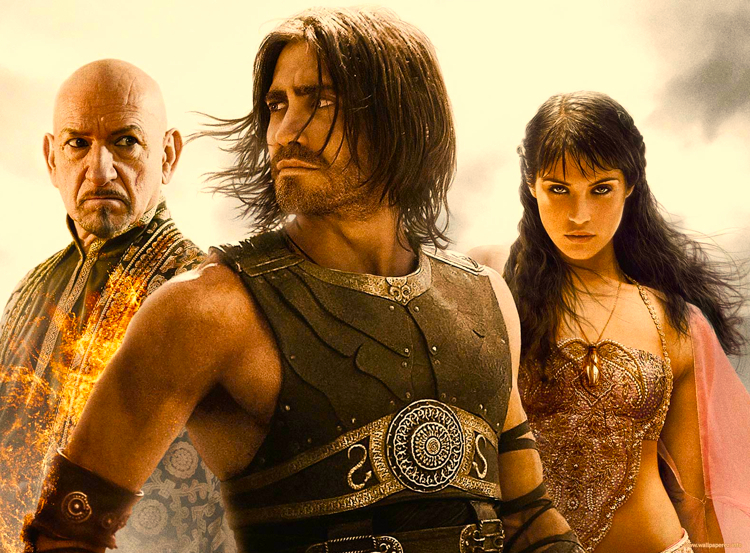
By Jason Apuzzo. The LA Times’ Patrick Goldstein apparently wasn’t very pleased with Govindini’s DVD review of Prince of Persia from this past weekend. Patrick attacked the premise of Govindini’s piece yesterday, dismissing suggestions that the film has an anti-Iraq War subtext as “far fetched,” and rather ungraciously calling the review a “screed” in a piece over at the LA Times’ site.
Govindini herself will be responding to Patrick later, but I wanted to throw in my own thoughts on the matter.
• First of all, let me begin by saying that we don’t write “screeds” here at Libertas. Patrick really should know better than that – he must be confusing us with another site. Govindini’s piece is actually rather drily written – in fact, our readers were surprised that she invested so much care and analysis into an otherwise trite film – and her argument is well-referenced with respect to details within the film. I’m at a loss to understand how anyone who isn’t ideologically-driven could possibly read the piece, or what’s on this site regularly, and refer to it as a “screed.” The only “screed” here actually is the film – not our pointing out what’s in it.
• What’s extraordinary is that Patrick’s own piece neither refutes nor even addresses any of the specific details the review made about the film. He simply passes Govindini’s entire thesis off as “far fetched,” without actually engaging any of its details. Suffice it to say that if what she’s saying is so “far fetched,” why did he feel compelled to write the article then?
• Patrick’s entire ‘refutation’ of Govindini’s thesis amounts to this: that the film’s producer, Jerry Bruckheimer, is a Republican – and therefore the film simply couldn’t have an anti-Iraq War subtext. In other words, Bruckheimer’s party affiliation alone is supposed to make the actual content of the film irrelevant.
If that’s the case – i.e., if a filmmaker’s political affiliations are entirely determinative of the content of their films – then here are a few cases I’d like Patrick to address:
How it is that ‘Republican’ Rupert Murdoch’s Fox funded and released Avatar, which more or less everyone on planet Earth (save Patrick?) agrees was as ideologically left-wing as any film Michael Moore or Oliver Stone has ever made?
How is it that ‘Republican’ Sylvester Stallone could make The Expendables, featuring a waterboarding former CIA operative as a villain?
How is it that ‘Hollywood liberals’ Steven Spielberg and George Lucas could make Indiana Jones and the Crystal Skull, featuring murderous Soviet spies bent on mind-control as villains?
How is it that ‘Hollywood liberal’ Angelina Jolie could make Salt, featuring rogue ex-communist agents as villains?
How is it that the first major Hollywood film made about Nelson Mandela (Invictus) was made by ‘right wing Republican’ Clint Eastwood? I would’ve thought good ‘Hollywood liberals’ would’ve beaten Clint to the mark on that one.
I could go on but you get the point. [I could spend an hour writing about all the left-wing content that eventually appeared in the ‘right wing’ show 24, for example.] None of these cases really make sense, if what Patrick says is true. Because actually, I dare say that it’s Patrick who is viewing things here in a somewhat simplistic manner, if he thinks that something as complicated as a film can have its meaning neatly and easily grasped by looking at the party affiliation of the producer writing the checks. I’m surprised I even have to say that to someone as otherwise savvy as Patrick is.
What we try to focus on here at Libertas – and the Stallone/Expendables controversy really demonstrated this – is the content of entertainment, rather than what ‘team’ entertainers are supposedly on.
For example, just recently we reported here at Libertas how Mad Men’s Jon Hamm made disparaging remarks about the Tea Party. It was disappointing to report that, because we like Hamm’s show here – and we suspect that a lot of people who attend Tea Parties do, as well. Interestingly, however, we haven’t stopped reviewing Hamm’s show – i.e., we haven’t junked it – just because one actor made a few injudicious remarks. Hamm’s private opinions are ultimately his own, and aren’t dispositive of the meaning of the show. It would actually be silly to think they were.
Let me conclude, though, with the real whopper line in Patrick’s article from yesterday.
There are tons of liberals in showbiz, but when it comes to big-budget studio films, all those liberals check their politics at the door. They’re trying to sell movie tickets, not make converts.
I don’t even know where to begin here. Patrick, are you kidding me? Please convey all this to James Cameron, or Oliver Stone, or Roland Emmerich – because I suspect those particular Hollywood liberals and makers of ‘big-budget studio films’ would passionately disagree with you. Your argument is as much with them as it is with us here. I don’t know how you missed the memo on this, but Hollywood has cheerfully branded itself asliberal – even if not 100% of the time – and nobody feels any compunctions any more about jamming politics into big-budget fare if they feel like it. That Rubicon was crossed long ago.
 After providing viewers an essential grounding in cantorial music and great cantors past (including the jazz-influenced Moishe Oysher), Voices follows the cantors on their eventful tour, organized by the forceful Cantor Nathan Lam of the Stephen S. Wise Temple in Los Angeles. Adding additional tragic significance, Polish President Lech Kaczyński was in attendance for their tour-opening command performance at Warsaw’s National Opera House mere weeks before his fatal plane-crash. It was a heavy program featuring an original composition penned by Charles Fox (probably best known for “Killing Me Softly”) inspired by Pope John Paul II’s simple prayer left at the Western Wall.