LFM Reviews Quiet in Odessa

Quiet in Odessa Trailer from dmitriy khavin on Vimeo.

By Joe Bendel. It has been frustrating to hear western media unquestioningly parrot the Putin propaganda line on Ukraine. Of course, that is much easier to do than actually reporting on-scene and talking to everyday Ukrainians up-close-and-personal. Fortunately, Dmitriy Khavin does things the hard way. As part of his continuing efforts to document Ukrainian cultural life and the Jewish Ukrainian experience, Khavin interviewed a diverse cross-section of Odessa’s Jewish community. Their first-hand accounts and unfiltered responses make Khavin’s Quiet in Odessa absolutely must-see viewing when it screens this Sunday at the JCC in Manhattan.

For historically painful reasons, Jews around the world have traditionally been leery of nationalism. However, the recent crisis has brought out new found feelings of patriotism in Khavin’s interview subjects, who now more readily self-identify as Ukrainians and Odessans, as well as Jews. In one case, a young Jewish Odessan has indefinitely postponed making Aliyah out of solidarity with her fellow Ukrainians.

Khavin also talks to older Jewish Odessans who, much to their own surprise, volunteered for the civilian Self-Defense Brigade. Despite their age, they are still not to be trifled with. They also represent the country’s inclusiveness, serving shoulder to shoulder with Catholic and Orthodox comrades, as well as at least one Georgian. (In fact, Ukrainian-Georgian diplomatic bonds have grown stronger at all levels, due to their unfortunate shared experiences with Putinist Russia.)

Probably the greatest revelation though, will be the surprising ties many Jewish Ukrainian have forged with Right Sector, Putin and the American media’s favorite bogeyman. In a particularly telling episode, Odessa’s senior rabbi relates how the leader of Right Sector came to him to apologize for a rash of anti-Semitic graffiti, disavowing any involvement, but pledging his group’s support painting over the provocations the following weekend. It is exactly the sort of story that should be reported, but isn’t.
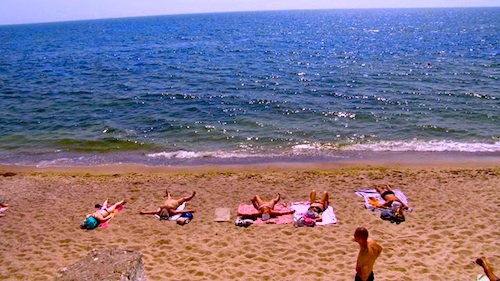
From "Quiet in Odessa."

There is also a good deal of humor in Quiet, much of it coming from the old timers at the city’s venerable bathhouse, who joke about their Jewishness in terms that would raise the eyebrows of old school borsch belt comics. Just as importantly, Khavin also conveys a vivid sense of Odessa’s old world charm and sophistication. It seems like a very livable city to call home—and a place worth fighting for.

You really have to respect Khavin’s go-and-report approach to filmmaking. He puts a very personal face on people the news media prefers to cover with broad stereotypical strokes. Yet, his micro focus yields macro insights. Frankly, this is a film that needs to reach a mass audience rather urgently. It is timely and informative, but also consistently engaging, supported by a subtle but elegant soundtrack, featuring Uri Cane and vocalist Sofiya Leavsie. Very highly recommended, Quiet in Odessa screens this Sunday (11/2) at the JCC in Manhattan. It also screens at Brooklyn’s Central Library on November 20th as part of a double bill with Khavin’s eye-opening The Territory.

LFM GRADE: A

Posted on October 30th, 2014 at 12:14pm.
LFM Reviews Crime Wave

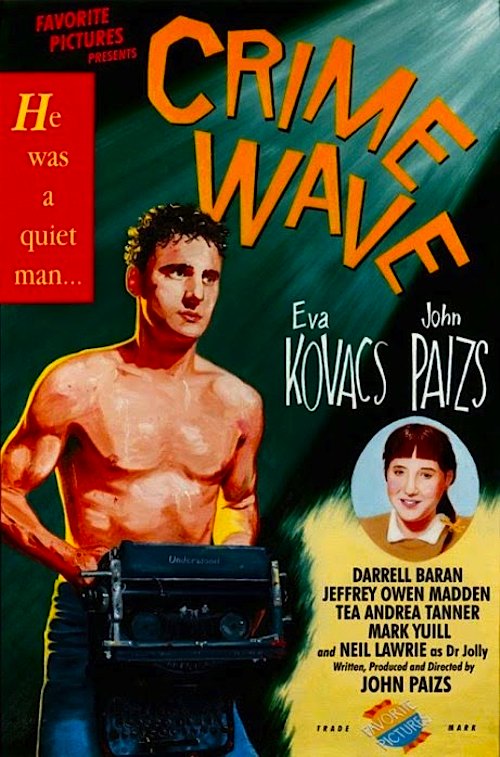
By Joe Bendel. In Winnipeg, they don’t care for black-and-white film noir. They prefer “color crime movies.” It is a strange city, as viewers should know from Guy Maddin’s My Winnipeg. Although Maddin is much better known today, John Paizs provided the Winnipeg auteur his early inspiration. One can see a kinship in their films, but Paizs’ magnum opus is truly singular unto itself. Color crime dreams turn into nightmares in Paizs’ Crime Wave, which has a special revival screening this Sunday at Anthology Film Archives.

Steven Penny is a shy loner, who rents a room from Kim’s parents above their garage. For some strange reason, the pre-teen becomes fascinated with their lodger and his ambition to write a great color crime screenplay. Each draft of Crime Wave he writes starts and ends the same way. Some eccentric field of employment (like celebrity tribute performers or self-help gurus) is dominated by a small clique that pretty much “has the racket sewn up,” until a brash upstart “from the north” blows into town “with a dream.” Apparently, they commence some sort of crime spree to usurp the competition, but just when they are poised on the brink of success, they are brought down by a violently confrontation.

How does Penny get from the beginning to the end? Unfortunately, he does not know either. Try as he might, he just can’t write middles. The frustration takes a toll on his psyche, even though Kim tries her best to be encouraging. In fact, he seems increasingly uncomfortable with her obsessive attention. However, when she finds him a potential screenwriting mentor in Kansas, the film really veers out into strange, dark territory.

With characters eventually interacting with their failed author, Crime Wave is more in the tradition of Borges or Pirandello than the early color melodramas it ostensibly spoofs. It is often quite funny, especially the successive takes of Penny’s middle-less screenplay we watch play out. Yet, there is something rather sad and slightly unsettling about Paizs’ taciturn performance as Penny. It is hard to describe the eccentric chord he strikes, but it is certainly distinctive.

The look of the film is also perfect in a perfectly idiosyncratic way. Whatever cameras and filmstock Paizs used aptly evoke the look of 1960s educational films as well as the contemporaneous color work of Douglas Sirk and Roger Corman. It is easily one of the most self-referential, postmodern films of the 1980s, but its sensibility not so far removed from a sketch comedy show like The Kids in the Hall, where Paizs did some segment directorial gigging.

It is really amazing how completely insane yet tightly controlled Crime Wave really is. It is clearly the work of a mad auteur that must be experienced from start to finish to truly get its scope and vibe. For obvious reasons, it has become cult favorite amongst Canadian cineastes. It is well worth seeing under any conditions, but especially when Paizs answers post-screening questions this Sunday (11/2) at Anthology Film Archives, because there are sure to be many and the answers will likely be a little odd. Indeed, Crime Wave is definitely recommended for color crime fanatics as a memorable way to wrap-up the weekend.

LFM GRADE: B+

Posted on October 30th, 2014 at 12:13pm.

LFM Reviews Horns

By Joe Bendel. Ig Perrish is in for some Kafkaesque body horror, but at least there will be productive side effects. Those horns he finds growing from his temples are like paranormal sodium pentothal when it comes to getting people to reveal their hidden secrets—the darker and more shocking the better. Sadly, he will employ his grim new talent to find the murder of his lifelong girlfriend in Alexandre Aja’s Horns, which opens this Friday in New York.

Perrish was a pariah in his Twin Peaks-ish Pacific Northwest town, even before the horns. Nearly everyone assumes he murdered Merrin Williams, the love of his life, who had just thrown him over. Unfortunately, he does not have one of those alibi thingamajigs, but there is no direct evidence tying him to the murder. The situation just continues fester until he wakes up with the mother of all scarlet letters sprouting from his head.

Strangely, most people hardly notice the horns and promptly forget them shortly thereafter. Nonetheless, when talking to Perrish in-the-moment, everyone develops a wicked case of TMI, answering his questions with brutally revealing honesty. Weaker characters can also be somewhat susceptible to suggestion. Only a handful of people appear immune to Perrish’s power, including Merrin Williams’ utterly bereft father and their mutual childhood friend, Lee Tourneau, who now represents Perrish as the local public defender.

Based on a novel by Joe Hill (Stephen King’s son), Horns is definitely a genre film, featuring plenty of macabre and outlandish scenes. However, it is surprisingly engaging on an emotional level, especially for a horror film, but even by the standards of conventionally square drama. Viewers will really care what happens to Perrish and mourn the pure-hearted romance that was violently cut short.

Given the horns and all, it is not surprising to find so much religious symbolism and subtext, but the film’s deep moral center comes as another pleasant surprise. While Perrish’s uncanny growths erupt after he spurns God (following an encounter with a highly judgmental clergyman) his salvation will come (if indeed it does) through the honest fate of Williams and her father Dale.

That’s all great, but Horns genre mechanics are also quite strong. Perrish’s supernaturally enhanced interrogations are quite cleverly written and often darkly comic. Yet, Aja still takes care of horror movie business, steadily building the sense of foreboding and genuine suspense.

From "Horns."

Daniel Radcliffe, who used to make kiddie movies, is terrific as Perrish, convincingly getting at his deep-as-the-marrow pain and angst, rather than hiding behind hipster bravado. David Morse manages to be even rawer, providing the film’s moral touchstone as Dale Williams. Juno Temple is almost too spritely for Merrin Williams, but Max Minghella’s Tourneau has some memorable moments too complicated to explain here.

It is debatable whether Horns is really a horror film or a dark urban fantasy, but it should thoroughly satisfy fans of both. It is a strangely powerful film that hits a heck of a lot of bases. Highly recommended, Horns opens Halloween Friday (10/31) in New York at the Village East.

LFM GRADE: A-

Posted on October 29th, 2014 at 11:49am.

More Found Footage for Halloween: LFM Reviews Hollows Grove

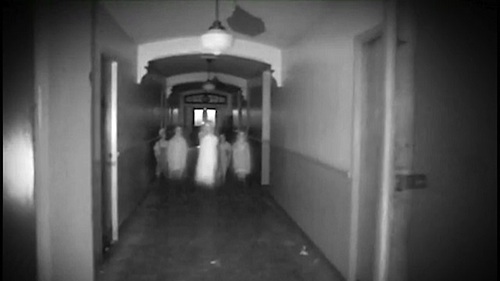
By Joe Bendel. Reality TV show crews make convenient grist for found footage horror films, because nobody will be terribly distraught when they are dispatched in supernatural fashion. That is particularly true of the on-air “talent” comprising S.P.I.T., the Spirit Paranormal Investigation Team. They will pick the wrong haunted orphanage for their ghost chasing in Craig Efros’ Hollows Grove, now available on VOD.

Grove starts out with a canned introduction from an FBI Agent thanking us for cooperating with their investigation by reviewing the footage to follow, which doesn’t make sense. Clearly, it is an attempt to shake up the found footage format, so whatever. What we will see is supposedly edited from the cameras of a S.P.I.T. crewmember and Harold Maxwell, a down-on-his-luck would-be filmmaker trying to produce a documentary on his old college buddies who made good in “reality” TV. Of course, Maxwell is quickly disillusioned when he meets retired Hollywood special effects artist Bill O’Neal, who stages all the spooky mayhem seen on the show.

To maintain spontaneity, they never know what surprises O’Neal has in store for them. This will be important to keep in mind when they start taping in Hollows Grove, an orphanage that became a dumping ground for special needs children. Residents were routinely abused, physically and sexually. At least two nurse committed suicide, in the same room, naturally enough. All that’s missing is a Nazi staff director performing black masses in the basement, but for all we know that happened too.

If the studio could successfully sue the distributors of Abby for infringing on The Exorcist, the Vicious Brothers ought to have a cast iron case to make against Grove for “paying homage” to Grave Encounters. However, Efros has a nice wrinkle with O’Neal’s presumed trickery. Since the lads assume all the weird stuff in the early stages is his handiwork, they mug for the cameras, while viewers realize they are majorly in for it. The crusty veteran FX hand also happens to be played by Lance Henriksen, who is as cool as ever in what is essentially a long cameo appearance.

From "Hollows Grove."

So yes, we have seen this before—and seen it better in the recent Taking of Deborah Logan and the original Encounters. Nonetheless, the bickering and bantering of Matt Doherty and Sunkrish Bala as the show’s co-hosts helps keep it fresh. Bresha Webb also adds some style and attitude as their somewhat bemused segment producer, Julie Mercade.

Frankly, the entire ensemble sells the madness relatively well, but the stakes have definitely been raised in the found footage game. There are several creepy sequences in Grove, but the aforementioned films are more consistently scary. It is a passably diverting haunted institution movie, but fans should have better options during Halloween. Those who order it up anyway should be warned there is a stinger, so don’t log off when the credits start to roll. For diehard Henriksen fans (and we know you’re out there), Hollows Grove is now available via VOD platforms.

LFM GRADE: C+

Posted on October 29th, 2014 at 11:48am.

LFM Reviews The Taking of Deborah Logan

From "The Taking of Deborah Logan."

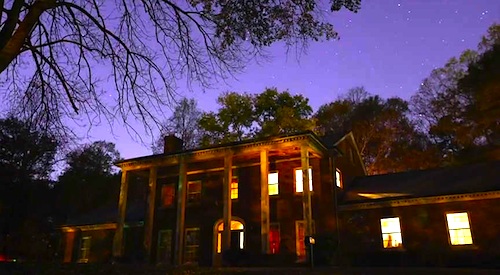
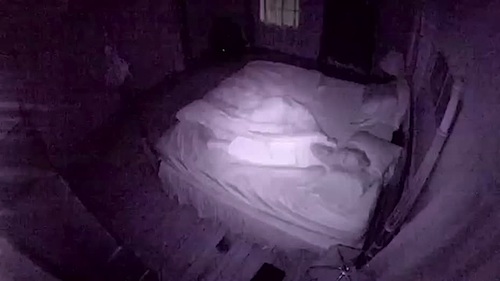
By Joe Bendel. There are three attics in Deborah Logan’s spooky old house, where evil ought to have more than enough room to supernaturally lurk about. However, the best corner for a demonic force to wreak havoc might be within her age-addled soul. A research team shooting a video study of life with Alzheimer’s will end up filming a found footage horror movie in Adam Robitel’s The Taking of Deborah Logan, which is now available on early EST (electronic sell-through), just in time for Halloween, but duly in advance of its DVD release next Tuesday.

Mia Medina’s research thesis postulates that those who care for family members with Alzheimer’s will also face long term health issues of their own, as a result. Sarah Logan appears to be an excellent case study. Dealing with her increasingly erratic mother has her at the end of her tether. Deborah Logan’s tendency to make cracks about her sexuality during lucid moments does not help much either. As a further complication, Mrs. Logan is still proud enough to resent the presence of Medina’s camera crew, but they need the fees provided by her research grant.

Initially, Medina and crew think they are merely documenting Logan’s precipitous decline, but really messed up things start happening. Eventually, Logan is hospitalized when she exhibits violent symptoms not associated with Alzheimer’s. Unfortunately, the madness only gets worse at this point. Oh by the way, you don’t suppose the ritualistic killer who once preyed on children in the neighboring towns could somehow be involved?

Yes, we have been down this dark corridor before, but Taking is shockingly scary nonetheless. Partly it is because Robitel starts the sinister uncanniness slowly, cranking up the intensity subtly and deliberately throughout the first two acts. Frankly, one sly “what the heck” moment is better than a barrage of special effects. Plus, Robitel and co-screenwriter Gavin Heffernan tap into some deeply rooted anxieties regarding the vulnerabilities of age and the resulting deterioration of the faculties. They also play on those traditional horror movie fears of getting done over by a strange unseen force.

From "The Taking of Deborah Logan."

Further aiding the cause is a far superior cast of TV veterans than ordinarily found in more-or-less straight-to-DVD releases. Sometimes funny and sometimes profoundly sad, Anne Ramsay (recognizable from Dexter and Mad About You) is terrific as the exasperated Sarah Logan. Likewise Michelle Ang (who co-starred in several long-running Australian shows) brings attitude and edginess as Medina, while it is truly frightening to watch All My Children’s Jill Larsen portray Deborah Logan’s disintegrating body and soul.

Taking is a way more effective film than skeptical horror fans will expect. It is worth noting it was produced by Bryan Singer, which gives it further genre cred (and some extra added meta awkwardness). Highly recommended for Halloween-inspired viewing, The Taking of Deborah Logan is now available via EST (not a New Age cult in Marin County) and releases on DVD next Tuesday (11/4) from Millennium Entertainment.

LFM GRADE: B

Posted on October 29th, 2014 at 11:48am.

LFM Reviews The Newly Restored The Cabinet of Dr. Caligari

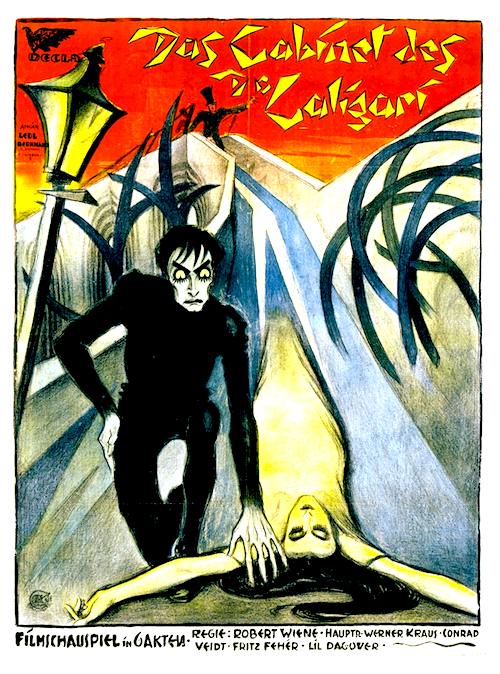
By Joe Bendel. Never ask a sideshow somnambulist when you will die. It is simply too easy for him to make his prophecies come true, especially when he is commanded by a psychotic Svengali with advanced psychiatric training. It is a mistake people still repeat in horror movies. There are a great many such genre motifs that can be traced back to this silent German classic, but the inferiority of public domain prints made it difficult to fully appreciate its feverish vision. Happily, Robert Weine’s ground-breaking The Cabinet of Dr. Caligari has been digitally restored to its original German expressionist glory, or as close to it as humanly possible. After playing to a packed house as part of MoMA’s annual To Save and Project film series, Weine’s restored Caligari opens this Friday at Film Forum.

Like the Ancient Mariner, Francis has a story that will disturb his elderly listener, but it needs to be told. It involves his rather distraught-looking fiancée Jane Olsen, and his best friend Alan. Like the German equivalent of Jules and Jim, both men openly courted Olsen, but resolved to remain friends regardless whom she chooses. Unfortunately, the choice will be made for her when the two friends attend the annual fair.

This year, Dr. Caligari has been granted a permit to exhibit his somnambulist, Cesare, by the soon to be deceased city clerk. According to Caligari, Cesare exists in a state of uncanny slumber, but can be temporarily roused to predict the future. “When will I die,” asks Alan. “At first dawn,” replies the zombie-like Cesare. Late that evening, a hulking figure roughly Cesare’s shape makes the prediction come true. Distraught over the death of his friend, Francis starts pursuing his killer, quickly focusing his suspicions on Caligari and Cesare.

Hans Janowitz & Carl Mayer’s screenplay is considerably more sophisticated than most silent era potboilers, but the ironic framing device was not their idea. In fact, it is largely thought to subvert their ideological intentions. Nevertheless, it is hard to feel comfortable with the authority Caligari represents, despite the eleventh hour twist. Indeed, Cabinet can be seen as an early example of subjective reality achieving equal standing with objective reality.

Regardless, Cabinet is a thoroughly otherworldly environment that only vaguely approximates the forms of our world. Aside from that titular box, you will hardly find any right angles in this town out of time. Instead, everything is made out of jagged lines and slanting diagonals. Janowitz and Mayer’s screenplay was conceived out of aesthetic notions of film as a truly collaborative, inter-disciplinary endeavor, where set designers would be as creatively engaged as actors, writers, and directors. Cabinet might the greatest realization of their egalitarian ideal.

Visually, it is an absolute wonder—and a disorienting horror show. The 4K restoration went back to the incomplete camera negative and the best extant prints available, adding footage typically not seen in PD cuts. The original inter-titles have been reinserted and the seemingly abrupt cuts have been augmented with previously missing frames. Gone are the hiss and scratches, replaced by a close approximation of the 1920 color tints and washes. It all looks great on the big screen—and the bigger the better.

Rather inconveniently, it is Werner Krause’s performance as Caligari that holds up best for contemporary viewers. He chews the scenery with villainous relish, shifting gears on a dime when necessary. Despite Cabinet’s lineage, Krause would become an outspoken supporter of the National Socialists and star in Veit Harlan’s notoriously anti-Semitic Jew Süss. On the other hand, Conrad Veidt would play Major Strasser in Casablanca, but he sleepwalks (in a literal sense) through the picture as Cesare. Still, the physicality and theatricality of his work have helped make Cabinet so iconic.

This is a true classic film that has lost none of its power to mesmerize, but the restoration makes it a much smoother and more lucid viewing experience. Almost a century later it remains vastly influential, even though for years it has not been shown in its true glory. Very highly recommended, The Cabinet of Dr. Caligari opens Halloween Friday (10/31) in New York at Film Forum.

LFM GRADE: A

Posted on October 28th, 2014 at 5:07pm.