Same Old Godard Agenda, Now in 3D: LFM Reviews Godard’s Goodbye to Language

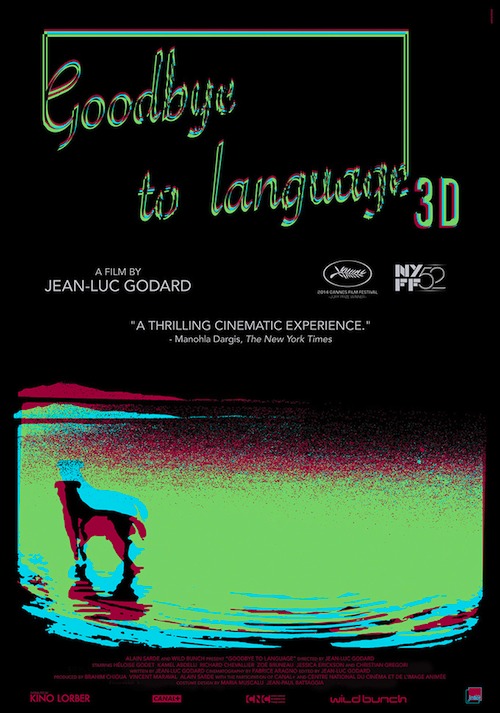
By Joe Bendel. Jean-Luc Godard might be using the latest in 3D technology, but it is in the service of his decades-old ideological and aesthetic program. He will strip away bourgeois affectations, like plot and characterization, in favor of wordplay and collage. However, all viewers are left with is Godard’s dog Miéville (playing Roxy) in Goodbye to Language, which opens this Wednesday in New York.

A single man and a married woman commence an affair. It is passionate at first, but eventually turns violent. It is a familiar story, but still promising dramatic grist in the right hands. Of course, Godard cannot be bothered to develop it. Instead, we will simply dole out fragments of the mercurial relationship, in between episodes of linguistic gamesmanship.

As is usually the case with recent Godard films, viewers had better come prepared to read, because the auteur will explicitly tell them just what and how they should think. That might sound problematic in a 3D film like Language, but Godard uses the effect to privilege certain words above others. It might be the only clever aspect of the film.

Much has been made of the superimposition of 3D images in one sequence, in which different scenes can be seen out of either eye. Unfortunately, neither is particularly interesting. Indeed, the film’s drably pedestrian visuals are arguably its greatest sin. For all of its gamesmanship, it looks stylistically similar to early 1980s experimental films, like Joan Jonas’s Volcano Saga or Double Lunar Dogs, but without similar hooks for the audience to grab onto.
Arguably, we are not supposed to luxuriate in lush imagery, because that too would be bourgeois. Godard would rather goad us with dashed off would-be profundities, such as the observation Hitler fulfilled all his promises (except, presumably that 1,000 year Reich thing), which only a Parisian Maoist could find provocative. There is so little in Godard’s kit bag this time around, he frequently resorts to the oldest, cheapest trick in the book: sudden deafening blasts of noise.

Frankly, this film has no reason for being, because Godard and his fellow traveling poststructuralists won the philosophic day decades ago. Language represents the state of critical and aesthetic thinking in today’s academia, chapter and verse. They just never had a plan for winning the peace, so the old discredited forms still hold sway over the popular culture. As if on cue, Lord Byron, Percy Shelley, and Mary Shelley (she wrote Frankenstein, get it?) pop up as representatives of the old order to be swept away. Yet, each has more currency to the lives of ordinary proletarians than any of Godard’s films have, since at least the 1980s.

3D aside, there is nothing in Language that has not been done before and done better. It is possible to jettison narrative and still produce something intriguing. Whether they speak to readers or not, the novels of Alain Robbe-Grillet are impressive, because he removes narrative and character, yet they still retain the form of mystery novels. In effect, he pulls the tablecloth out from under the place settings, without upsetting a glass. In contrast, with Language, Godard simply kicks over the table and then takes an ostentatious bow.

As a work of cinema, Language is dreadfully slight, but that is not really how it should be judged. It is really part of a wider piece of performance art, in which Godard keeps testing the limits of how little he can give the film festival intelligentsia while still maintaining their adulation. You’re being punked, so stop encouraging him. Not recommended, Goodbye to Language opens this Wednesday (10/29) at the IFC Center.

LFM GRADE: F

Posted on October 28th, 2014 at 5:06pm.
Brothers in Arms: LFM Reviews Private Peaceful

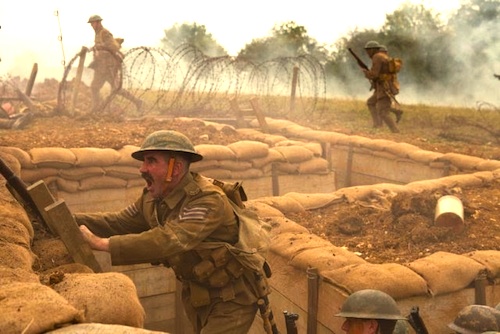
By Joe Bendel. When two movie brothers go off to war, it is a lead pipe cinch one of them is not coming back. The questions will be which one and under what circumstances. The answers will be revealed in a series of flashbacks throughout Pat O’Connor’s WWI drama, Private Peaceful, which opens this Friday in New York.

Adapted from the novel by War Horse author Michael Morpurgo, Private will incorporate the themes of Paths of Glory and Saving Private Ryan within the trenches of Flanders, but Simon Reade’s screenplay scrupulously takes its time establishing the Peaceful family dynamics before reaching that point. Charlie Peaceful is the older, brasher brother, who always looked out for the shier, more sensitive Thomas “Tommo” Peaceful. Poor Tommo will become increasingly withdrawn, first blaming himself for the death of their gamekeeper father and then watching Charlie marry Molly Monks, the childhood friend they both love, after getting her in the family way.

Initially, Tommo Peaceful volunteers as a way of escaping his broken heart, but he quickly learns the bitter realities of trench fighting and chemical warfare. Soon his brother enlists, despite his parental obligations, in order to keep Tommo alive. Naturally, Charlie Peaceful clashes badly with the gung ho Sgt. Hanley, ultimately leading to the court martial seen in deliberately cagey snippets throughout the film.

The notion that the officers and war boosters were blithely anticipating previous wars is hardly a new insight, but Private adds a clumsy element of class warfare in the person of the corpulent Colonel, who owns the estate employing the Peacefuls’ father and subsequently exploiting the Peaceful mother and brothers. “Guns and horses, that’s how we beat the Boers,” he blusters. As great as the late Richard Griffiths was (we prefer to remember him in Withnail & I rather than Harry Potter), his turn as the Colonel is total caricature.

On the other hand, the fraternal drama is rather honest stuff, quite nicely turned by two of the UK’s fastest rising stars. Private technically predates ’71 and For Those in Peril, clearly showing why Yann Demange picked Jack O’Connell as the young face of war’s chaos in the former, while George MacKay demonstrates an affinity for guilt-tormented brothers that would also manifest in the latter.

From "Private Peaceful."

In fact, O’Connell is considerably more dynamic here than he is convincingly portraying Demange’s overwhelmed fresh recruit. Indeed, it is the young cast members who carry Private, including the smaller supporting players, such as Eline Powell, who is terrific as Anna, Tommo’s potential French love interest.

While it lacks the tragic sweep of Galipoli, Private is an effectively micro-focused period anti-war film that should be considered a cut or two above standard PBS Masterpiece programming. O’Connor balances the familial drama with the horrors of war well enough in the third act, but tarries somewhat in the mid-section devoted to the difficult days following the senior Peaceful’s death. Earnest and respectable, Peaceful Private is recommended on balance for fans of British literary adaptations when it opens this Friday (10/31) in New York at the AMC Empire.

LFM GRADE: B-

Posted on October 28th, 2014 at 5:05pm.

LFM Reviews Night of the Living Dead @ The Anthology Film Archive

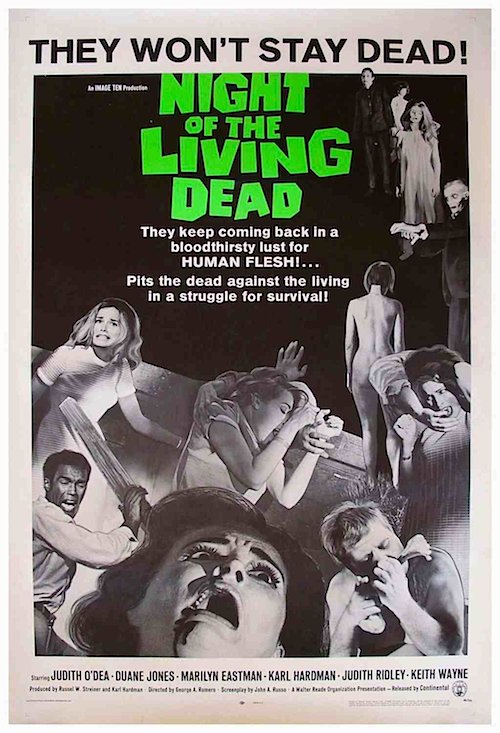
By Joe Bendel. It was the very last film ever screened at the late, lamented Two Boots Pioneer Theater. Obviously, they had no intentions of going quietly. It was also one the few films broadcast on MTV at the height of its 1980s cool cachet and now holds a richly deserved spot on the Library of Congress’s National Film Registry. Yet, the auteur who would inaugurate the zombie genre spent years whipping up commercials for Pittsburgh television as one of the principals of the Latent Image production house. Rightly and necessarily, George A. Romero’s The Night of the Living Dead screens together with a selection of his commercial work as part of Anthology Film Archive’s Industrial Terror film series.

Somehow this film is just as potent the twentieth or thirtieth time around. As you really ought to know, at least according to the LOC, the original Living Dead follows the plight of a group of strangers stranded in a farm house during a mysterious zombie apocalypse. Yet, despite the peril outside, they end up turning on each other.

It is a simple formula many have tried to replicate, but never with the same success. Romero masterfully doles out information via the unreliable media, using zombies sparingly in the second act. Instead, he relies on human nature to build the tension. Of course, he delivers the zombie cannibalism when he is good and ready.

On yet another repeat viewing, a few things jump out about Living Dead. After witnessing her brother’s death, the character of Barbra spends the rest of the film in a state of shock, which we rarely see in horror movies, but it is a much more believable response than dropping a series of ironic pop culture references.

While it has been said before, Duane Jones really should have become a much bigger star. He immediately instills viewer confidence as Ben and the subtle manner in which he takes a protective interest in Barbra is quite touching. A few more of him and things might have turned out better.

Keith Wayne’s Tom also serves as an effective audience surrogate. He is the sort of conciliator you want in your life boat and he is handy with tools. Yet, it is probably Bill Hinzman who truly made the film. As the first zombie in the cemetery, his gaunt face has become an iconic image of cinematic zombies.

Decades later, Living Dead’s conclusion remains the same stinging slap in the face. Indeed, it all holds up remarkably well. You have seen it before, but this is the perfect venue to see it again, along with some apt commercial selections, including a groovy riff on Fantastic Voyage for Calgon and a racially-themed presidential campaign spot, which should scare the willies out of everyone with the prospects of a McGovern administration. Highly recommended under any circumstances, the original black-and-white (non-colorized) Night of the Living Dead screens this Saturday (10/25) and Tuesday (10/28) at Anthology Film Archives, as part of Industrial Terror.

LFM GRADE: A

Posted on October 23rd, 2014 at 3:50pm.

LFM Reviews The Return @ The 2014 Margaret Mead Film Festival

By Joe Bendel. There are those who use the term “right of return” as a holy mantra, but if it were ever granted to the Jewish diaspora in every country that ever dispossessed their Jewish citizenry, nearly all of Europe and the Middle East would face serious legal implications. However, at least one nation would readily welcome them back. That would be Poland, which has embraced its Jewish history in recent years, even though its Jewish population remains small. Nevertheless, there are a significant number of Poles who belatedly learned of their families’ secret Jewish heritage in the post-Communist era. In very different ways, four such women will chose to embrace their Jewish roots in Adam Zucker’s The Return, which screens during the American Museum of Natural History’s 2014 Margaret Mead Film Festival.

During the National Socialist occupation, anyone whose family was the smallest part Jewish had every reason to keep it secret. The circumstances were somewhat less dire under Communism, but it is important to remember the atheistic Party periodically launched its own anti-Semitic campaigns. However, in a modern Poland shaped by Walesa and Wajda, attitudes are dramatically different. In one scene, we see a long abandoned provincial synagogue with the words “Jews, we miss you” scrawled across it, in a weird but affecting graffiti tribute.

Tusia and her boyfriend are scouting that building, hoping they can repurpose it into some sort nonprofit that will serve both the local town and pay tribute to those who once worshipped there. However, their future is uncertain, because they both feel the lure of Bushwick, Brooklyn (there’s no accounting for taste). In fact, all four women profiled share a common dilemma. Do they stay in Poland to rebuild the Jewish community or do they go abroad for the sake of their families and careers? Both Kasia, a leftwing activist, and Maria (who alone among Zucker’s subjects was born and bred Orthodox) find the grass is greener in Israel, either for academic research or raising children. Similarly, Katka, a Slovakian Orthodox convert, will debate where she should pursue her studies.

From "The Return."

One of the great ironies of Return is the sort of ambiguous state Kasia and those whose mothers were not Jewish find themselves in. While not technically considered Jewish, they would have been more than Jewish enough to be persecuted under the previous regimes. It is a thorny question that the Kasia and Katka resolve in their own ways.

Together with films like 100 Voices: a Journey Home, Return presents a more complete portrait of the tolerant, modern day Poland that deeply mourns its Jewry lost to National Socialism and further repressed by Soviet Socialism. It even has some celebrity cachet, thanks to Matisyahu, whose performance at the Krakow JCC clearly held a great deal of personal significance for the performer. However, the film’s POV figures are maybe not as consistently riveting as one might hope. Nonetheless, it is a laudably optimistic film that offers a lot of helpful context and food for thought. Respectfully recommended, The Return screens this Saturday (10/25), as part of this year’s Margaret Mead Film Festival.

LFM GRADE: B

Posted on October 23rd, 2014 at 3:50pm.

LFM Reviews Viktor

By Joe Bendel. Perhaps for his next action picture, Gérard Depardieu could team up with fellow friend-of-Putin Steven Seagal to fight for lies, injustice, and the Neo-Soviet way. Best of all, he would not pay any French taxes on his earnings. Another strange chapter in the Depardieu saga opens with Philippe Martinez’s bizarrely watchable Russian payback thriller Viktor, which opens tomorrow in New York.

After doing a seven year stretch in his native France, expatriate art thief Viktor Lambert has returned to Russian to get to the bottom of his son Jeremy’s murder. Plutova, a hot Russian copper, immediately puts him on notice not to try any gangster stuff. She also requests his “assistance” tracking down a still missing masterwork heisted from the modern art museum. Of course, Lambert has different ideas.

With the help of his old art thief-choreographer crony Souliman, Lambert figures out his son was killed by an elite gang of gem smugglers, in about fifteen minutes of highly motivated asking-around. However, before he can go on the offensive, Lambert will need a place to stash his son’s pregnant girlfriend. Fortunately, his old flame Alexandra Ivanov has a country home and a couple of loyal retainers to spare. There will also be a day trip to Chechnya, where Jeremy Lambert is inexplicably buried.

From "Viktor."

Granted, Martinez rather forthrightly presents the gangsterism running rampant in Putin’s Russia, but watching Depardieu stomp through the streets of Moscow just makes the head spin. Wisely, most of his action scenes have him hunkered down behind the wheel of a speeding car or trading gun shots from a fixed cover position. At least we cannot hear him audibly wheeze, like in Chabrol’s Inspector Bellamy.

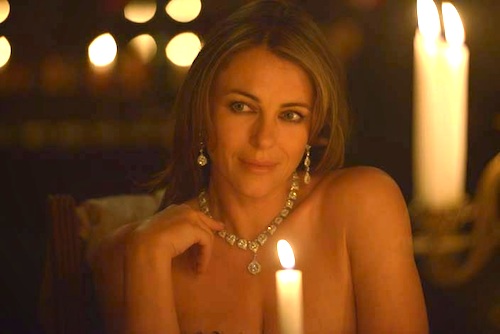
Regardless, nobody should ever doubt Elizabeth Hurley’s acting chops ever again, because as the sultry Ivanov, she never busts up laughing during her romantic afterglow scenes with Depardieu. In fact, she brings some spark and presence to the proceedings. Likewise, Eli Danker’s Souliman is hardly shy when it comes to fretfully chewing the scenery and Evgeniya Akhremenko is appealingly cool and severe as Plutova. Unfortunately, the villains are a rather dull, forgettable lot.

Technically, Viktor is perfectly presentable, sporting a suitably noir sheen thanks to cinematographer Jean-François Hensgens (whose credits include the super-charged District 13: Ultimatum). Still, it is awfully hard to get one’s head around Depardieu, the action hero, in Chechnya. Recommended for members of the U.S.-Putin Friendship Society, Viktor opens tomorrow (10/24) in New York at the Cinema Village.

LFM GRADE: D+

Posted on October 23rd, 2014 at 3:49pm.

LFM Reviews Revenge of the Green Dragons

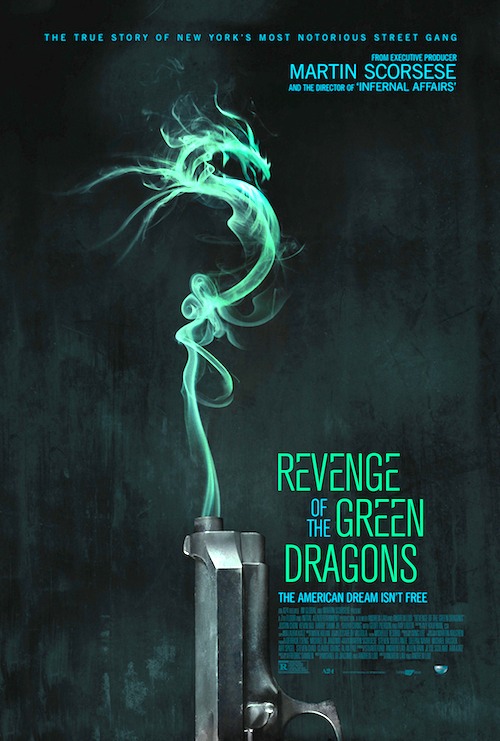
By Joe Bendel. The 1980s were glory days for Queens, especially 1986, unless you were working in virtual slavery to pay off the human trafficker who brought you into the borough illegally. Sonny and his adopted brother Steven will be two of the ostensibly lucky ones who are recruited by the Green Dragon street gang, but their life expectancy will be limited. Survival of the fittest comes with a code of silence in Andrew Lau & Andrew Loo’s Revenge of the Green Dragons, which opens tomorrow in New York.

Nobody has to tell Sonny life is not fair. When his mother died during the harsh passage over, the traffickers forced Steven’s mother to take him in. They never warmed to each other, but the boys became fast friends and sworn brothers. For years, they were relentlessly bullied, until a Green Dragon leader intercedes. Soon they are rising through the ranks, especially the even-keeled Sonny.

There are many Asian gangs in 1980s Queens, but the Green Dragons are the most sophisticated and badassedest. Paul Wong, their benefactor, represents the Dragons in the board room, but in the backroom, they are led by Snakehead (who is presented like she is Fu Manchu’s daughter). Wong has engineered a grand scheme that will give them a stranglehold on the Queens Heroin trade, but Steven jeopardizes the established order when he kills a white guy by mistake.

Sadly, Andrew Lau does not replicate the magic of Infernal Affairs in Queens. There is a fair amount of violence, but the film is caught betwixt and between an issue-driven immigration morality tale and a gangster thriller. Frankly, it is spectacularly tone-deaf, constantly interrupting the action with loaded video snippets of Presidents Reagan and Bush I. It is not just heavy-handed. It also confuses the narrative thread by cutting away to a Reagan speech on immigration during the early 1990s.

The FBI agent Michael Bloom is another case in point. Presumably, he represents the racist Federal government, constantly issuing dire warnings about the Asian mobs, but since he is played by Ray Liotta with his usual energy and attitude, he comes to be an audience favorite, since he at least relieves the boredom. Indeed, even though the film wears its immigration heart on its sleeve, it is hard to envision many viewers walking out of a screening convinced we need a “pathway to citizenship” after watching the Green Dragons racketeering, raping, and murdering with abandon.

From "Revenge of the Green Dragons."

It is a shame Green Dragons wastes a likable lead like Justin Chon. Some will know him from the Twilight franchise, but AAIFF patrons will recognize him from festival fare like Innocent Blood and the excellent short Jin. He develops some finely wrought chemistry with Shuya Chang’s Tina, the daughter of a former HK celebrity now beholden to Wong’s patronage. Unfortunately, the film cuts them off just as they are getting started. It also completely wastes Eugenia Yuan (Cheng Pei-pei’s daughter) as Snakehead.

Admittedly, Lau and Loo turn a heck of a twist down the stretch, but it feels like it takes much longer than the film’s ninety-some minutes to get there. Despite some nice performances, it is an awkward mishmash that is too heavy on message and too light on fun. Disappointingly not recommended, The Revenge of the Green Dragons opens tomorrow (10/24) in New York at the Village East.

LFM GRADE: D

Posted on October 23rd, 2014 at 3:48pm.