LFM Reviews Vultures of Tibet @ The 2014 Margaret Mead Film Festival

By Joe Bendel. If ever there was a documentary short that cried out for the IMAX treatment, this would be it. The expansive vistas are truly breathtaking, but this is not merely travelogue. It is a scathing critique of cultural insensitivity and exploitation, shot guerilla style without the sanction of the Chinese authorities. That is usually a promising indicator and Russell O. Bush’s Vultures of Tibet is no exception. Indeed, it is a particularly fitting selection of the American Museum of Natural History’s 2014 Margaret Mead Film Festival, which screens the twenty-one minute documentary this weekend.

The Tibetan “Sky Burial” represents a supreme act of Buddhist charity, in which the body is offered to the great Griffon Vultures, closing the great cycle of life. However, photos and videos of the vultures devouring bodies of the devout have become a crass internet sensation, inspiring a cottage industry of wildly inappropriate tours.

Although Westerners also come to gawk, it is the Chinese sightseers who seem to be particularly invasive. Clearly, there are multiple meanings to the titular vultures, who become a metaphor for a metaphor. Obviously, the Chinese tourists are vulture-like intruders, but they are really manifestations of a wider, more insidious cultural and political exploitation.
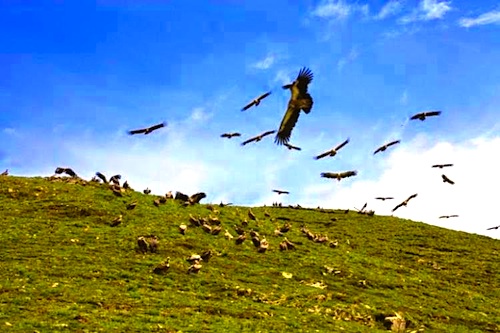
From "Vultures of Tibet."

For greater perspective, Bush interviews several Tibetans, maintaining the integrity of their commentary, but re-recording their responses with the voices of Tibetan exiles to preserve their anonymity. Like the best Iranian films, much of the credits are simply ascribed to “anonymous,” which says quite a bit about the human rights situation for average Tibetans.

Vultures is a particularly effective film, because it is not overtly political, per se, but the implications are inescapable. It is also quite impressive on a technical level, with considerable credit due to cinematographer Drew Xanthopoulos for the incredible shots he captured. It is a challenging work that ought to strike a nerve with festival patrons. Highly recommended, Vultures of Tibet screens this Saturday (10/25) with Tender (an Australian funerary-themed feature doc), as part of this year’s Margaret Mead Film Festival.

LFM GRADE: A

Posted on October 23rd, 2014 at 3:47pm.
LFM Reviews 1,000 Times Good Night

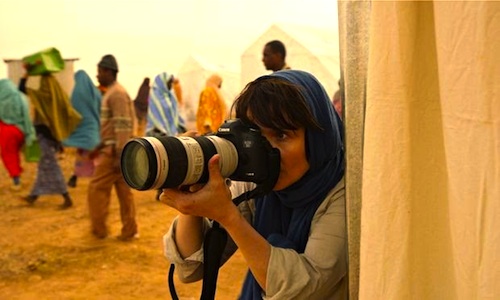
By Joe Bendel. Yes, women have also become homicide-suicide bombers in Afghanistan. An Irish photojournalist with the hints of a French accent has the photos to prove it. In fact, she could not stop taking them, contributing to a premature detonation while she was still within the general blast area. She survives, but the damage done to her family unit will be harder to patch-up in Erik Poppe’s 1,000 Times Good Night, which opens this Friday in New York.

If you find it problematic to compulsively document (and consequently somewhat fetishize) a terrorist bomber’s final hours, than congratulations. You had the appropriate human response. On the other hand, Rebecca argues that she is bearing witness to the inhumanity of the world, but at some point bearing witness will come to resemble abetting through inaction.

Good Night’s opening sequence consists of some truly provocative, visceral stuff, but to really understand it, you also have to see the symmetrically related conclusion. Ultimately, the film forces Rebecca to confront the ethics of her calling in gut-wrenching, soul-churning terms. However, to reach that point, we have to slog through some just okay family drama.

When Rebecca is finally discharged from the hospital, she has clearly lost a step physically and might be gun-shy for the first time in her career. Her marine-biologist husband Marcus is ready to divorce her and their daughters are emotionally reeling from the near permanent loss of their often absent mother. Frankly, the youngster bounces back faster than moody teenaged Steph, perhaps because the older girl better understood the circumstances. For the sake of her family, Rebecca resolves to retire, but maybe she can be convinced to take Steph on a bonding tour of a Kenyan refugee camp, because it’s absolutely, positively safe as houses.

From "1,000 Times Good Night."

If Juliette Binoche ever gave a bad performance, the sun might start orbiting the earth. In fact, she is admirably restrained, given the horrors her character witnesses and the bodily and spiritual wounds she suffers (had Meryl Streep overacted the part in her place, she would have been rending her garments and howling at the moon). Instead, Binoche smartly and convincingly portrays a woman forced to emotionally blinker herself, for survival’s sake.

While the mother-daughter melodrama becomes tiresome over time, Lauryn Canny is still quite impressive as Steph. Likewise, Game of Thrones’ Nikolaj Coster-Waldau does his best to scratch out something as the long suffering hubby. U2 fans should also keep their eyes open for Larry Mullen, Jr, who is perfectly respectable as Tom, a friend of the family.

1,000 Times is an uneven film, but when it does connect, it is with a haymaker. You have to keep with it, but it is worth it if you do. Recommended on balance, 1,000 Times Good Night opens this Friday (10/24) in New York, at the Quad Cinema.

LFM GRADE: B

Posted on October 22nd, 2014 at 8:32pm.

Bigfoot Returns: LFM Reviews Exists

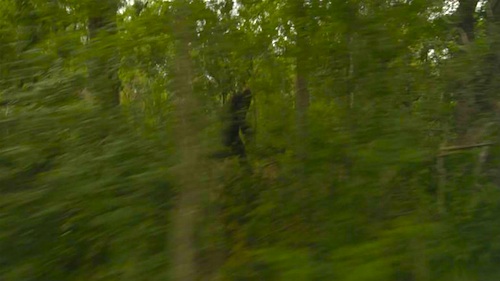
By Joe Bendel. It turns out Bigfoot is as big and blurry as he looks in photos. Frankly, it is probably smart not to show too much of your monster, too soon. Of course, if anyone knows their way around a found footage horror film it is Blair Witch and VHS2 co-director Eduardo Sánchez. An annoying camera geek will naturally have the tools to document the mayhem when a group of friends get on Sasquatch’s bad side in Sánchez’s Exists, which opens this Friday in New York.

For some reason, Uncle Bob stopped going to his rustic hunting cabin, so his nephews Matt and Brian had to steal the keys for a weekend getaway. Convinced it will be Shangri-La up there, they drag along Matt’s girlfriend, their pal Todd, and his girlfriend. Actually, their friends are more Matt’s than Brian’s. Matt is the brooding, popular brother, while Brian is the goofy one who hopes to post a Bigfoot video on YouTube. Oh, he’ll have some footage alright. However, he was asleep when their car hit some sort of mysterious furry object.

No, whatever it was, it was not a deer. The state of Uncle Bob’s cabin is also a bit of a buzz kill. It sure looks like he left in a hurry. Nevertheless, the five not-as-young-as-they-act partiers start drinking and getting on each other’s nerves before Bigfoot basically lays siege to the joint. Unfortunately, ‘Squatch is probably the smartest character in the film.

To be fair, Chris Osborn is not bad as Brian, nibbling on the scenery here and there. In contrast, the rest of the ensemble is so nondescript viewers will hardly remember them from scene to scene. Still, the Sasquatch could serve as a highly credible Wookie audition for big and athletic Brian Steele.

From "Exists."

Exists is like the Busch Beer of horror movies. If you want to sit back and savor a drink, there are much more refined options, but if you just want to get hammered, it will get the job done. We have seen found footage of plenty other cabins in the woods, but Sánchez has a strong command of the genre mechanics. Shrewdly, he keeps the big harry one under wraps in the early going, framing some rather effective what-did-we-just-see-out-of-the-corner-of-our-eyes shots.

Even if it does not break any new genre ground, Exists is a lean and brisk foray into the dark woods, thanks to Mike Elizalde’s creature design, Andrew Eckblad and Andy Jenkins’ tight editing, and Sánchez’s willingness to occasionally fudge the found-footage format. There are better Halloween selections screening during Anthology Film Archives’ Industrial Terror series, but there are far worse possibilities at the multiplex. It opens this Friday (10/24) in New York at the AMC Empire.

LFM GRADE: C+

Posted on October 22nd, 2014 at 8:32pm.

LFM Reviews The Gold Spinners @ The 2014 UN Association Film Festival

TheGoldSpinnersTrailer2 from Taskovski Films on Vimeo.

By Joe Bendel. He was Soviet Estonia’s Don Draper, the only Mad Man operating in a barking mad system. Thanks to a unique set of circumstances, his Esti Reklaamfilm (ERF) Studio prospered nicely as the only production house for television commercials in the USSR. Peedu Ojamaa looks back on his strange but groovy career in Hardi Volmer & Kiur Aarma’s The Gold Spinners, which screens as part of the 2014 UN Association Film Festival in the Stanford area.

Ojamaa started at as a cub reporter, transitioning into newsreel production, specializing in uncommonly watchable reports, at least by the admittedly dismal standards of the Soviet media. Of course, Estonians were familiar with the TV commercial as a concept, because they were furtively watching Finnish broadcasts (by all means, see Aarma’s even more rollicking Disco and Atomic War for the full glorious story).

Why oh why, would a Socialist Workers’ Paradise need something as crassly capitalistic as the commercial spot? To help perpetuate certain illusions, such as the non-existent demand for some state-mandated products. Conversely, even though scarcities like butter and sugar would immediately sell-out anyway, ERF’s commercials created a false image of plenty.

From "The Gold Spinners."

Arguably, Ojamaa became the first crony capitalist when Soviet planners, in their infinite wisdom, declared one percent of all state enterprises’ annual budgets had to be spent on advertising. As a result, ERF probably produced spots for products that never really existed—and the likely examples are pretty incredible to behold. Frankly, many of ERF’s commercials are considerably more entertaining than Super Bowl ads, like animator Priit Pärn’s energy conservation PSA. While prudish Party censors maintained a tight rein on programming, ERF was also apparently “free” to pursue the old adage “sex sells,” so parents be warned.

Granted, there is a good deal of nostalgia for the work ERF produced, but no illusions regarding the corruption and inefficiency of the Soviet Socialist system. One might say, Volmer and Aarma treat the Communist era with the irony it deserves. Regardless, the impish humor of both the film and the commercials it documents are quite winning.

Indeed, Spinners has the same punchy editing, subversive humor, upbeat soundtrack, and wickedly insightful cultural-political history that made Disco such a blast. Aarma and his collaborators on both films prove documentaries can be wildly entertaining and enormously informative at the same time. Very highly recommended, The Gold Spinners screens this Sunday (10/26) as part of session 29 of this year’s UNAFF.

LFM GRADE: A-

Posted on October 22nd, 2014 at 8:31pm.

LFM Reviews The Darkside @ The 2014 Margaret Mead Film Festival

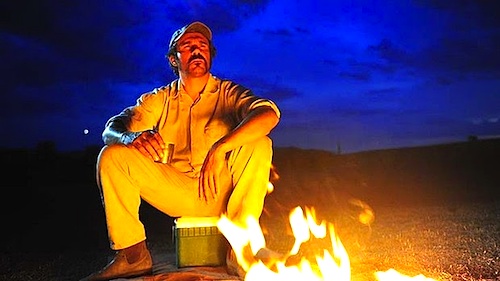
By Joe Bendel. It is sort of like ethnographic research for the campfire. Indigenous filmmaker Warwick Thornton invited Australians to submit stories about their interactions with the spirit world as part of a larger oral history project with an aboriginal focus. However, the results were not always as spooky as he expected. Family and loss are the primary themes of the thirteen tales re-told by screen-actors in The Darkside, Thornton’s documentary by monologue, which screens during the American Museum of Natural History’s 2014 Margaret Mead Film Festival.

Like nearly every anthology film, Darkside is a bit uneven, but Thornton, serving as his own cinematographer, always gives his static shots a warm eerie glow befitting the subject matter. By far the scariest story (and the one most riveting to watch) chronicles the tragedy wrought on the narrator’s family by a cast-off Ouija board. Occasionally, Thornton breaks format, as when he pans and scans the darkened corridors of the National Film and Sound Archive. Another more traditionally creepy tale of the supernatural, it should particularly interest AMNH patrons, since it involves poet Romaine Moreton’s brush with the malevolent spirit of Sir Colin Mackenzie, the notorious director of the discredited Australian Institute of Anatomy, whose building was repurposed to serve as the film archive.

For fans of 1980s movies, it is quite amusing to see Bryan Brown turn up as one of the storytellers, but his yarn does not have the archetypal weight of the better installments. Easily, the most emotionally resonant tale is logically the final chapter, whereas the penultimate segment features the liveliest delivery. Oddly, the weakest anecdote, a mere sketch about a traditional aboriginal grandfather’s response to a lunar eclipse apparently inspired the one-sheet, but at least most of the constituent ghost stories hold some sort of deeper cultural significance.

From "The Darkside."

Executed with tremendous sensitivity, Darkside is a quiet film that takes its time finding its footing, with some of the earlier stories feeling like warm-ups for the heavier stuff to follow. It is a bit unusual to have a Margaret Mead selection that is so appropriate for Halloween programming, but its concern for indigenous people and oral history nicely fits the festival’s mission. More elegiac than scary overall, The Darkside is recommended for viewers interested in indigenous Australian culture and the ghost story-telling tradition when it screens this coming Sunday (10/26) at the American Museum of Natural History as part of this year’s Margaret Mead Film Festival.

LFM GRADE: B

Posted on October 22nd, 2014 at 8:30pm.

LFM Reviews Kismet @ The 2014 Margaret Mead Film Festival

By Joe Bendel. Many of them sound more like telenovelas than soap operas, but whatever you call them, Turkish television serial melodramas are doing boffo business internationally. Bulgaria and Greece are important markets, but the popularity of Turkish television has exploded in the Middle East. Greek filmmaker Nina Maria Paschalidou documents the progressive influence of Turkey’s primetime soaps in Kismet, which screens during the American Museum of Natural History’s 2014 Margaret Mead Film Festival.

Only in the Middle East could a series about a sultan and his harem be considered liberal and progressive. That would definitely be the awkward case study in Kismet. A far better example is Fatmagul, an extraordinary bold drama following a woman’s quest to bring her three rapists to justice. In the Islamist world, that is explosive stuff. Other shows frankly address issues such as arranged marriages to child brides, spousal abuse, and genital mutilation, inspiring women to speak out and even seek divorces. Not surprisingly, one misogynistic bureaucrat in the Emirates’ Department of Religious Affairs launches into quite a tirade against Turkish television (it goes without saying, but if your government has some sort of Department of Religion, you probably live in a theocratic fever-swamp).

Paschalidou profiles the fans who watch the programming, the cast-members they adore, and the creative staff (often led by women) who put them together and keep them going. While the strongest sequences focus on the Middle Eastern market, she also interviews fans in Bulgaria and Greece (where there is also growing resentment of Turkish programming, not for ideological reasons, but simply due to its Turkishness).

From "Kismet."

Frankly, Kismet’s execution will not blow anyone away, but the premise is fascinating. Paschalidou vividly illustrates her points with film clips shrewdly selected for their taboo-breaking content and their inherent theatricality. You are unlikely to see any of these shows picked up by American broadcasters anytime soon, for a variety of reasons. Still, a program like Fatmagul really ought to be available to some extent, just for the way it uncompromisingly reflects the violence and exploitation of women endured by women in the Middle East (and the greater Islamic world).

Having received production support from Al Jazeera and clocking in at about an hour, Kismet definitely has the feel of a television special report, albeit one of reasonable depth and substance. However, you are unlikely to see the hidebound news media tackle this subject, so intrigued viewers should see it now. Recommended for patrons concerned about global women’s rights, Kismet screens this Friday (10/24) at the AMNH, as part of this year’s Margaret Mead Film Festival.

LFM GRADE: B

Posted on October 22nd, 2014 at 7:47pm.