He Had His Day: LFM Reviews The Dog

By Joe Bendel. It was late in the Lindsay administration. New York really was becoming the grungy crime-ridden vice pit largely sustained by attitude people remember with such strange fondness. John Wojtowicz helped paint that picture. True, there is more to his story than the ill-fated bank robbery immortalized in Sidney Lumet’s Dog Day Afternoon, but there is no getting around that notorious incident in Brooklyn. Wojtowicz speaks for posterity (and he is not shy about it) in Allison Berg & Frank Keraudren’s The Dog, which opens this Friday in New York.
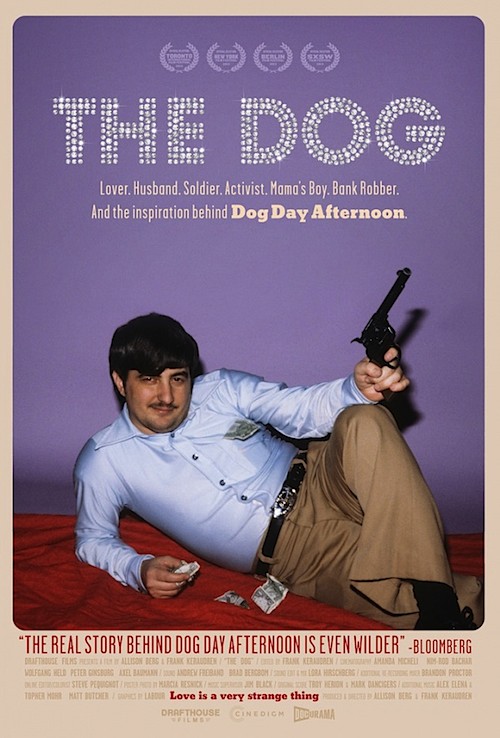
For the record, Wojtowicz did his time in Lewistown, not Attica. Arguably, he was a something of a gay marriage pioneer, wedding his lover Ernest Aron (subsequently known as Liz Debbie Eden) in a Catholic-aping ceremony. It was a troubled union, mostly because of Aron’s discomfort living as a man. Initially, Wojtowicz opposed the gender re-assignment surgery, but he eventually relented. Of course, that would cost money. Recruiting two accomplices from the scene, Wojtowicz hatched a very half-baked plan.

The late Wojtowicz (adopting the moniker of “The Dog”) sounds every bit the tough talking, unapologetic New Yorker viewers would expect. His interviews dominate Berg & Keraudren’s film, for obvious reasons. They also evoke plenty of the era’s seedy atmosphere, while documenting the early years of New York gay activism. It definitely has value as a time capsule, but it does little to burnish Lindsay’s reputation.

In addition to Wojtowicz, Berg & Keraudren talk to nearly all of the surviving principles, including his first “legal” wife, Carmen Bifulco, and George Heath, the third wife Wojtowicz met in prison. Clearly, the man was not shy or commitment phobic. Unfortunately, Eden and Lindsay have long since passed.

Berg & Keraudren keep the pacing brisk, never getting overly fixated on any particular tribulation. While the film holds unmistakable GLBT interest, it should also appeal to true crime audiences. Recommended for old school New York nostalgics, The Dog opens this Friday (8/8) in New York at the Elinor Bunin Munroe Film Center uptown and the IFC Center downtown.

LFM GRADE: B

Posted on August 8th, 2014 at 1:32pm.
LFM Reviews The House at the End of Time @ The 2014 Fantasia International Film Festival

By Joe Bendel. Like many Venezuelans, Dulce has spent long years in prison for crimes she did not commit. However, she is not a political prison. She was simply blamed for the supernatural tragedy that unfolded in her house. Considered the first Venezuelan horror movie, Alejandro Hidalgo’s The House at the End of Time had fans sit up and take notice during the 2014 Fantasia International Film Festival.

The audience will get numerous added perspectives on what exactly happened that night, but one thing is certain. Dulce’s husband Juan José was stabbed to death. There were not a lot of other suspects to be found, especially not their eldest son Leopoldo, who seemingly vanished without a trace. Convicted of both their presumptive murders, Dulce eventually is granted a supposedly humanitarian release. However, the terms of her parole require her confinement in the very house where she endured those horrors.

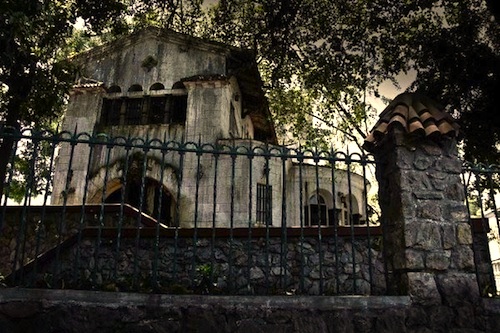
As Hidalgo flashes back in time, we witness an earlier night of terror that thoroughly destabilizes Dulce’s family. Clearly, some strange agency is at work, but Juan José and the cops are quick to dismiss Dulce. Frankly, the only person who ever believes her is the sympathetic parish priest, who tries to counsel the older Dulce her during her house arrest. Researching the evil looking domicile, he discovers it was specially constructed by a mysterious English Mason. Over time, the state took possession of the house, offering it to low income families, but never revealing its macabre history.

House starts out as a decidedly atmospheric horror movie, but it evolves into a genre-defying, reality-bender. It is a far more complex narrative than viewers will initially suspect, but Hidalgo marshals the assorted strands quite adroitly. It is also rather refreshing to see an uplifting portrayal of a Catholic priest, with the ultra-subtle implication of government bureaucratic disregard for public welfare being a nice added bonus.

From "The House at the End of Time."

Former Miss Venezuela Ruddy Rodríguez glams down rather boldly to play Dulce. Far from a heroic mother figure, it is a full-fledged, emotionally complicated performance. Guillermo García also raises the good Father above a mere symbol of decency. However, the younger cast-members can be a bit awkward on-camera.

Of course, one of the biggest stars is that creepy old house, which art director Evadne Mullings decks out in lovingly dark detail. There must be more keys in House than any other film playing at Fantasia (all those locked doors seem like a fire hazard, but they well serve Hidalgo’s tense narrative). Cinematographer Cezry Jawkorski’s gives it all a moody, morose look that heightens the foreboding. It all works surprising well, raising the stakes for the old dark house movie. Recommended for genre fans, The House at the End of Time was one of the pleasant surprises at this year’s Fantasia.

LFM GRADE: B+

Posted on August 8th, 2014 at 1:32pm.

LFM Reviews Bold & Brash @ The 2014 Fantasia International Film Festival

By Joe Bendel. Simon Boisvert might be the world’s most misunderstood unknown filmmaker. Through sheer gumption, he produced six independent features, but he is keenly aware of their various flaws. Viewers might be unfamiliar with his films, but they will come to fully understand them all when the Quebecois filmmaker turns the camera on himself in Bold & Brash: Filmmaking Boisvert Style, which screened during the 2014 Fantasia International Film Festival.

Boisvert may have been tragically influenced by Neil LaBute’s In the Company of Men. For some reason the Aaron Eckhart character struck such a chord, he inspired the protagonist of Boisvert’s debut, Stephanie, Nathalie, Caroline & Vincent. To save money, Boisvert played Vincent himself, but he readily acknowledges the limitations of his acting chops. Nonetheless, the film garnered a bit of notice, even though it released on VHS on September 11, 2001.

For at least one commentator, Boisvert is a French Canadian Ed Wood, but the comparison is rather unfair. He sort of has his critical champions, who can find worthiness in some, if not all of his films. Arguably, his talky, relationship-driven films are not so very different aesthetically from the work of Henry Jaglom (is that a heresy to suggest?). However, Boisvert has had more than his share of bad luck, including uncooperative crews and sound mixing disasters.

While Boisvert’s candidness is often surprising, his tenacity is equally impressive. Despite his frustrations, he has gotten his films distributed in some form, except for Barmaids, which he was forced to shelve for purely technical reasons. Aspiring filmmakers should draw some real business lessons from his experiences.

From "Bold & Brash."

Ironically, Bold & Brash looks considerably more polished than many of the films it surveys. Were it not for the raggedness of many of the illustrating film clips, it could pass for a more conventional documentary on indie filmmaking. At times, Boisvert argues sometimes budget constraints really are too severe, as when he produced the concert scenes in the rock & roll melodrama Venus de Milo with less than twenty extras. Still, his resiliency is impressive.

Oddly enough, Bold & Brash might find his widest audience yet. Consistently entertaining and rather insightful, it ought to be programmed somewhere like Anthology as part of a full Boisvert retrospective. It was one of the pleasant surprises at this year’s Fantasia.

LFM GRADE: A-

Posted on August 8th, 2014 at 1:31pm.

Welcome to the Hamptons: LFM Reviews The Maid’s Room

By Joe Bendel. She does the kind of work Americans “just won’t do,” like cleaning up Master Crawford’s vomit. The Crawfords are most definitely one percenters—and writer-director Michael Walker will never let us forget it in the dark morality play/borderline-thriller The Maid’s Room, which opens this Friday in New York.

Drina seems pretty, hard working, and illegal enough not to complain. That is good enough for the Crawfords to hire her as the live-in maid at their Hamptons house. They will only be there over the weekends, but their entitled son Brandon will spend the entire summer there. Of course, he notices Drina, but he is mostly too busy drinking like a fish to do anything horrifically inappropriate. Unfortunately, one drunken mistake will kill his buzz and put Drina in an increasingly awkward position.

Just in case you did not get it, the Crawfords think the rules do not apply to them because of their wealth, whereas the naïve Drina believes everyone is accountable in the eyes of God and the law. Subtle Maid’s Room is not. Still, the first major dark turn is a bit of a surprise, because the film seemed to be conditioning the audience to go in a different direction.

Perhaps Maid’s Room’s greatest inequity is the disparity between characters. Frankly, Drina is sweet but boring. Granted, Brandon Crawford, a sort of Raskolnikov figure, does not have much more going on, either. However, Mr. Crawford is a forceful, surprisingly complicated character, who dominates the film in every sense. Even with the deck completely stacked against him, Bill Camp elevates his performance to classically tragic dimensions.

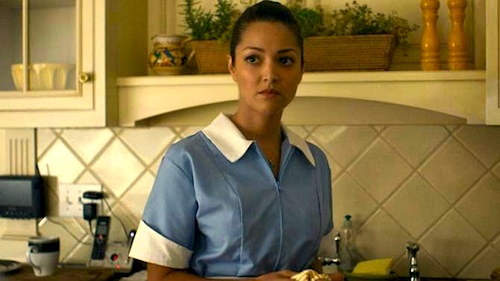
In contrast, Paula Garcés is unflaggingly earnest as Drina, but mostly she just bites her lip and furrows her brow as she wrestles with her employer’s moral bankruptcy. Annabella Sciorra is also fairly potent as Mrs. Crawford, but the uptight mom routine feels pretty familiar by now.

From "The Maid’s Room."

The Crawford home certainly looks exclusive, but some of the film’s details are a little ridiculous, like the Erin Brockovich movie poster Drina hangs in her titular quarters. Seriously, a Colombian immigrant in her early twenties would choose the 2000 Soderbergh film to brighten her walls? It is almost laughable when Walker uses it as a device to strengthen her resolve, as if asking WWEBD, what would Erin Brockovich do?

There are several nicely staged sequences in the second act that demonstrate how one mistake inevitably begets another. Unfortunately, the film is overly preoccupied with its intended take-aways at the expense of narrative. As a result, the promising moments are smothered by its class consciousness. A misfire despite Camp’s highlight reel work, The Maid’s House opens this Friday (8/8) in New York at the Cinema Village.

LFM GRADE: C-

Posted on August 8th, 2014 at 1:31pm.

LFM Reviews James Cameron’s Deepsea Challenge 3D

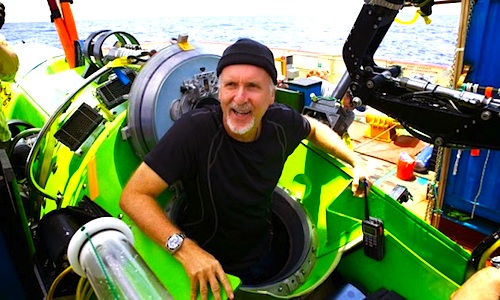
By Joe Bendel. The Deepsea challenger submersible is a marvel of engineering. It can withstand the pressure diving to the lower depths of the Mariana Trench, while still containing James Cameron’s ego. The Oscar winning filmmaker follows his passion to the remotest corner of the ocean floor in John Bruno, Ray Quint, and the late Andrew Wight’s Deepsea Challenge 3D, which opens this Friday nationwide.

To avoid confusion, the film is title Deepsea Challenge 3D, the expedition is the “Deepsea Challenge” and the craft is named “Deepsea Challenger.” Clearly, all the inventiveness was saved for the engineering. To a large extent, all three were made possible by Titanic and Avatar. Cameron was no mere figurehead attached to the project. He cut checks and pilots the Deepsea Challenger during its historic dive, which is not so crazy given his short stature and long enthusiasm. However, he comes across as quite the demanding taskmaster during the extensive development process. Tragically, the entire project is temporarily called into question when Wight and underwater cameraman Mike duGray perish in a helicopter accident.

You cannot say Cameron never put his money or the rest of his body where his mouth is. In fact, one gets the sense his wife, former model and actress Suzy Amis would just as soon see him collect vintage cars, like Leno. Still, Cameron’s evangelical zeal for deep sea exploration is admirable. In fact, the best sequences in Challenge 3D revolve around the research vessel Trieste’s previous voyage to the depths of the Mariana in 1953. Subsequently overshadowed by the Moon landing and Jacques Cousteau, the Trieste fired young Cameron’s imagination, directly inspiring The Abyss.

From "Deepsea Challenge 3D."

Strictly speaking, the 3D adds very little to the viewing experience, even when the mission is underway. On the other hand, it is so unlikely most viewers will ever find themselves exploring the Mariana Trench, it makes sense to replicate the experience as fully as possible, much like the Chauvet Cave in Werner Herzog’s Cave of Forgotten Dreams. Of course, it also necessarily comes with 3D pricing, which many audience members may not believe is warranted for a film produced very much in the style of a National Geographic television special.

Regardless, Challenge 3D should be considerably informative for most layperson viewers and they way it captures the team’s spirit of innovation and derring-do is certainly appealing. It just lacks the “wow” moments Cameron fans might expect. Recommended for aquatic-fascinated audiences of all ages, Deepsea Challenge 3D opens this Friday (8/8) nationwide.

LFM GRADE: B

Posted on August 4th, 2014 at 10:02pm.

LFM Reviews Wolfcop @ The 2014 Fantasia International Film Festival

By Joe Bendel. Usually, it is the police who expect the crazies to come out during a full moon. Now it is the criminals’ turn to worry. Lou Garou was never much of a cop, but he has been changing lately. He still drinks like a fish, but he lays down a lot of law during the night shift. However, there might be more nefarious reasons for his lycanthropic state in Lowell Dean’s Wolfcop, which screened during the 2014 Fantasia International Film Festival.

Garou is a drunk, who apparently only holds his job on a small Saskatchewan town’s police force out of respect for his late father. The captain hates his guts and his hard-charging colleague Tina thinks he is a loser, but Jessica, the hot barkeep, values him as a regular customer. After responding to a report of teenagers engaging in some sort ritual in the woods, Garou wakes up in bed with a pentagram carved into his chest. He also just cannot shave his persistent stubble anymore.

Yes, he is a werewolf, but he exercises a fair degree of control. He actually starts busting the meth gang that needed busting. Of course, he still swills whiskey and binges on donuts. He ought to be more concerned about the forces that caused his metamorphosis, but anticipating the long-term is not his forte.

How can you dislike a town that is home to the Liquor Donuts store and holds an annual “Drink & Shoot?” It all sounds very over the top, but Wolfcop is actually more of a movie-movie than the collection of gags it might look like. This sounds ridiculous, but Garou the Wolfcop has a fairly satisfying character development arc and it nicely brings a lot of the town’s history full circle.

Most importantly for werewolf fans raised on Rick Baker’s American Werewolf in London, Emerson Ziffle’s Wolfcop makeup is terrific. His transformations are satisfyingly gross, but the full wolf still has all kinds of personality to latch onto. It is not hard to see a franchise developing around him.

A game lead, Leo Fafard absolutely feasts on Garou’s degeneracy and revels in the Wolfcop’s fierceness. Clearly, he was also a good sport enduring Z’s make-up. Sarah Lind vamps it up quite entertainingly as Jessica, while Amy Matysio brings unexpected verve and attitude to the straight-laced Tina. Considering all the madness going on, the whole ensemble plays it rather impressively straight, scrupulously refraining from winking at the camera.

Never fear, there is still plenty of outrageous gore, plus the sex scene Universal never gave Lon Chaney Jr. Wolfcop is a tough titular concept to live up to, but Dean pulls it off. Good, gruesome, goofy fun, Wolfcop is likely to take on considerable legs following its screening at this year’s Fantasia.

LFM GRADE: B+

Posted on August 4th, 2014 at 10:02pm.