LFM Reviews The Search for Weng Weng @ The 2014 Fantasia International Film Festival

The Search For Weng Weng trailer from Monster Pictures on Vimeo.

By Joe Bendel. It might be hard to imagine Ferdinand and Imelda Marcos rolling out the red carpet for a two foot-nine inch martial arts film star, but it makes sense when you consider how much money Weng Weng’s films made. In the early 1980s he was the Philippines’ top cinematic export—and there really wasn’t a number two behind him. Cult film connoisseur Andrew Leavold set out to discover the unvarnished truth about the ironic icon, while grappling with the obvious issues of exploitation as best he could in The Search for Weng Weng, which screens during the 2014 Fantasia International Film Festival.

The man born Ernesto de la Cruz will always be best known as Agent 00 in For Y’ur Height Only. As seen in Mark Hartley’s Machete Maidens Unleashed, it has become a word of mouth favorite amongst midnight movie patrons. While investigating Weng Weng’s whereabouts, Leavold confirmed a number of earlier featured appearances by his subject, including a film starring future president Joseph Estrada.

Many of the Philippines’ established film scholars and critics are uncomfortable talking about Weng Weng, because they consider his films the cinematic equivalent of a carnival sideshow. However, Leavold found some people who were happy to talk about the Guinness record holding actor, such as his former co-stars and director, as well as fans Imelda Marcos and her daughter, Governor Imee Marcos.

Of course, Search is all about weird cinema, but Leavold’s considerable time spent with Imelda reveals much about the current state of Filipino society and politics. Clearly, she still considers herself the nation’s First Lady-in-spirit, but you cannot call her delusional because there seem to be an awful lot of people who agree with her. It is a heavy thing to say, but Leavold’s footage of her might just be stranger than the Weng Weng movies that brought him to the Philippines in the first place. Yet, nobody can say she is not a gracious hostess.

On the other hand, there is one person conspicuously missing from Search: Cora Caballes, who produced Weng Weng’s films with her late husband. It is his relationship with the Caballeses that most directly raises questions of exploitation, including issues of fair compensation, or lack thereof.
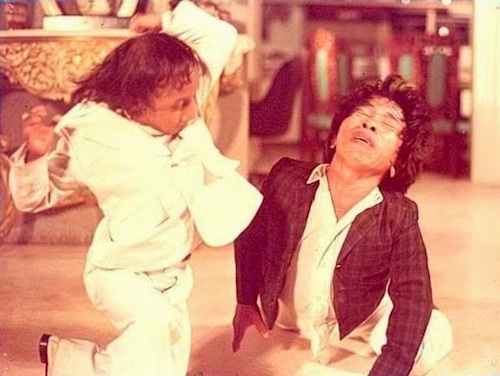
From "The Search for Weng Weng."

Through interviews with old school movie business veterans, Leavold conveys a vivid sense of the Philippines heyday as an unregulated haven for low movie production. He also achieves closure in his quest to determine whatever became of Weng Weng, but his fate holds few real surprises. It will sound like a bit of cliché, but the journey is what is important in Search, rather than the ultimate destination.

Along the way, Leavold tantalizes viewers with truly bizarre film clips, while treating his subject with scrupulous sensitivity. It is a tricky balance to maintain, but he pulls it off. The result is a big, entertaining valentine to B- movies that opens a strangely insightful window into the contemporary Philippines. Highly recommended for anyone who appreciates the ragged glory of offbeat cinema, The Search for Weng Weng screens again on Monday (8/4), as part of this year’s Fantasia.

LFM GRADE: A-

Posted on August 4th, 2014 at 10:01pm.

LFM Reviews Web Junkie

By Joe Bendel. Evidently, you can still get addicted to the internet, even when it is heavily censored. China has become the first nation to official classify internet addiction as a psychological disorder. To combat the menace of World of Warcraft dependant teenagers, the government has instituted a network of boot camp style clinics to “cure” the anti-social gamers. Gaining unprecedented access to the Daxing Boot Camp outside of Beijing, Israeli filmmakers Shosh Shlam and Hilla Medalia document their patients’ response to treatment in Web Junkie, which opens this Wednesday at Film Forum.

They are mostly boys, aged thirteen to eighteen or so. From what viewers see, each and every one of them are gamers, suggesting the government is censoring the wrong websites, if they are really concerned about the social development of younger generations. Since most patient/inmates are either tricked into entering Daxing or in some cases drugged, the initial adjustment is often a rough process. However, once resigned to their situation, they typically try to say and do what they think the staff wants to hear.

Despite the admittedly excessive hours the patients had spent gaming (several uninterrupted days straight in many cases), none of the featured teens ever expresses any love or passion for their games. Yet, when a recent arrival stages a successful escape, they all head directly for an internet café.

Indeed, most of the kids in treatment seem rather dead inside. Frankly, they might benefit from access to Ai Weiwei’s blog and information on the real Dalai Lama. Clearly, they do not relate to either the Party ideology represented by the camp director or the go-go capitalism practiced by their parents, but they have nothing to fill that void accept first-person shooters.

From "Web Junkie."

Shlam and Medalia capture some very real drama, but their strictly observational approach apparently precluded them from asking any tough questions of the staff. It would be especially interesting to know how many of their charges are the sons of Party members, compared to those who come from religious families. The Chinese Communist Party’s legacy of “re-education” also distractingly hangs over the film, like an unacknowledged ghost.

Web Junkie is an eye-opening look at Chinese spiritual malaise, but it never really attempts to determine if the internet addiction diagnoses are genuine and whether the Daxing regimen is really necessary. Frankly, the evidence Shlam and Medalia collect looks rather ambiguous from a layperson’s standpoint. However, there is clearly a profound generational gap at play. Recommended for those who closely watch Chinese sociological developments, Web Junkie opens this Wednesday (8/6) at New York’s Film Forum. We also wish the best for the Israeli crew and their families as they bravely confront yet another round of craven terrorist attacks from Hamas.

LFM GRADE: B

Posted on August 4th, 2014 at 10:00pm.

LFM Reviews Celluloid Dreams

CELLULOID DREAMS Teaser from Jonathan Dillon on Vimeo.

By Joe Bendel. Christopher Nolan and his colleagues saved film production, at least as long as their films stay popular. Much to the relief of Rochester, New York (home of the last surviving Kodak film factory), the practice of threading film stock will not completely disappear from everyday life. It is an act that takes on significant meaning in Jonathan Dillon’s short film Celluloid Dreams, which screens for three Academy-qualifying days this week in Los Angeles.

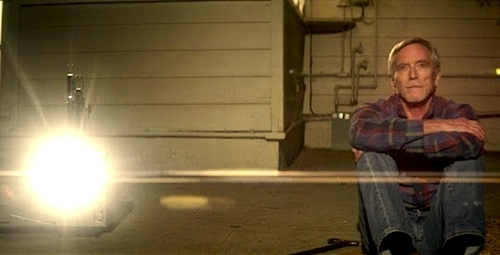
For decades, Robert Thompson has lived alone with his memories and regrets. He was once an avid A-V hobbyist happily married to his wife Deanna, but their wedded bliss was short lived. One day, he impulsively fixes his long broken projector, allowing him to visit their early good times together, as well as the events leading up to tragedy. As Thompson watches the flickering black-and-white home movies, he seems to be physically transported back into the past.

Celluloid immediately brings to mind films like Somewhere in Time and Peggy Sue Got Married, but it maintains a sense of ambiguity regarding its nature, whether it is an excursion into magical realism-time travel or a simple memory play. Either way, it is an effective calling card for Dillon, who nicely manages the two separate timelines taking place simultaneously within the same location.

From "Celluloid Dreams."

Although the dialogue is masked by a highly sentimental soundtrack, Greg Lucey’s powerful performance as the contemporary Thompson is still eloquent without words. Cinematographer Hanuman Brown-Eagle’s black-and-white sequences look spot and perfect, while his color work has an appropriately nostalgic sheen.

Indeed, Celluloid Dreams is a great looking film and its romantic portrayal of moving pictures ought to appeal to the Academy’s sensibilities. Recommended for short film fans, it screens this Tuesday through Thursday (8/5-8/7) at the Laemmle NoHo 7.

LFM GRADE: B+

Posted on August 4th, 2014 at 9:59pm.

LFM Reviews Time Lapse @ The 2014 Fantasia International Film Festival

TIME LAPSE – Official Trailer from TIME LAPSE on Vimeo.

By Joe Bendel. It is too bad the late, great James Garner never got to take this Polaroid camera out for a spin. It has been specially modified. The big bulky mainframe spits out a picture of whatever is in its field of vision, twenty-four hours into the future. Unfortunately, its inventor no longer has a future, which allows his underachieving neighbors to put it to dubious employment in Bradley King’s Time Lapse, which screens during the 2014 Fantasia International Film Festival.

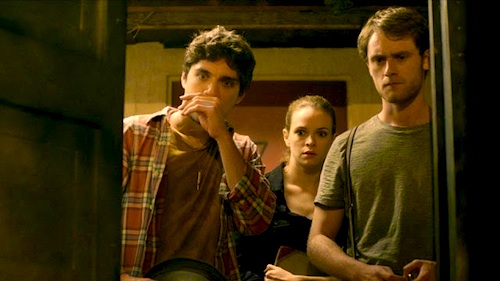
Finn fancies himself a painter, but he is really the super of a suburban condo complex. He is the guy who has to check up on the eccentric Mr. Bezzeredes when the retiree’s papers start piling up. His girlfriend Callie is a writer who works as a waitress and their housemate Jasper is basically a degenerate gambler.

It turns out the former scientist was compulsively snapping photos through their front window before he met with death through some mysterious form of misadventure. From Bezzeredes’ journal and the evidence of the photos, the trio quickly deduces the nature of his breakthrough and concludes he was burned (literally) because he tried to pull a fast one on time. Therefore they resolve they must always conform to whatever future comes spitting out of the machine. Of course, it always seems to provide Jasper the daily winners at the racetrack. It also shows Finn the paintings he had been struggling to produce.

We do not need a crystal ball to predict Jasper’s bookie will get suspicious when he keeps picking race after race. However, that is just the start of the complications for the trio. For one thing, they essentially lose all free will once they commit to conforming to the nightly 8:00 photo. It becomes a compelling dramatic constraint King and co-writer B.P. Cooper wriggle in and out of quite cleverly.

In fact, Time Lapse represents a continuation of the renaissance for low budget, high concept indie science fiction, successfully following the example of James Ward Byrkit’s Coherence, Hugh Sullivan’s Infinite Man (a fellow Fantasia selection), and Darren Paul Fisher’s Frequencies. Like those films, Time Lapse is not about special effects. Instead, they start with a fantastical Macguffin and trace its effects on realistic, everyday people. Arguably, Time Lapse is the most character-driven of the lot, presenting the dark side of a Three’s Company-like situation.

From "Time Lapse."

Danielle Panabaker is terrific as Callie, pulling off some nifty pivots that really make the film. George Finn also relishes Jasper’s increasingly erratic behavior, chewing scenery like a genre pro. Matt O’Leary sort of draws the short straw as the painfully reserved Finn (the painter character), but he holds up his end, keeping the action moving forward.

One of the cool things about Time Lapse is it is the sort of science fiction film you could adapt as a stage production without it suffering from a lack of SFX mumbo jumbo. Tightly executed by King, it is a worthy addition to the growing time travel canon. Recommended with a good deal of enthusiasm, Time Lapse screens again tomorrow (8/2) as part of this year’s Fantasia.

LFM GRADE: B+

Posted on August 1st, 2014 at 6:20pm.

LFM Reviews Cabin Fever: Patient Zero

From "Cabin Fever: Patient Zero."

By Joe Bendel. It is a horror franchise that already has quite a checkered history. Eli Roth made his name with the original Cabin Fever, but Ti West (then an up-and-coming young horror auteur) unsuccessfully lobbied to have his name taken off Cabin Fever 2: Spring Fever. A comic-book artist like Kaare Andrews might sound like a promising candidate to breathe new life into the prequel, but it is still pretty much the same skin-sloughing viral business as usual in his Cabin Fever: Patient Zero, which opens today in New York.

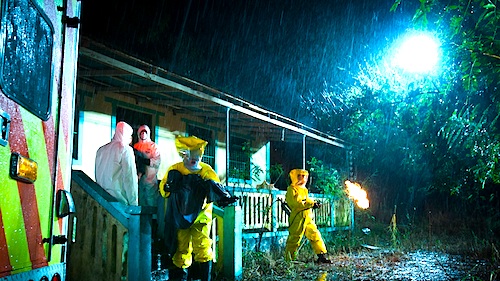
Not to be hopelessly pedantic, but there is no cabin in Zero. Instead, our young and dumb partiers are out for some fun in the Caribbean sun. For his last minute bachelor night, Marcus’s hopelessly irresponsible brother Josh, his business partner Dobbs, and Josh’s girlfriend Penny have whisked him off for a night of hedonism on an uncharted island. Of course, there are no phones or radios to interrupt the good times. After all, what could go wrong, even if the numbskulls somehow managed to pick the one deserted island with an apparently abandoned research facility on the opposite end of the coast?

For a while, Andrews lets the camera ogle Penny’s bikini body (she is played by Jillian Murray, the co-star of the straight-to-DVD sequel Wild Things: Foursome, if that means anything to you). Although Penny is hooking up with Josh, she has some steamy history with Marcus as well. As awkward as that is for all involved, their problems are about to get a whole magnitude worse. After swimming in the viral infected water, Penny and Josh start developing some nasty rashes. It progresses rapidly. Seeking help in the not-so abandoned laboratory, Josh and Dobbs encounter some rabid victims of the virus, the sociopathic Dr. Edwards, and Porter, the naturally immune Patient Zero.

From "Cabin Fever: Patient Zero."

Basically, Zero is all about its gross-out, face-dripping, bloody projectile-vomiting effects, but the lighting is often so low, it is hard to get a clear picture of the gore. The acting is not exactly any great shakes here, even from Sean Astin, a.k.a. Rudy, as the increasingly resentful Porter. Mitch Ryan is ridiculously bland as Marcus, but he is easier to take than the annoying mugging indulged by Brando Eaton’s Josh. At least, Murray delivers what is expected of her, falling to pieces (literally) rather well, all things considered.

Zero maintains the tradition of spectacularly grisly make-up concoctions established by the previous films, but it largely drops the irony and social commentary. The results feel very disposable. If you want to hoot and holler at some on-screen gruesomeness, it has its moments, but it will still outlast its welcome. Bound to disappoint franchise fans, Cabin Fever: Patient Zero opens today (8/1) in New York at the AMC Empire.

LFM GRADE: D+

Posted on August 1st, 2014 at 6:19pm.

LFM Reviews The Winding Stream @ The Lincoln Center’s Sound + Vision Film Series

By Joe Bendel. They are the first family of American Roots music and they represent royalty at its most hardscrabble. While many of their songs dated back generations, country music as a thing to market and identify with pretty much started with the Carter Family and a handful of other artists signed to Victor Records during the recording industry’s infancy. Beth Harrington chronicles the family history behind the music in The Winding Stream: the Carters, the Cashes, and the Course of Country Music, which screens free of charge during the Film Society of Lincoln Center’s Sound + Vision Film Series.

The Carters lived most of their lives in the Poor Valley region of southern Virginia. It was not named with irony. The land is hard and unforgiving, but most work still revolves around agriculture. However, A.P. Carter had an ambitious notion that the family’s musical talent could earn them a better life. With his somewhat reluctant wife Sara and sister-in-law Maybelle, Carter formed a trio that would be known professionally as the Carter Family. At great inconvenience, A.P. dragged the women out to perform for Victor producer Ralph Peer, who was scouring the region like a commercial Alan Lomax for songs that would appeal to a “traditional” market.

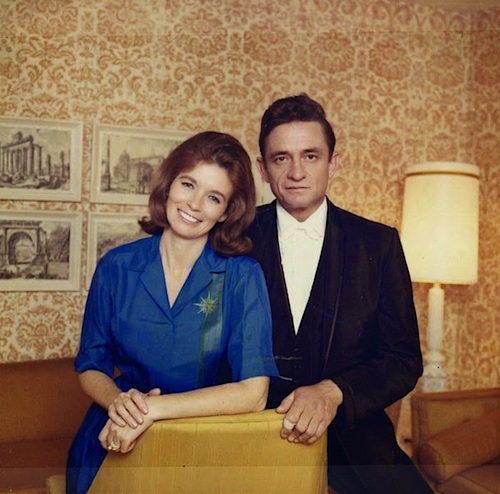
Of course, the Carter Family perfectly fit the bill, but they nearly forgot about their legendary sessions during the lag between the informal recordings and the release of their 78s. Nevertheless, they sold well enough to vindicate A.P. Carter’s lofty ambitions. Unfortunately, the original ensemble would eventually fracture along with A.P.’s marriage to Sara. For years, Maybelle Carter performed with her daughters as Mother Maybelle and the Carter Sisters before reclaiming the official Carter Family mantle. As most fans know, one of the Carter Sisters was June, who turned the head of a talented but troubled young performer named Johnny Cash.

From "The Winding Stream."

While telling the Carter story, Harrington also addresses some largely forgotten early Twentieth Century cultural history, such as the phenomenon of ultra-high wattage Border Radio and the ethically problematic attribution of traditional songs assumed by the likes of A.P. Carter. For obvious reasons, Johnny Cash plays an essential role in the film, but Harrington never lets him outshine the Carters. Her musical instincts are also quite shrewd, including plenty of archival clips, a stirring rendition of the title song by Rosanne Cash, and a bizarrely good musical flash mob performance of “Will the Circle Be Unbroken,” attesting to the song’s lasting resonance.

Harrington does indeed touch all the necessary documentary bases, but arguably what is most refreshing about Stream is her sensitive treatment of the largely white, God-fearing, under-advantaged population of Poor Valley. There is no sneering at their “Jesus talk” or condescending commentary on their un-cosmopolitan style. Instead, she respects them on their terms.

Winding is often entertaining, featuring original performances from the likes of John Prine and Cheryl Crow, but it also submerges viewers in the ancient spirit of their artifice-free music. One commentator says the Carters’ music exposes us as the “fakers” we are—and it is easy to get what he means. Recommended for fans of “roots” music and those who appreciate old school Americana, The Winding Stream screens for free this coming Monday (8/4) at the Walter Reade Theater, as part of Sound + Vision.

LFM GRADE: A-

Posted on July 31st, 2014 at 10:53pm.