LFM Reviews Unforgiven @ Japan Cuts

By Joe Bendel. For Jubei Kamata, it is the end of an era—the Tokugawa Era. The former samurai-assassin used to kill with impunity and then he simply killed to stay alive, but he gave up killing at the behest of his beloved late wife. However, killing is a skill you never forget. Reluctantly, Kamata digs up his sword for a final violent errand in Sang-il Lee’s Unforgiven, an inspired cross-cultural remake of Clint Eastwood’s Oscar-winning western, which screened during this year’s Japan Cuts: the New York Festival of Contemporary Japanese Film.

In a remote frontier village on Hokkaido Island, two ranchers brutally disfigure Natsume, a young prostitute. Rather than prosecute them, local police chief Ichizo Oishi merely requires the former samurai pay restitution to the brothel owner. Outraged by his callous disregard for Natsume’s suffering, her fellow prostitutes pool their money to place a bounty on the offending settlers.

Old Kingo Baba intends to collect that bounty, so he tries to recruit his old samurai comrade Kamata, a.k.a. “Jubei the Killer.” Already haunted by his past carnage, Kamata dearly wishes to keep his promise renouncing violence. Unfortunately, a disastrous harvest leaves him no other option to provide for his young son and daughter. Soon, Kamata and Baba are joined by Goro Sawada, an impulsive would-be outlaw, who also happens to be half Ainu (the indigenous people of Hokkaido and Sakhalin). As it happens, Kamata’s late wife was also Ainu, giving the two men a distant kinship and a shared outage at the Meji government’s repression of Ainu customs.

Arguably, the Ainu element further deepens the Unforgiven story beyond the Eastwood’s revisionist critique of a violent, misogynistic American west. Closely paralleling the original, Lee’s adaptation perfectly fits within the rough and tumble early Meiji northern provinces, where many former Shogunate ronin sought refuge.
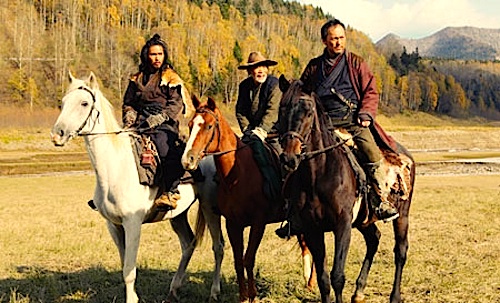
From "Unforgiven."

Ken Watanabe (who starred in Eastwood’s Letters from Iwo Jima) is impressively hard-nosed and world weary standing in for his former director. Akira Emoto’s nervous energy playing Baba is a bit of a departure from Morgan Freeman’s analog, but it works well in context. Koichi Sato is smoothly fierce in the Hackman mold and Shiori Kutsuna is devastating as the disfigured (but still beautiful) Natsume. Yet, it is evidently still hard to get the balance of exuberance and angst right for Sawada/the Schofield Kid.

Cinematographer Norimichi Kasamatsu gives the Hokkaido vistas the full John Ford treatment, while Lee invests the action sequences with a tragically operatic vibe. It is a gritty period production that represents a triumph return to the tradition of Jidaigeki films and westerns riffing and channeling each other. Frustratingly, it is also a reminder of how rare the contemporary western has become in Hollywood, even though Japanese cinema continues to find creative grist in its national history. Highly recommended for fans of moody westerns and samurai films, Unforgiven screened as part of the 2014 Japan Cuts.

LFM GRADE: A-

Posted on July 17th, 2014 at 9:48am.

LFM Reviews Greatful Dead @ Japan Cuts

From "Greatful Dead."

By Joe Bendel. Japan is the nation that brought us the hikikomori phenomenon and Nami is grateful, so to speak. However, she is not interested in garden variety shut-ins. It is the seriously cracked loners, or “solitarians” as she dubs them, that fascinate her. Her unhealthy obsession will take on dangerous dimensions in Eiji Uchida’s Greatful Dead (yes, that is how it is spelled), which screens as part of this year’s Japan Cuts: the New York Festival of Contemporary Japanese Film.

Nami’s parents were highly flawed. Her mother’s compulsive third world child sponsorship never left her time for her own daughters. In contrast, their father was only interested in her, so when she abandoned her family to live the Mother Theresa lifestyle, it essentially killed him inside. Eventually, he takes up with a seductive new mistress Akko-chan, but she hardly helps his state of mind. At least he has a lot of money to leave Nami.

Now in her twenties, the privileged Nami consumes like mad, while her sister revels in the ordinariness of her stable family life. Nami wants no part of it. She prefers documenting the sad and sometimes twisted lives of her solitarians. Her latest seems to hold special meaning for her. Mr. Shiomi was evidently once a man of some position, but now he shuns his family, leading the sort of aggressively anti-social existence Nami finds so charming. However, when Korean evangelical Su Yong starts to reform and uplift Shiomi, it threatens to spoil Nami’s fun. Extreme measures will be taken in response.

In a way, Greatful asks which is the stronger force, consumerism or Christian fellowship. Surprisingly, it treats the latter quite fairly. However, it takes viewers to an existentially dark and bloody place, like nothing one would ever see in evangelical cinema. Still, Su Yong is unquestionably the film’s most sympathetic and virtuous character, played with deep sensitivity by Korean indie star Kim Kkobbi.

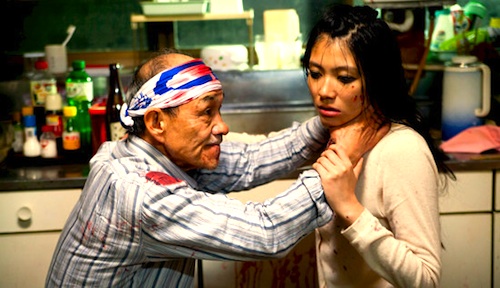
From "Greatful Dead."

Nonetheless, Kumi Takiuchi completely dominates the film, effortlessly transitioning from eccentric kookiness to raging sociopathic ferocity. It is an unsettling performance, because she shows the little girl inside Nami, lashing out for attention. Likewise, Takashi Sasano is pretty fierce himself, convincingly portraying Shiomi’s personal evolution and his sudden snap back into brutishness, courtesy of Nami.

Greatful is absolutely chilling at times, but its morbid sense of humor takes the worst of the edge off. It is quite cleverly constructed and Uchida’s execution is unflaggingly tight and tense. It is not what you would call “feel good,” yet Uchida someone leaves us some ambiguity to clutch at. Highly recommended for those who take their horror-comedies unsweetened, with a side order of social commentary, Greatful Dead screens tomorrow (7/18) at the Japan Society as part of the 2014 Japan Cuts.

LFM GRADE: B+

Posted on July 17th, 2014 at 9:46am.

LFM Reviews Gaamer @ The Odessa International Film Festival

By Joe Bendel. Really good film festivals are not just an assortment of screenings. They provide a sense of community. Every year, I look forward to fests like Sundance, NYAFF, and the Bosnian-Herzegovinian Festival because of the people I expect to see there. That is why the continuation of the Odessa International Film Festival represents a small but significant victory for Ukraine’s cultural sector. Unfortunately, there is one particular filmmaker who will not be able to attend.

Pro-Ukrainian democracy activist Oleg Sentsov was arrested by the Russian military while attempting to smuggle food to barricaded Ukrainian military personnel in the occupied province of Crimea. He is now being held on trumped up terrorism charges, awaiting a show trial in Moscow. To date, Ukrainian consular personnel have been denied access to Sentsov, in clear violation of diplomatic law and custom. In his place, Sentsov will be represented at this year’s inspiringly defiant OIFF with his 2011 feature directorial debut, Gaamer, which has a special screening this Tuesday.

Ostensibly, there are no political implications to be gleamed from Gaamer. The extra “a” represents a distinctively Slavic pronunciation of “gamer” adopted by video game fanatics in parts of Eastern Europe. Sentsov was once part of the subculture, just like his protagonist. Alex is an unrepentant underachiever. However, under his gamer handle Koss, he is one of the top players of the first-person shooter Quake in his depressed post-industrial town.

Much to his long suffering mother’s frustrations, Alex/Koss has been expelled from his technical school, preferring to idle his time away in a computer gaming parlor, presumably much like the one Sentsov once managed. When he places highly in a local tournament, he is recruited by one of the top national teams. At least he will have free gaming for the near future, but then what?

It is tempting to try to read further political significance into the work of filmmakers like Sentsov or Iranian dissident Jafar Panahi, because you would think it has to be in there somewhere to justify such heavy-handed human rights abuses. However, there is absolutely no commentary on neo-Soviet Imperialism to be found in Gaamer.

Instead, it is a film about lifestyle choices and their consequences. Specifically, it examines the awkward period when gaming loses its thrill. After all, a video game is by its nature fleeting and apparently Quake is one of those games that always ultimately ends with a player’s in-game death. So just what does Alex/Koss have to show for his monitor time?

Frankly, Putin would probably prefer an anesthetized Ukraine, lulled by video games or whatever into a state of extreme myopia. In that limited sense, Gaamer’s get-out-and-get-involved-in-life message is somewhat at odds with his expansionist agenda. However, the truth of the matter is Sentsov was simply rounded up for being a prominent ethnic Ukrainian in the Crimea, with a history of democratic activism.

Clearly, Sentsov also understands the characters of Gaamer and the worlds in which they interact. Vladislav Zhuk is totally convincing as the socially underdeveloped Alex/Koss, but his distant, cipher-like nature is sometimes frustrating. While it is not exactly a showy role, Zhanna Biryuk perfectly calibrates her performance as his mother.

From "Gaamer."

All things considered, Gaamer is a very promising first feature. It has its odd rough edges and pacing issues here and there, but those who see it would be intrigued enough look out for Sentsov’s follow-up film. Unfortunately, production on what was to be called Rhino was postponed due to the Maidan Square protests and the Russian invasion. Any serious filmmaker like Sentsov deserves to have a chance to develop his art over the course of several pictures, but his abduction and incarceration now makes that impossible. Even Putin-approved filmmaker Nikita Mikhalkov has (somewhat boldly) joined the chorus of voices demanding his release.

If you happened to be in Odessa attending the screening of Gaamer on Tuesday (7/15), that was a great way to show solidarity, while seeing a good movie in the process. For the rest of us, light up the social networks and online petitions. Free Oleg Sentsov.

LFM GRADE: B+

Posted on July 16th, 2014 at 10:39am.

LFM Reviews All-Round Appraiser Q: The Eyes of Mona Lisa

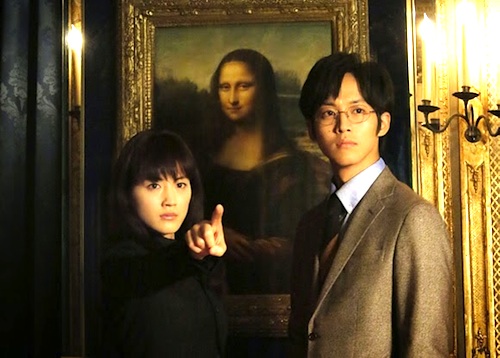
From "All-Round Appraiser Q."

By Joe Bendel. Riko Rinda is sort of the Japanese Lovejoy, except she is far more reputable and much cuter. She can appraise anything, but she specializes in fine art and jewelry. Much to her surprise, she will be called upon to evaluate a masterpiece that should need no appraisal in Shinsuke Sato’s All-Round Appraiser Q: The Eyes of Mona Lisa, which screens as a co-presentation of the 2014 Japan Cuts and New York Asian Film Festival.

Rinda, a.k.a. All-Round Appraiser Q, is good at her job. Struggling journalist Yuto Ogasawara is not. They both happened to be working the same gourmet reception. Rinda’s client is concerned the slicker than slick outfit renting his restaurant is too good to be true. Ogasawara’s boss thought a cooking demonstration would be the only assignment he couldn’t possibly make of hash of. He was wrong. Rinda duly foils the criminal goings on, but Ogasawara misses the photo. However, he suspects Rinda might be an even bigger story, especially when she is offered a chance to serve as a special Japanese curator on the Mona Lisa’s world tour.

After sleuthing out the real La Joconde to pass her audition, Rinda is whisked off for training with her snooty colleague, Misa Ryusenji. Rinda eventually develops some fake-spotting chemistry with her. They appear to have the makings of a real team, until Rinda falls sway to a sinister force. At this point, the eager Ogasawara takes up the case in earnest.

Yeah yeah, Dan Brown, right? In point of fact, Manbu Uda’s adaptation of Keisuke Matsuoka’s source novel rather cleverly incorporates the painting’s strange history, including handyman Vincenzo Peruggia’s unlikely theft in 1911 and the recent discover of the initials in her eyes. However, Appraiser Q is considerably more fun than a month of Da Vinci Code clones.

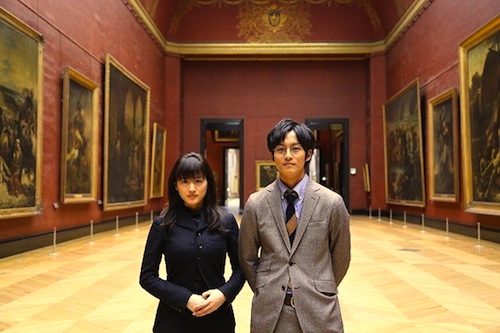
From "All-Round Appraiser Q."

In large measure, this is due to the character of Rinda. While she is as brilliant and nearly as eccentric as Cumberbatch’s Sherlock, she is also warm and empathetic. Frankly, it is nice to see an endearing underdog find her niche, especially when seen shortly after the emotional angst of Yoshihiro Nakamura’s The Snow White Murder Case. Haruka Ayase’s performance is scrupulously demure, yet she lights up the screen.

Tori Matsuzaka’s Ogasawara trails after her as best he can, largely keeping the shtick in check. Asian film connoisseurs will not be shocked to hear that awkward looking westerner Pierre Deladonchamps is embarrassingly clunky as Rinda’s French instructor, but Eriko Hatsune delivers some subtle surprises as Ryusenji.

Appraiser Q has several nice twists and loads of genre appropriate atmosphere. The “Monna Lisa” misspelling is a tad unfortunate, but these things happen. Ayase and company put on a great show, which is the thing to focus on. It makes you hope this is the start of a franchise. Highly recommended for those who enjoy old fashioned romantic mysteries, All-Round Appraiser Q screened this week at the Japan Society, as a joint selection of this year’s NYAFF and Japan Cuts: the New York Festival of Contemporary Japanese Film.

LFM GRADE: A-

Posted on July 16th, 2014 at 10:38am.

LFM Reviews The Snow White Murder Case @ The 2014 Japan Cuts and New York Asian Film Festival

By Joe Bendel. Nobody in their right mind would call Mao Inoue homely and the young actress playing her middle school aged self has to be one of the cutest kids ever. Yet, those caught up in the mob mentality will believe anything. Group think in its many guises, including social networking, scandal mongering journalism, and peer pressure, stands thoroughly indicted in Yoshihiro Nakamura’s The Snow White Murder Case, which screens as a co-presentation of the 2014 Japan Cuts and New York Asian Film Festival.

Noriko Miki was Little Ms. Perfect at her cosmetic company (makers of Snow White soap). Outwardly beautiful and gracious, she was actually manipulative and mean. She also happens to be dead, having been found stabbed repeatedly and then burned to beyond recognition. The media will chose to print the legend, led by TV news part-timer Yuji Akahosi, who sees his relationship with one of the murdered woman’s co-workers as his opportunity to hit the big time. During their interview, Risako Kano not so subtly casts suspicions on Miki Shirono, referred to in his reports as “Miss S.”

In subsequent interviews, their fellow co-workers are eager to follow Kano’s lead, especially since Shirono has conveniently disappeared. Slowly, old high school and college friends emerge to defend Shirono. As they tell their stories in flashbacks, viewers see a pattern of bullying develop in her formative years. Yet, Akahosi doubles down on his narrative, egging on the internet’s baying hounds.

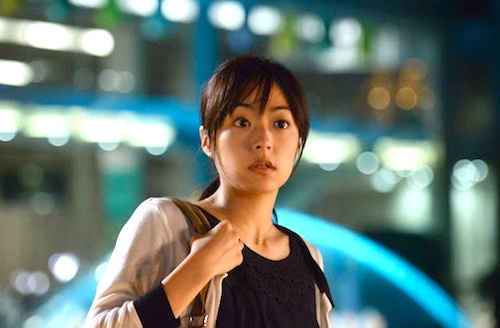
Ostensibly a mystery, Snow White is really the sort of film that rips your heart out and stomps on it. All three actresses playing Shirono are just overwhelmingly endearing and vulnerable. Viewers with any sliver of sympathy will be deeply moved by her/their sensitivity and indomitable faith the future will somehow be better.

From "The Snow White Murder Case."

Snow White was adapted from Kinae Minato’s novel, as was Tetsuya Nakashima’s incendiary Confessions—and it is easy to see a kinship between the two, especially in the way students’ causal cruelty leads to major macro consequences. However, Nakamura’s film does not leave audiences feeling so bereft and numb.

In addition to Inoue and her fellow Sironos, Shihori Kanjiya and her younger alter ego are terrific as Miss S.’s loyal but emotionally stunted childhood friend, Yuko Tanimura. Arguably, Go Ayano is appropriately vacuous and annoying as Akahosi, in a hipster Williamsburg kind of way. Yet, it is TV actress Nanao in her first feature role as Miki, who really gives the film a disconcerting edge.

Considering how intricately plotted Snow White is, the final resolution comes surprisingly quickly and cleanly. Nevertheless, witnessing Shirono’s life is an experience that really gets into your soul. Indeed, its genre trappings are rather deceptive, dressing up an intensely personal drama that steadily expands in scope. Highly recommended, The Snow White Murder Case screens today (7/11) at the Japan Society, as a joint selection of this year’s NYAFF and Japan Cuts: the New York Festival of Contemporary Japanese Film.

LFM GRADE: A-

Posted on July 11th, 2014 at 11:52am.

LFM Reviews The Devil’s Path @ The 2014 Japan Cuts and New York Asian Film Festival

From "The Devil's Path."

By Joe Bendel. Junji Sudo is a yakuza. Shuichi Fujii is a journalist. That means they are both users. Yet, each will discuss justice with earnest indignation in Kazuya Shiraishi’s The Devil’s Path, which screens as a joint presentation of the 2014 New York Asian Film Festival and Japan Cuts.

In the opening scenes, the audience watches Sudo kill, torture, and torment several victims, so it causes no great distress to learn he is now on death row, awaiting word on his final appeal. Before he goes, Sudo has a few things he wants the world to know. Fujii’s editor assigns him the provisional interview, expecting he will quickly dismiss Sudo’s letter as an attempt to buy time at the eleventh hour and move on to the political scandal stories in which she is much more interested. However, it does not work that way.

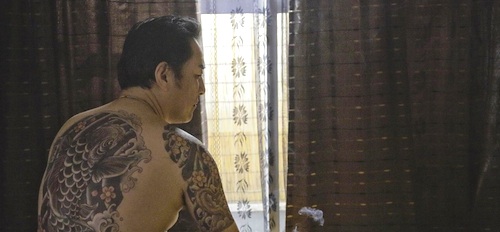
Sudo is willing to admit to three additional murders the cops know nothing about, for the sake of implicating the associate who set him up. He had always considered the man he called “Doc” (or “Sensei” depending on the translation) as a close friend and ally. During their time together, Doc was the brains behind some really nasty real estate and insurance schemes and Sudo was the brawn. Nevertheless, Doc duped the yakuza into believing his closest cronies had betrayed him. Needless to say, they all met very bad ends, for which Sudo will likely pay the highest price.

Naturally, Fujii is skeptical and Sudo’s accounts are frustratingly light on details. Considering how many horrible deeds he committed, these three just were not that memorable at the time. Yet, when Fujii starts probing, Sudo’s story holds up.

The idea of a malevolent bad guy helping an investigating-protagonist solve some sort of crime probably sounds like another pale copy of the Silence of the Lambs-Blacklist formula, but there is considerably more to Devil’s Path. For starters, Fujii’s relationship with Sudo is decidedly awkward and nearly entirely antagonistic. It is also a rather bracing look at what are typically considered white collar crimes, perpetrated in a lethal blue collar fashion.

From "The Devil’s Path."

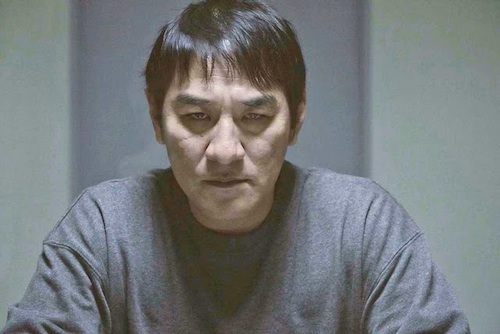
As Sudo, Pierre Taki is a truly riveting presence, holding a vice-like grip on viewers. In contrast, Takayuki Yamada’s Fujii is rather weak and dull opposite him, which is surprising given his fierceness in the thematically related The Samurai that Night (seen at last year’s Japan Cuts). On the other hand, Lily Franky calls and raises Taki as the ruthless Doc. Usually cast in shaggy dog roles, such as the easy going father in Kore-eda’s Like Father, Like Son, Franky delivers a lightning bolt out of the blue here. Amongst the rest of the large but mostly beaten down supporting ensemble, Nozomi Muraoka stands out a bit, bringing some Runyonesque dash as Fujii’s editor.

In all honesty, Devil’s Path could have lost an entire subplot involving Fujii’s wife Yoko and her mounting frustrations caring for his mentally deteriorating mother. Yet, the grit and grime of Sudo’s story is quite distinct from any other yakuza film. Recommended for those who prefer their crime dramas dark and existential, The Devil’s Path screens tomorrow (7/12) at the Japan Society, as a joint selection of this year’s NYAFF and Japan Cuts: the New York Festival of Contemporary Japanese Film.

LFM GRADE: B

Posted on July 11th, 2014 at 11:51am.