LFM Reviews The Mole Song: Undercover Agent Reiji @ The 2014 Japan Cuts and New York Asian Film Festival

By Joe Bendel. Yakuzas do not sing, but they should be able to tell jokes. However, theme songs are a handy way to ensure undercover cops always remember their principles. I mean obviously, right? These are about the only rules that apply during The Mole Song: Undercover Agent Reiji, Takashi Miike’s manic adaptation of the hit manga series, which screened as a co-programmed selection of the 2014 Japan Cuts and New York Asian Film Festival.

Reiji Kikukawa is the lowest scoring patrolmen to somehow graduate from the police academy. Basically, he is an idiot, so who would suspect him of being a deep cover narc? After trying to bust a pervy city councilman, Kikukawa is summarily fired and then wink-wink rehired to infiltrate the feared Sukiya-kai clan. Kikukawa’s ultimate target is the elusive boss Shuho Todoroki, but for reasons that would not make sense to explain, the #2, Masaya Hiura (a.k.a. Crazy Papillion) quickly takes Kikukawa under his wing.

Kikukawa also takes a shine to Hiura because of the yakuza’s unyielding stand against drug trafficking. Unfortunately, someone within the organization is not so principled. Kikukawa soon feels rather confused and abandoned. Much to his frustration, being a gangster also complicates his awkward attempts to put the moves on his cute former colleague, Junna Wakagi.

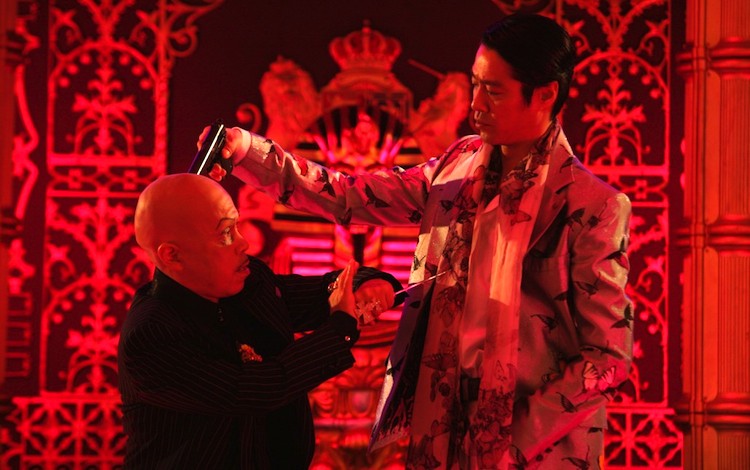
Periodically, Kikukawa experiences flashbacks of his superior officers singing “The Mole Song,” which is a crime in itself. However, that sort of shameless lunacy is right in Miike’s power alley. Mole Song makes the original Police Academy look like a Noel Coward drawing room comedy. No gag is too slapsticky and no humiliation is too unlikely to inflict on Kikukawa.
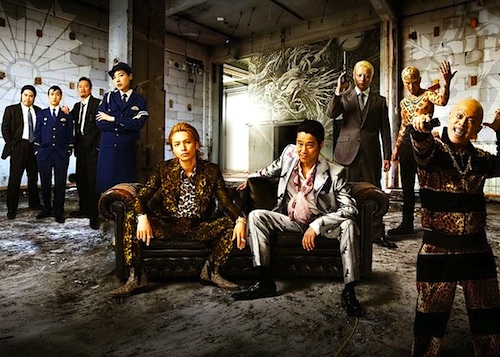
From "The Mole Song: Undercover Agent Reiji."

Yet, he keeps plugging away, because Mole Song also has heart. You have to hand it to Toma Ikuta’s Kikukawa—there is nothing he will not do for a laugh—starting with being strapped naked spread eagle to the hood of a speeding car. Literally, that is where Miike starts. Kenta Kurokawa and Itsei Nekozawa also make quite a strong impression as feline-themed yakuza assassins, who look like CATS chorus members on crystal meth.

Riisa Naka does her level best to provide some grounding as the decent Wakagi, but she is fighting a losing battle. However, Shinichi Tsutsumi (who also plays a bonkers yakuza in Sion Sono’s Why Don’t You Play in Hell?) largely steals the show as the indomitably hardnosed Miura.

Miike seems to be having a ball trying out nutty ideas throughout Mole Song and the fun is contagious. Frankly, it is rather impressive how many of the bits successfully land. Recommended for those who want to see a madcap cartoon with live people, Mole Song: Undercover Agent Reiji screened yesterday at the Japan Society, as the opening film of this year’s Japan Cuts: the New York Festival of Contemporary Japanese Film, co-presented by NYAFF.

LFM GRADE: B

Posted on July 11th, 2014 at 11:28am.

LFM Reviews Why Don’t You Play in Hell? @ The 2014 Japan Cuts and New York Asian Film Festival

By Joe Bendel. Which is a greater menace to society, the Yakuza or independent filmmakers? It hardly matters, because when they join forces, there will be blood on the floor. We are talking wall-to-wall pooling here. Yes, this is a Sion Sono joint, so get your game face on when Why Don’t You Play in Hell? screens as a joint presentation of the 2014 New York Asian Film Festival and Japan Cuts.

Ten years ago, scruffy would-be teen filmmaker Hirata Don and his two camera-operating chums first met Sasaki, their supposed martial arts star. On that fateful day, they also crossed paths with Jun Ikegami, a profusely bleeding yakuza. He was supposed to assassinate Taizo Muto, a rival clan leader, but they ran into his wife Shizue instead. Only Ikegami survives her wrath, but not before getting a severe dressing-down from her ten year old daughter, Michiko.

Michiko had been well on her way to being Japan’s sweetheart, based on her perversely catchy TV toothpaste commercial, but her mother’s murder convictions derail her career. Feeling understandably indebted to his wife, Muto promises to establish their daughter in the movies before her release. However, the now punky and petulant Michiko walked away from her legit film debut, forcing the studio to recast. With mere days left before Shizue’s parole, Muto needs to find a production for Michiko fast. You see where this is going? Eventually, Don’s dubious crew will hook up with Muto’s clan, but everyone thinks the director is Koji Hashimoto, a poor schmuck on the street Michiko roped into her madness.

From "Why Don’t You Play in Hell?."

With no time to write a proper script, Don opts to film Muto’s war with Ikegama verite-style. Buckle up, because there is going to be a body count. When it comes to over-the-top, outrageously gory comedic violence, Sono’s latest film stands tall, in a field all its own. The sheer level of mayhem Sono unleashes in the third act would even leave Itchy & Scratchy slack-jawed. It is impressive.

Amid all the carnage, there is also something of a valentine to filmmaking and an affectionate eulogy for old school 35mm. It also features one of the greatest and fiercest performances by a child actor, maybe ever, but it will probably be a good eight or ten years before Hara Nanoka’s parents let her see her work as young Michiko. As the older Michiko, NYAFF Rising Star Award winner Fumi Nikaido smoothly picks up the baton and proceeds to bash just about everyone with it. It is a butt-kicking star turn, but nobody can out hard-nose Jun Kunimura (Boss Tanaka in Kill Bill vol. 1, which seems so tame in comparison) as the steely but devoted Muto.

On the Sion Sono spectrum, this is more polished than Bad Film, but more ragged around the edges than Love Exposure. Regardless, whatever you think WDYPIH is, raise it to a power of ten. Highly recommended for cult film connoisseurs who have a general idea what they are getting into, Why Don’t You Play in Hell? screened yesterday at the Japan Society, as a joint selection of this year’s NYAFF and Japan Cuts.

LFM GRADE: A-

Posted on July 11th, 2014 at 11:27am.

Momoa Rides Through the Mojave: LFM Reviews Road to Paloma

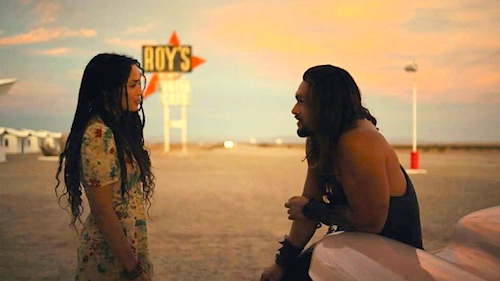
By Joe Bendel. It is like Easy Rider, except there is a reason for the angst and defiance. When Robert Wolf’s mother suffered a brutal attack, the Feds, being Feds, declined to prosecute the case. It was just too much work. However, when Wolf took the law into his own hands, they made his capture a top priority. There will not be a lot of sunsets for the biker and his new traveling companion to ride off into during Jason Momoa’s directorial debut, Road to Paloma, which opens this Friday in New York.

Wolf is a lot better at being a drifter than the self-destructive rocker, Cash Guirgis. Nevertheless, they ride together for a while, sharing some colorful encounters on the road. Wolf has secretly picked up his mother’s ashes from his estranged reservation policeman father, to spread in accordance with her wishes. Anticipating he might do something like that, Special Agent Williams grabs a reluctant local white copper and heads into the Mojave after him.

Wolf and Guirgis will see some scenery worthy of John Ford on their journey, stopping along the way for some bare-knuckle brawling and a little bit of loving. For Guirgis that means lap-dances, but Wolf prefers using his mechanical skill to seduce Magdalena and her broken down vintage car. It is nice for a while, but it the law is never far behind.

Frankly, Paloma is far more sensitive and moodier than you would expect from Jason Momoa’s WWE-distributed motorcycle-powered directorial debut. Small in scope, it is much more closely akin to his Sundance series The Red Road than Game of Thrones or Conan. They both feature Native themes, as well Momoa’s wife, Lisa Bonet. Regardless, Paloma’s cinematic vistas and alienated vibe are surprisingly effective. On the other hand, Momoa largely wastes the timelessly cool character actors Lance Henriksen and Wes Studi (who has a bit more to do than the former).

From "Road to Paloma."

As his own lead, Momoa is a serviceable renegade-brooder. He also generates some decent heat with Bonet, as well they should. Even in his brief scenes, Studi shows everyone how it is done, but it might co-writer Robert Homer Mollohan who makes the strongest impression as the reckless Guigis. Unfortunately, Timothy V. Murphy’s unapologetically serpentine Williams just does not ring true. Feds are nothing if not politically astute, so the degree he goes about antagonizing local law enforcement feels more like a clichéd contrivance.

Although it has some swagger, Paloma is not a meathead movie. It is a rather dark, character-driven affair that has a real point to make. Essentially, Momoa, Mollohan, and co-writer Jonathan Hirschbein suggest federal jurisdiction over crimes committed by outsiders on reservation land has created an incentive for predators to prey on Native victims. That is the good old Federal government at work. Recommended on balance, Road to Paloma opens this Friday (7/11) in New York at the Quad Cinema.

LFM GRADE: B-

Posted on July 11th, 2014 at 11:27am.

LFM Reviews Firestorm 3D @ The 2014 New York Asian Film Festival

From "Firestorm."

By Joe Bendel. Despite an innate laissez-faire attitude towards government, Hong Kong has always trusted its police. That is why there was such profound disappointment when the cops broke up recent pro-democracy demonstrations, as per their instructions from above. That might seem ironic for those raised on a steady diet of Johnnie To-John Woo rogue cop thrillers, but the general populace has always been willing to forgive a little corner-cutting to bring down the baddest baddies. However, Inspector Liu Ming-chit will take off-the-books justice to a whole new level of recklessness in Alan Yuen’s Firestorm 3D, which screened during the 2014 New York Asian Film Festival.

Fronting as an art dealer, Mainland armed robber Cao Nan and his gang have been running circles around the police in general and the by-the-book Inspector Liu in particular. They enjoy a challenge and don’t give a toss how many bystanders are killed in the process. When Liu’s old high school judo partner To Shing-bong is released from prison, he rejoins Cao Nan’s outfit, while pretending to keep on the straight and narrow for the benefit of his loyal girlfriend, Law Yin-bing.

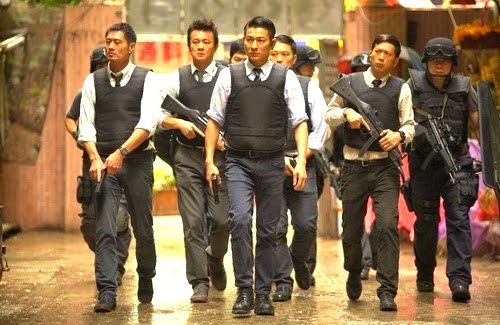
Liu is a cool, frosty cat, but the dead bodies start to push him towards the edge of legality. When a shocking atrocity hits home, the Inspector finally takes a running leap into the dark side. Of course, that leads to complications, culminating in a massively explosive shootout right smack in the middle of Hong Kong’s financial district that would even leave Michael Bay dazed and exhausted.

Even though there is no sex or nudity and little foul language to speak of, Firestorm is all about sheer excess. Whether it is the amped up action sequences, the over-the-top 3D effects, or the shameless emotional manipulation, writer-director Yuen has no patience for half measures. The last half hour or so is simply a jaw-dropper of an action set piece, spectacularly choreographed by Chin Kar-lok.

From "Firestorm."

If you have a problem with entire city blocks blowing up than Firestorm is not for you. Nevertheless, Andy Lau’s work proves there really is such a thing as an action performance. He broods so hard you can see the steam coming out of his ears, elevating Liu to the level of classical tragedy. On the flip side, Hu Jun is magnetically steely as the uncannily unruffled Cao Nan.

Yao Chen manages to scratch a few decent scenes as the thankless Law, which is saying something, considering how testosterone-driven the film is. Unfortunately, second-lead Gordon Lam’s macho slow burn as To suffers in comparison with Lau and Hu. However, the film is peppered with terrific supporting turns, including Michael Wong hamming it up as Liu’s boss and young Jacqueline Chan demolishing viewers’ heartstrings as his disadvantaged god-daughter.

There is no room for subtlety or hand-wringing in Firestorm. It is simply too busy firing RPGs into crowded city streets. Given the magnitude of it all, you wouldn’t think this is Yuen’s first solo turn in the director’s chair, but the screenwriter comes strong and lays it down with authority. Recommended for action fans who like a movie to shake them by the lapels, Firestorm screened this week at the Walter Reade Theater, as part of this year’s NYAFF.

LFM GRADE: A-

Posted on July 11th, 2014 at 11:26am.

LFM Reviews Aim High in Creation @ The 2014 New York Asian Film Festival

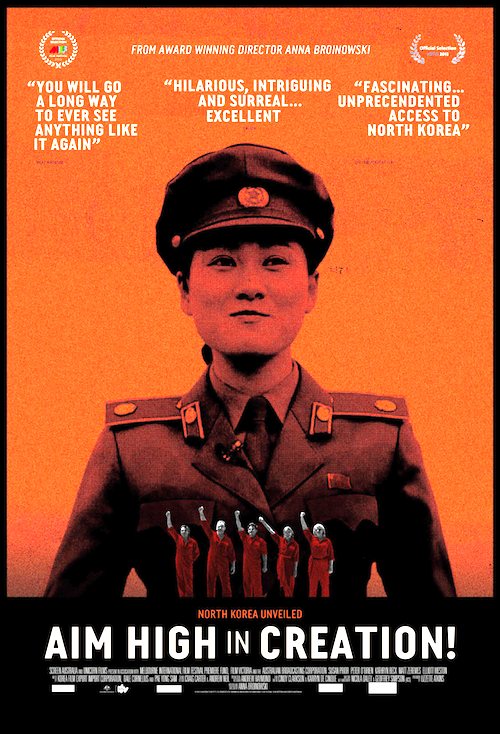
By Joe Bendel. How does this sound to you? “Sure, there were human rights abuses in Hitler’s Germany, but they produced some really entertaining propaganda films.” Absolutely unacceptable, right? Yet, Australian filmmaker Anna Broinowski essentially makes the equivalent argument for North Korea, except she never really acknowledges the Kim dynasty’s appalling oppression of its own people. Instead, she happily heads to the DPRK for pointers on how to make an anti-fracking propaganda film in Aim High in Creation, which screens during the 2014 New York Asian Film Festival.

According to Frontline, it is estimated that one out every one hundred North Koreans is a political prisoner. In that Orwellian state, it is not just perceived thought criminals who are purged, but also two generations of their families, in both directions. Apparently, Broinowski has no real problem with what she euphemistically calls North Korea’s “closed society,” but “fracking” generates no end of moral indignation.

After assembling her annoying hipster cast, Broinowski jets off to North Korea to get tips from the propaganda masters. She sees all the monumental sites, hanging on her minders’ every word. Not once does she challenge anything said to her, passively accepting their charges of American war crimes. She also readily agrees her native Australia is a country of drunks.

Perhaps the idea was to simply record the state of affairs in North Korea and let the surreal images speak for themselves. However, that approach still requires Broinowski to ask the blindingly obvious questions, to cue the resulting dissembling. That never happens. Instead, she obsequiously sucks up to the propaganda filmmakers, like a star-struck teenager.

Yes, it takes courage to speak truth to the apparatus of control in a “closed society.” Few will ever live up to the gold standard set by Mads Brügger in Red Chapel, but those filmmakers fortunate enough to gain access to the rogue state have to at least try. If Broinowski lost her nerve when faced with the regime’s everyday pervasiveness, she should have scrapped the film and preserved her dignity. Instead, her brown-nosing is just embarrassing.

At times, Broinowski’s own images contradict her words, as when she claims there are no advertisements to be seen in North Korean. We can see this is patently false. Pyongyang is covered in propaganda posters and murals, which are indeed advertisements selling blind obedience to the state. She simply finds their aesthetic consistency pleasing, which is what happens when the state exercises absolute control over all means of expression.

From "Aim High in Creation."

Great value seems to be placed on Broinowski’s “just folks” interactions with her propaganda colleagues, as if the audience will be shocked when they do not immediately throw the thumb screws on her, while singing the Internationale, but of course they are carefully crafting their image. These are propagandists, after all.

Not surprisingly, the resulting anti-fracking propaganda short is utterly unwatchable. However, if enough people see it, The Gardener should secure the safe and profitable production of coal seam gas for many generations to come, which is exactly the legacy Aim High deserves. To return to the original question, National Socialism boasted a stable of world renowned filmmakers that included Leni Riefenstahl and the now discredited Viet Harlan. Arguably, one could learn something from their work, whereas their North Korean counterparts are literally following the Great Leader’s formula.

Either Aim High represents a massive editing room meltdown, or it is a profound failure to document the reality of one of the most oppressive regimes in the world. In any event, it is not worthy of your ticket dollars, especially when there are so many great films still to come at this year’s NYAFF, including the bizarrely heartbreaking Miss Zombie and the deeply moving Great Passage. Both are highly recommended, but Aim High in Creation is definitely not. It screened yesterday (7/10).

LFM GRADE: D-

Posted on July 11th, 2014 at 11:25am.

LFM Reviews Silent Witness @ The 2014 New York Asian Film Festival

By Joe Bendel. Evidently, the Chinese legal system is not overly concerned with potential conflicts of interest. For instance, nobody objects to a hotshot state’s attorney prosecuting the daughter of his longtime nemesis, even though she is also the beloved pupil of his art teacher wife. His integrity may very well be above reproach, but the defense attorney will possibly cut a few ethical corners that would be spoilery to address in detail. However, it is safe to say the media-frenzy trial is never headed exactly where the opposing counsels assume in Fei Xing’s Silent Witness, which screened during the 2014 New York Asian Film Festival.

About the only cases Tong Tao has lost were his white collar prosecutions of slippery financier Lin Tai. Despite his history with her father, Lin Mengmeng still knows him as “Uncle,” but the evidence that she murdered her father’s pop idol fiancée is so overwhelming, he must prosecute her anyway. Indeed, it is all so open-and-shut that her defense attorney Zhou Li passively sits on her hands, apparently resigned to defeat, until she suddenly obliterates a key prosecution witness. It seems to be more of a game-ender than a game-changer, but there are several more stunning revelations coming down the pike.

Given the title, one might assume somebody out there saw something important. However, Silent Witness is rather more complicated than that. It is a direct descendant of Agatha Christie’s Witness for the Prosecution, but it clearly depends on the “flexibility” of the Chinese legal system to revise charges on the fly. A case like this would have probably taken decades to unfold in American courts, but it feels like Fei’s characters wrap it up in about a week.

From "Silent Witness."

Regardless, the series of shoes he drops are invariably clever. Yet, there is real drama at the heart of the picture. Considering his work in Silent Witness, viewers are strongly advised not to play poker with Sun Honglei. Even though we can tell his Lin Tai is nursing a secret, he still successfully pulls the rug completely out from under the audiences feet. It is a wickedly subtle slow build that completely upends viewers’ responses.

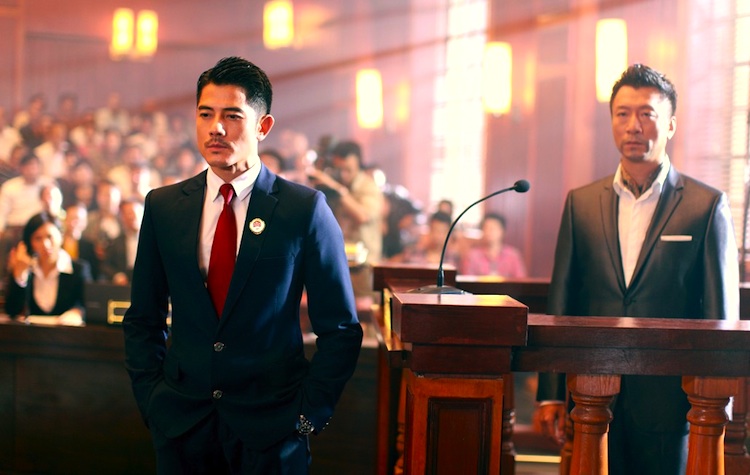
Yu Nan and HK superstar Aaron Kwok nicely anchor the film as the legal eagles navigating the schemes within schemes. Deng Jiajia is also quite compelling as the emotionally stunted Mengmeng. In a smaller but critical role, Zhao Lixin perfectly sells the first reversal as the unreliable witness, Sun Wei. In fact, Silent Witness boasts an unusually deep bench of intriguing supporting players, such as NYAFF special guest Zishuo Ding, who brings verve and energy to the film as Zhou’s associate, Meizi.

Silent Witness presents a nifty series of twists and turns that take on real emotional stakes thanks to the fine work of Sun and the accomplished below-the-titles ensemble. It is such an effective thriller, it would not be surprising if Hollywood started sniffing around the remake rights. Highly recommended for fans of courtroom dramas, Silent Witness screened this week as part of this year’s NYAFF.

LFM GRADE: A

Posted on July 9th, 2014 at 12:02am.