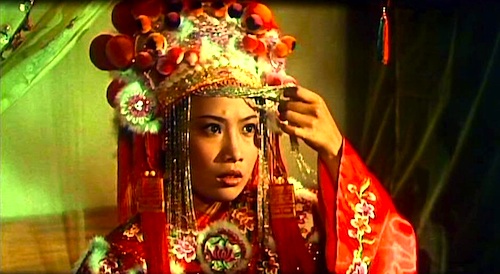
LFM Reviews Blind Massage @ 2014 New York Asian Film Festival

By Joe Bendel. Real massage therapists have anatomical and physiological training to rival doctors, but it remains a widely misunderstood profession. Perhaps in hopes of separating the therapeutic and sensual connotations, it has been one of the few avenues of employment traditionally open to the blind in China. The so-called “doctors” of such a Nanjing clinic are highly skilled, but also deeply human. Their lives will connect and conflict in Lou Ye’s ensemble drama Blind Massage (clip above), which screens during the 2014 New York Asian Film Festival.

The staff is blind, but the patients are entirely sighted, at least as far as we know. That itself is a role reversal. The Sha Zongqi Massage Centre is run by the gregarious Sha Fuming and his reserved partner, Zhang Zongqi, who always try to place new therapists in need of work. Their latest two recruits come with issues. Sullen Xiao Ma gradually lost his sight during his early teen years and has yet to come to terms with his blindness. In contrast, Dr. Wang had once amassed a sizable nest egg, but he lost it all during the financial crisis, forcing him to ask his old friend Sha for a job.

The relationships between staff members will become complicated, like a Chinese massage version of ER. Xiao Ma will be recklessly attracted to Dr. Wang’s partial sighted fiancée Kong, before developing a full-on obsession for local (fully sighted) prostitute Xiao Man. Despite Xiao Ma’s frequent brothel patronage, his beautiful colleague Du Hong nurses an attraction to him, while rebuffing the advances of the desperately lonely Sha.

About a dozen other characters factor into the mix somehow. Frankly, Blind Massage is a bit unwieldy with subplots, but it is hard to say where to cut, because they each work on their own terms. The film was adapted by Lou’s documentary filmmaker wife Ma Yingli from Bei Feiyu’s novel that has already been produced as a multi-part television drama—and it is easy to imagine these characters working in a telenovela format.

However, Lou’s approach is distinctly cinematic, approaching the experimental. His past films have directly raised issues of perception (particularly last year’s NYAFF selection, Mystery), but he takes it in a different direction during Blind Massage, visibly reducing the light and softening the focus during scenes driven by blind characters and reverting to standard levels for sequences involving sighted characters or expository housekeeping. He also employs a narrator to read the unseen credits and provide background information on characters, evoking the experience of enhanced visual descriptions.

Blind Massage captures the arbitrary unfairness of life in vivid terms, but that also offers an opportunity for unlikely cast-members to shine. As a case in point, Guo Xiaodong’s Dr. Wang seems rather unassuming, until blowing the doors off the joint in a confrontation with loan sharks dogging his irresponsible, sighted younger brother. It is a scene and a performance worthy of Shakespeare’s Merchant of Venice.
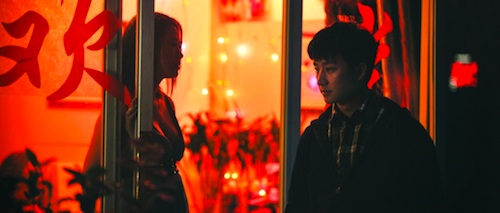
From "Blind Massage."

Mei Ting also pulls the emotional rug out from under us, as the ostensibly standoffish, Du Hong. She resents the fuss made by her colleagues (especially Sha) over the beauty they can never see, yet experiences some of the film’s greatest heartsickness.

On its face, Blind Massage is totally apolitical, but You is still pushing boundaries with its uncomfortable intimacy and matter-of-fact description of contemporary Chinese life for any sort of underdog population. It seems downright tame by our standards, but considering the Puritanism of Communist censors, many scenes represent no small risk to You’s standing. Yet, they are never gratuitous, well serving the characters’ emotional development at crucial junctures. Despite a bit of narrative messiness, it is an engrossing film that pulls viewers into the lives on screen in a vivid, ambitiously experiential way. Recommended for mature audiences, Blind Massage screens Wednesday (7/2) at the Walter Reade Theater, as part of this year’s NYAFF.

LFM GRADE: B+

Posted on July 1st, 2014 at 11:40pm.
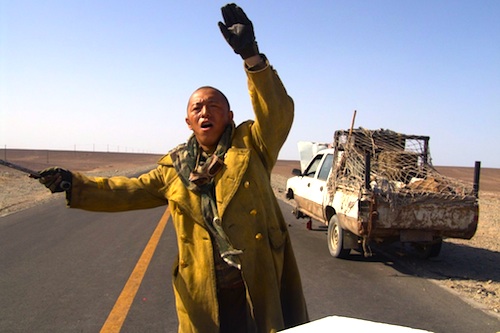
LFM Reviews No Man’s Land @ 2014 New York Asian Film Festival

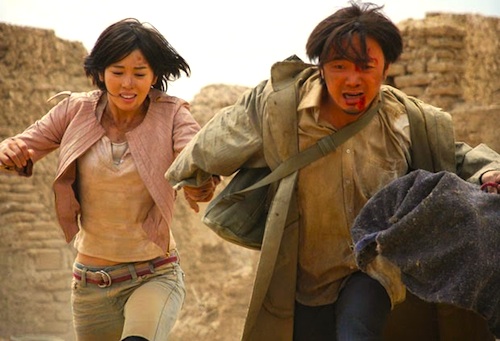
From "No Man’s Land."

By Joe Bendel. Dennis Weaver only had one psycho-semi to deal with in Duel. There are multiple parties of angry rustics-on-wheels out to drive Pan Xiao off the road—permanently. Of course, he sort of has it coming. He’s an attorney. Only the law of the jungle applies on this lonely stretch of Gobi Desert highway, but at least there is a socially redeeming coda tacked on to satisfy Chinese censors. Nevertheless, audiences can see most of the dark beast that is Ning Hao’s long delayed No Man’s Land when it screens during the 2014 New York Asian Film Festival.

The hot shot big city attorney has come to represent Lao Da, a falcon poacher accused of murder. Of course, we know he is guilty, because we have seen the prologue. Nevertheless, Pan Xiao gets him off with a little Billy Flynn razzle dazzle. This was no mere charity case. Pan Xiao expects to get paid, so when Lao Da balks at ponying up cash on the barrelhead, the lawyer takes possession of his client’s shiny new Mustang instead. He really should have just used his return ticket on the train.

In fact, the counselor has been played by the poacher, who stashed a cache of falcons in the car and has a henchman waiting to waylay Pan Xiao. It is a good plan, but it did not anticipate the long-haul truckers the mouthpiece tangles with on his way out of town. Posing as a broken down motorist, Lao Da’s accomplice Lao Er is supposed to ambush the attorney once he has pulled over, but due to a cracked windshield, he plows over the his would-be assailant. Not knowing Lao Er’s intentions, Pan Xiao now believes he has a body to dispose of. However, stopping by a remote price-gauging gas station only makes matters worse, particularly when their trafficked lap dancer, Li Yuxin, looks to Pan Xiao to be her rescuer.

That takes us about twenty minutes into the film. From there, things get very brutish, violent, and complicated. Nearly everyone wants to kill Pan Xiao and the cops are ready to assume the worst about him, after their embarrassment in court. Nonetheless, it is hard to see what activated the state censors’ schoolmarm reflexes, except maybe the pervasive nihilistic violence. Could they really be so concerned about the image of the legal profession or are they reluctant to admit the lurid truth regarding falcon poaching?

From "No Man’s Land."

After it was liberated from the vault, No Man’s Land set the Chinese box-office on fire, largely thanks to the presence of two stars from Lost in Thailand. Xu Zheng’s characters just do not travel well, but he plumbs hitherto unseen dark places as Pan Xiao. He is not a standard issue victim, by any stretch, but he cannot out-fierce steely Tibetan actor Duobujie’s Lao Da. Yu Nan (the only under-40 cast member of The Expendables 2) also adds some heat and a human touch as Li.

Even the approved-happy-happy cut of No Man’s Land is totally in-yer-face stuff, but we can only wait and hope for a straight no chaser director’s cut to trickle out. Regardless, it is hard to beat action director’s Bruce Law’s car-crashing survivalist mayhem. Highly recommended for genre fans who take their coffee black, No Man’s Land screened yesterday (7/1) at the Walter Reade Theater, as part of this year’s NYAFF.

LFM GRADE: A-

Posted on July 1st, 2014 at 11:35pm.

LFM Reviews Kano @ The 2014 New York Asian Film Festival

By Joe Bendel. Sure, a three hour baseball movie might sound like bizarre overkill, but it is still considerably brisker than many of Al Leiter’s outings for the Mets (we’re all fans here, by the way). It is long, but this scrappy underdog story of tolerance and resilience generally makes good use of its time. Taiwanese and Japanese players will indeed come together on the diamond in Umin Boya’s Kano, the centerpiece selection of this year’s New York Asian Film Festival, which screens Sunday, so forget that World Cup noise.

Despite the spectacular revolt dramatized in co-writer-producer Wei Te-sheng’s Warriors of the Rainbow: Sediq Bale, Japan has consolidated its imperialist hold on Taiwan. Despite the increasing (but unequal) economic ties between the two countries, Taiwan is not where the Japanese go when their careers are on the way up. However, for tightly wound account Hyotaro Kondo, it represents a chance to start over following a vaguely defined public humiliation. Yet, against his better judgment, Kondo soon volunteers to coach the Kagi Agriculture and Forestry Public School’s high school baseball team (called Kano for short).

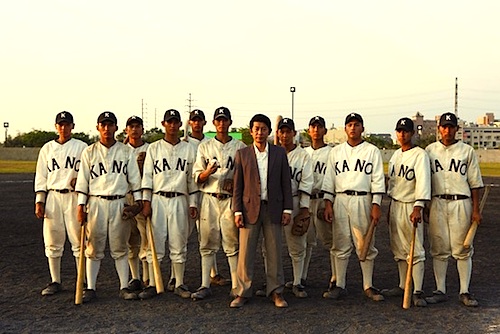
It was Kondo’s intense coaching style that led to so much grief in Japan, but he has never had a team like this. For one thing, it is an ethnically mixed squad, consisting not just of Japanese and Taiwanese players, but aboriginal and Chinese students as well. They also receive next to no material support from their school. Still, Akira Go, the kid on the mound, has a monster arm. Everyone scoffs when Kondo vows to take the team to Koshien, Japan’s national high school tournament, especially given their ‘O-fer record, but guess what happens next year.

Despite its incontrovertible status as a sports movie, Kano neatly sidesteps a number of the genre clichés. The big game will duly choke you up, but in a far more satisfying way than you expect. Coach Kondo even says there is no crying in baseball, but good luck with that.

Masatoshi Nagase is truly the coach of all movie coaches as the strict but fiercely loyal Kondo. He commands the screen just like Kondo commands his players, but when he lets his softy paternal side peak through, it is always heavy. Oddly, perhaps the most distinctive supporting turn amongst the players is actually Ken Aoki as rival pitcher Hiromi Joshiya, whose trip to see Kano’s dirt playing field for himself while on leave from the Imperial Army supplies the film’s framing device. British based Japanese actor Togo Igawa also adds a note of gruff dignity as Kondo’s former mentor, Coach Sato.

From "Kano."

Production designer Makoto Asano’s recreation of 1931 provincial Taiwan looks so real you can practically taste the mud and thatch. It is a high quality period production and probably the most epic baseball movie ever thanks to cinematographer Chin Ting-chang’s sweeping, wide screen visuals. Yet, the on-field camaraderie is not simply a good lesson in sportsmanship. It looks like a conscious attempt at Taiwanese-Japanese rapprochement , strategically coming at a time of high Mainland saber rattling (and frankly that is probably not a bad impulse to act on).

Happily, Kano does not feel like it runs anywhere near its three hours, but there is no getting around the generous helpings of baseball. As great as Nagase is, Kano’s appeal will probably be limited to fans of the game (which includes just about everyone in Taiwan judging from its domestic box-office). Earnest, entertaining, and appealingly old fashioned, Kano is recommended for lovers of baseball and those who follow Japanese and Taiwanese cinema when it screens Sunday evening (6/29) at the Walter Reade Theater, as the centerpiece of this year’s NYAFF.

LFM GRADE: B+

Posted on June 29th, 2014 at 12:14am.

LFM Reviews The White Storm @ The 2014 New York Asian Film Festival

By Joe Bendel. Eight-Faced Buddha is the Al Sharpton of Thai drug lords. That ridiculous coif should be sufficient grounds to throw his butt in jail. However, he also has an extensive body count to his credit and a massive wave of heroin headed towards Hong Kong. The only thing standing in its way is an extremely tired undercover cop, his handler, and their boss and mutual boyhood chum. Their friendship will be severely strained in Benny Chan’s action conflagration The White Storm, which screens during the 2014 New York Asian Film Festival.

So Kin-chau is due for some R&R with his very pregnant wife, but Chief Inspector Ma Ho-tin keeps sending him out for one more sting. They were supposed to finally bust his longtime target Black Chai, but when Ma learns the trafficker has a deal in the works with Eight-Faced, So must engineer a last minute escape for the both of them. So reluctantly goes deep undercover with Black Chai – with only Ma, their third Musketeer Cheung Chi-wai, and another honest HK colleague for back-up.

Frankly, the boundary between cops and criminals in Thailand is rather porous. Ma and his colleagues have to go rogue just to foil the crooked cops trying to rat out So. Unfortunately, when Ma’s game-changing operation goes wrong, it goes massively, cinematically wrong. It will fatally sabotage his career and plague his conscience for years, until a big twist suggests his guilt might be a tad misplaced.

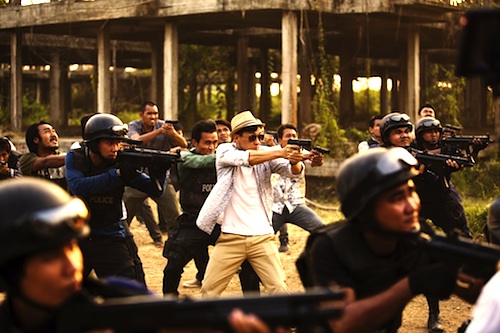
From "The White Storm."

There is nothing subtle about White Storm. It is all about projectile explosions and brooding, but it truly delivers some awesome over-the-top action spectacle. Nothing is off the table including a romance with Eight-Faced’s transgendered daughter, Mina Wei. Arguably, that is the most sensitively rendered element of this delirious gun-down. Evidently, Nick Cheung’s steamy publicity photo shoot with the transgender beauty queen Treechada “Poyd” Malayaporn raised quite a few eyebrows in HK, so mission accomplished.

In fact, all three big name leads are in fine form throughout. Louis Koo’s So slow burns like nobody’s business, while Sean Lau Ching-wan compellingly portrays Ma’s rapid descent from hot shot to a self-loathing shell of a man. However, Cheung takes viewers on the wildest character arc as his rapidly evolving namesake. Vithaya Pansringarm, who stole just about every scene in Only God Forgives, also turns up, playing a far more ethically ambiguous cop, but he is criminally under-employed.

While White Storm indulges in quite a bit of Thai exoticism, Chan never strays too far from an old school hail of bullets. Its super-charged energy level and tragic sensibilities follow in the tradition of some of the best HK action films. Highly recommended for fans of Hong Kong Cinema and the big name cast, The White Storm screens tomorrow (6/29) at the Walter Reade Theater, as part of this year’s NYAFF.

LFM GRADE: A-

Posted on June 29th, 2014 at 12:09pm.

LFM Reviews Top Star @ The 2014 New York Asian Film Festival

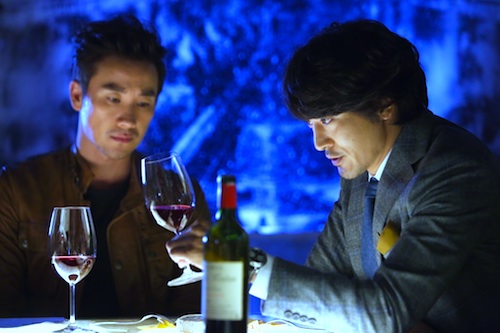
From "Top Star."

By Joe Bendel. It is the bromantic version of A Star is Born. Kim Tae-sik was once Jang Won-joon’s manager—the term manager in this context meaning the gopher assigned to Jang by his management agency. Kim harbors his own dreams of stardom that Jang will help fulfill in exchange for help cleaning up yet another scandal. There will be drama when the overnight success story threatens to eclipse his former boss in actor-turned director Park Joong-hoon’s Top Star, which during the 2014 New York Asian Film Festival.

In exchange for taking the fall for Jang’s non-fatal hit-and-run, Kim lands a part on the star’s latest television crime drama. Despite his questionable chops, Kim catches on with viewers. Soon he is nearly as big a star as Jang, but many of their colleagues still refuse to accept the tacky bounder. Nevertheless, Jang’s agent-lover Mi-na recognizes his commercial potential. He quickly falls for her, but she never returns his interest with enough enthusiasm for the trio to be considered a love triangle.

For about ten seconds, when Kim is big enough to be considered a social equal but not big enough to constitute a threat, the two stars become friends. Then it all falls about. The voluminous skeletons lurking in their closets do not help matters either.

There is indeed a rise and fall dramatic arc to Top Star, but it not nearly as predictable as it probably sounds. Frankly, Mi-na is considerably smarter and Kim is significantly more sociopathic than one would expect, while Jang is just too slippery to ever get an easy handle on. Still, it is safe to say the entertainment business is a wee bit corrupting, as Park (the recipient of NYAFF’s Celebrity Award) should know.

From "Top Star."

There are some knowing winks throughout the film, such as veteran thesp Ahn Sung-ki playing a fictionalized version of himself and an art-house director, who brings to mind Hong Sang-soo. Without question though, the guts of Top Star are devoted to a gleefully reckless morality tale.

As Kim, Uhm Tae-woong totally nails the everyman gone bad. He is creepy, yet we can still see the shy, insecure dreamer in there, somewhere. So E-hyun and her withering stare make Mi-na refreshingly strong and sexy. Similarly, Kim Min-jun’s portrait of erratic, less-than-self-aware privilege keeps the audience rather off balance.

Yes, it really is like what Chris Rock says: “here today, gone today.” It might sound like a dark downer, but the sure-footed Park maintains a brisk trot-like pace, while bringing out some surprisingly understated work from the fine ensemble. Solidly entertaining (but only slightly voyeuristic), Top Star is recommended for fans of upscale melodrama and those who closely follow the Korean film scene. It screens Monday (6/30) at the Walter Reade Theater, as part of this year’s NYAFF.

LFM GRADE: B

Posted on June 29th, 2014 at 12:04am.

The Angela Mao Ying Collection: LFM Reviews The Himalayan

By Joe Bendel. It is sort of like Shaolin’s Tibetan Buddhist cousin, but it is not called Esoteric Kung Fu for nothing. Practitioners are few and far between, but it might be just the discipline to take on the savage tiger claw. Regardless, vengeance will not be denied in Feng Huang’s The Himalayan, which is included in The Angela Mao Ying Collection now available from Shout Factory.

In the high Himalayas, a martial arts competition is a fine place for a courtship. As it happens, when Ceng Ching-lan faces Gao I Fan, they make more of an impression on her father, Lord Ceng and his older brother, Gao Zhen, than on each other. An arrangement is quickly struck, but when I Fan expresses reservations, the devious Gao Zhen permanently dispatches his brother, replacing him with a more compliant look-a-like. He was adopted anyway.

It quickly becomes apparent Gao has designs to take over the power and wealth of the Ceng house. Through his dreaded tiger claw kung fu, Gao incapacitates Lan, framing her for the murder of the latest I Fan. Fortunately, her boyhood chum Xu saves her from the ritual cast-off-into-the-river form of execution. Together they will regroup in the Eagle Lama’s monastery, hoping to be deemed worthy of learning his rare Esoteric Kung Fu.

From "The Himalayan."

With its wide mountain vistas and Tibetan-Nepalese locations, The Himalayan is an unusually visually striking martial arts film, much in the King Hu tradition. Similarly, it also has some highly cinematic fight scenes choreographed by Sammo Hung (sharing duties with Han Ying-chieh). However, since it was produced by Golden Harvest in the 1970s there are also the requisite nude scenes featuring Angela Wang En-chi as Gao’s vixen accomplice, Man. Genre fans will also want to keep their eyes peeled for Hung, Jackie Chan, and Corey Yuen, who pop up briefly as fight extras.

While Mao is not always front and center, she still takes a strong and steely star turn as the wronged Lan. She meets one of her best antagonists in the form of Chan Sing, who truly looks like he enjoys evil scheming more than any Bond villain. His tiger claw moves are also suitably fierce. Yet, it is Han, the co-action director, who nearly steals the show as Uncle Qu, Lord Ceng’s wise but surprisingly spry old advisor.

Altogether, The Himalayan is a winning blend of Buddhist wisdom and exploitation goodies. It is a great showcase for Mao, while getting the most from a talented supporting ensemble. Enthusiastically recommended, The Himalayan is now available on DVD as part of Shout Factory’s Angela Mao Ying Collection.

LFM GRADE: A-

Posted on June 26th, 2014 at 6:03pm.