The United States vs. Public Enemy #2: LFM Reviews Whitey

By Joe Bendel. Between James J. “Whitey” Bulger, the leader of the Winter Hill Gang and his brother, former Massachusetts Senate President William M. Bulger, the Brothers Bulger long ruled Boston from both ends of the law. Bulger the politician was never implicated in his brothers crimes, but his refusal to reveal communications received from the fugitive James J. effectively ended his public career. However, it now seems Whitey Bulger had such highly placed protectors in the FBI he would not have needed much help from his brother. Joe Berlinger documents the revelations and controversies that emerged during Bulger’s highly anticipated trial in WHITEY: United States of America v. James J. Bulger, which opens this Friday in New York.

You will not hear the name William Bulger much in Berlinger’s WHITEY, nor hear from probably the brothers’ greatest media critic, the defiant radio talk show host, Howie Carr. However, viewers will hear an awful lot from the titular Bulger. Indeed, Berlinger features extensive telephone interviews with the convicted murderer, presented sans rebuttal. Frankly, it is rather strange the extent to which Berlinger adopts Bulger’s narrative as the film’s own—so much so, one almost expect him to receive a writing credit.

Of course, Bulger’s guilt is never in question. Instead, Bulger’s general defense strategy is to cloud the issue as much as possible, while causing maximum discomfort for the Feds. The central issue is whether Bulger really served as a government informant, dropping dimes on the competition, or if the late U.S. Attorney granted him immunity in exchange for protection from the Italian mafia instead.

While Berlinger’s editorial tone almost slides into Bulger apologetics, he is always scrupulously sensitive when dealing with victims and their family members. Tragically, the filmmakers faced a shocking challenge when Stephen Rakes, one of the potential witnesses they were following through the trial, was dramatically murdered. Supposedly, it turned out to be an unrelated case, but there is a note of skepticism detectable in the doc—for good reason.

From "Whitey."

Berlinger and his assembled talking heads leave no doubt in viewers’ mind that a corrupt echelon in the FBI protected Bulger for no legitimate law enforcement reason. They are morally complicit in several murders—and perhaps legally complicit too. They also helped ruin the sport of Jai Alai for the rest of us, which is one of the film’s most intriguing episodes that could have  been explored further (and perhaps was in the longer Sundance cut). In fact, Berlinger’s WHITEY somewhat rights itself when it becomes a conscious and deliberate vindication of Special Agent Robert Fitzpatrick, who tried to sever agency ties to the mobster. (Full disclosure, my house published Fitzpatrick’s book, but we have never met.)

WHITEY will once more shake viewers’ depleted faith in the Federal government, while chronicling some morbidly fascinating criminal history. However, it has a tendency to lose sight of the forest for the trees. The actions of Bulger’s handlers were badly misguided and downright criminal, but he remains the worst of the lot. The resulting doc holds one’s rapt attention, but leaves you feeling a little queasy, as if you have been getting an earful from Bulger himself (which is sort of the case). Recommended mainly for true crime fans, WHITEY opens this Friday (6/27) in New York at the IFC Center.

LFM GRADE: B-

Posted on June 26th, 2014 at 5:58pm.
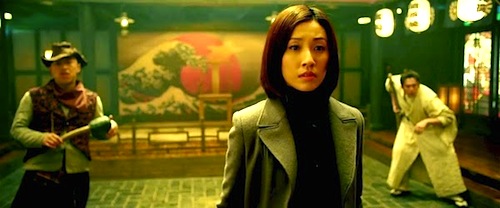
Chinese Opera in the Time of Cholera: LFM Reviews The Chef, the Actor, and the Scoundrel

By Joe Bendel. The Imperial Japanese Army’s notorious Unit 731 has been the subject of several highly controversial docudramas that were sharply criticized for their exploitative use of horrific archival footage. This is not one of them. Instead, two members of the biological warfare research center will find themselves on the business end of an unorthodox interrogation in Hu Gaun’s comedic-tragic action mash-up The Chef, the Actor, and the Scoundrel, which releases today on DVD and Blu-ray from Well Go USA.

A particularly nasty strain of Cholera is raging through China, courtesy of Unit 731. However, their leading biochemist Col. Ogasawara Goro and his aide de camp have been waylaid by a highwayman, who has more or less commandeered an inn to serve as his temporary hideout. However, the chef and his mute wife are not thrilled to have them there, but their Chinese opera singer sort of sides with the Scoundrel (and against his employers), for patriotic reasons. With varying degrees of reluctance, they proceed to grill the officer in hopes of exploiting his valuable formula.

Frankly, you just have to get through the first twenty minutes of buffoonery before Guan tips his hand. It turns out that the four bickering captors are much smarter, disciplined, and unified than they would have the Japanese believe. In fact, we are witnessing an elaborate ruse inspired by Chinese opera, designed to lull Ogasawara into accidentally revealing the formula. The set-up works like a charm, but time is not on their side, especially when the Japanese military finally comes knocking.

Really, you want to stick with this film, because it reinvents itself several times. In a way, it rather shows up the kind of rubber-faced slapstick of co-star Huang Bo’s Lost in Thailand. There are indeed a number of twisty plot reversals and some ripping good action spectacle in the third act. In fact, it wins over viewer affections in surprising (but spoilery) ways.

From "The Chef, the Actor, and the Scoundrel."

Huang and Zhang Hanyu are rather amazing while dialing it up and then cranking it down as the Scoundrel and the Actor, respectively. Liu Ye cannot quite turn on a dime as quickly as his two comrades, but he shows off the strongest action chops as the Chef. Yet, it is Liang Jing who probably undertakes the greatest upstairs-downstairs transformation as the goonish wife. One should also keep one’s eyes on Taiwan-based Japanese actress-model Chie Tanaka, for dramatic reasons, because she nicely turns her own subtle surprises, as well.

Somehow, the misleadingly Greenaway-esque titled Chef manages to be both a traditional homage and an ironic riff on the King Hu-inspired inn period drama. Guan throws just about everything into the mix, except maybe space aliens and cynicism. Highly recommended (but seriously, don’t bail on it early), The Chef, the Actor, and the Scoundrel is now available on DVD, Blu-ray, and digital platforms from Well Go USA.

LFM GRADE: A-

Posted on June 26th, 2014 at 5:56pm.

Revolt of the Eggheads: LFM Reviews Radio Free Albemuth

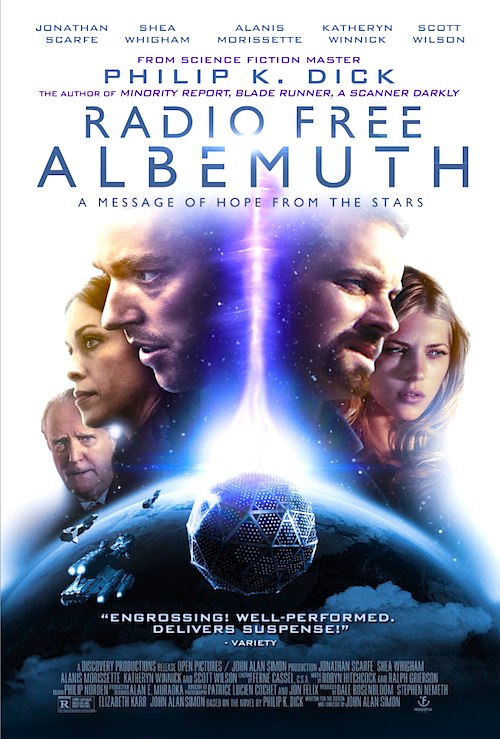
By Joe Bendel. Transrealism is a sub-genre of science fiction in which the author frequently appears as a character in their own work, freely melding the fantastical and the autobiographical. The style has several proponents, but they are all largely swimming in Philip K. Dick’s wake. Amongst his most transreal works were his VALIS trilogy and a related posthumous novel. While many Dick novels have been loosely adapted for the screen, the courageous John Alan Simon took a shot at a comparatively faithful take on the more self-contained latter novel. Things will get all kinds of transreal in Simon’s Radio Free Albemuth, which opens this Friday in New York.

In this alternate world, America is a crypto-fascist state, but ironically there is less intrusive surveillance afoot than under the Obama Administration. President (for life) Ferris F. Fremont (FFF = 666) continues to be re-elected despite his bizarre campaign against “Aramcheck,” a supposed shadowy cabal of Soviet sleeper agents still conspiring against the country, years after the fall of Communism. Science fiction novelist Philip K. Dick will chronicle his pal Nicholas Brady’s ill-fated attempt to foment an uprising against Fremont. We know it will be ill-fated because of the decidedly dystopian framing device.

Frankly, the Orwellian state was working quite well for Brady, at least for a while. Thanks to subliminal messaging sent to him by a hive-mind alien entity he dubs VALIS (Vast Active Living Intelligence System), Brady leaves his Berkley record store gig in favor of a position at a record label, where he quickly advances. Due to his previous visions, he is convinced he should sign the mysterious Sylvia to a recording contract when she applies for a receptionist position. She has no idea what he is talking about, but appreciates any opportunity because of her unfortunate surname: Aramcheck.

Eventually, we learn those who commune with VALIS have an egg implanted in their heads, the Roman Empire never really fell, but continues to be the power behind the curtain, and perhaps Fremont was a Manchurian Candidate-style Soviet plant. Strangely, it all mostly makes sense in context.

Simon goes for a trippy, hallucinatory vibe, but unfortunately he succeeds too well. There is indeed a far-out atmosphere to the proceedings, but that consequently slows the pacing down to a somnambulist shuffle. This also gives viewers more than enough time to fully acknowledge the MST3K-worthy special effects. Frankly, it would be better not to show VALIS’s Satellite of Love than to green screen something that looks cruder than Overdrawn at the Memory Bank.

Clearly, Dick was not holding back the weirdness in Albemuth, yet it now seems somewhat dated, not just in terms of the escalated surveillance. There are weird L. Ronian echoes to the VALIS egg-implants, while Dick’s Cold War disdain seems rather naïve in light of Eastern Europe’s independence movements and Putin’s subsequent  Neo-Soviet imperialism. Frankly, the best thing about Simon’s film is the self-reflexively ironic Dick character and the understated but intense performance of Boardwalk Empire’s Shea Whigham.

Albemuth also boasts Alanis Morissette in her first substantial dramatic role, but it is nothing to write home about. Yet, Jonathan Scarfe is even more dour and dull as Brady. At least Hanna Hall seems to enjoy playing the fascist vixen toying with Dick (that doesn’t sound right, but so be it).

As if it needed any stranger credentials, Albemuth also boasts Robyn Hitchcock’s original song “Let’s Party,” which is bizarrely effective playing a critical role within the narrative. In fact, Simon’s ambition is admirable, but there are just too many disparate parts in conflict with each other. It is easy to see why his Hollywood predecessors opted to crank up the action instead. A noble car crash of a film that “Dickheads” will have to see regardless of mere mortal criticism, Radio Free Albemuth opens this Friday (6/27) in New York at the Quad Cinema.

LFM GRADE: C+

Posted on June 26th, 2014 at 5:46pm.

LFM Reviews The Pleasures of Being Out of Step: A Portrait of a True Iconoclast

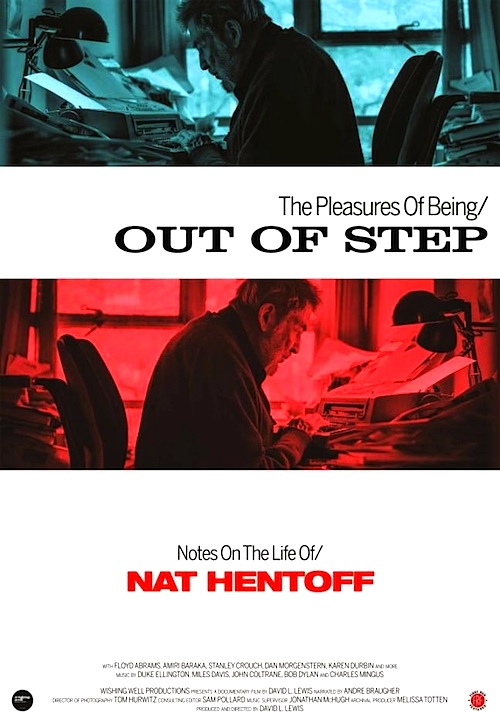
By Joe Bendel. Napster-generation kids will probably never appreciate the art of liner notes. Obviously, there is no place to put them on an illegal download. There is also the clear implication that the music contained within is worth taking the time to discuss at length. Nat Hentoff always, always believed jazz was an art form worthy of serious attention. Not surprisingly, many of Hentoff’s admirers first knew him for his LP notes and jazz journalism. However, David L. Lewis devotes roughly equal time to Hentoff’s tireless defense of free expression. It is a continuing commitment that cuts across ideological lines. As a result, he offers an unusually complex and intellectually engaging profile of the NEA Jazz Master in The Pleasures of Being Out of Step: Notes on the Life of Nat Hentoff, which opens this Wednesday in New York.

Hentoff never worried about winning popularity contests. To put things in perspective, Hentoff was fired from Downbeat magazine decades ago, because he hired an African American. In a bit of a scoop, Hentoff provides an ironic coda to this notorious story during a public appearance Lewis captures. Nevertheless, it still illustrates Hentoff’s personal and political commitment to racial equality. The fact that he was on good terms with musicians like Max Roach and Charles Mingus (not exactly shrinking violets) and developed a considerable level of trust with Malcolm X, speaks volumes.

Through his long association with the Village Voice, Hentoff also emerged as arguably the strongest and most consistent defender of civil liberties. While Lewis never addresses Hentoff’s dissenting reports on Terri Schiavo (which frankly shames us all as a nation), he tackles the columnist’s unapologetically pro-life evolution (for much the same reasons he opposes capital punishment).

Indeed, Lewis’s instincts are pretty much spot-on throughout Pleasures. While fully establishing Hentoff’s nonpartisan dedication to principle, he largely lets the man speak for himself. Of course, it is easy to see why. Six decades of courting controversy have not dulled his wit, eloquence, or flair for the provocative. Most importantly, Lewis licensed many classic, thematically appropriate jazz recordings for the soundtrack (Mingus, Roach with Abbey Lincoln, Duke Ellington, Artie Shaw, etc.). It probably sounds like a no-brainer to use jazz music in a film about jazz, but you would be surprised how many filmmakers lose faith in their subjects and opt for mushy mood music instead.

So good for Lewis for recognizing jazz and contrariness make an entertaining combination. Probably nobody agrees with Hentoff up and down the line (his wife certainly does not, but she is also a smart, dynamic interview subject). Yet, it is always interesting hear the Cato Institute fellow make his case. Fittingly, Hentoff is also on the board of the Jazz Foundation of America, so he would most likely approve of closing this review with an invitation to support their efforts on behalf of real deal musicians in need at their website. Highly recommended for supporters of jazz and the Constitution, The Pleasures of Being Out of Step opens this Wednesday (6/25) in New York at the IFC Center.

LFM GRADE: A-

Posted on June 25th, 2014 at 11:11pm.

LFM Reviews Snowpiercer

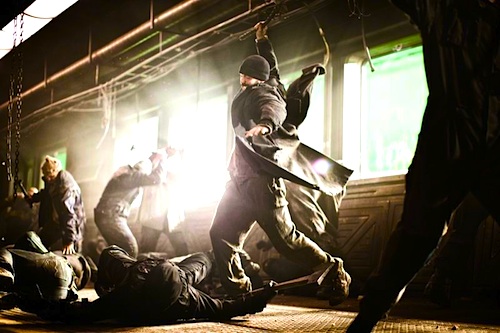
By Joe Bendel. In the future, the world will become a giant allegory. Nothing in this claustrophobic dystopia performs a practical purpose, but serves as a vision of class warfare at its most extreme. At least it all looks cool when the train’s tail-section revolts in Bong Joon-ho’s first English language production Snowpiercer, which opens this Friday in New York.

Seventeen years ago, a climate control experiment went horribly wrong. Now that the Earth is a frozen wasteland, the only surviving humans live in the protection of the globe circling train providentially prepared by the mysterious Wilford. However, instead of assigning productive tasks to each survivor, the Wilford express maintains a rigid and bafflingly bizarre social caste system. The further up you travel, the richer, crueler, and idler the passengers get. It’s all sushi and filet mignon up front, but gelatinous protein bars for the proletarian in the tail-section, who do not really appear to work either, but just sit around waiting to be beaten by the guards (apparently the train’s only productive class).

Curtis Everett has emerged as the leader of the proles in the back of the train, whether he likes it or not. He is still haunted the things he did during his darkest, most desperate hours, but old Gilliam provides encouragement and wise counsel to the budding revolutionary. Everett is biding his time, waiting for a cue from a source ensconced somewhere further up the train, but the arbitrary ruthlessness of Minister Mason, a buck-toothed caricature of an elitist exploiter, forces his hand. Freeing Nam-gung Min-su, the drug-addled Korean security specialist who designed the train’s door locks, and his train-born daughter Yo-na, Everett and his followers plan to fight their way to the engine room. Stopping anywhere short of that will doom their revolt.

From "Snowpiercer."

Frankly, Snowpiercer is even less subtle than it sounds. Tilda Swinton is a great screen thespian, but her portrayal of Mason is embarrassingly cringey. She is also emblematic of the film’s fundamental problem—this simply is not a believable world. People act mean and savage for no logical reason accept to live up to a class-based stereotype. Nonetheless, production designer Ondřej Nekvasil and art director Štefan Kováčik created a distinctively detailed calling card that ought to earn them a gig on the next Terry Gilliam or Tim Burton film.

If you prefer your movie leads on the sullen side then you will probably be okay with Chris Evans’ turn as Everett. He is a brooding machine, but looks respectable during the well-staged action sequences. John Hurt’s Obiwan shtick also works well enough for Gilliam the sage. However, the only real surprises found in the film come from the characters of Nam-gung Min-su and Yo-na—as well as the respective performances of Korean superstar Song Kang-ho and Ko Ah-sung, his juvenile co-star in The Host. Viewers should keep their eyes on this tandem, because together they nearly redeem all of Snowpiercer’s flaws.

Uncut by the Weinsteins, Snowpiercer is so didactic it will give intellectually sophisticated viewers a headache. Yet, there are fascinating Easter Eggs buried throughout it, thanks to a skilled design team and Bong’s Host alumni. Diverting for those who appreciate spectacle and mayhem, but disappointing on any deeper level, Snowpiercer opens this Friday (6/27) in New York at the Angelika Film Center.

LFM GRADE: C

Posted on June 25th, 2014 at 11:06pm.

Singing Freely in Estonia: LFM Reviews To Breathe as One

To Breathe as One – Film Trailer from Maureen Tusty on Vimeo.

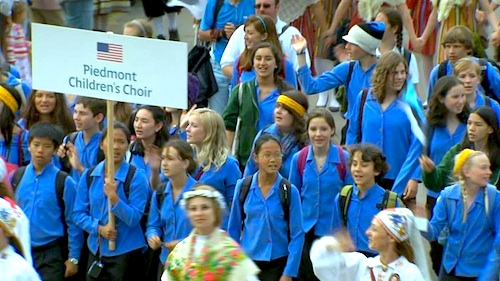
By Joe Bendel. Every five years, Estonia mounts a massive chorale festival called Laulupidu. Do not expect to hear “The Internationale” on the program anytime soon. Traditionally more than a concert, Laulipidu provided a venue for several extraordinary spontaneous acts of defiance during the Soviet years. Today, it continues as a symbol of Estonian freedom and a celebration of its culture. It is a big deal for the small number of international choirs that are invited to participate. For the Piedmont Children’s Choir, it will also be a world-expanding learning experience. With co-directors Bestor Cram and Mike Majoros, Singing Revolution filmmakers James and Maureen Castle Tusty return to Laulupido to follow the Piedmont choir’s journey in To Breathe as One, which premieres on PBS World Channel this Friday.

As the Tustys documented in their previous film, even a heavily armed police state cannot silence thirty thousand voices singing in harmony. Frankly, the Estonians never fully submitted to their Communist occupiers. When cracks started appearing in the Iron Curtain, Estonia’s chorale tradition played a critical role in unifying the renewed resistance. It is an inspiring story chronicled with sensitivity and authority in the Tustys’ The Singing Revolution, but they also provide a fine abridgment in Breathe.

The members of the Piedmont performance ensemble (predominantly high school and perhaps some middle school students) will come to appreciate that history as they learn their Estonian repertoire. The conscientious efforts of their director Robert Geary to connect the difficult pronunciations to their deeper cultural and historic meanings clearly bear fruit. In fact, they probably understand Baltic history better than most of our current foreign policy decision-makers (sadly, a pathetically low bar to clear).

A great deal of Breathe captures the Piedmont Choir’s person-to-person diplomacy, as they befriend and perform with their Estonian counterparts rather easily. It might sound pleasant but rather precious, in a “human interest” kind of way. However, the striking scale of the Laulupidu backdrop is not just photogenic. It provides a constant reminder of the wider significance of the festival.

From "To Breathe as One."

Even if you do not think chorale music is your bag, the performances at Laulupidu will make the hair on the back of your neck stand on end. You can literally hear one hundred fifty years of tumultuous history crescendoing in triumph over their Czarist and Communist oppressors. It is also a timely reminder of the precariousness of liberty, particularly in light of Putin’s expansionist ambitions. Does anyone seriously think the Obama administration has a plan of response should the Russians move against our Baltic NATO allies?

While they stand alone, the macro Singing Revolution and micro Breathe would be even better viewed in tandem. Both films are highly recommended for students, but Breathe will likely be somewhat more accessible for young viewers. A must-see for lovers of freedom and chorale music, To Breathe as One airs this Friday (6/27) on PBS World Channel.

LFM GRADE: B+

Posted on June 23rd, 2014 at 11:00pm.