Andy Garcia Knows It’s Out There: LFM Reviews A Dark Truth

By Joe Bendel. Jack Begosian went from cover-ups to bottom-feeding. The former CIA agent now hosts a conspiracy theory driven radio program in Toronto. He claims the new gig eases his conscience. However, he will have the opportunity to atone for past sins with more direct action in Damian Lee’s A Dark Truth, which opens in Miami today.

To be fair, Begosian is not trafficking in space alien rumors, but he gets plenty of those calls on his late night talk show. Although his backstory is never fully spelled out, Begosian left the Agency under scandalous circumstances. A Congressional hearing was involved. Trying to live quietly with his frustrated wife and emotionally withdrawn son, Begosian is not looking for freelance gigs. Nevertheless, one comes his way.
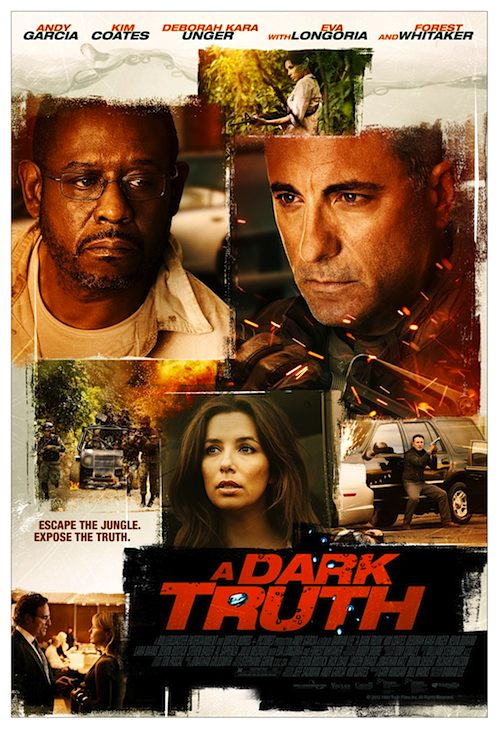
Heiress Morgan Swinton suspects Clearbec, her family’s industrial water filtration company, is up to no good in Ecuador. She needs an independent hardnose to go down there and check things out. For Begosian, it represents karma coming full circle. According to reports, environmental activist Francisco Francis has incriminating evidence on Clearbec. That would be the same Francis who served time in a rather unpleasant Latin American prison thanks to Begosian’s behind-the-scenes maneuvering. Now his assignment is to get Francis and his wife safely out of the country and into a courtroom, despite the efforts of the Ecuadoran military and Clearbec’s enforcers.

Dark Truth largely recycles Hollywood’s standard issue corporate villainy plot, but Lee’s screenplay is less morally simplistic, portraying the culpable Swinton brother in relatively sympathetic terms. Yet, it is Andy Garcia who truly dominates the film as Begosian. He still has plenty of credibility in the adequately staged action scenes and brings the appropriate gravitas for Begosian’s “that’s the way it is” radio pronouncements.

Garcia is still one bad cat and so is Kevin Durand, who is coolly hardboiled as the unpredictable hitman, Torrance “Tor” Mashinter. Unfortunately, Forest Whitaker and Eva Longoria do not fare so well as the Francises, awkwardly trying to look noble as they scramble through the jungle. In contrast, Kim Coates makes an intriguingly human villain, nicely conveying Bruce Swinton’s guilt and desperation.

Lee, whose credits including producing Death Wish V, is not exactly a distinctive visual stylist, but if you’re filming a difficult scene in the Dominican rain forest, he can probably be relied on to get it in the can quickly. He also delivers some pretty good work from his cast, most notably Garcia, Durand, and Coates. An okay diversion on a commercial flight or as a VOD time killer, A Dark Truth is really just recommended for Garcia’s biggest fans. Conveniently, it begins its theatrical run at the O Cinema in Miami (where a fair number of them probably are) today (1/4), expanding to Lake Worth the following week. For New Yorkers, it is already available on-demand.

LFM GRADE: C+

Posted on December 4th, 2012 at 12:39pm.
Weaponized ESP Down Under: LFM Reviews Crawlspace

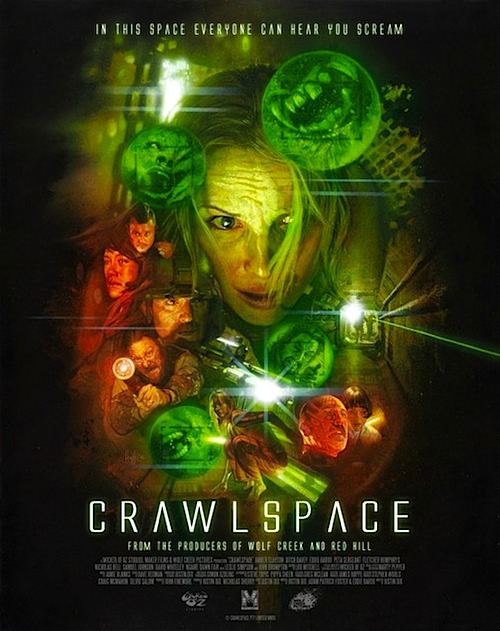
By Joe Bendel. In the 1980’s, the Soviets really did launch an ambitious “remote viewing” program, training psychic spies to watch and perhaps even read the American President’s mind. It is hard to imagine any hostile powers bothering with such efforts now, unless they had no other access to the latest news from ESPN. Nonetheless, the “technology” was taken seriously and it is about to blow up in the face of a clandestine Australian research institute, becoming the Macguffin of Justin Dix’s Crawlspace, which debuts on VOD and begins a series of midnight screenings at the IFC Center beginning today.

Echo Companies 1, 2, and 3 are approaching the double-secret Pine Gap facility buried beneath the Australian desert (where there are no pine trees). They have two missions: terminate the dangerous inmates let loose during a power failure and rescue the scientific personnel. It seems like it is a bad idea to combine a maximum security prison with a research lab, so maybe these prisoners are not whom they are billed to be. Oddly enough, one of them also appears to be the late wife of company leader Romeo, who apparently harbors a wee bit of guilt over her assumed death.

Much to his team’s surprise, Romeo goes rogue, deciding to protect E.V.E., as her wristband identifies her, rather than fulfill their mission objectives. This becomes particularly awkward when the monsters start attacking. It is not until they “rescue” a truly annoying group of scientists that the psychic battle unfolding around them is insufficiently explained. What does that make Eve? Dangerous.

The directorial debut of SFX artist Dix, Crawlspace liberally incorporates narrative elements from the original Alien and Solaris, but little of their artistry. It is long on atmosphere, though, taking viewers through air ducts, service tunnels, and all manner of passages requiring grown men to stoop. There are also several distinctively gruesome deaths for those who measure genre films by such standards.

Again, Crawlspace’s cast might not earn marks for distinction, but they get the job done. While not remarkably expressive, Ditch Davey (a name so awesome it must be Australian) is appropriately manly as Romeo. Strangely, both Peta Sargeant and Ngaire Dawn Fair exhibit more cinematic presences (as Wiki the commando and Emily the psychic blocker, respectively) than Eve, the pseudo-romantic co-lead, but Amber Clayton can at least act twitchy and roll her eyes back in her head when necessary.

Crawlspace is no genre classic but it is entertaining in a Big-Mac-with-fries kind of way. Basically, it is heavily armed people going nuts in confined spaces. Horror movie fans, particularly those with a taste for flicks with a light sci-fi seasoning, should have at it this Friday (1/4) when it screens Midnights at the IFC Center and hits VOD platforms.

LFM GRADE: B-

Posted on January 4th, 2012 at 12:35pm.

LFM’s Jason Apuzzo & Govindini Murty at The Huffington Post: Courage & Individual Conscience: The Top 10 Pro-Freedom Films of 2012

[Editor’s Note: the post below appears today at The Huffington Post.]

By Jason Apuzzo & Govindini Murty. Freedom must thrive for the arts to flourish. It’s therefore an encouraging sign that so many of 2012’s most acclaimed films – such as Zero Dark Thirty, Lincoln, Les Misérables, or Skyfall – should explore the centrality of freedom to our civilization. As we celebrate 2012 in film, it’s fitting that we honor movies that affirm the very liberty that makes our art, our traditions of free speech, and our democratic form of government possible.

Whether depicting historical figures like Abraham Lincoln, or pop-culture icons like James Bond and Katniss Everdeen, or contemporary dissidents like China’s Ai Weiwei and Russia’s Masha Drokova, the movies below illustrate how freedom only survives when brave individuals are willing to risk their lives fighting for it. These films also depict the virtues that accompany such bravery: a strong individual conscience and empathetic feelings of responsibility toward one’s fellow human beings.

Many of this year’s best pro-freedom films also portray the bravery of women. In a refreshing development, movies like Zero Dark Thirty, Barbara, The Hunger Games, and Putin’s Kiss all feature complex, independent women as their leads – while Skyfall, in the character of “M” (Judi Dench), features a strong woman in a pivotal leadership role. This is another way in which these movies powerfully affirm the democratic spirit.

Here then are our ten best pro-freedom films of 2012:

2012-12-31-ZDT3.jpg
Jessica Chastain in "Zero Dark Thirty."

1. Zero Dark Thirty

A taut and intense account of the almost ten year hunt for Osama bin Laden, director Kathryn Bigelow’s Zero Dark Thirty captures the emotional and ethical complexity of the War on Terror – while unfolding a vast, investigative mystery that takes audiences from secret CIA bases in Afghanistan, to the corridors of power in Washington D.C., to the urban mazes of Pakistan. Leading this historic manhunt is an indomitable young CIA analyst named Maya, played with steely resolve by Jessica Chastain, who for nearly a decade tracks down bin Laden’s courier on the way to locating the terrorist mastermind. Scrupulously non-partisan, Zero Dark Thirty gives primary credit for bin Laden’s demise not to any politician – but to sober career intelligence professionals as well as military personnel, a tragic number of whom gave their lives in pursuit of Al Qaeda’s leader. Telling their story with a refreshingly understated realism, Zero Dark Thirty honors these largely anonymous men and women who protect our freedom in an increasingly dangerous and chaotic world.

2. Barbara

Germany’s official Oscar entry and winner of the Silver Bear for Best Director (Christian Petzold) at the 2012 Berlin Film Festival, Barbara is the most compelling depiction since The Lives of Others of day-to-day life in a modern surveillance state – in this case the communist East Germany of the early 1980s. Nina Hoss gives a complex, Oscar-worthy performance as a pediatric surgeon whose desire to leave East Germany puts her under the watchful eye of the Stasi (the secret police), and of a conflicted, would-be lover played by Ronald Zehrfeld. Austere and suspenseful, Barbara is one Germany’s best dramas since the 1970s, and an indictment of any society in which allegiance to a political system overwhelms common humanity.

2012-12-31-Lincolnsmall.jpg
Daniel Day-Lewis in "Lincoln."

3. Lincoln

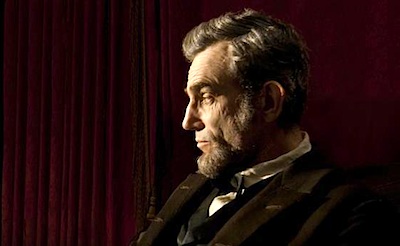
Director Steven Spielberg’s Lincoln brings the story of The Great Emancipator to life in a way that is both respectful of our 16th President’s achievements and alive to his humanity. In perhaps the richest depiction of Abraham Lincoln since Henry Fonda’s in John Ford’s Young Mr. Lincoln (1939), Daniel Day-Lewis brings warmth, interiority and conviction to a man charged with the weightiest responsibilities in American history – as both slavery and the fate of the Union hang in the balance. Lincoln also highlights the value of eloquence in free societies; in recounting the sometimes baroque political backstory behind passage of the Thirteenth Amendment, Spielberg suggests that it was Lincoln’s poetic oratory as much as any other factor that ended slavery in America for good.

4. The Other Dream Team

One of the best sports documentaries in recent years, and a highlight of the 2012 Sundance Film Festival, director Marius A. Markevičius’ The Other Dream Team tells the emotional story of the 1992 Lithuanian Olympic basketball team – a symbol of freedom and Lithuanian national pride after decades of Soviet rule. The film tells the improbable tale of how Lithuanian basketball talents like future NBA stars Arvydas Sabonis and Šarūnas Marčiulionis came to dominate Soviet basketball in the 1980s (even defeating Team USA in the 1988 Olympics) – only to face off against Russia in the ’92 Barcelona Games, wearing tie dyed uniforms provided by The Grateful Dead (!), after Lithuania had just won its hard-fought independence. A moving and uplifting piece of Cold War history, The Other Dream Team is as much a tribute to the courage of the Lithuanian people in the face of communist tyranny as it is to the inspirational power of sports.

2012-12-31-SkyfallCraigsmall.jpg
Daniel Craig in "Skyfall."

5. Skyfall

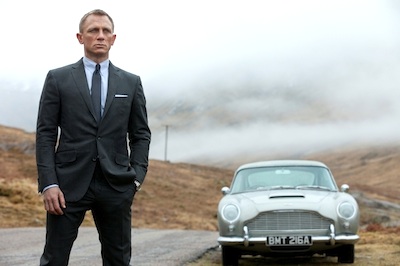
One of the best James Bond thrillers since the 1970s, director Sam Mendes’ Skyfall reinvents 007 as a hero for the War on Terror era – and thoughtfully affirms the value of our intelligence agencies in the post-9/11 world. In Skyfall, information pertaining to NATO penetration of worldwide Islamic terror cells has been stolen in Istanbul, and Bond must retrieve the data before Western agents are exposed and killed – the opening act of an elaborate revenge plot orchestrated by the sociopathic Raoul Silva (Javier Bardem). In a film rife with references to Winston Churchill and his legacy, Bond and his colleagues are depicted as reflexively selfless in the cause of freedom – and Dame Judi Dench’s quotation of Tennyson’s poem “Ulysses,” as both she and Britain come under attack, packs an unusually stirring punch for a Bond film. Continue reading LFM’s Jason Apuzzo & Govindini Murty at The Huffington Post: Courage & Individual Conscience: The Top 10 Pro-Freedom Films of 2012

The Retro Loner: LFM Reviews Jack Reacher

Tom Cruise as Jack Reacher.

By Patricia Ducey. You need to stop humming Hugh Jackman’s showstopping tunes and puddling up – especially in grocery lines. You’ve also just realized that Tehran isn’t Paris – and that no matter how glamorous foreign service looks, it’s probably a good thing you “forgot” to follow through on that State Department job app all those years ago. Plus, you’ve just run out of chocolate-covered candy canes and leftover champagne and have nothing for dinner.

Yes, the holiday parties, the fall movies – Life of Pi‘s fantastical 3D journey to enlightenment, Ben Affleck’s paean to the unsung heroes at the CIA and State Department, and the glorious Les Misérables (triumphant over some febrile staging) – they have been rich and tasty this season, but humdrum January is approaching, real life, and you need something or someone to snap you out of it.

And Jack Reacher is just that guy.

Because Jack Reacher is a “ghost.” He’s a cool – as in, “ice-in-your-veins” cool – ghost, and he’s a loner. You don’t know how he got this way but it probably has something to do with his military service. You may find out if there are subsequent films. Or, if you’re a purist, you could read the books. But that might ruin the fun.

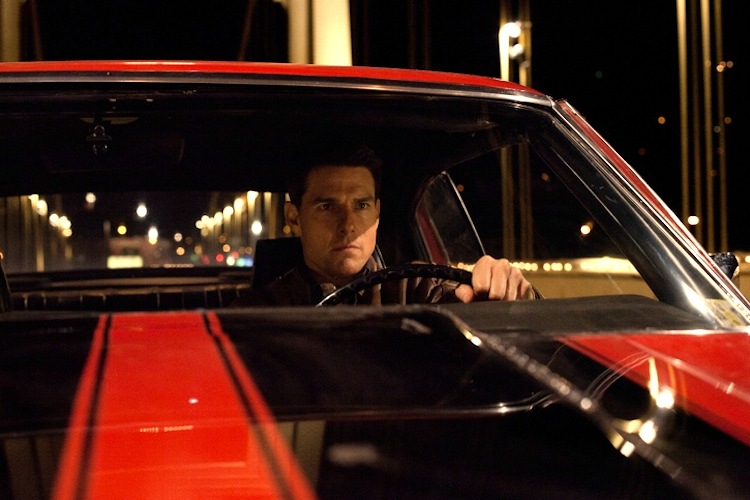
Adapted by writer/director Christopher McQuarrie from author Lee Child’s One Shot (from the Jack Reacher series, which I have not read), and produced by Tom Cruise, this old fashioned mystery thriller is fun — and delivers just enough mayhem and clever plotting to keep all but the most jaded critics on board. McQuarrie, who burst upon the Hollywood scene as the screenwriter of the witty, unconventional The Usual Suspects and is now a Cruise collaborator (2008’s Valkyrie, possibly the forthcoming Mission: Impossible 5), delivers another clever whodunit here with plenty of fresh twists and turns, humor, and even a mysterious super-arch fiend, a la Keyser Soze, to keep you interested.

The story is set in gritty, noirish Pittsburgh and opens with a mad sniper in a parking structure across the river from the Pirates’ baseball park picking off five random people. A SWAT team of cops, decked out in full military swag, arrive at his precise location quickly but futilely – the sniper is long gone. But Detective Emerson (David Oyelowo) swiftly retrieves the cartridges and fingerprints and assorted evidence – and a mere 16 hours later sits, smirking, across from suspect James Barr along with the D.A. That was easy! The suspect listens in despair as they tick off the mountain of evidence against him. He reaches for the typed confession to sign; but as Emerson and DA Rodin (Richard Jenkins) smugly congratulate themselves on their slam dunk, Barr writes “Get Jack Reacher” on the dotted line instead of his signature. And off we go. Continue reading The Retro Loner: LFM Reviews Jack Reacher

Storming the Barricades: LFM Reviews Les Misérables

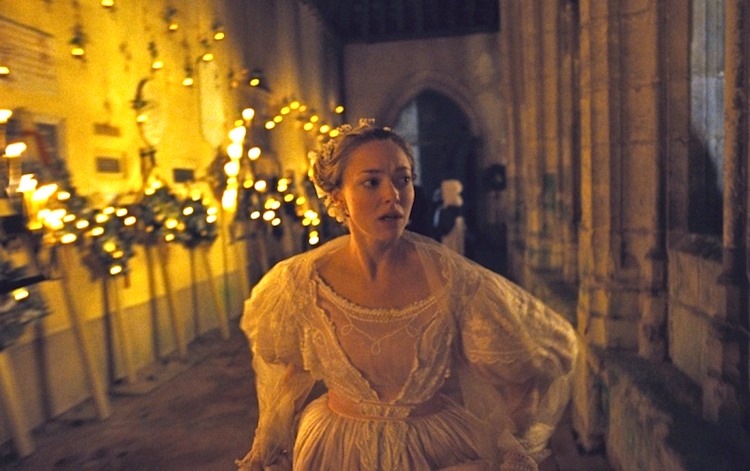
Amanda Seyfried in "Les Misérables."

By Joe Bendel. Even viewers who have not read Victor Hugo’s novel or seen Cameron Mackintosh’s stage musical know Jean Valjean spent nineteen years in prison for stealing a loaf of bread. Such a fate is undeniably unjust, but it is important to keep in mind that it was a very nice sourdough. For years it has defied cinematic adaptation, but now Tom Hooper brings the musical Les Misérables to the big screen, with all its bombast. It opened yesterday nationwide, so Merry Christmas everyone.

Distilled from Hugo’s cinderblock sized novel, Les Mis follows Valjean after he is released from prison. He has been freed from the unyielding Javert’s lash, but the terms of his parole make him a desperate outcast. He finds temporary refuge with the truly pious Monsignor, but he abuses the kindly cleric’s trust. Yet much to his shock, his betrayal is met with forgiveness.

Thanks to the Monsignor, Valjean reinvents himself under an assumed identity. He becomes a factory owner and the mayor of his hardscrabble community. Then Javert is transferred to his jurisdiction. For a while they circle each other warily, until Valjean confirms the copper’s suspicions to save an innocent man arrested in his place. Thus begins his life on the run (albeit a relatively well-heeled one) with Cosette, the daughter of a tragic former employee, in tow.

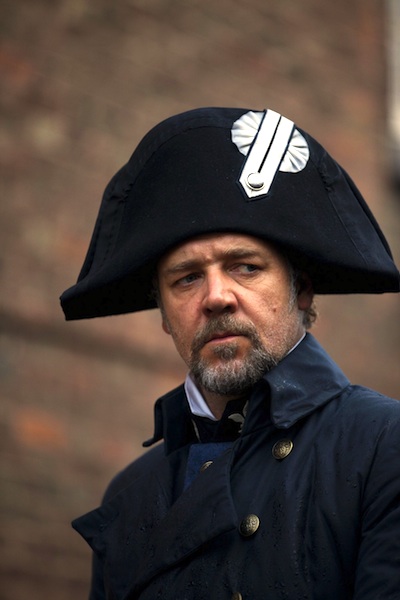
Russell Crowe in "Les Misérables."

Yes, this is Les Mis, a rather odd combination of Christian fellowship and proletarian solidarity. Barricades will definitely be stormed, but at least the church is not part of the apparatus of oppression. As the film’s publicity campaign is quick to point out, Hooper returned to old school movie musical production techniques, recording the actors in performance live on the set – rather than have them lip-sync to pre-recorded tracks. This allows them more in-the-moment interpretive freedom. However, as your TV talent show judges might say: “it gets a little pitchy, dog.” Frankly, it is hard to understand why they did not clean some of that up with Pro-Tools or a similar program.

Critical reaction to Hooper’s Les Mis is also something of spectacle, ranging from adulation to castigation. Word that Russell Crowe was making a movie musical may have led some to fear the worst. When Les Mis did not completely bite, many evidently concluded it must therefore be awesome. In truth, it falls somewhere in the middle.

To be fair to Crowe, he has been unduly hammered as Javert (a small irony there), but in the story’s abbreviated stage form, his character’s actions during the third act are jarringly problematic. Also: likely Oscar contender Anne Hathaway knocks “I Dreamed a Dream” out of the park, completely reclaiming the signature tune from Susan Boyle, and then promptly exits the narrative. Hugh Jackman has the perfect presence for Valjean and his performances of “Who Am I” and “One Day More” are fairly stirring, but the show definitely peaks in the first act. Frankly, all the third act barricade songs and revolutionary anthems just blend into a faux Internationale blur.

While Jackman, Crowe, and Hathaway meet or exceed expectations, the rest of the supporting cast is a dramatically mixed bag. Eddie Redmayne sorely lacks romantic lead credibility as Marius, but his voice is not bad. The real standout though is British fan favorite Samantha Barks. She is the real deal as lovesick Éponine, probably boasting the finest voice of the ensemble.

In contrast, Sacha Baron Cohen and Helena Bonham Carter quickly become tiresome as the felonious innkeeper Thénardier and his wife, the show’s ostensive comic relief.  A little of them goes a long, long, long way. You know the Nile River? That long. They must have assumed they were in a Tim Burton movie when they saw the period sets, and started hamming it up accordingly. In fact, the Nineteen Century Paris recreated by the design team often looks like it was the work of the same Neo-gothic architect responsible for The Dark Knight’s Gotham, particularly when Javert compulsively paces about on high ledges.

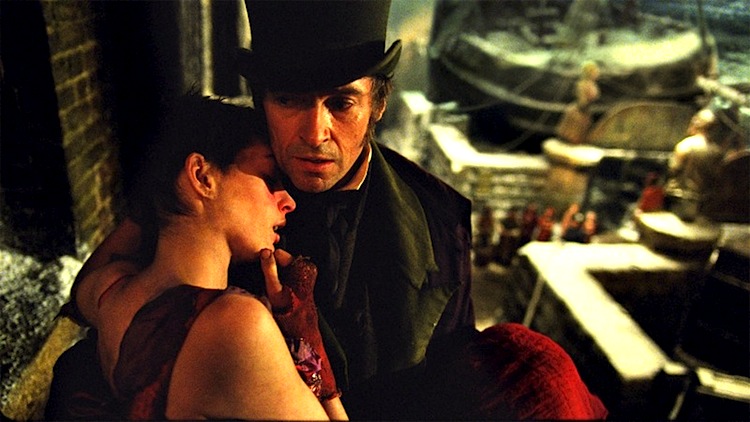
Anne Hathaway and Hugh Jackman in "Les Misérables."

Nonetheless, Les Mis its moments, like “I Dreamed a Dream” and “One Day More,” which might be Hooper’s best staging, utilizing the cross-cutting toolkit of music videos more than traditional movie musical production numbers. Elements of the show, like the touching relationship between Valjean and Cosette, prove to be absolutely bullet-proof.

Hooper and screen-adapter William Nicholson also deserve a lot of credit for not watering down the themes of faith and redemption. Indeed, it is refreshing to see a senior man of the cloth depicted in an unambiguously virtuous manner. Oddly though, when everyone hits the barricades, it becomes something of a bore. Recommended primarily for Les Mis devotees and diehard movie musical fans, Les Misérables opened yesterday (12/25) across the country, including the AMC Empire in New York. Merry Christmas and to all a good night.

LFM GRADE: B-

Posted on December 26th, 2012 at 12:05pm.

Blondes in Peril: LFM Reviews Hitchcock

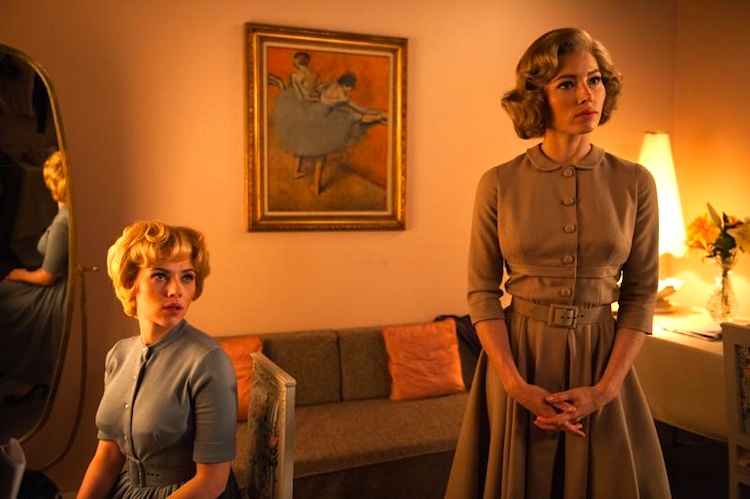
Scarlett Johansson and Jessica Biel in "Hitchcock."

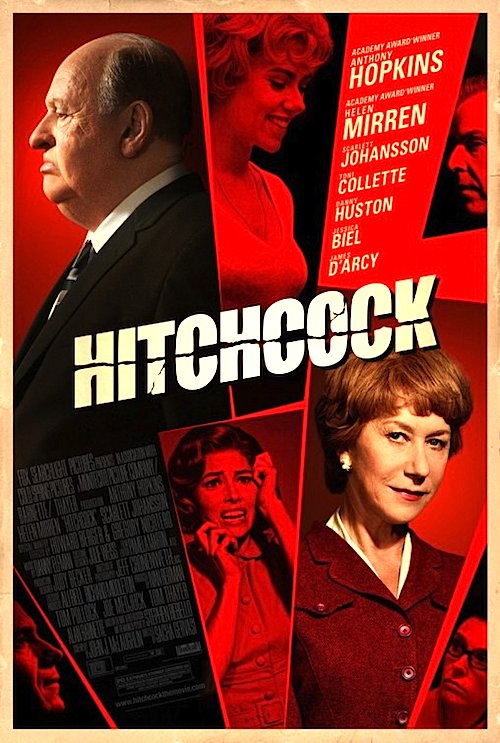
By Joe Bendel. Alfred Hitchcock, the master of suspense, largely self-financed his notorious 1960 classic, Psycho. He picked the right film to literally bet his home on. A spectacular success by any standard, the film that would introduce Norman Bates to the world looked like it might be his swan song during its rocky development and production stages. Dramatizing the behind-the-scenes story of arguably his most iconic work, Sacha Gervasi’s sympathetic but bitingly witty Hitchcock is now in award contention for at least one and possibly two of its accomplished leads.

Hitchcock is not a story Hitch would have made. Since we know Psycho was completed to his satisfaction and became a monster hit at the box office, there is not a lot of suspense to the tale. However, the getting from point A to point B is quite fascinating. As we meet Hitchcock and his patient wife Alma Reville, he is basking in the triumph of North by Northwest, which somewhat bores them both. As a distraction, Reville starts doctoring a new spec script written by Strangers on a Train screenwriter Whitfield Cook, who is hoping she will convince Hitchcock to attach himself to it. Of course, he has his mind set on very different property.

Based on Robert Bloch’s novel, which in turn was inspired by Wisconsin serial killer Ed Gein, Psycho is the sort of film no respectable studio director would think of touching. That is exactly why Hitchcock is attracted to it. As the closing titles remind viewers, Hitchcock never won an Academy Award (a fact that could either help or hinder the film’s own Oscar campaign). Throughout Gervasi’s film, Hitchcock is clearly presented as a brilliant but ragingly insecure filmmaker. Resenting his lack of recognition, Psycho is convincingly framed as an effort to make an exploitation horror movie that is vastly superior to the prestige pictures the studios released. And so it was.

Yes, this Hitchcock is somewhat neurotic and there is no denying his eye for blondes. Yet John J. McLaughlin’s screen treatment is refreshingly forgiving of his foibles. He was indeed a man of expensive tastes (taste being the most apt word), but the audience also sees Hitch and Alma puttering about the kitchen in slippers, like relatively down to earth people.

Both Sir Anthony Hopkins and Dame Helen Mirren are terrific as the first couple of suspense. As the title auteur, Hopkins is Hitchy without getting kitschy or shticky. Likewise, Mirren is the picture of mature sophistication as Reville. Listening to them bantering like an old familiar couple is one of the film’s great pleasures.

Yet the supporting work of Toni Collette and Scarlett Johansson really fleshes out the film, as it were. Collette’s smart, surprisingly attractive turn elevates what could easily have been the thankless role of the Hitchcock’s thankless assistant Peggy Robertson. Beyond being a spooky dead-ringer for Janet Leigh, Johansson also has some wonderful scenes with both principles that really deepen their humanity. While an Oscar campaign on her behalf might be pushing it, Hitchcock should definitely be on the bill for any future Johansson retrospective.

Gervasi commits a few missteps along the way, such as overplaying Hitchcock’s interior dialogues with the convicted and committed Ed Gein, perhaps hoping to throw genre diehards a bone. Still, the film pays off handsomely, especially for Hitchcock fans. In fact, you could say it has a real Hollywood ending. Deserving award consideration for the work of both Hopkins and Mirren, Hitchcock is recommended for the director’s admirers and those who enjoy films about the cinema. It is now playing nationwide, including at the AMC Empire in New York.

LFM GRADE: B+

Posted on December 26th, 2012 at 12:02pm.