The First London Games in 1948: LFM Reviews The BBC’s Going for Gold

By Joe Bendel. Seventy-three year-old British artist John Copley became the oldest Olympic medalist at the 1948 London Games, taking silver for his etchings. It would be the penultimate artistic competition of the modern-era games, all of which have since been segregated from the official medal counts. He might have made history (for a while, at least), but fortunately this will not be his story. Instead, BBC America takes viewers to the Thames, where a hastily assembled British sculling duo carries the hopes of their nation in Going for Gold: The ’48 Games, a one-shot airing this Wednesday as part of the current season of Dramaville.

Bert Bushnell and Dickie Burnell both competed for a spot on the 1948 Olympic team, but fell short. Pairing-up was not their fallback plan, but the brainchild of five-time British medalist and Olympic committeeman Jack Beresford. The double sculls is an event close to his heart, since he and his partner upset the favored Germans in front of Hitler at the 1936 Berlin Games.

The stakes are not quite so high for Bushnell and Burnell, but the malaise-ridden United Kingdom could use a lift. London could also use the tourist dollars generated by a successful Olympiad. However, with mere weeks to go, they’re still woefully behind on construction. Evidently its déjà vu all over again.

From "Going for Gold."

Likewise, Bushnell and Burnell have just started training together – and it shows. Socially and temperamentally quite different, the pair clash rather badly. In fact, the respectably middle class Bushnell’s class resentment of Burnell’s privileged background becomes tiresomely repetitive, perhaps saying more about screenwriter William Ivory (whose credits include the labor drama Made In Dagenham) than two athletes who fundamentally share so much in common. They both have a passion for their sport, similar last names, and persistent issues with their fathers.

For many viewers (as well as for BBC America) the most important thing to know about Gold is the presence of Doctor Who’s Matt Smith as Bushnell. He is credible enough as the tightly wound rower, but Sam Hoare certainly looks more athletic as Burnell. He also has some of the better turned straight dramatic scenes. However, for longtime TV anglophiles, it will be Geoffrey “As Time Goes By” Palmer who stands out as Burnell’s severely reserved father.

If rowing races is your thing, Going for the Gold (a.k.a. Bert & Dickie) is your tele-drama. Smoothly helmed by TV veteran David Blair, it still is hardly Chariots of Fire-on-the-Thames (notwithstanding one eyebrow raising quote), but it is about on par with most subsequent Summer Olympic movies. An appealing period production with a decent payoff, Going for the Gold is a pleasant enough warm-up for the London Games, recommended for sculling and Olympic enthusiasts when it airs this Wednesday night (7/25) on BBC America’s Dramaville showcase.

Posted on July 23rd, 2012 at 8:41pm.
LFM Reviews Mr. Cao Goes to Washington @ The 2012 Asian American International Film Festival

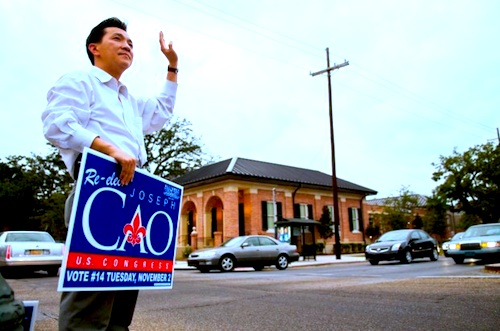
By Joe Bendel. Anh “Joseph” Cao was elected to Congress in 2008, a generally bad year for Republicans. He was defeated in his re-election bid two years later—a decidedly good year for Republican candidates. In a mere two years, the idealistic former Jesuit seminarian received an eye-opening education in all manner of group-think politics. Cao’s short tenure in office is documented in S. Leo Chiang’s Mr. Cao Goes to Washington, which screens during the upcoming Asian American International Film Festival in New York.

Immigrating to America while his father was still a captive of a Communist Vietnamese re-education camp, young Cao led an eventful life before he even considered a political career. Choosing law school over a life of the cloth, Cao became an activist leader in Versailles, New Orleans’ small but enterprising Vietnamese community (profiled in Chiang’s previous documentary, A Village Called Versailles). Louisiana’s second congressional district was deliberately drawn to elect an African American Democrat, everything that Cao is not. However, the ethical issues dogging William “Cold Cash” Jefferson gave Cao a once in a lifetime opportunity to flip the seat—and he was precisely the transcendent candidate to do it.

The question throughout MCGTW is whether or not Cao can hold his seat against a relatively untarnished Democrat (if one can be found in the Crescent City). Unfortunately, most viewers already know the answer, undercutting the suspense, but also preparing them for the inevitable crushing disappointment.

Chiang and film editor Matthew Martin arduously walk a political tight-rope, trying to frame Cao to be as appetizing as possible to left-of-center film critics. Much is made of Cao’s relative liberalism within the Republican caucus, including many laments that he might be better suited to the other party. Yet Cao remains staunchly pro-life throughout his term of office, so so much for that idea. Frankly, Cao had no complaints with his Republican colleagues, getting more than his share of their earmarks for his ungrateful district. Conversely, the figure who emerges in Chiang’s doc as the poster boy for political hypocrisy and opportunism is none other than the current (but perhaps not long term) occupant of the Oval Office.

From "Mr. Cao Goes to Washington."

Initially wooed by Obama, Cao genuinely believed the President’s pretenses of friendship. Indeed, Cao took a lot of heat voting for the House’s first Obamacare bill. However, when Obama inevitably cuts a commercial for his Democrat opponent (a less than inspiring figure with a history of disbarments and barroom brawling), it is profoundly disillusioning for Cao. Indeed, for all the film’s attempts to distinguish Cao from the national GOP, time and again it is the Democrats (both nationally and in New Orleans) who refuse to look past party labels and racial identity. To their credit, Chiang and his team show this quite clearly.

Nonetheless, MCGTW is so intent on presenting Cao in non-partisan terms, it declines to correct a few inaccuracies. While Cao was the only Asian American Republican in Congress at the time of his election, he was eventually joined by Charles Djou, the first Thai American congressman, who won a special election in Hawaii (but was subsequently defeated in 2010, like Cao). Perhaps more problematically, MCGTW lets a local provocateur’s incendiary racial attacks on the GOP stand unchallenged. Still, it illustrates the sort of rhetoric Cao faced from some extremists.

Perhaps most importantly, MCGTW always treats Cao fairly, recognizing his earnestness and integrity. He is clearly the real Horatio Alger deal, with the attractive wife and cute kids perfectly suited for campaign brochures. Watching his re-election campaign unfold will be a frustrating experience for viewers of most political stripes. If anything, it suggests the greatest problem with the current political system is not money or PACs, but the voters themselves.

That is a real downer of a Pogo-like message, isn’t it? Still, Cao’s frank, vigorous spirit is quite refreshing. After viewing MCGTW, one hopes for a sequel with a more satisfying ending.  Clearly, Cao is talented man and Chiang has a keen understanding of the community he represents. Considering the mildness of its biases, the mostly fair and responsible Mr. Cao Goes to Washington is recommended for political junkies on both sides of the aisle, particularly those who following events in New Orleans from a distance, when it screens this Thursday (7/26) at the Chelsea Clearview as an official selection of the 2012 AAIFF.

LFM GRADE: B-

Posted on July 23rd, 2012 at 8:39pm.

LFM Reviews Chen Kaige’s Sacrifice

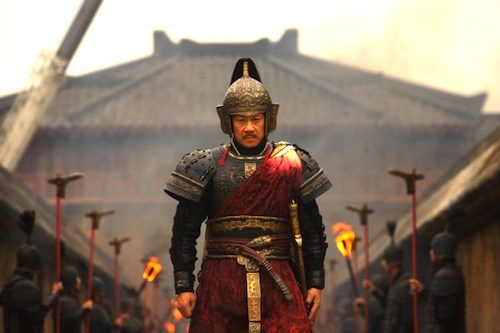
By Joe Bendel. Generally ascribed to Yuan Dynasty playwright Ji Junxiang, The Orphan of Zhao was the first Chinese play to be translated in Europe.  It was even adapted (quite liberally) for the French stage by Voltaire. Profoundly tragic and also rather violent in places, it has timeless elements that continue to appeal to audiences. Celebrated auteur Chen Kaige vividly captures both qualities in his grand big screen version, Sacrifice, which opens this Friday in New York.

General Tu Angu is not a man to take the slights of the Zhao clan lightly. Framing the patriarch and his son, General Zhao Shuo, for the murder of the ruling Duke, Tu uses the outrage as pretext for wiping out the Zhao clan. A swifter, more awe-inspiring massacre you are not likely to see on film anytime soon. However, he misses two of the Zhaos, the young General’s wife, Princess Zhuang, and her newborn baby. Sacrificing herself for her child, Zhuang entrusts the infant heir to her doctor, respected commoner Cheng Ying.

As fate would dictate, Cheng’s wife has also recently delivered. Suddenly having a newborn is dangerous business and Cheng has two. In a truly Biblical turn of events, Tu orders all the town’s babies to be collected at his palace to be duly vetted. Through a catastrophically Shakespearean turn of events, the Zhao and Cheng babies essentially trade places.

From "Sacrifice."

Growing up as Cheng Wu, the presumed son of Dr. Cheng, the Zhao orphan knows nothing of his birthright. However, unbeknownst to the boy, the doctor is grooming him to take wreak his vengeance at the appropriate time. To do this he plays a dangerous game, entering the service of the Tu retinue, manipulating his nemesis into serving as Cheng Wu’s godfather. Needless to say, some rather messy issues of filial loyalty arise.

Some have often knocked Chen’s films as pretty but rather bloodless historical dramas, but this is absolutely not the case with Sacrifice. While the period trappings are as richly detailed as ever, there is also plenty of blood. In fact, the first act is quite a spectacle of mayhem, segueing into a tense cat-and-mouse game, in which the fate of the city’s infants hangs in the balance. The film ultimately settles into a stone cold revenge drama.

Featuring several of Chen’s semi-regulars, Sacrifice’s talented ensemble is equally adept at the stately tragedy and the gutty action sequences. As Tu Angu, Wang Xueqi is in his element. Ruthless yet charismatic, he is the sort of villain viewers find themselves identifying with, in spite of themselves. While Ge You might be better known to American audiences for his shticky work in Let the Bullets Fly, he wrings real pathos from his performance as Dr. Cheng. While her character is not long for the world, Fan Bingbing is a typically ethereal presence as Princess Zhuang. Yet it is Mainland TV star Hai Qing who really lowers the emotional boom as Cheng’s equally ill-fated wife.

Admirers of Chen’s Chinese Opera sagas Farewell My Concubine and Forever Enthralled should still appreciate the classical elegance of Sacrifice. It is based on a play, after all. Likewise, fans of more action-driven Asian cinema should never get bored with the relentless scheming and vigorous swordplay.  Indeed, Chen integrates the intimate and the epic halves quite masterfully. Highly recommended for fans of literate historicals and the wuxia genre, Sacrifice opens this Friday (7/27) in New York at the Quad Cinema.

LFM GRADE: A

Posted on July 23rd, 2012 at 8:37pm.

LFM Reviews Isn’t Anyone Alive? @ Japan Cuts 2012

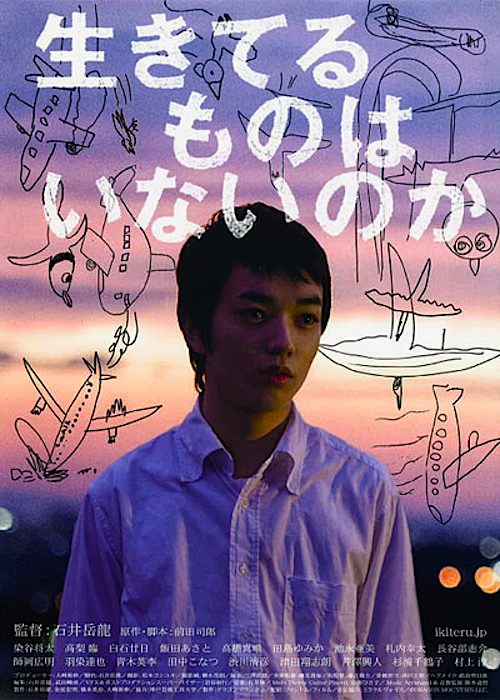
By Joe Bendel. You might expect the end of the world would get played up more in the media. Unfortunately, they only have time to report a few train crashes before it is pretty much too late for breaking news bulletins. Indeed, the end comes swiftly but dramatically for the residents and visitors of a sleepy provincial university in Gatukyu (formerly Sogo) in Ishii’s Isn’t Anyone Alive? (trailer here), which screened over the weekend at the 2012 Japan Cuts: the New York Festival of Japanese Cinema.

Adapted by playwright Shiro Maeda from his own stage drama, IAA is about as reserved as apocalyptic films ever get. The darnedest comedy of manners, it takes its time establishing a group of college students, only to start killing them off.

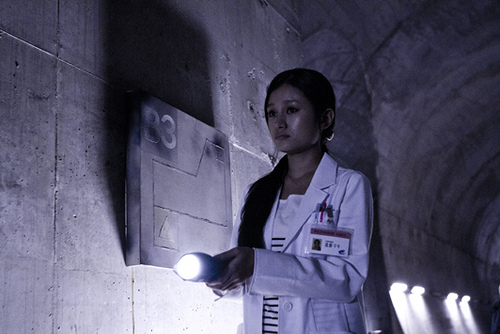
Evidently, this campus has two specialized fields of study: medicine and urban legends. Maki is a medical technician receiving an unwelcome visit from her ne’er do well brother. Nana is the chair of the urban legend studies association, who has been advancing the campus myth that high level military research goes on in the hospital’s third sub-basement. When people start keeling over, they naturally blame the hospital’s apocryphal black ops projects, but it is all balderdash Maki assures anyone still alive to listen.

Frankly, we never have any real idea what is going on, because nobody has enough time to determine anything. Yet, when facing the apocalypse, those still living struggle to develop a new etiquette for impending collective death, which is nonetheless ignored as often as it is observed. There is a lot of razor sharp dialogue and distinctly black humor in IAA. Frankly, it is rather a bummer when Nana is the first character to go. However, it is just as well for her. In Ishii and Maeda’s bleak world, the last one left standing is the cosmic loser.

From "Isn't Anyone Alive?"

As Nana, Mai Takahashi exhibits an upbeat screen presence that would ordinarily mark her as the leading candidate to survive a conventional horror movie. Rin Takanashi, Hakka Shiraishi, and Asato Iida also hilariously play out one of the unlikeliest love triangles, as the world burns unbeknownst to them. Yet it is Shota Sometani who nicely turns IAA’s defining scenes as the decent work-study café employee Keisuke, through whose eyes the audience ultimately sees the totality of it all.

IAA is one of the oddest end-of-the-world movies you are likely to see. Yet cinematographer Yoshiyuki Matsumoto makes it look eerily believable, slowly but surely transforming a sunny afternoon into an ominous Judgment Day. For those who enjoy their cinema dark and slightly off-kilter, it is definitely worth taking a gander at when it plays at this year’s Fantasia Festival (7/31 & 8/3), but naturally Japan Cuts screened it first, presenting the North American premiere this past weekend.

LFM GRADE: B+

Posted on July 23rd, 2012 at 8:35pm.

LFM Reviews Rent-a-Cat @ Japan Cuts 2012

From "Rent-a-Cat."

By Joe Bendel. It is not much of a business, but at least the inventory is cheap. In fact, Sayoko attracts stray cats like a magnet. Profits really are not the point anyway. She is out to fill the holes in people’s hearts, perhaps even including her own in Naoko Ogigami’s Rent-a-Cat (trailer here), which screens as part of the 2012 edition of Japan Cuts: the New York Festival of Japanese Cinema.

In a sleepy corner of Tokyo, Sayoko lives in the picturesque Minka-esque house she once shared with her beloved late grandmother, along with a dozen or so cats. The woman has become a crazy cat lady at a young age, but there is a method to her madness. Most days, she pulls her cart through the neighborhood, hawking cats for rent. Of course, she will not rent to just anyone. A home inspection is required.

Intentionally episodic, we watch Sayoko repeat the cat rental ritual with several customers, each with a hole to fill in their lives. For an elderly widow reluctant to buy a new cat knowing her time is short, Sayoko’s service is a godsend. However, some clients take a bit of convincing, like the desperately unfulfilled car rental agency manager. Yet the most intriguing potential client-story arc involves Yoshizawa, the former delinquent middle school classmate Sayoko initially wants nothing to do with.

Rent-a-Cat is a quiet film, chocked full of feline adorableness. It wears its sentimental heart on its sleeve, deriving gentle laughs from its characters quirks (to use a loaded word). However, it is more bittersweet than compulsively cute, particularly during Sayoko’s smartly ambiguous encounter with Yoshizawa.

From "Rent-a-Cat."

As Sayoko, Mikako Ichikawa blends goofy awkwardness and sincere sensitivity quite touchingly. Indeed, it is a very humane performance, displaying real on-screen chemistry with her animal co-stars and Kei Tanaka’s Yoshizawa.

There might not be a lot of surprises in the unhurried Rent-a-Cat, but Ogigami infuses the proceedings with a wistful atmosphere that is quite beguiling. Essentially, it is an animal lovers’ indie that well reflects traditional Japanese aesthetics of elegant simplicity. An effective mood piece featuring several nice turns from its small human ensemble, Rent-a-Cat is recommended surprisingly highly for those who suspect they might appreciate its discreet charms. It screens this coming Wednesday (7/25) at the Japan Society, as this year’s Japan Cuts continues.

LFM GRADE: B+

Posted on July 21st, 2012 at 10:42am.

LFM Reviews The Woodsman and the Rain @ Japan Cuts 2012

From "The Woodsman and the Rain."

By Joe Bendel. If you’re wondering where Harrison Ford and Tommy Lee Jones’ fifty-plus mojo went, it’s been in Japan with Kôji Yakusho. While American audiences might know him best as the salaryman who cuts a rug in Shall We Dance?, nobody working in film today is more credible as a middle-aged man you do not want to mess with. His hardnosed everyman charm is also perfectly suited to the gently humanistic comedy of Shȗichi Okita’s The Woodsman and the Rain (trailer here), which screens as the centerpiece of this year’s Japan Cuts and a key selection of their Focus on Kôji Yakusho retrospective sidebar.

If you have seen Takashi Miike’s 13 Assassins, you know what a dynamic presence Yakusho can be in an action-driven film. If you haven’t, the Japan Society will give you an opportunity this Saturday.  It’s kind of awesome, but Woodsman is too, in a very different way. Here Yakusho plays a sixty year-old lumberjack and you would not want to be a tree in his sites. He is not a superhero, though. Having survived a health scare, Yatsuhiko Kishi (Yatsu-san) can no longer eat sweets. The widower’s relationship with his slacker son Koichi is strained at best. However, he can now predict precipitation with uncanny accuracy. Given the title, this ability will obviously come into play at some point, but wisely nobody in the film belabors it.

Kishi is pretty set in his routine, until a film crew comes to town. Much to his own surprise, he finds himself shuttling about a nervous assistant director and a socially awkward twenty-something in search of locations for their zombie film. That quiet kid turns out to be Koichi Tanabe, the first time director with massive confidence issues. Yes, he has the same first name as Kishi’s son, but Okita never overplays that card either.

From "The Woodsman and the Rain."

Before you know it, Kishi is deeply involved in the shooting of Tanabe’s dubious b-movie. Many of these scenes are essentially played for laughs, but in an earthy, understated way. Still, for genre film fans, how can you resist a film about lumberjacks and movie-zombies?

Woodsman is a perfect film to anchor the Yakusho showcase. His performance is rich, nuanced, and deeply felt. He is a good sport, willing to look slightly ridiculous at times, yet he always maintains his dignified bearing. As the Koichis, both Shun Oguri and Kengo Kora grow on viewers, subtly but convincingly showing their characters grow up as the film progresses.

Not exactly bittersweet, but certainly not compulsively cheerful either, Woodsman is ultimately wholly satisfying, in a rugged, down-to-earth way. It is a great example of Yakusho’s powerful screen presence, as well as a wistfully wise bit of storytelling. Very highly recommended, The Woodsman and the Rain screens this Saturday at the Japan Society as this year’s Japan Cuts centerpiece (featuring an intro and Q&A with the man himself), but good luck getting in. It is already sold out, so if you do not have your ticket booked, you’re flying stand-by. Also very highly recommended, tickets for 13 Assassins and Shall We Dance? are currently available on Saturday (7/21).

LFM GRADE: A

Posted on July 21st, 2012 at 10:41am.