LFM’s Jason Apuzzo & Govindini Murty at The Huffington Post and AOL-Moviefone: Basketball Diplomacy: An American Point Guard Becomes a Symbol of Freedom in The Iran Job

[Editor’s Note: the post below appears today at The Huffington Post and at AOL-Moviefone.]

By Jason Apuzzo & Govindini Murty. NBA fans know that two-time MVP point guard Steve Nash recently joined the Los Angeles Lakers. Fans are buzzing, because the addition of Nash could soon result in a return to championship glory for the league’s most glamorous franchise. As big as Nash’s impact on the Lakers might be, however, it can’t possibly match the impact that flashy point guard Kevin Sheppard — the former Jacksonville University star and Virgin Islands native — had in 2008 on A.S. Shiraz, a professional basketball team in Iran’s Super League.

The reasons for this go beyond sports, however, because over the course of one gripping and emotional season — a season documented by director Till Schauder and producer Sara Nodjoumi in their extraordinary new documentary, The Iran Job — Sheppard becomes one of Iran’s most popular athletes, and brings a ray of hope into an increasingly repressive and isolated society.

The Iran Job screened last week in Washington, D.C., and had its world premiere recently at the Los Angeles Film Festival, where we had the chance to talk to the film’s creators.
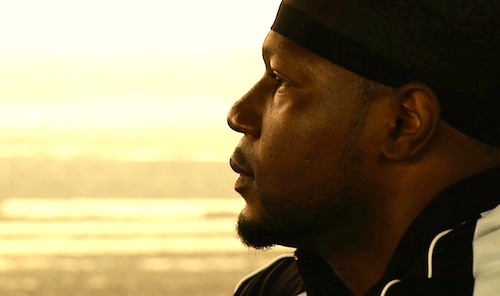
American basketball player Kevin Sheppard in Iran.

As depicted in the film, Kevin Sheppard’s Iranian odyssey begins in the fall of 2008, when he’s offered a spot on A.S. Shiraz’s roster. Having already played professional basketball in South America, Europe, China and Israel, the voluble Sheppard is unfazed by the prospect of playing overseas — but is understandably nervous as an American traveling to Iran. Coming in the midst of a 2008 election in which Barack Obama, Hillary Clinton and John McCain all had sharp words for Iran and its nuclear program, Sheppard nonetheless decides to take the plunge out of a spirit of professionalism.

It was a decision that would change his life, as well as the lives of everyday Iranians — and in particular, those of three young Iranian women.

One of the most compelling aspects of The Iran Job is the way it captures the casual details of life in today’s Iran — a closed society that clearly harbors some unusual stereotypes about the outside world. So for example, the moment Sheppard arrives in Iran and meets up with his Serbian roommate (the team’s 7-foot center, and the only other non-Iranian allowed on the squad), Sheppard learns that his cable TV has been custom-provided with hundreds of pornographic channels — the assumption being that because he is an American, he must be sex-obsessed. The irony that such programming is even available in a “strict” Islamic society, of course, is not lost on Sheppard — who can’t help but laugh at Iranian officialdom’s awkward notions of diplomatic courtesy.

Such ticklish moments aside, however, Sheppard immediately begins bonding with average Iranians. A natural show-off with a wicked sense of humor, Sheppard dazzles everyone around him — even when they barely speak English, and are only able to respond to his warm smile and playfulness. The camera follows him early on as he goes out to grab dinner, and we see regular Iranians high-fiving him and snapping pictures with him before he’s even picked up a basketball. His enthusiasm and dynamic personality ignite smiles everywhere.

We asked Sheppard about the rock-star treatment he received from average Iranians:

“The funny thing about it is, once I got over there — people really love America. The government would say, ‘Down with America.’ They have all kinds of signs — ‘America is the Devil,’ ‘Down with the U.S.A.’ — but once you get to the people, they love American culture, they know everything about America, they love all the American sports. So it was a little bit ironic and crazy for me at first. I was like, how can you have all these signs around? But yet, when you speak to the people it’s totally different. So I know it [hostility toward America] was not coming from the mass of the people in general. This was all pushed upon them by the government.”

As The Iran Job proceeds, however, Sheppard’s innate enthusiasm is challenged by his lackluster basketball team, A.S. Shiraz a new and untested squad in Iran’s Super League, and a team sorely lacking in the kind of talent or winning attitude to which Sheppard is accustomed. Viewers basically get the sense that Sheppard has just joined The Bad News Bears of Iranian basketball, and his first task will be to shake up the underwhelming squad.

It’s worth noting here that The Iran Job follows the usual parameters of sports documentaries in depicting how one inspirational player can turn the fortunes of a franchise around by getting his teammates to believe they can win. That’s precisely what Sheppard does, due in part to his on-court heroics (we watch him win several games with buzzer-beating shots), but mostly due to his cocky swagger and high standards. The intense, demanding point guard simply hates to lose — and refuses to let his teammates ever be comfortable accepting defeat. Continue reading LFM’s Jason Apuzzo & Govindini Murty at The Huffington Post and AOL-Moviefone: Basketball Diplomacy: An American Point Guard Becomes a Symbol of Freedom in The Iran Job
LFM Reviews Matraga @ Premiere Brazil

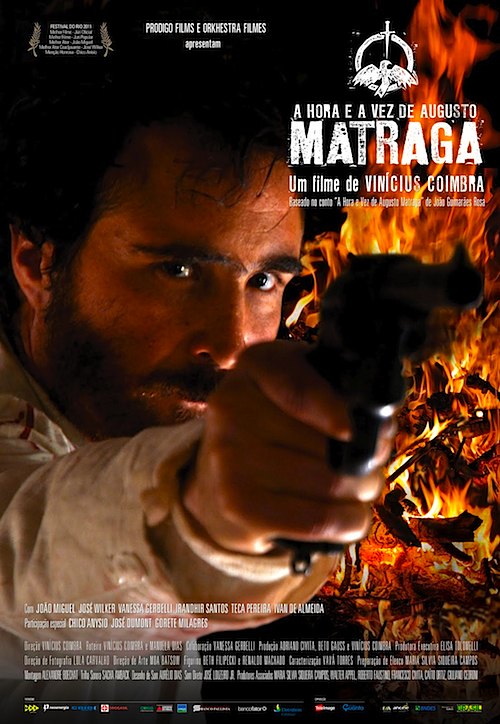
By Joe Bendel. Those who know their Brazilian cinema and literature will know Augusto Esteves, a.k.a. Matraga, is one bad cat. The protagonist of João Guimarães Rosa’s short story, adapted for the screen in 1965 by Roberto Santos, made a triumphant return, sweeping most of the prizes at the 2011 Rio International Film Festival, proving Brazilians appreciate a rugged convert. Once again, he sees the light in Vinícius Coimbra’s Matraga, which screens as part of the 2012 edition of Premiere Brazil!, now underway at MoMA.

Better at drinking and whoring than farming, Esteves has made his share of enemies, most definitely including Major Consilva. Eleven of the local land baron’s gunslingers got the jump on him out in the wild grasslands. It was a decent idea, but they did not bring enough men. They will learn from this mistake. Using the incident as a pretext to banish his wife and child, Esteves continues his reckless hedonism, pressing his luck. Beaten and branded, Esteves is left for dead after pitching head first into a rocky gorge. However, a devout elderly couple nurses his broken body back to health and puts his spirit on the path of righteous.

Though sometimes tempted to give into his inner demons, Esteves holds to the Christian faith of his adopted parents, living with them in anonymous isolation. Eventually, the powerful landlord Joaozinho Bem-Bem and his extra-legal posse of enforcers ride into Esteves’ village, like a Brazilian John Tunstall and the Regulators, hoping to skirt a company of legitimate government troops. Much to their surprise, Matraga receives them in the spirit of Christian hospitality, welcoming them into his home. Recognizing a kindred spirit beneath Esteves’ pious exterior, Bem-Bem feels an instant rapport with the reformed killer. Indeed, their fates will be intertwined.

Matraga is often billed as a Brazilian spaghetti western, and that is fair to an extent. Yet Esteves is as much Paul on the Road to Damascus as the Man with No Name. In truth, it is quite a solid film, but it will be tricky finding the right audience for it beyond Brazilian cinema showcases, such as MoMA’s Premiere. This is a brooding film that treats issues of faith with deadly seriousness. Still, when its go time, everyone gets down to business as the bullets fly.

Glowering impressively, João is convincingly fierce and conflicted as Esteves. He handles the fight scenes quite credibly, but most importantly his depiction of the character’s hard won new faith is grittily realistic and in no way caricatured. Nonetheless, José Wilker earns most of the film’s style points as the smoothly lethal Bem-Bem.

Clearly, Coimbra and cinematographer Lula Carvalho were taken with the wide open vistas of the Minais Gerais countryside, giving it the full John Ford treatment. Yet what is most notable is the manner the film stays true to the expectations of the western genre and the integrity of Esteves’ post-conversion character. That is quite a trick. Partly a moody, unhurried art film and partly a violent western shootout, it is recommended fairly strongly for patrons of Brazilian cinema and those drawn to dark morality tales when it screens Tuesday (7/17) and the following Sunday (7/22) as part of the tenth annual Premiere Brazil! at MoMA.

Posted on July 17th, 2012 at 2:36pm.

LFM Reviews Gyo @ 2012 Japan Cuts & The New York Asian Film Festival

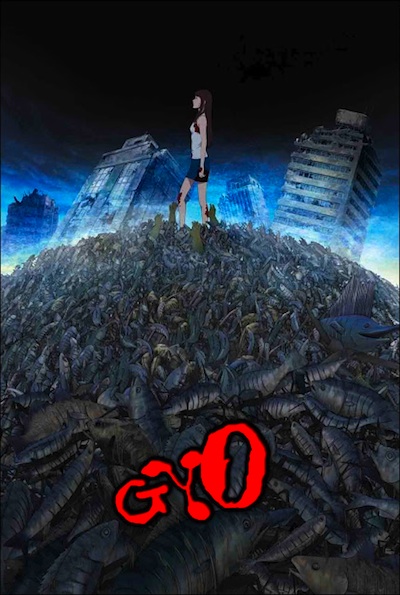
By Joe Bendel. The end of the world is nigh and it smells like feet. Mutant fish flatulence is a tough way for humanity to go out, but it looks like our number is up, nonetheless. Prepare yourself for a messy apocalypse in Takayuki Hirao’s Gyo (trailer here), which must be poised on the brink of taking the world by storm after it screened yesterday as a co-presentation of the 2012 Japan Cuts and New York Asian film festivals.

Kaori and her friends are spending their last spring break together vacationing in Okinawa. This will not be a good time to be near the water. Kaori is hot but nice. Erika is hot and mean. Aki, the third one, is plain and dumb. They will act accordingly throughout the impending crisis. It turns out the trio is on the front line. They are the first to record an encounter with the stinky fish with strange bio-mechanical legs. It turns out there were plenty more where that one came from and they have already overrun Tokyo.

Fearing the worst from a disconnect with her fiancé Tadashi, Kaori rushes back to the fish-battered city, hooking up with Shirakawa, an only slightly sleazy photojournalist. Ostensibly acting as her protector, Shirakawa really wants to get a story from Tadashi’s at least partially mad scientist uncle, who has apparently become the world’s preeminent authority on “walking fish” in a matter of hours.

Nothing says End of Days like hordes of walking fish cascading over Tokyo’s boulevards. However, it is the death stench that is the real poison, mutating humans through their open wounds. It looks like it is payback time for all that sushi Japanese chefs served up.

By the way, Gyo is not for kids. As if all the mutant mayhem were not enough of a red flag for parents, let’s just say Kaori’s friend Erika is kind of a tramp. It did not screen as part of the Anime from Hell sidebar for nothing. Considering how gleefully notorious it will surely become, Gyo is sure to be picked up by other festivals, so you’ve been warned.

From "Gyo."

Give Gyo credit—it takes the wild premise of Junji Ito’s manga and runs with it. There are times it plays like the anime equivalent of a Roger Corman film, but how can that be a bad thing? To Gyo’s further credit, it features a strong female protagonist, though it would probably be a stretch to call it empowering, unless you’re a fish. It should also be noted those mutant farting fish seem to be the result of a nefarious Imperial Japanese research project during WWII. Frankly, North Korean lunacy would be a more likely culprit, but it is just nice to see this one not blamed on the American military, as in Bong Joon-ho’s overrated The Host.

This is a good film to see with an audience. Indeed, it is surely fair to say most of the patrons at the Japan Society felt they got their money’s worth, even if nobody will be mistaking it for a Miyazaki film anytime ever. Worthy of a long run of midnight festival screenings, Gyo was an entertaining bit of strangeness for this year’s NYAFF and Japan Cuts: The New York Festival of Japanese Cinema.

Posted on July 17th, 2012 at 2:29pm.

LFM Reviews Potechi (Chips) @ 2012 Japan Cuts & The New York Asian Film Festival

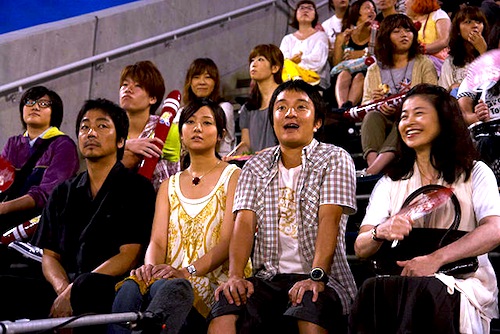
From "Potechi (Chips)."

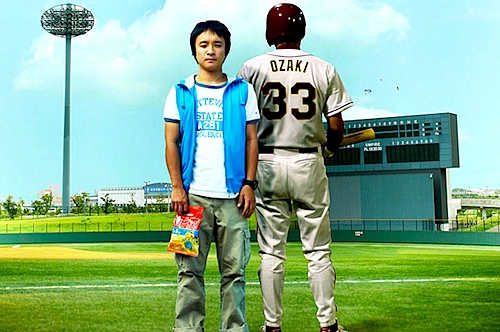
By Joe Bendel. After the devastating 2011 earthquake, the city of Sendai could use something to cheer about. An unassuming burglar could, too. He has a girlfriend considerably out of his league and a mentor who cares about him in his own gruff fashion, but he has a lot of issues gnawing at him. However, redemption may yet arrive through the most unlikeliest of agencies in Yoshihiro Nakamura’s graceful knockout punch of a film, Potechi (Chips) (trailer here), the official closing film of the 2012 New York Asian Film Festival, co-presented with the 2012 edition of Japan Cuts: The New York Festival of Contemporary Japanese Cinema.

Tadashi Imamura dresses like a gasman, but it is just a front. He works pretty steadily, though, since the ringleader (a.k.a. “the CEO”) of a burglary ring has taken a shine to him. Earnest to a fault, the young thief is pretty good at his job, having been trained by one of the best—the glacially stoic Kurosawa. Breaking-and-entering has been good to Imamura. Through a strange set of circumstances, a job led to his relationship with the attractive Wakaba. However, Imamura gets an odd sensation of déjà vu when he drags his indulgent girlfriend on a fateful break-in.

Imamura did not just happen to be in a certain baseball player’s apartment when the phone rings. Ozaki has long been his sports idol. The player used to be Sendai’s local hero during his high school years, but for several seasons he has been stuck riding the pine for the local pro franchise. Imamura still has faith, though, feeling a certain connection to the player. As it happens, he and Ozaki share the same birth date.

From "Potechi (Chips)."

Potechi (or Chips depending on which website you visit) is driven by a confluence of coincidences, yet Nakamura never bashes the audience over the head with them. Instead, he allows them to quietly accumulate over time. What could have been heavy as an anvil is quite subtle and beguiling, until Nakamura dexterously lowers the climatic emotional boom.

As the felonious Obiwan figure, Nao Ohmori (still best known as Ichi the Killer) displays super-heroic powers of understatement, dominating his scenes with his uber-gravitas. Still, it is Gaku Hamada who truly sets the tenor of the film as Imamura with a performance so sincere, it sort of hurts. Fumino Kimura’s spirited Wakaba keeps the proceedings nicely grounded, while Nakamura himself steals a few scenes as the CEO.

Potechi (Chips) is a fantastic little film, but the sixty-eight minute running time might make it difficult for some fests to program (fyi, stay for the stinger during the closing credits). Fortunately, Japan Cuts and NYAFF will screen anything they jolly well feel like, which is why they rock. In an elliptical way, it is a film about healing that earns its payoff fair and square. Very highly recommended, Potechi (Chips) screens this Sunday (7/15) as the 2012 NYAFF closes and the 2012 Japan Cuts continues with its independent selections.

LFM GRADE: A

Posted on July 12th, 2012 at 1:46pm.

Ai Weiwei Retrospective in San Francisco: LFM Reviews Disturbing the Peace & So Sorry

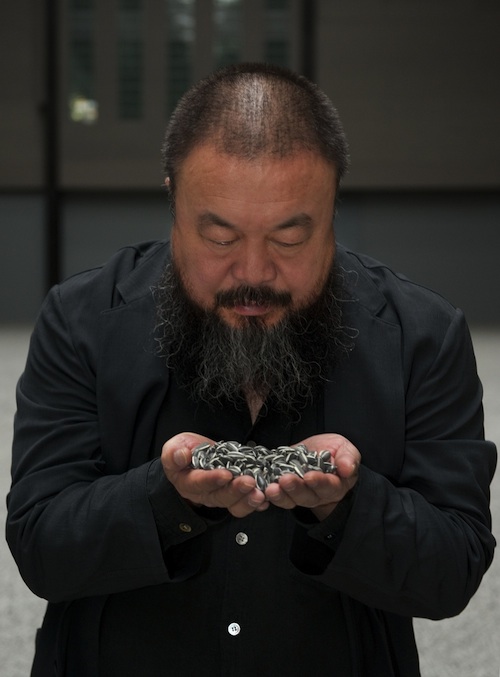
Chinese artist-activist Ai Weiwei.

By Joe Bendel. Arguably, Ai Weiwei is the single most important artist of our time. One might expect the Chinese government to take pride in his international preeminence, but instead they are threatening him with specious bigamy and pornography indictments. While best known for his architecture and large scale installations, he is also a filmmaker—and rather a muckraking one at that. Indeed, it is easy to understand the Communist regime’s relentless campaign against Teacher Ai after viewing his fearless documentary investigations of the 2008 Sichuan earthquake. Defiantly exposing the hypocrisies of the Chinese justice system, Ai Weiwei’s Disturbing the Peace and So Sorry will screen as part of the Yerba Buena Center for the Arts’ enormously timely retrospective, now underway in San Francisco.

Still prohibited from traveling, the artist will not be present for these screenings. The series includes several of Ai’s films recording his ambitious artistic projects that are surely well worth your time and attention. However, Disturbing and Sorry are particularly relevant to the legal purgatory he now finds himself in. Following the 2008 quake, Teacher Ai and his assistants launched a campaign to tabulate an accurate death toll of the students killed by shoddy so-called “tofu” school construction and record each name. Yet, every time they asked the authorities for fatality statistics, they were branded American or Japanese spies.

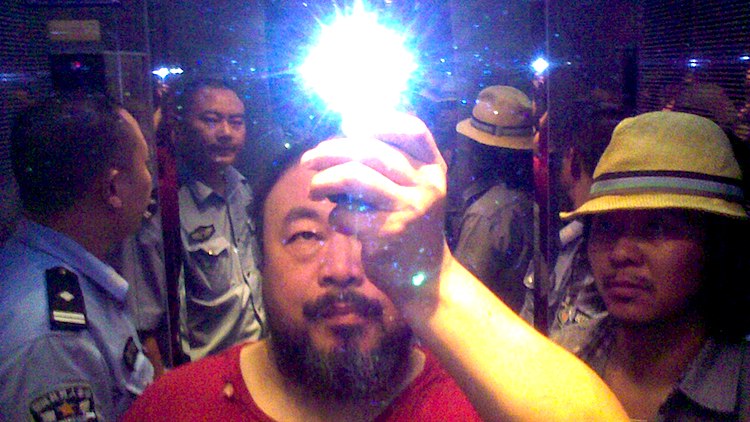
While both Sichuan documentaries cover overlapping events, Disturbing concentrates on Teacher Ai’s direct challenges to the government authorities. As the film opens, Ai has returned to Chengdu to appear as a witness at the trial of Tan Zuoren, an independent researcher also investigating the Sichuan earthquake. Denied his day in court, Ai and his party are rousted and detained by the police at three in morning. Teacher Ai is physically assaulted and one of his assistants is ominously whisked away, without any pretense of due process.

Ai subsequently returns with the woman’s husband and Tan’s fearless attorney Pu Zhiqiang to demand answers. Finally jumping through enough hoops to meet face-to-face with a high ranking bureaucrat, Ai makes it plain they will not leave until they receive a satisfactory accounting. Frankly, the meeting gets rather ugly, with Ai dropping f-bombs and openly questioning the integrity of the man across from him. He had a right to be irritable though, having not eaten for hours on end, as the apparatchiks stalled and dissembled. Clearly, Ai and his colleagues believe any hope they have of securing their colleague’s release depends on them staying in that conference room and in the authorities’ faces. From what viewers see, they do not seem far wrong in their judgment.

So Sorry also covers the Sichuan earthquake and the scandalous aftermath, but the focus is slightly different. We see more of the investigation itself and hear from some of the devastated parents, whose grief is compounded by China’s One Child policy. While Ai again confronts agents of the state not so subtly surveilling him, the grim drama in Sorry centers around Ai’s cerebral hemorrhage resulting from the Chengdu attack, coming while he is in the midst of preparing a major exhibition in Germany.

From "Disturbing the Peace."

Not surprisingly, Alison Klayman’s forthcoming documentary Ai Weiwei: Never Sorry draws heavily on Ai’s Sichuan films. However, if you have only seen the excerpts, you haven’t seen the half of it. Disturbing the Peace is particularly staggering, as Ai “talks truth to power” in a way officialdom is most definitely not accustomed to. Especially telling is the way he needles them with the Party’s own rhetoric. It is also chilling to witness, knowing how dearly he will pay for his boldness.

It is hard to think of two braver, more revealing documentaries than Ai’s Sichuan films. They are literally video dispatches from an Orwellian police state. Viewed together, the two films conclusively establish tens of thousands of young lives were needless lost and that those who ask questions will find themselves in serious jeopardy. One would hardly expect them to meet with the Party’s approval, but they make it easy to understand why so many everyday Chinese citizens have rallied to support Teacher Wei during his Kafkaesque ordeal.

Immeasurably important for understanding contemporary China, Disturbing the Peace screens this Sunday (7/15) as part of the YBCA’s Ai Weiwei series. Recommended nearly as earnestly, So Sorry screens the following Sunday (7/22) as part of a double bill with Ordos 100, Teacher Ai’s record of a yet unfinished architectural project in Mongolia. More than just topical programming, the YBCA deserves great credit for keeping Ai Weiwei and his work, both the political and the artistic, in the public eye at this critical period of time.

Posted on July 11th, 2012 at 4:55pm.

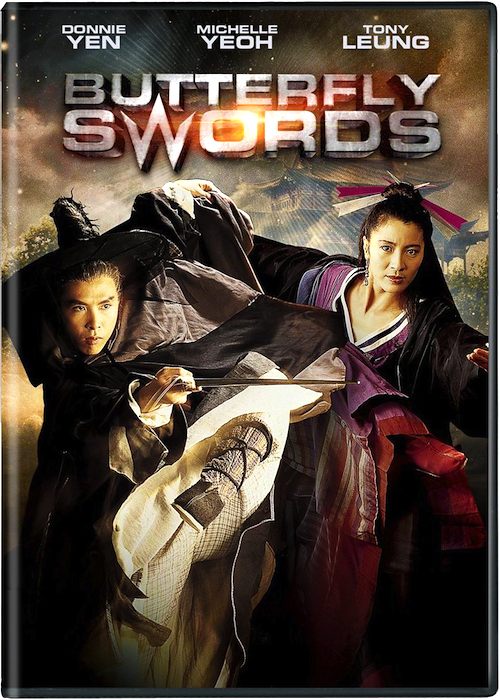
Yeoh, Yen, and Leung Bring the Wuxia: LFM Reviews Butterfly Swords on DVD

By Joe Bendel. Who would you rather have your butt kicked by 2012 NYAFF Star Asia award winner Donnie Yen, Michelle “The Lady” Yeoh, or Tony Leung? Leung would probably be the safest choice. You certainly would not pick Yeoh, if you know what’s good for you. She is characteristically lethal and rather Machiavellian, but also unexpectedly vulnerable in Michael Mak’s Butterfly Swords, which Well Go USA recently released on DVD.

Once fellow street urchins, Meng Sing-wan, Lady Ko, and Yip Cheung have become the top assassins of the Happy Forest martial arts alliance. Lady Ko is the brains of the operation, reporting directly to Eunuch Tsao. Unfortunately, her patron is not long for this earth. As his nearly dying wish, he asks Ko to retrieve a document proving the conspiracy between a rival eunuch and the rebellious Estates Villa martial arts faction.

Tiring of the assassin’s life, Meng wants to settle down with Butterfly, the daughter of a reformed martial artist. As far as she knows, he is just a humdrum businessman, who happens to know an awful lot about weapons. However, since the fate of the empire is at stake, he agrees to go undercover with the Estates Villas. Ko is supposed to look after Butterfly while he is on assignment, but she rarely holds up her end of the bargain. Even though Meng considers her “Sister” Ko, she has always carried a torch for her not-really brother. Likewise, Yip pines for her, but his feelings are definitely not reciprocated.

Given Meng and Ko’s status as sort-of but not really siblings, Butterfly Swords has an odd, vaguely Tennessee Williams-V.C. Andres vibe that sets in apart from other wuxia swordplay spectacles. While consistently preposterous, many of the action sequences choreographed by Ching Siu-tung are quite inventive, particularly a gravity-defying melee atop a bamboo forest (remember, those trees bend but do not break). The exposition is brief, yet confusing. However, the longing triangle of Ko, Meng, and Yip works surprisingly well.

The lynchpin of the film is unquestionably Yeoh. She has some great action scenes with her decapitating scarf, but is also quite convincing expressing Lady Ko’s yearnings and insecurities. Of the trio, Donnie Yen is probably the one short-changed for screen time as Yip, but he still has some decent drunken fight scenes. Tony Leung does not have the same presence he would display in subsequent John Woo and Wong Kar-wai masterworks, but he develops some engaging chemistry with Yeoh and Joey Wong’s Butterfly, nonetheless. It is also nice to see the latter in one of her final screen roles before she entered her semi-retirement (periodically interrupted by special return appearances), even if the character is a bit of a stock type.

Butterfly Swords is not a transcendent wuxia classic, but its willingness to go for broke is certainly entertaining. Yet its best moments are the relatively quiet ones. Fans of Yeoh and Yen (and isn’t that just about everyone?) should enjoy checking it out on DVD, now on-sale from Well Go USA, a company with offices in Texas, China, and Taiwan, so they ought to know and thing or two about brawls and beatdowns.

LFM GRADE: A-

Posted on July 11th, 2012 at 4:55pm.