LFM Reviews Scabbard Samurai @ 2012 Japan Cuts & The New York Asian Film Festival

By Joe Bendel. What do you get when you combine the labors of Hercules with Make Me Laugh in feudal Japan? A disgraced samurai with a lot of deep bruising. Yet, his dignity will take the hardest hit in Hitoshi Matsumoto’s physically demanding Jidaigeki dramedy Scabbard Samurai (trailer here), which screens this weekend as a co-presentation of the 2012 Japan Cuts and New York Asian film festivals.

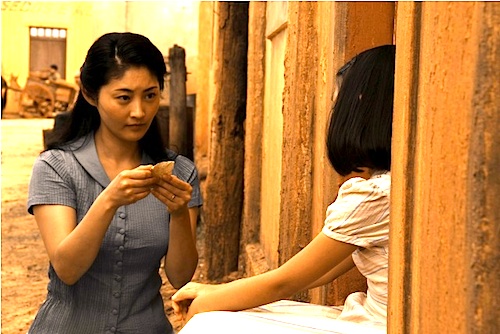
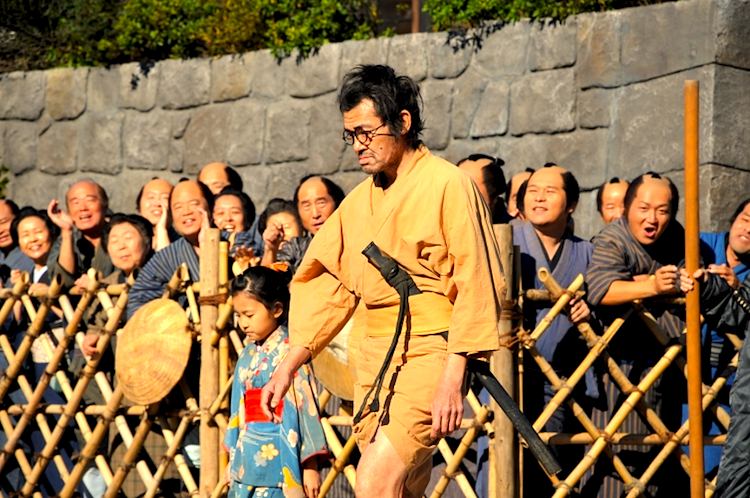
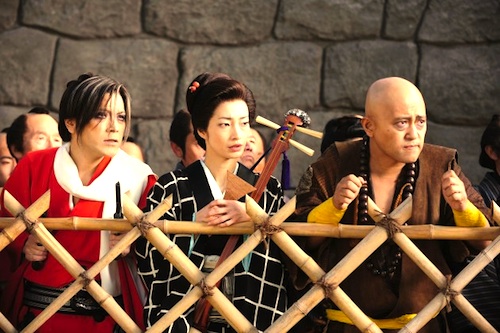
Kanjuro Nomi is not even a ronin. He is a deserter, who symbolically emptied his scabbard after his wife’s death from the plague. He aimlessly roams the countryside with his young daughter Tae, who makes no secret of the higher expectations she had for her father. Thanks largely to his thick head, they elude three distinctive looking bounty-hunters: O’Ryu the Shamisen Player, Pakyun the Pistol Boy, and Gori Gori the Chiropractikiller. However, his luck runs out when the Tako Clan captures him.

Rather than a quick execution, Kanjuro will have to face the “thirty day feat.” Like a Gong Show Scheherazade, Kanjuro has thirty days to make the lord’s emotionally catatonic son smile, or its hara-kiri time. At first Tae is disgusted by the sight of her father performing belly dances and shoving foreign objects up his nose. However, when his well-meaning guards start coaching him, she also gets with the program. As his stunts become more elaborate Sisyphean exercises, the entire town rallies behind Kanjuro, but Matsumoto is not going for the easy Hollywood ending here.
From "Scabbard Samurai."

Scabbard’s period details are passable enough, but they are hardly the point. Frankly, it is hard to think of another film that mixes such liberal helpings of slapstick humor, maudlin sentiment, and high tragedy. Yet, somehow it all blends together easily in Scabbard. The impressively straight-faced Takaaki Nomi is quite the good sport, putting up with all sorts of Fear Factor humiliation, while managing to maintain Kanjuro’s dignified bearing. As Tae, Sea Kumada is truly something else giving the old man what-for, but she is also shockingly good in her big dramatic scenes. One-named actress-model Ryō also brings an icy charm to the proceedings as the lethal shamisen player.

Kanjuro is no Sanjuro, that’s for sure. Yet there is something deeply heroic about him. It is that unlikely integrity that gives the film such a unique spirit. Sensitively helmed by Matsumoto, Scabbard Samurai is definitely not for the jaded, but that is what makes it such a nice surprise at the overlapping festivals. Recommended without reservation for those who appreciate earnest father-daughter stories, as well as the odd pratfall, Scabbard Samurai screens this Saturday (7/14) as a joint-selection of the 2012 Japan Cuts and New York Asian film festivals.

LFM GRADE: A-

Posted on July 11th, 2012 at 4:54pm.
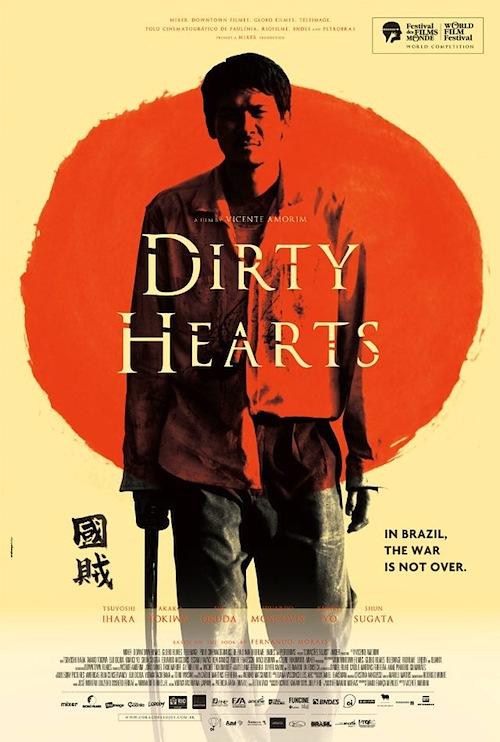
LFM Reviews Dirty Hearts @ Premiere Brazil!

By Joe Bendel. Brazil was the only Latin American country to commit troops to the Allied cause during World War II, but the country’s early strategic alignment was decidedly slippery. However, they evidently prosecuted the war quite zealously after the armistice. As home to the largest expatriate Japanese community, Brazil outlawed the Japanese language, the public display of the Japanese flag, and the free assemblage of Japanese-Brazilians. Ironically, this would isolate the targeted enclaves, making them susceptible to extremist groups that refused to accept Japan’s defeat. A decent man loses his soul to those Shindo Renmei nationalists in Vincete Amorim’s Dirty Hearts (trailer here), which screens during this year’s Premiere Brazil! showcase at the Museum of Modern Art.

Most Japanese immigrants in post-war Brazil only speak Japanese. Already shunned by the Brazilian establishment, they have little need of Portuguese within their cooperative. Ekemi, the young daughter of the cooperative president is an exception. She often translates for Takahashi, the mild mannered portrait photographer. Takahashi is a simple man devoted to his wife Miyuki, but his lack of confidence makes him vulnerable to the venom of Colonel Watanabe, a retired Imperial officer and big wheel amongst the community.

According to Watanabe, anyone who believes Japan has surrendered and the emperor has renounced his divinity has willfully bought into Allied propaganda and must therefore have a “dirty heart.” The characters for that ominous epithet start to appear on the walls of Portuguese speaking Japanese, serving as none too subtle death threats. Perhaps because of his size, Watanabe taps the reluctant but impressionable Takahashi to be their lead hatchet man. Assassinating former friends, Takahashi jeopardizes his wife’s love, the affection of Akemi, and his sense of honor.

Regardless of what we have seen in samurai films (like for instance 13 Assassins, in which lead actor Tsuyoshi Ihara also appears), it is rather hard work killing someone with a sword. Dirty features some of the ugliest, messiest, least glamorous swordplay viewers are likely to see on film. This is an anti-war film after all, positing ideology as the real killer.

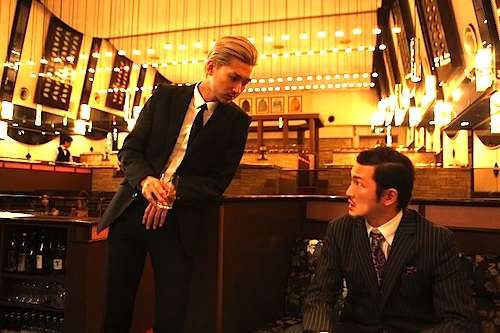
From "Dirty Hearts."

Ihara’s portrayal of the guilt-ridden Takahashi is viscerally intense, yet the film’s most memorable work comes from young Celine Fukumoto. Her earnest but utterly natural performance makes Akemi a worthy successor to Scout Finch in the annals of youthful cinematic consciences. Likewise, Tokako Tokiwa is quite arresting as the increasingly horrified Miyuki. The Portuguese-Brazilians are rather few and far between in Dirty, but fans might recognize Eduardo Moscovis (who went crazy rather nicely in The Last Madness) as the local ineffectual lawman.

Frankly, Dirty largely lets the Brazilian authorities off the hook, despite creating the conditions that gave first rise to the Shindo Renmei movement and then allowing them to tear the Japanese immigrant community apart. Granted, Amorim employs plenty of emotional manipulation, but he illustrates the danger of extremist group-think quite effectively.

Often riveting but also eye-opening, Dirty Hearts is strongly recommended when it screens this Friday (7/13) and Monday the 23rd as part of MoMA’s Premiere Brazil!, the only game in town for Brazilian cinema after Petrobras unceremoniously withdrew the funding for Inffinito’s New York Cine Fest. (FYI: New York taxpayers, that would be the same Petrobras that potentially stands to receive controversial U.S. Export-Import Bank loans and continues to fund the London Cine Fest.)

LFM GRADE: B+

Posted on July 11th, 2012 at 2:58pm.

LFM Reviews Hard Romanticker @ 2012 Japan Cuts & The New York Asian Film Festival

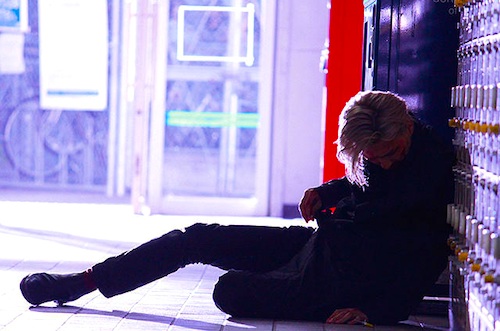
From "Hard Romanticker."

By Joe Bendel. It feels like the 1970’s again, in a good way. Strutting through the streets of Shimonoseki in a leather coat, slapping about petty thugs like little girls, while some funky soul-jazz s chugs away in the background, Gu Su-yeon’s latest film certainly follows in the tradition of vintage 70’s era exploitation films. Yet Gu’s story of life amid the zainichi underworld is reportedly based on real life experience. His alter-ego namesake should definitely be considered an anti-hero throughout Gu’s Hard Romanticker (trailer here), which screens as a co-presentation of the 2012 Japan Cuts and New York Asian film festivals.

Bleached-blond Gu is a lone wolf freelancer, who treats the North Korean gangs with the contempt they deserve. He enjoys the limited protection of his childhood friend Shoji, who has risen up through the ranks of the legit Yakuza. However, when a couple of knuckleheads bludgeon to death the grandmother of an up-and-coming NK delinquent (supposedly with Gu’s encouragement), it ignites a war among street gangs that threatens to engulf the unaligned Gu. With a crooked cop dogging his trail and his pal Shoji playing a dangerous game with the boss’s wife, Shoji is in for a rocky patch. Of course, that does not stop him from making enemies among mobbed-up lowlifes or putting the moves on the ostensibly demur Naksuko Chieko.

Romanticker might be intended as a cautionary confessional, but its pure testosterone and adrenaline will key-up viewers to the point many will be ready to grab a length of rebar and jump into the fray. If you want to see some spectacularly violent street fights, than this is the movie for you. Yet, despite the wardrobe, attitude, and greasy soundtrack, Gu is no Shaft. Frankly, there is a decidedly mean-spirited misogyny to the film that Gu the character explicitly contributes to.

From "Hard Romanticker."

An electric presence, Shôta Matsuda is all kinds of intense as the hardnosed Gu. Sei Ashina looks great in Chieko’s sailor suit and she is quite affecting in her big dramatic scenes, almost completely undercutting viewer sympathy for the ethically challenged protagonist, as a result. While the large ensemble of juvenile delinquents does not look particularly youthful, they are all pretty convincing when either giving or receiving a massive beatdown.

In Hard Romanticker’s world, life is cheap and sex is cheaper. The action and attitude are highly cinematic, but the nihilism becomes a tad exhausting over time. Recommended specifically for those who enjoy hardcore blaxploitation or Yakuza films, Hard Romanticker screens this Friday (7/13) at the Japan Society as a joint presentation of the 2012 editions of Japan Cuts and the New York Asian Film Festival.

LFM GRADE: B-

Posted on July 11th, 2012 at 2:57pm.

LFM Reviews Secret Love @ The 2012 New York Asian Film Festival

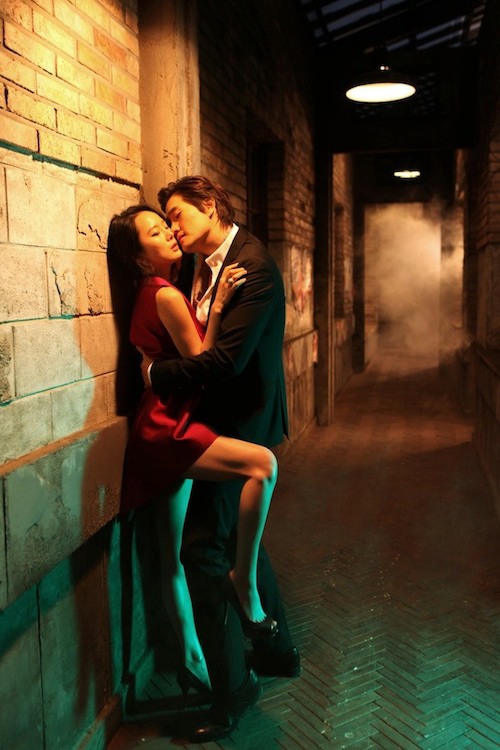
From "Secret Love."

By Joe Bendel. Jin-ho and Jin-woo are not just brothers. They are twins with Shakespearean bad luck. Each has suffered from a coma-inducing accident, but not simultaneously. In fact, it is when both are finally conscious and ambulatory that things really get complicated for Jin-woo’s wife. Starring NYAFF special guest Yoon Jin-seo of Oldboy fame, Ryu Hoon-i’s Secret Love (trailer here), screens today (Tuesday 7/10) as a co-presentation of the 2012 New York Asian Film Festival and the Korean Cultural Service in New York.

Two months after their wedding, an exhausted Yeon-yi dutifully cares for her comatose husband. She knew he had a brother, but she is not prepared for the sight of Jin-ho. Much to her consternation, the prodigal twin seems more interested in her emotional condition than his brother’s physical prognosis. Yet, slowly but surely, she starts to fall for Jin-ho. Frankly, he might just be the better of the matched set. Of course, right when she is poised to embrace her new love for Jin-ho, Jin-woo pops up again.

The premise of Secret might sound vaguely like Sandra Bullock’s While You Were Sleeping, but it is anything but. It starts out as a classier if more or less conventional Korean melodrama, but pivots into a sinister psychological thriller. Indeed, it does not take Jin-woo long to figure out the reason his wife and brother are acting so awkward around him and he is slightly put out by it. Before long, she is looking at Jin-woo like he is Charles Boyer in Gaslight—or at least she thinks it is Jin-woo. When he changes his look to match his brother, it makes it devilishly difficult to tell them apart.

Secret begins with a rather confusing prologue that will eventually be explained during the denouement. It is worth sticking with it though, thanks to Ryu’s wickedly stylish approach to both the forbidden love story and psychological thriller aspects of the film. To top it off, his dizzying climax would appeal to the old master himself.

Yoon Jin-seo in "Secret Love."

Of course, there is a reason Secret was chosen as part of the Korean Cultural Service’s mini-Yoon Jin-seo tribute series. Her performance is sensitive, but also brittle and raw, making it far more realistic than anything you will see in a Hollywood tearjerker. Basically hitting for the cycle, she creates a convincing portrait of a woman struggling with depression, while also appearing in some scorching love scenes.

For a time, it looked like circumstances would force Yoon to cancel her trip to New York, but she subsequently rescinded her cancellation. If she can make it from Korea, New York cineastes have no excuse for missing Tuesday’s screening. It’s free after all, so plan to arrive early. A strange but compelling thriller-tragedy hybrid, Secret Love is definitely recommended for anyone who likes their cinema dark and moody when it screens this Tuesday (7/10) at the Tribeca Cinemas, courtesy of the 2012 New York Asian Film Festival, in conjunction with the Korean Cultural Service.

LFM GRADE: B+

Posted on July 10th, 2012 at 2:05pm.

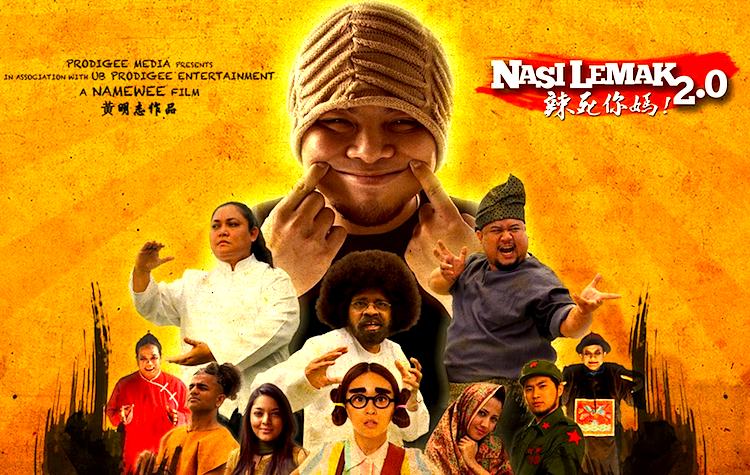
LFM Reviews Nasi Lemak 2.0 @ The 2012 New York Asian Film Festival

By Joe Bendel. Every country has its native rice dish. In Malaysia, it is nasi lemak. They also have their local political rabble-rousing rapper, known by his handle Namewee. The Malaysian government was not thrilled at the prospects of the latter extolling the virtues of the former, which is why they were less than supportive of this foodie movie. It was a hit nonetheless. Prepare yourself for generous helpings of multi-ethnic humor (that you might not fully get) when Namewee’s Nasi Lemak 2.0 (trailer here) screens at the 2012 New York Asian Film Festival.

Having studied abroad with a master, Hero Huang is an uncompromising specialist in Chinese cuisine. He is beloved in the neighborhood because he stands up to all the punks, but everyone prefers the street vendors’ Malaysian food. However, Xiao K. has need of a skilled Chinese chef. Control of her family’s upscale restaurant depends on a Chinese cooking competition instigated by her greedy aunt, who hopes to turn the establishment over to her lover, Lan Qiao.

Xiao K. and her father need a champion like Huang, but he has never beaten his old class rival Lan before. After enduring a few beatings and some official harassment at the behest of Xiao K’s aunt, Huang gets with the program and sets off on a roadtrip with her to discover the mystical secrets of Malaysian cuisine in all its ethnic varieties.

Supposedly there are a lot of jokes in Lemak that only Malaysians will understand, but the silly slapstickiness of it all is hard to miss. Reportedly, a few local professionally-offended Muslims were upset with the film, but it is hard to understand why unless you happen to be barking mad. The film could also have more cameos than Around the World in Eighty Days, but many of them will be lost on Western audiences. For instance, former Miss Malaysia Nadine Ann Thomas appears as Curry Daughter, whom Huang and Xiao constantly press to enter the Miss Malaysia contest while they stay with her curry-master father.

From "Nasi Lemak 2.0."

Namewee might have his Public Enemy moments in Malaysia, but Lemak is all rather gentle and well intentioned stuff. Essentially, it extols unity and tolerance through Don Rickles and Jerry Lewis style humor. Most of the musical numbers are comedic novelty numbers, such as the Bollywood parody, but the closing hip hop version of the Malay folk song “Rasa Sayang” is pretty cool.

Given his comfort with physical comedy and his big lummoxey screen presence, Namewee acquits himself just fine as Huang. Malaysian pop idol Karen Kong is also quite a good sport, buried under prosthetic Dukakis eye-brows, Pippi Longstocking pigtails, and Clark Kent glasses, but still projecting a vivacious earnestness.

Innocently goofy, Nasi Lemak 2.0 is ultimately more interesting to international audiences for what it represents for Malaysia than the on-screen humor. It is not the only film at this year’s NYAFF to mix music with beatdowns. Grandmaster Y.K. Kim & Park Woo-song’s The Miami Connection (video here) also screens at the festival, ahead of its in-your-face re-release later this year, courtesy of Drafthouse Films. The Miami Ninjas pick a fight with the wrong band when they try to roust Dragon Sound from their new gig at “Central Florida’s hottest new night club.” The ninjas and drug dealers might have formed an alliance, but they are no match for the one-two punch of Tae Kwon Do and cheesy 80’s synthesizer rock.

The plot is maybe a touch hackneyed (you know when a Dragon Sound member puts on a fancy new suit for a special occasion, he is in for a world of hurt) and the dialogue is what it is, but the fighting is pretty awesome—and since co-director and motivational speaker Grandmaster Kim will be attending the screening (demonstrating the power of Tae Kwon Do and motivating your lazy butt), you had better agree, if you know what’s good for you.

This is why we love NYAFF. You don’t see films like this at most other snobby festivals. So take note, Miami Connection screens this Thursday (7/12) as the New York Asian Film Festival continues at the Walter Reade Theater.

LFM GRADE: C+

Posted on July 10th, 2012 at 2:04pm.

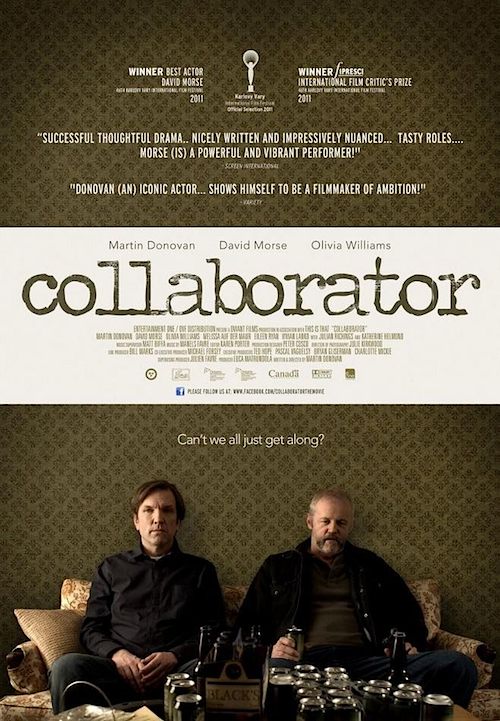
LFM Reviews Collaborator

By Joe Bendel. If you are ever taken hostage, start doing acting exercises. Anyone that annoying is sure to be quickly released. It does not quite work that way for snobby leftwing playwright Robert Longfellow, but it is debatable just how much danger his captor really represents in Martin Donovan’s directorial debut and star vehicle, Collaborator, which opens today in New York at the IFC Center.

Smarting from the critical drubbing unleashed on his latest play (the appropriately pretentious sounding American Excursion), Longfellow left New York and his ever patient wife to visit his aging mother. As luck would have it, he is also able to re-connect with his former romantic interest, Hollywood actress Emma Stiles. His childhood acquaintance still living across the street also wants to hang. One of those right-wing ex-cons, Gus Williams has not made good. In trouble with the law again, Williams shows up with a gun and a shopping bag full of beers. Thus begins Longfellow’s hostage ordeal.

Donovan might have been Hal Hartley’s bro-muse in all those great 1990’s indies, but as a director-screenwriter he does not exhibit a natural talent for pacing or characterization. While he deserves credit for his relatively sympathetic treatment of Williams, we never really believe the hostage-taker would pull the trigger, at least with Longfellow on the receiving end. As a result, instead of a taut cat-and-mouse game, the deliberately stagey and static Collaborator feels more like forty-plus minutes of extended endgame, grinding along laboriously.

In lieu of plot progression, Longfellow engages Williams in a series of actors’ improvs designed to show the intellectual superiority of a New York elitist to the bitter red-stater. Yet, the truth is that both characters are just talking in clichés when they debate hot-button issues, such as the Viet Nam War. This is all supposed to reveal the fundamental essences of their psyches, but it really just leaves viewers shrugging, so what then?

Frankly, Donovan’s emotional frozen Longfellow, as well as David Morse’s wounded, anti-social Williams are only too familiar, following predictable development arcs. We have seen similar from both of them before. However, Olivia Williams has some intriguing moments as Stiles. Ironically, in Collaborator, the movie star is the most human character of the lot.

While the premise of Collaborator had potential, the execution never really clicks. There are some well turned moments here and there, especially from Ms. Williams, but it is clearly the product of an insular environment, much to its detriment. Highly skippable, Collaborator opened Friday in New York at the IFC Center.

LFM GRADE: D+

Posted on July 10th, 2012 at 2:02pm.